---
title: "ThinkingCap — complete corpus"
description: "ThinkingCap product and company knowledge — features, solutions, and guides, as published on our website. Every published page, concatenated for whole-corpus readers."
canonical: https://console.thinkingcap.com/guest/all.md
documents: 136
---
# ThinkingCap — complete corpus
ThinkingCap product and company knowledge — features, solutions, and guides, as published on our website.
This document is the entire public ThinkingCap corpus, one article after another, each with its own front matter and canonical URL. The canonical tree starts at [/guest/index.md](/guest/index.md); the machine manifest is [/guest/index.json](/guest/index.json).
---
---
title: Recognition
description: "If you’ve got what it takes to win an eLearning award, you’re in the right place. Whether you’re a vendor, teacher, instructional designer, or thought leader, you’ll find an award to recognize your skills in our…"
created: 2025-03-24
updated: 2025-03-24
authors: ThinkingCap
topics: [About Thinking Cap]
status: published
canonical: https://console.thinkingcap.com/guest/About-Thinking-Cap/awards
type: page
source_url: "https://www.thinkingcap.com/awards"
lastmod: 2025-03-24
scraped: 2026-08-19
herotitle: Elearning Awards
kicker: In Their Words
subtitle: The trust, appreciation and experiences of the people we have had the privilege of working with.
- label: Explore Use Cases
href: "https://www.thinkingcap.com/solutions"
style: primary
order: 4
---
# Elearning Awards
If you’ve got what it takes to win an eLearning award, you’re in the right place. Whether you’re a vendor, teacher, instructional designer, or thought leader, you’ll find an award to recognize your skills in our directory below.
### Excellence in Human Capital Management (Spring) Program

The HCM Spring Program has a dedicated focus on entries from corporate training, learning, talent, HR or other related departments. Corporations can either enter alone or together with a helping organization (such as a vendor, solution provider, or consultant). Helping organizations (vendors, solution providers and consultants) cannot enter alone in this program. Please see our Technology Fall Program, as an alternative.
Deadline
15-Apr-2022
Presentation
18-Aug-2022
[View ↗](https://excellenceawards.brandonhall.com/hcm/)
### Excellence in Technology (Fall) Program

The HCM Spring Program has a dedicated focus on entries from corporate training, learning, talent, HR or other related departments. Corporations can either enter alone or together with a helping organization (such as a vendor, solution provider, or consultant). Helping organizations (vendors, solution providers and consultants) cannot enter alone in this program. Please see our Technology Fall Program, as an alternative.
Deadline
09-Sep-2022
Presentation
08-Dec-2022
[View ↗](https://excellenceawards.brandonhall.com/technology/)
### CIPD People Management Awards 2022

The CIPD People Management Awards are the benchmark of excellence for the HR and People Development profession. We believe that people professionals can be a force for change and each year we see exceptional entries that reflect the influence and reach of the people profession within their organisations. So now is the time to showcase your best work and get the recognition you and your team deserve.
The Awards are open to all organisations, regardless of sector or size and we welcome entries from International organisations. There are 23 categories which address the areas impacting the people profession today and are based on the shared values and standards in the CIPD Profession map. We encourage entries to reflect the CIPD professional principles by demonstrating that work matters, people matter and professionalism matters.
Deadline
27-Apr-2022
Presentation
22-Sep-2022
[View ↗](https://www.cipdpmas.co.uk/)
### The 8th e-Learning Excellence Awards at ECEL 2022

E-Learning and blended learning are now well integrated into teaching and training. This method of education is being used from preschool through to postgraduate study, not to mention in business and industry.
However, examples of high performing e-Learning applications are hard to find. For this reason, in 2015, ACPIL established the e-Learning Excellence Awards to showcase innovative examples of e-Learning use. These examples are presented through case histories which can be written by academics, teachers, business professionals or students. Examples are welcome from universities or schools as well as the private and public sectors. The Awards are now in their seventh year and the finals will be run alongside the European Conference on e-Learning in Brighton, UK on the 27-28 October 2022.
Deadline
18-May-2022
Presentation
15-Aug-2022
[View ↗](https://www.academic-conferences.org/conferences/ecel/e-learning-excellence-awards/)
### International Accreditors for Continuing Education and Training (IACET) 2022 Awards

IACET awards honor deserving individuals, innovators, projects, or programs that have significantly contributed to the field of continuing education and training. IACET members are invited to submit self-nominations or nominations for other AP programs.
Deadline
16-May-2022
Presentation
14-Jul-2022
[View ↗](https://www.iacet.org/events/annual-conference/2022-annual-conference/award-nominations/)
### The 2022 International E-Learning Awards

The International E-Learning Awards are given each year for the best work in online learning, in two divisions: Academic and Business/Industry. All submissions are evaluated by the IELA Awards Committee, who look for a variety of attributes. These include, among others, educational soundness and effectiveness, user experience, and overall significance.
The Business Division is intended for courses and products created for organizational learning, professional development, and related purposes, and for software tools used to create products for those audiences. The Academic Division is intended for school and university courses and software used in the creation of academic courses.
Deadline
20-Jun-2022
Presentation
27-Sep-2022
[View ↗](https://www.ielassoc.org/submission-process-and-deadlines)
### IMS Learning Impact Awards

IMS Global's annual Learning Impact Awards competition is conducted globally to recognize outstanding, innovative applications of educational technology that address the most significant challenges facing education. View the award program details and eligibility for more information.
Deadline
28-Feb-2022
Presentation
24-May-2022
[View ↗](http://www.imsglobal.org/lili/awards.html)
### ITC Awards for Excellence in eLearning

The Instructional Technology Council would like to give you the opportunity to recognize your staff for their tremendous hard work, excellent service to your students, and quality eLearning courses.
Nominees can include college administrators, faculty members, or individuals from other agencies that have supported eLearning initiatives at a community college or other higher education organization. Nominees and award recipients must be members of ITC.
Deadline
—
Presentation
12-Feb-2023
[View ↗](https://www.itcnetwork.org/awards-of-excellence)
### Learning Technologies Awards 2022

The Learning Technologies Awards are the most independent and sought-after awards in the industry. They recognise the commitment, enthusiasm and passion for learning technologies across the world. Finalists are selected by our independent judging panel of experts organised by the **eLearning Network**.
Entries for the Learning Technologies Awards 2022 will open on 21 April 2022.
Deadline
TBD
Presentation
TBD
[View ↗](https://www.learningtechnologies.co.uk/learning-tech-awards)
### LearnX Live

Awarding innovation, new practices and technologies that drive/support talent development across corporate, government, education, non-profit, and community service sectors – globally.
Deadline
02-Sep-2022
Presentation
23-Nov-2022
[View ↗](https://www.learnx.live/)
---
---
title: Giving Back
description: Inspiration Wanted. Apply Within.
created: 2025-03-24
updated: 2025-03-24
authors: ThinkingCap
topics: [About Thinking Cap]
status: published
canonical: https://console.thinkingcap.com/guest/About-Thinking-Cap/giving
type: page
source_url: "https://www.thinkingcap.com/giving"
lastmod: 2025-03-24
scraped: 2026-08-19
subtitle: Supporting people, organizations and causes that matter to us.
kicker: Our Community
order: 6
---
# Giving
Inspiration Wanted. Apply Within.
Thinking Cap is donating 500,000 seats to educational programs that can change the world. Programs that meet our criteria will be able to use Thinking Cap free of charge for two years, at which time they can reapply for an extension. We hope to expand this program each year.
Any organization can apply, though we have a particular preference for projects that advance science and education technology. Below is a list of some of the areas of study from which we would like to receive applications.
### Carbon sequestration technologies
Climate change is the great challenge of the 21st century and it will be solved by science. We wish to support a cleanup project to remove a hundred years of industrialization.
Do you have a way to stick it under the ocean? Or a design for a new cow that poops carbon blocks? Or a boring machine that pulls it right out of the air? We think all of this is amazing.
If you’re running a project like this and you think Thinking Cap can help you with your training needs, we’d like to be on board with you.


### CRISPR technology
CRISPR (Clustered Regularly Interspaced Short Palindromic Repeats) technology is at the cutting edge of genome editing. Nothing will change the world in the next decade more than this new molecular “Photoshop” will, and teams from around the world are extending every day the potential of this field.
Do you need to train scientists or lab technicians? Do you need a platform for helping to educate the public or the politicians about the incredible future of this field? Contact us and let us help you on this journey.
### Advancement of best practices in public education
We believe strongly in the value of public education, and we want to ensure that teachers have all the tools they need to help your children fulfill their potential and change the world. Thinking Cap is a great opportunity for teachers to create content and have a sandbox to try out new ideas.
Even if you have what you think is a small idea that can make a difference, we’d like to help, particularly with ideas dedicated to helping children who are at risk or have dyslexia.


### Distance learning in the developing world
Are you a ministry of education with more learners than teachers and a huge geographical area to cover? We want to help. We can give you the tools you need to create elearning content and deliver it to your children. We welcome all projects, and have a particular interest in those dedicated to educating girls.
---
---
title: Partners
description: Building long-lasting relationships
created: 2025-03-24
updated: 2025-03-24
authors: ThinkingCap
topics: [About Thinking Cap]
status: published
canonical: https://console.thinkingcap.com/guest/About-Thinking-Cap/partners
type: page
source_url: "https://www.thinkingcap.com/partners"
lastmod: 2025-03-24
scraped: 2026-08-19
herotitle: Our Partners
subtitle: Working with organizations whose expertise complements our own and helps clients succeed.
heroimage: "https://cdn.thinkingcap.com/medialibrary/00000000-0000-0000-0000-000000000000/86b78f6f-cb97-461e-9f5f-7d216725e894.jpg"
kicker: Better Together
- label: Start a Conversation
href: "https://www.thinkingcap.com/contact-us"
style: primary
order: 7
---

# Our Partners
Building long-lasting relationships
Thinking Cap is happy to work with your other vendors. On top of our integrations, we work with vendors on many of our onboarding projects. Some we have loved so much we have partnered with them.
Content development
## Ewyse

> "We build tailored courses that engage, entertain, and educate... Our eLearning solutions help clients all over the globe, who have ranked us as one of the top eLearning agencies in the world."
**Services offered:**
Microlearning Mobile learning Explainer videos 360 experience Blended learning
**Why we partnered:**
Courses developed by Ewyse are beautifully designed with high quality instructional design.
[Find out more ↗](https://ewyse.agency/#thinkingcap)
Content development
## ezector

> "We offer tailormade courses to different organizations in all kind of subjects - for instance Cyber Security, Duty of Care and HR courses. The courses are integrated with leading LMS."
**Services offered:**
Course library Content development Learning and development
**Why we partnered:**
Courses developed by ezector are beautifully designed with high quality instructional design.
[Find out more ↗](https://ezector.dk/#thinkingcap)
Content Library
## iSpring

> "Empower your teams with an ever-expanding collection of ready-made eLearning courses developed by iSpring experts. Gain unlimited access to our course library through a subscription, and enjoy new courses at no extra cost."
**Services offered:**
Course library
**Why we partnered:**
Comprehensive content library.
[Find out more ↗](https://www.ispringsolutions.com/course-library#thinkingcap)
Content Library
## LinkedIn Learning

> "Learn business, creative, and technology skills to achieve your personal and professional goals. Join LinkedIn Learning today to get access to thousands of courses. Lynda is now LinkedIn Learning."
**Services offered:**
Course library
**Why we partnered:**
Comprehensive content library.
[Find out more ↗](https://www.linkedin.com/learning/#thinkingcap)
Content Library
## OpenSesame

> "Transform your workforce with OpenSesame. Thousands of eLearning courses from the world’s top publishers that work perfectly in your LMS."
**Services offered:**
Course library
**Why we partnered:**
Comprehensive content library.
[Find out more ↗](https://www.opensesame.com/#thinkingcap)
LMS support services + content consulting
## Petra Mayer & Associates Consulting

> "We help you with customized and effective training services so you can increase productivity and scalability by offering engaging learning solutions."
**Services offered:**
Learning And Development Consulting Learning Management System Implementation Curriculum Development Learning Strategy & Virtual Facilitation Action Planning
**Why we partnered:**
Courses developed by Petra Mayer are beautifully designed with high quality instructional design.
[Find out more ↗](https://petramayerconsulting.com/#thinkingcap)
Curriculum design, content development, and consulting
## ProMobile BI

> "Headquartered in the U.S. and represented globally, ProMobile BI is an award winning trusted partner in designing, developing, and implementing large-scale learning and development programs that generate measurable results. Our principals are not just experts, but masters in their fields. With formal training and education in adult learning theory, instructional design, gamification, project management, data analysis, and program evaluation, they hold prestigious certifications such as Sententia Gamification Master Craftsmen, PMP-certified Project Managers, and are internationally recognized L&D evaluation/ROI experts."
**Services offered:**
Program Design Development Implementation Program Evaluation Data Analysis Project Management Gamification
**Why we partnered:**
ProMobile BI's expertise in instructional design, gamification, and program evaluation enhances Thinking Cap LMS's ability to deliver impactful and measurable learning solutions.
[Find out more ↗](https://ProMobileBI.com/#thinkingcap)
Content development + LMS support services
## WeLearn

> "WeLearn builds better humans through learning. Learning solutions and workforce development focused on changing the way in which organizations use learning."
**Services offered:**
Content Development Learning Strategy & Consulting Learning Administration & Services Workforce Development Learning Brand Consulting Workshops Course Pass™
**Why we partnered:**
Courses developed by Ewyse are beautifully designed with high quality instructional design.
[Find out more ↗](https://welearnls.com/#thinkingcap)
---
---
title: Services
description: We're here to help you
created: 2025-03-24
updated: 2025-03-24
authors: ThinkingCap
topics: [About Thinking Cap]
status: published
canonical: https://console.thinkingcap.com/guest/About-Thinking-Cap/services
type: page
source_url: "https://www.thinkingcap.com/services"
lastmod: 2025-03-24
scraped: 2026-08-19
order: 3
herotitle: Thinking Cap Services
subtitle: From discovery and implementation to onboarding, migration, training and ongoing support.
heroimage: "https://cdn.thinkingcap.com/medialibrary/00000000-0000-0000-0000-000000000000/7cb4bcce-e787-4ae4-a5a8-2290adae2f10.jpg"
kicker: How We Help
- label: Talk to Our Team
href: "https://www.thinkingcap.com/contact-us"
style: primary
---

# Thinking Cap Services
We're here to help you
We prefer to collaborate with our customers to build a long-term relationship. Tell us your objectives,
and success metrics and find out why our clients are so loyal.
Setting up the LMS for you.
## Onboarding
Setting up a new LMS, or migrating from a previous one, can be overwhelming. Learning a new LMS,
while simultaneously setting up your training program, is challenging at the best of times.
Thinking Cap's onboarding team takes the guesswork out of the setup, handling tasks such as
importing your data, setting up activities, and mapping out your learner journey as part of our
onboarding process.
Many of the organizations we work with are transitioning from an existing LMS to Thinking Cap
LMS. Our onboarding process includes migration support to help you move your training programs,
user data, and reporting history with minimal disruption. Whether you are coming from an
open-source platform, a legacy LMS, or a SaaS learning tool, we will guide your team through a
smooth and secure migration.
We will meet your team every two weeks to facilitate each of the following tasks, document your
LMS set-up, and train our support team on the nuance of your training program.

```feature
icon: hand-holding-heart
title: Free
description: Investing in long-term relationships means complimentary onboarding services.
```
```feature
icon: tasks-alt
title: Agile Project Management
description: Project meetings every two weeks to ensure the project is completed on time and as you wish.
```

#### Activities
Importing all of your activities, activity content, and historical enrollments, along with
selecting the activity settings and bundling them into learning paths.
```feature
icon: palette
title: Learner Experience
description: Customizing the learner experience, from branding to page content to user flow, while ensuring it remains mobile-friendly and accessible.
```
```feature
icon: hand-holding-usd
title: Commerce
description: Connecting the LMS with your payment processor, while generating pricing models, promotional codes and more.
```
```feature
icon: file-lines
title: Certification
description: Activating customized certificates, badges, credits, and automated re-enrollments on the appropriate cadences.
```
```feature
icon: comments
title: Communication
description: Setting up the flow of all communication within the LMS, from automated notifications, discussion forums, activity collaboration, mentorships, and live chat.
```

#### Integration
Setting up integrations with your internal and/or specialized applications including ERPs,
webinar providers, payment processors, analytics and more.
```feature
icon: chart-line
title: Reports
description: Visualizing your data by providing access to metrics pages, generating stakeholder reports, and integrating with external data stores.
```
```feature
icon: shield-halved
title: Security
description: Enforcing your required security and privacy by setting up your single-sign-on, user permissions, and account and security settings.
```
Creating engaging learning experiences.
## Instructional Design & Course Authoring
Creating effective online learning requires more than simply uploading content. Our instructional
design team develops engaging, real-world training experiences that help learners retain
knowledge and apply it confidently on the job.
We specialize in the design and development of highly interactive learning content, including
scenario-based training, animation, assessments, gamification, and bilingual voiceover
coordination. Each experience is carefully crafted to align with your organizational goals,
learner audience, and training outcomes.
As adaptive learning becomes one of the fastest growing trends in Learning & Development,
Thinking Cap is actively leveraging AI and advanced learning technologies to create more
personalized learning experiences. From adaptive learning pathways and branching scenarios to
AI-assisted content generation and learner recommendations, we help organizations move beyond
one-size-fits-all training.
If you are looking to have both the learning platform and the content development delivered under
one roof, this sits exactly in our wheelhouse.
Our team is led by a Certified Gamification Master Craftsman and supported by multi award-winning
designers and developers. We have worked with organizations such as Microsoft, Amazon, and
JetBlue, creating engaging, adaptive learning experiences using AI and modern learning
technologies.

```feature
icon: brain
title: AI Adaptive Learning
description: Creating personalized learning experiences using AI-driven pathways, adaptive content delivery, learner recommendations, and intelligent reinforcement.
```
```feature
icon: project-diagram
title: Scenario-Based Training
description: Designing immersive, real-world learning scenarios that improve decision-making, engagement, and learner confidence.
```
```feature
icon: photo-video
title: Animation & Media
description: Developing custom animations, motion graphics, visual storytelling, and multimedia learning assets that improve retention.
```
```feature
icon: language
title: Multilingual Narration
description: Using AI-generated multilingual narration and localization to create scalable, engaging learning experiences for global learner audiences.
```
```feature
icon: gamepad
title: Gamification
description: Applying proven gamification strategies to increase learner motivation, participation, and course completion.
```
```feature
icon: layer-group
title: End-to-End Delivery
description: Delivering both your LMS platform and custom learning content together through one coordinated team and strategy.
```
Ready to answer all of your questions.
## Support
The Thinking Cap team is known for going the extra mile to help our customers. To ensure they
understand your training program and compliance needs, they begin by joining your onboarding
meetings. This helps them learn the reasoning behind your specific requirements and build
context for ongoing support.
Our support is designed for organizations where training is critical. Whether you serve regulated
industries, public sector teams, or diverse learning audiences, we provide responsive and
knowledgeable support to help you deliver training with confidence.
We provide this level of support as part of your LMS license. There are no added costs for
premium support, and no tiered service levels to manage. Our team is available to respond to all
tickets within two business hours and to offer live support when needed.
We also prioritize the needs of compliance-driven organizations. Our support team understands the
importance of training deadlines, regulatory requirements, and secure data handling, and we
bring this focus to every support interaction.

```feature
icon: hand-holding-heart
title: Free
description: Investing in long-term relationships means access to complimentary support for your admins.
```
```feature
icon: house-user
title: In-house Support
description: Knowledgeable experts in-house, available by phone, email or online.
```
```feature
icon: stopwatch
title: Responsive
description: Meeting and exceeding your expectations, responding to all tickets within 2 business hours.
```
```feature
icon: headset
title: Live assistance
description: Choose how you reach out support team, based on your preference and urgency. Our team is ready to take your call, answer your email, or respond to your ticket.
```
```feature
icon: brain
title: Screen sharing
description: Need additional help? Our team can join screen-sharing sessions to assist you in applying changes to your LMS, or better understand a feature.
```
```feature
icon: comment
title: Feedback
description: Our support team takes your feedback back to the team, including adding your suggestions to our roadmap.
```
Personalized training for your administrators.
## Training and Mentorship
Our training and mentorship program is designed to help your team adopt Thinking Cap LMS quickly
and continue building expertise over time. We provide personalized training during onboarding
and ongoing mentorship, resources, and live sessions as your needs evolve. Our goal is to help
you get full value from your LMS, now and in the future.
Beyond formal training, we provide a comprehensive online mentorship hub, The Lounge, where your
team can access tutorials, webinars, updates, and additional resources.

```feature
icon: hand-holding-heart
title: Free
description: Investing in long-term relationships means access to complimentary Administrator training and resources.
```
```feature
icon: house-user
title: In-house Experts
description: Knowledgeable experts in-house, available by phone, email or online.
```
```feature
icon: chalkboard-teacher
title: Admin Bootcamp Sessions
description: Personalized training sessions, with recordings to reference later.
```
```feature
icon: toolbox
title: The Lounge
description: Online resources including LMS tutorials, reference materials, updates, and more.
```
```feature
icon: headset
title: Mentorship
description: One-to-one sessions answering your every question... even training refreshers.
```
```feature
icon: brain
title: Webinars
description: Regular webinars delve deeper into new LMS features, giving you a chance to see examples of how each could be used.
```
## Want to find out more?
Book a session today for a personalized demo and Q&A.
[Book a Demo](https://www.thinkingcap.com/Book-a-demo)
---
---
title: Thinking Camp
description: "Every year, we round up some clients, friends, and ideas and head to Toronto Island to plan our next big thing. Thinking Camp is not a typical conference. It is a two-day gathering where the people who build Thinking…"
created: 2026-11-19
updated: 2026-11-19
authors: ThinkingCap
topics: [About Thinking Cap]
status: published
canonical: https://console.thinkingcap.com/guest/About-Thinking-Cap/thinkingcamp
type: page
source_url: "https://www.thinkingcap.com/thinkingcamp"
scraped: 2026-08-19
herotitle: Thinking Camp
subtitle: Bringing curious minds together to share ideas and explore what is possible in learning.
heroimage: "https://cdn.thinkingcap.com/medialibrary/00000000-0000-0000-0000-000000000000/d030714b-65b4-4653-8da6-24a76dfef92e/1/d030714b-65b4-4653-8da6-24a76dfef92e.jpg"
kicker: Learning Together
order: 5
---
Every year, we round up some clients, friends, and ideas and head to Toronto Island to plan our next big thing. Thinking Camp is not a typical conference. It is a two-day gathering where the people who build Thinking Cap LMS sit down with the people who use it every day.
Together, we talk openly about what is working, what could be better, and where the platform should go next. It is part customer council, part innovation retreat, and part long-running Thinking Cap
tradition.
## Why Thinking Camp Exists
#### We pitch our tents around the roadmap
In 2008, Thinking Cap President Douglas Wallace created an environment where employees and
clients could speak freely, share honestly, and feel comfortable saying, “I wish your
product could...” That idea became Thinking Camp.
#### We make room for frank, useful conversations
Thinking Camp breaks down the walls between our team and our clients. Executives, developers,
support staff, quality assurance specialists, learning experts, and core users talk openly
about the platform, service, technical delivery, industry trends, and real-world training
needs.
#### No good idea is left behind
We deeply value the thoughts and opinions of our clients and employees alike. Their ideas,
feedback, solutions, and leadership influence how we plan, improve, and grow Thinking Cap
LMS.
## Thinking Caps On
With blackboards ready, notebooks neatly piled, pens in order, and coffee close at hand, the atmosphere is relaxed and ready for ideas to flow. The setting helps everyone step out of the everyday rush and into a more open, creative conversation.
Doug begins with an energetic look at the learning industry, then moves into the questions at the heart of Thinking Camp: Where are Thinking Cap products now? How do we envision them? How do we get them going? From there, clients and employees share what they would like to see next.
## What Happens at Camp?
#### Roadmap conversations
We look at where Thinking Cap LMS is now, where clients need it to go, and how we can move the right ideas forward together.
#### Client-led insight
Clients share how they use the LMS, what their learners need, and which improvements would make the biggest difference in their day-to-day work.
#### Whole-team participation
The full Thinking Cap team participates, including leadership, developers, support, QA,
and client-facing staff, so feedback reaches the people best positioned to act on it.
#### A setting made for fresh thinking
Held on Toronto Island, Thinking Camp feels intentionally cut off from the world. The
location gives everyone space to focus, connect, and think creatively.
#### Radical transparency
Thinking Camp gives clients a clear view into our thinking, priorities, challenges, and
product direction. We talk about the relationship honestly, including the wins, the
friction points, and the work still ahead.
#### Community connection
Clients learn from our team and from one another. For new clients and long-time users
alike, the conversations often spark practical ideas they can bring back to their own
learning programs.
## How Camp Ideas Shape the Roadmap
Thinking Camp is built around collaborative roadmap definition. Clients can lobby for feature requests,
share emerging training needs, compare best practices, and explain the small day-to-day details that
make a big difference in real learning environments.
Those conversations directly influence Thinking Cap LMS. The event helps us decide what to improve, what
to build, what to revisit, and how to keep our product aligned with the people who depend on it.
## Why Clients Come Back
> Spending time with the staff of Thinking Cap and the other users was invaluable to us as new clients, and first time LMS/Author users. We were able to hear where the company and solutions were headed and had an opportunity to discuss and truly influence the future. I truly appreciate how much power they are putting into our hands to self-service, and am really excited about the new innovations.
>
> — Josh Goldman, Senior Director for ACUHO-I
## Join Us at Thinking Camp
This free event has grown steadily since it began in 2008. Attendees return because they know their
voices matter, their ideas are heard, and their feedback helps shape something bigger than a single
feature request.
Between annual camps, the conversation continues through our online community at [camp.thinkingcap.com](https://camp.thinkingcap.com), where clients can access training
resources, collaboration forums, and examples from the wider Thinking Cap community.
[Ask us about Thinking Camp](https://www.thinkingcap.com/contact)
---
---
title: Why Thinking Cap
description: Most learning platforms force you to adapt your program to their system. Thinking Cap is built to adapt to you.
created: 2026-11-19
updated: 2026-11-19
authors: ThinkingCap
topics: [About Thinking Cap]
status: published
canonical: https://console.thinkingcap.com/guest/About-Thinking-Cap/why-thinking-cap
type: page
source_url: "https://www.thinkingcap.com/why-thinking-cap"
scraped: 2026-08-19
kicker: Our Story
herotitle: "Why Thinking Cap?"
subtitle: Decades of experience, a passion for solving complex learning challenges, and a vision for what learning can become.
heroimage: "https://cdn.thinkingcap.com/medialibrary/00000000-0000-0000-0000-000000000000/384f8dd1-7128-41a9-aca0-50ed42567901/1/384f8dd1-7128-41a9-aca0-50ed42567901.jpg"
- label: Explore Our Research
href: "/research-and-development"
style: default
abstract: Most learning platforms force you to adapt your program to their system. Thinking Cap is built to adapt to you.
order: 1
---
Most learning platforms force you to adapt your program to their system. Thinking Cap is built to adapt to you.
[Explore Key Benefits](https://www.thinkingcap.com/key-benefits)
[Request a Demo](https://www.thinkingcap.com/book-demo)
## What Makes Thinking Cap Different
Flexible. Scalable. Yours.
Whether you're training a few hundred people or tens of thousands, Thinking Cap gives you control over the entire experience. You can tailor every workflow, dashboard, and detail to your team and your learners.
Here’s how we stand out:
```feature
icon: sliders
title: Truly Configurable
description: **Customize the system from top to bottom**, including admin and supervisor roles, learner paths, reports, dashboards, labels, and everything in between. **You’re in full control** of how your LMS works.
link: /solutions
linkText: See What’s Possible
```
```feature
icon: swatchbook
title: Learner-Friendly
description: A **focused**, **responsive design** that feels intuitive from the first click. It’s **accessible**, **fully branded** to your organization, and built to support real learning without distractions.
link: /learner-experiences
linkText: View Learner Experiences
```
```feature
icon: handshake-angle
title: Support That’s All-In
description: We pair **expert support** with ongoing mentorship. From **onboarding and training** to launch and long-term success, we’re here to **guide and grow with you**.
link: /services
linkText: Learn About Our Service
```
Features
## Designed for Teams That Expect More
If you're looking for a simple box-checking system, this probably isn't it.
Thinking Cap is built for organizations that treat learning as a strategic part of growth and success.
- Support multiple departments, programs, and brands
- Automate admin tasks that slow you down
- Get meaningful insight from detailed learning data
- Deliver blended, personalized learning experiences

Discover what makes Thinking Cap the right choice for your team.
## Where to Next?
You’ve got a sense of who we are. Now take a closer look at the details. Explore the features, hear from real clients, or see how we compare to other platforms.
```feature
image: 
title: Key Benefits
description: See how Thinking Cap helps you simplify training, automate work, and improve learner outcomes.
link: /key-benefits
linkText: Explore Key Benefits
```
```feature
image: https://cdn.thinkingcap.com/medialibrary/00000000-0000-0000-0000-000000000000/87dba144-e8bb-4781-bb3c-bdef1d3642f1/1/87dba144-e8bb-4781-bb3c-bdef1d3642f1.png
title: Testimonials & Success Stories
description: Real stories from organizations who built something better with Thinking Cap.
link: /success-stories
linkText: Read Success Stories
```
```feature
image: 
title: Thinking Cap vs Other LMSs
description: Thinking about Absorb, Moodle, or TalentLMS? See how we compare on features, support, and flexibility.
link: /thinking-cap-vs
linkText: Compare Platforms
```

[##### Key Benefits
See how Thinking Cap helps you simplify training, automate work, and improve learner outcomes.
Explore Key Benefits](https://www.thinkingcap.com/key-benefits)

[##### Testimonials & Success Stories
Real stories from organizations who built something better with Thinking Cap.
Read Success Stories](https://www.thinkingcap.com/success-stories)

[##### Thinking Cap vs Other LMSs
Thinking about Absorb, Moodle, or TalentLMS? See how we compare on features, support, and flexibility.
Compare Platforms](https://www.thinkingcap.com/key-benefits)
## Not sure which solution fits best?
Let us guide you through the right setup for your audience, content, and goals.
[Book a Personalized Demo](https://www.thinkingcap.com/book-demo)
---
---
title: About Us
description: "Thinking Cap supports many distinct learning activities. We also have a system of equivalencies to track when different activities can substitute for one another in your curriculum. If you use only one type of…"
created: 2025-03-24
updated: 2025-03-24
authors: ThinkingCap
topics: [Archive]
status: published
canonical: https://console.thinkingcap.com/guest/Archive/About-Thinking-Cap/Company/about
type: page
source_url: "https://www.thinkingcap.com/about"
lastmod: 2025-03-24
scraped: 2026-08-19
herotitle: "Hello, We’re Thinking Cap"
subtitle: Passionate, trusted, attentive
heroimage: "https://thinkingcap.blob.core.windows.net/demolearnerview/00000000-0000-0000-0000-000000000000/advanced/banner_about.jpg"
---
Thinking Cap supports many distinct learning activities. We also have a system of equivalencies to track when different activities can substitute for one another in your curriculum. If you use only one type of activity, you won’t be overwhelmed by seeing activities you don’t need. If you need to grow beyond one activity, we can easily give you what you need when you need it.
```feature
icon: heart
title: We’re passionate about what we do
description: Thinking Cap is our logo and our ethos – there is science, magic, and just a bit of whimsy in our Thinking Cap, in us, and in our clients.
```
```feature
icon: shield-halved
title: We’re a trusted source for innovative learning solutions
description: Since we started in 2001, we’ve delivered superior learning management solutions to corporate, higher education, and not-for-profit clients on four continents. The result is that we have helped hundreds of thousands of learners expand their knowledge, skills, and expertise.
```
```feature
icon: seedling
title: We’re care about your training and always listening, learning, and growing
description: Every year, we head to Toronto Island to hold a voice of the customer session called [Thinking Camp](https://www.thinkingcap.com/thinkingcamp) with our customers and friends. We listen to the customer experience, look for new and innovative ways to provide customer-focused learning solutions, and brainstorm the direction of the Thinking Cap system and the company as a whole. These listening sessions ensure that we continue to be the transparent, honest, and visionary solution our customers trust.
```
## What Sets Us Apart
```feature
icon: bell
title: The attention you deserve
description: Your company represents your unique innovation. Thinking Cap spends time getting to know you and your team, learning about your vision and priorities, to help make sure our learning solution provides the service and support you need to succeed.
```
```feature
icon: circle-check
title: The solution that's right for you
description: Since we started in 2001, we’ve delivered superior learning management solutions to corporate, higher education, and not-for-profit clients on four continents. The result is that we have helped hundreds of thousands of learners expand their knowledge, skills, and expertise.
```
```feature
icon: toolbox
title: The customization you want
description: Our solution is powerful enough to meet 90% of your needs straight out of the box. What really sets us apart is the attention we provide the remaining 10%, which is where much of the finely tuned customization lives. If it’s right for your business and meets your needs, we can add new rules, new reports, or entirely new functions. Whatever your business needs from its learning solution, we can give you.
```
```feature
icon: money-bill
title: Clear pricing that fits your budget
description: We know that you need to get the most out of your budget. No matter the size of your business, we can provide an affordable learning solution for your business. All our pricing reflects the total cost of the LMS with no hidden prices or add-ons. What you see is what you pay.
```
```feature
icon: ruler-combined
title: Standards you can live with
description: Our learning solution meets all industry standards for learning, security, and usability. Thinking Cap was the second LMS to be SCORM 2004 certified, and we are active contributors to the ongoing development of the standards and best practices in the LMS industry.
```
```feature
icon: handshake
title: The partnership you need, every step of the way
description: We learned our craft by relentlessly exploring every part of our industry. We’ve built ideas, dismantled them and rebuilt them, burned our fingers, and navigated our way out of dense forests of complex concepts, all to learn about what we can do to become better every day. When we learn, we can help you learn better, and our success becomes your success.
```
```feature
icon: globe-americas
title: Languages and Localization
description: We understand how your brand is more than just colours and logos. We allow you to choose how you would like to communicate with your learners. Using a different term to call your courses? we can adapt! Also, our user experience is available in 26 languages to communicate with your learners.
```
---
---
title: Activities and Learning Paths
description: SCORM elearning courses, instructor-led, assessments, surveys and more...
created: 2025-03-24
updated: 2025-03-24
authors: ThinkingCap
topics: [Archive]
status: published
canonical: https://console.thinkingcap.com/guest/Archive/About-Thinking-Cap/Platform/activities
type: page
source_url: "https://www.thinkingcap.com/activities"
lastmod: 2025-03-24
scraped: 2026-08-19
order: 8
herotitle: Activities + Learning Paths
subtitle: SCORM elearning courses, instructor-led, assessments, surveys and more...
heroimage: "https://cdn.thinkingcap.com/learnerview/00000000-0000-0000-0000-000000000000/advanced/banner_activities.jpg"
---

# Activities + Learning Paths
SCORM elearning courses, instructor-led, assessments, surveys and more...
Thinking Cap supports many distinct learning activities. We also have a system of equivalencies to track when different activities can substitute for one another in your curriculum. If you use only one type of activity, you won’t be overwhelmed by seeing activities you don’t need. If you need to grow beyond one activity, we can easily give you what you need when you need it.
## Elearning courses
Thinking Cap is a SCORM 1.2 and 2004 Certified learning management system (LMS). Your SCORM packages will work as you expect them to in Thinking Cap, no matter which authoring tool you use. If you don’t have a SCORM package, Thinking Cap can take your PDF, video, and PowerPoint files and automatically convert them into courses for you.

#### SCORM Certified
Thinking Cap is a SCORM 1.2 and 2004 Certified learning management system (LMS).

#### AICC Compliant
Thinking Cap is an AICC-compliant learning management system (LMS).

#### Video Courses
Upload videos (MP4s) and Thinking Cap will convert it to a SCORM-compliant elearning course.

#### Document Courses
Upload PDF documents and Thinking Cap will convert it to a HTML5, SCORM-compliant elearning course.

#### PowerPoint Courses
Upload PowerPoint presentations and Thinking Cap will convert it to a HTML5, SCORM-compliant elearning course.

#### External Courses
Link to external courses without losing the ability to track progress.

#### Course Libraries
Integrate a library of pre-built courses from one of our partners to provide additional learning materials.

#### Revision control
View and demo or download previous versions of your courses. Track major, minor, and pending updates to your content.
## Instructor-led training
You can conduct your instructor-led training (ILT) courses at a location or through a webinar. You can customize your training with: maximum class sizes; wait-listing; optional or required sessions; any number of sessions, and; several different modes of attendance management.

#### Webinars
Seamlessly integrate with Adobe Connect, GoToMeeting, GoToWebinar, MS Teams, WebEx, and Zoom for live, interactive online sessions.

#### Face-to-face sessions
Efficiently manage locations and rooms worldwide to organize in-person training sessions.

#### Session credits
Award continuing education credits upon completion of each session, ensuring learners receive recognition for their efforts.

#### Session certificates
Automatically generate and award certificates after each session to acknowledge learner achievements.

#### Optional or required
Set flexible attendance requirements, allowing for optional participation or mandatory attendance with provisions for missed or makeup sessions.

#### Attendance tracking
Utilize multiple options for tracking attendance, including manual marking, badge scanning, and attendance codes.

#### Registration and Waitlisting
Manage participant registrations, create waitlists for fully booked sessions, and handle cancellations efficiently.
## Assessments
You can create assessments in any tool and bring them in as SCORM packages. Or, if you prefer, you can create stand-alone tests and quizzes with choice and matching questions using Thinking Cap’s internal editor. You can also save questions to our question bank for reuse and have question groups that are randomized and weighted. You can also create assessments that you can add onto the end of any other learning or comprehension activity, which allows you to test learners after an ILT session.

#### Variety of Question Types
Support for various question types, including multiple choice, matching, yes/no, and more to assess different levels of learner understanding.

#### Question Bank
Create and maintain a comprehensive repository of assessment questions that can be reused across multiple quizzes and exams.

#### Randomized Question Pools
Organize questions into groups and randomize them to generate unique assessments for each learner, reducing the likelihood of cheating.

#### Detailed Result Summaries
Customize the level of detail in assessment result summaries to provide learners with comprehensive feedback on their performance.

#### Delayed Result Release
Option to hold back results and correct answer feedback until a specified date, allowing for controlled assessment review.

#### SCORM-Compliant Assessments
Build SCORM-compliant assessments directly within the LMS or upload pre-existing SCORM packages to ensure compatibility and standardization.
## Surveys
Add a Survey as a Learning Activity. Less formal than an Assessment use this tool to teach as you gather value feedback from your Learners.

#### Standalone Surveys
Enroll learners in dedicated survey activities to gather feedback independently of other course components.

#### Activity-Linked Surveys
Attach surveys to specific activities, prompting learners to provide feedback upon completion of those activities.

#### Diverse Question Types
Support a variety of question types including multiple choice, single choice, Likert scale, ranking, dropdown, date, comment box, document upload, and yes/no questions to capture comprehensive feedback.

#### Branching Questions
Utilize branching logic to present additional questions based on learners' responses, creating a dynamic and personalized survey experience.

#### Relevant Questions
Automatically include questions that are pertinent to the type of activity being evaluated, ensuring targeted and meaningful feedback.

#### Reusable Surveys
Create and save surveys that can be reused across multiple activities, streamlining the feedback collection process.

#### Comparison of Results
Compare feedback results across different activities to identify trends, strengths, and areas for improvement.

#### Delayed Feedback Collection
Set a delay for when learners are prompted to submit feedback, allowing for reflection and more thoughtful responses a set number of days after the activity is completed.

#### Anonymous Surveys
Provide options for anonymous responses to encourage honest and candid feedback from learners.
## Assignments
Learners engage in hands-on, practical tasks that reinforce their understanding of course material. These activities can include written assignments, projects, and presentations, providing a platform for learners to demonstrate their knowledge and skills in a meaningful way.

#### Customizable Assignment Creation
Instructors can create various types of assignments tailored to the course objectives and learning outcomes.

#### File Upload Support
Allow learners to submit various file types, including documents, presentations, and multimedia files. File are checked for inappropriate content and viruses.

#### Inline Text Support
Learners can enter and submit text directly within the platform using a WYSIWYG editor.

#### Inline Audio Support
Learners can record and submit audio responses directly within the platform, offering a versatile option for assignments.

#### Deadline Management
Set and manage deadlines for assignments, with automated reminders to keep learners on track.

#### Submission Tracking
Track and manage learner submissions efficiently, ensuring timely and organized assessment.

#### Grading and Feedback
Provide detailed feedback and grades directly within the LMS, helping learners understand their performance and areas for improvement.

#### Rubrics and Evaluation Criteria
Utilize rubrics to standardize grading and ensure consistency in evaluating learner submissions.

#### Assignment Resubmission
Provide options for learners to resubmit assignments based on feedback for improvement.
## Attestations
If none of the above cover your needs, there are always attestations.

#### Compliance
Learners review media (videos, documents) on policy or completion regulations and certify they understand.

#### Demonstration
Learners demonstrate a skill to a proctor/supervisor who certifies the requirements were met.

#### Portfolio
Learners completing training outside the LMS upload evidence of the work to meet the requirements for completion.

#### Attach documents
Allow learners to submit various file types, including documents, presentations, and multimedia files. File are checked for inappropriate content and viruses.

#### Record Audio
Learners can record and submit audio responses directly within the platform, offering a versatile option for assignments.

#### Certify
Learners and or proctors certify the completion with electronic signatures, following Title 21 CFR Part 11 requirements.
## Learning paths
Learning paths organize your different learning activities into a curriculum that supports your larger learning goals. This helps your learners also see a broader context about how time invested in learning benefits them and your organization. Learning paths map the best sequence of learning activities to provide the best learning in the shortest possible time. The best learning paths combine structured learning activities with real work experiences.
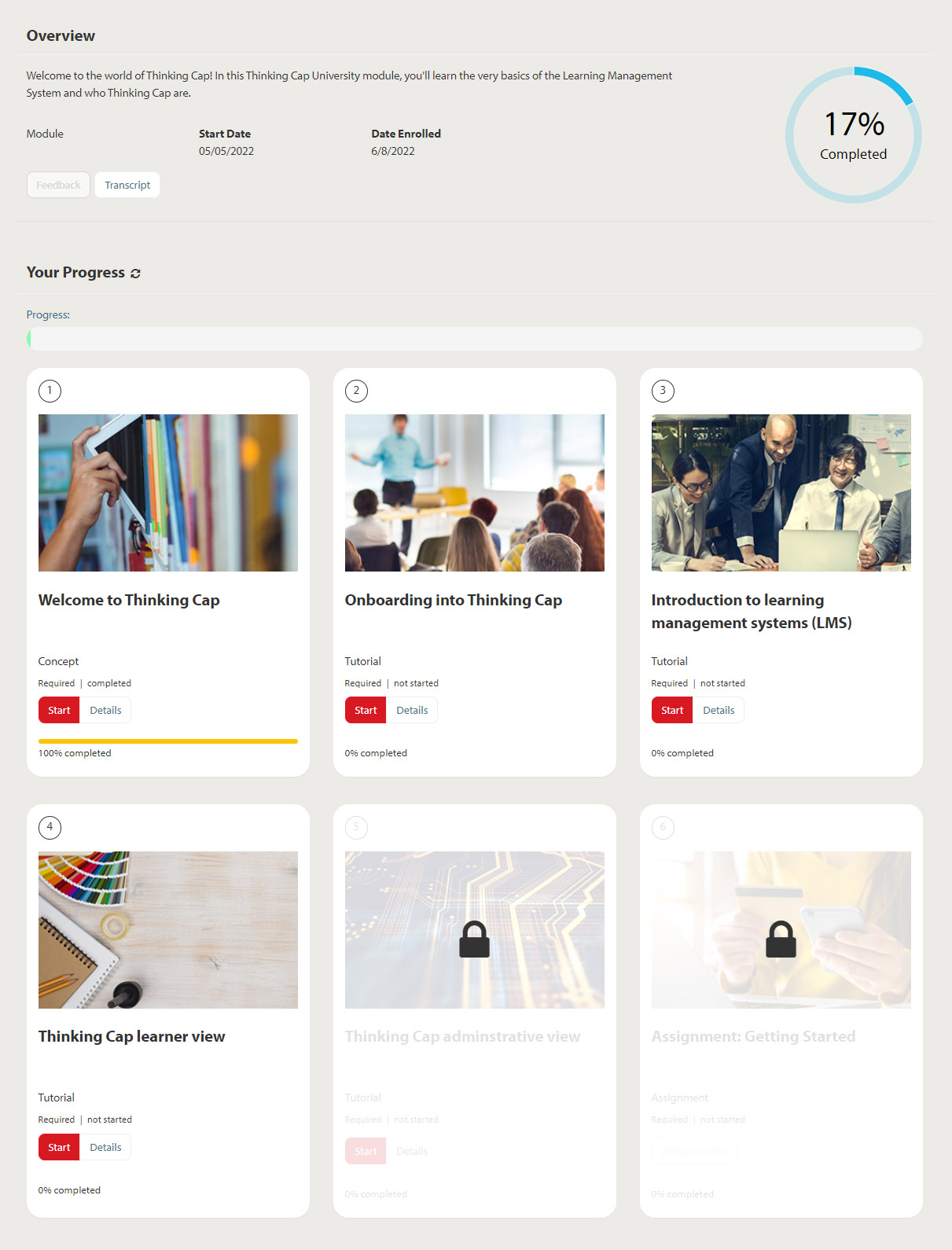

#### Discover Hidden Pools of Competency
Utilize reports to identify learners who are close to completing learning paths they are not yet enrolled in, uncovering hidden skills and competencies that can offer additional learning credits and new opportunities for role expansion.

#### Flexible and Accommodating Learning Paths:
Design learning paths with flexible options, defining which activities are required and which are optional. Use equivalencies to allow a choice of multiple activities to fulfill learning requirements, accommodating diverse learner needs.

#### Intuitive Drag-and-Drop Path Builder
Build learning paths quickly and easily with our drag-and-drop editor. Draw from your entire content library and create paths with multiple layers and options, making adjustments effortlessly as needed.

#### Progress Tracking and Learner Management
Monitor learner progress along their paths and manage credits issuance, choosing between maximum credits or a smaller amount based on specific settings.

#### Customizable Display Layout
Customize the display layout of learning path activities to suit your organizational preferences and enhance learner navigation.

#### Sequential Order Requirements
Set activities or groups of activities to be completed in a specific order, ensuring a structured and progressive learning experience.
## Custom types
Looking for something more? Create your own types of activities based on the types above, with your own twist.

#### Customizable Descriptive Activity Types
Define and describe your activity types using your specific terminology, such as "Modules," "Skill Demonstration," "Tasks," and "Scenarios," ensuring clear and consistent communication.

#### Sub-Division of Core Activity Types
Split core activity types into detailed sub-types. For example, categorize "Instructor-Led" activities into "Webinars" and "In-Person Sessions" for more granular management and tracking.

#### Advanced Filtering Options
Implement advanced filtering capabilities that allow users to filter activities based on your custom-defined types, enhancing searchability and organization within the LMS.

#### Type-Based Presets
Pre-select and apply settings automatically based on your custom activity types, simplifying the creation and configuration process of new activities.
## Want to find out more?
Book a session today for a personalized demo and Q&A.
[Book a Demo](https://www.thinkingcap.com/Book-a-demo)
---
---
title: Cloud
description: Software as a Service (Saas)
created: 2025-03-24
updated: 2025-03-24
authors: ThinkingCap
topics: [Archive]
status: published
canonical: https://console.thinkingcap.com/guest/Archive/About-Thinking-Cap/Platform/cloud
type: page
source_url: "https://www.thinkingcap.com/cloud"
lastmod: 2025-03-24
scraped: 2026-08-19
order: 11
subtitle: Software as a Service (Saas)
heroimage: "https://cdn.thinkingcap.com/medialibrary/00000000-0000-0000-0000-000000000000/30a03544-5617-420e-9fa3-30fbd8c3fa55.jpg"
---

# Cloud
Software as a Service (Saas)
Don't Buy Software. Subscribe to a Service
## The Benefits of Learning as a Service (LaaS)
Your Thinking Cap LMS is delivered as an all-in-one service provided on a monthly or yearly subscription. You’ll never need to worry about maintaining hardware or updating software – it’s all included in your subscription. Once it’s set up, we take care of the software, hosting and monitoring.
Here’s what that means for you.
```feature
icon: arrow-up-from-bracket
title: No downtime
description: You can count on your system running smoothly 24/7 because we’re always behind the scenes taking care of the hardware, software, security, and updates
```
```feature
icon: clock
title: No surprises
description: You get one bill, one vendor, and one consistent experience
```
```feature
icon: umbrella-beach
title: No worries
description: If you need a hand or have a question, support is always close at hand
```
## Auto Scaling and Fault Tolerant
 
We’re committed to delivering the fastest, smoothest and most dependable service for your LMS. That’s why we use Microsoft Azure and Amazon AWS, the largest and most powerful hosting platforms in the world. It lets us deliver your LMS services on the same platforms that delivers Amazon, Skype, Office 365, Bing, and Xbox. It means we can offer you a service level agreement of 99.95%. That’s about as high as it gets.
### It won’t slow down
Resource needs can be unpredictable. You may have 100 learners on your system one day and 5,000 the next. So we engineered our LMS from the ground up to be able to accommodate this unpredictability. By being able to ramp up the resources whenever they’re needed, your LMS can handle any number of users and any number of learning objects at any given time. This ‘bursting’ in power is what makes your Thinking Cap LaaS great.
### It’s as secure as it gets
Your security is of the utmost importance. You can count on us to safeguard your data as if it were our own. We diligently monitor your data and keep it right here in Canada for your protection and safety. As well, Microsoft has made an industry-leading commitment to the protection and privacy of your data. They were the first cloud provider recognized by the European Union’s data protection authorities for their commitment to rigorous EU privacy laws. Microsoft was also the first major cloud provider to adopt the new international cloud privacy standard, ISO 27018.
## Local Data Storage and Global Content Delivery
Azure runs on a worldwide network of data centres across 21 regions. Even mainland China. Protecting your data and respecting data privacy it core when creating a service in the cloud. This is why we match the storage of customer data to a single political border and perform backups in data centers that are both within those political boundaries but still no less than 500 miles from the primary data center.
That is leaner data. Course content and other resources is another matter. These we want as close to the learner as possible. To achieve this Thinking Cap stores these in a Content Delivery Network across the globe. So when your learner takes a course from Hong Kong, London or Duluth, they’re loading course files from a server close to them. This means low latency and great experience. The data for their account and the record of their experience is housed in your national data centre but the heavy image, audio and video files are served locally. And because Thinking Cap is a service, it’s all set up in advance and won’t cost extra.
## Industry Leading Security

We take security very seriously. This includes application security inside Thinking Cap and physical security in our data centres. Whether you need to report to the FDA on 21 CFR Part 11 or are bound by PCI ecommerce standards, you need to be sure that your data is safe. It is. Below is a list of the independently verified security compliance certifications that protect your data:
- ISO 27001/27002
- SOC 1/SSAE 16/ISAE 3402 and SOC 2
- Cloud Security Alliance CCM
- FedRAMP
- FISMA
- FBI CJIS (Azure Government)
- PCI DSS Level 1
- United Kingdom G-Cloud
- Australian Government IRAP
- Singapore MTCS Standard
- HIPAA
- EU Model Clauses
- Food and Drug Administration 21 CFR Part 11
- FERPA
- FIPS 140-2
- CCCPPF
- MLPS
At Thinking Cap, we layer on application security to the bedrock hosting security:
```feature
icon: box
title: Role-based security
description: Roles can be applied at any level of the branch tree
```
```feature
icon: key
title: Password management
description: Password freshness and complexity rules and practices
```
```feature
icon: circle-check
title: MFA
description: Multi-factor authentication options
```
```feature
icon: arrow-right
title: SSO (Single Sign On)
description: OAuth2, SAML2 and Open ID Federated Single Sign On.
```
```feature
icon: video
title: Intrusion detection
description: In-depth Logging and Intrusion Detection
```
```feature
icon: id-card
title: Identity veritification
description: Activity-level identity verification tools
```
```feature
icon: eye-slash
title: Obfuscation
description: Obfuscation of user data from both display and reporting
```
If your organization needs FDA 21 CFR Part 11 compliance, [click here](https://www.thinkingcap.com/Title21-CFR-Part11).
## Superior Support
We monitor that your services are running 24 x7. We also employ detection software that lets us know if an error occurs often before you’re aware of it. We make it easy for you to find us. Support is available by phone or online from 7am to 9pm Eastern Standard.
Learning as a Service is a commitment to giving you a solution – not just a bag of tools. Our support team is a group of highly-trained experts who know the software inside and out so you get the personalized help you need, fast.
### Talk to us 7am EST to 9pm EST
Our team knows who you are and how you’re using our software. We’re mentors and trainers and we’re here to help you succeed with your Thinking Cap LMS. Call us anytime, as often as you need to. If you need us after 9pm, emergency phone support is available 24/7/365.
### Open a ticket anytime
If you don’t have time to talk, take advantage of our amazing ticketing system. It shepherds your requests to the right team members and keeps you in the loop every step of the way. Our web-based system is always available and it’s packed with helpful videos and tools.
### Know we’ve got your back
The most important support we offer is the kind you don’t even see. We’re always behind the scenes, proactively monitoring your services to make sure they’re running 24/7. Our detection software lets us know if an error occurs – often before you’re aware of it. At the first sign of trouble our engineers will keep you in the communication loop even though your learners aren’t seeing any trouble at all.
## Want to find out more?
Book a session today for a personalized demo and Q&A.
[Book a Demo](https://www.thinkingcap.com/Book-a-demo)
---
---
title: Communication
description: Discussion forums, chat rooms, notifications, announcements, digests and more.
created: 2025-03-24
updated: 2025-03-24
authors: ThinkingCap
topics: [Archive]
status: published
canonical: https://console.thinkingcap.com/guest/Archive/About-Thinking-Cap/Platform/communication
type: page
source_url: "https://www.thinkingcap.com/communication"
lastmod: 2025-03-24
scraped: 2026-08-19
order: 13
subtitle: Discussion forums, chat rooms, notifications, announcements, digests and more.
heroimage: "https://cdn.thinkingcap.com/medialibrary/00000000-0000-0000-0000-000000000000/c909020a-bf47-4cf6-a55e-8aafc20af3bb.jpg"
---

# Communication
Discussion forums, chat rooms, notifications, announcements, digests and more.
Every great learner journey is augmented with a communication strategy. Collaboration, knowledge transfer, team building, notifications and reminders.... so are so many reasons to communicate with your learners. What's ever better, is that you can choose to send these messages either by email or SMS.
## Collaboration
People learn a lot from their peers. They transfer knowledge, sharing tips and insights, and become resources to each other. So why not capture that asset in your learner journey. Collabortion tools, such as discussion forums, chat rooms, blogs, and more, are very effective ways to moderate these communications and reward helpful behaviour.
```feature
icon: comment-dots
title: Threaded discussions
description: Start a discussion thread and post replies as you would expect for all learners enrolled in an activity, domain or LMS-wide.
```
```feature
icon: blog
title: Blog
description: Present your discussions through the lens of a blog. Drive discussions through a topical post for all learners enrolled in an activity, domain or LMS-wide.
```
```feature
icon: layer-group
title: Gallery discussion
description: Present your discussions through the lens of a media gallery. Drive discussions through the context of a media file, i.e PowerPoints, videos, images and more, for all learners enrolled in an activity, domain or LMS-wide.
```
```feature
icon: comment
title: Chat room
description: Open chat rooms to facilitate live discussions with all enrolled in an activity, domain or LMS-wide. Let these be open all the time or scheduled for specific hours/days.
```
## Notifications and digests
Every step of your learner journey maps to a possible notification. From the account creation to the completion of an activity. All notifications can be customized for both content and layout. Where notifications aren't enough, Thinking Cap also summarizes what may have been missed with a set of digest emails.
```feature
icon: at
title: Notifications
description: This comprehensive selection of over 60 types of notifications may be sent by email or SMS. Everything from enrollment notifications, recurring overdue notifications to forum moderation notifications, allow for formatting, content and recipient customization and more.
```
```feature
icon: chart-line
title: Supervisor Digests
description: Summarize a supervisor or manager's key activity by activating a supervisor-specific email. This digest can report on summary of specific details that every supervisor needs to know, from how many new enrollments their direct reports are now required, to who is overdue.
```
```feature
icon: comment-dots
title: Forum Moderator Digests
description: Ensuring forum discussions are moderated can be difficult. This digest sends a summary of any post not reviewed by a moderator - a perfect way to catch missed content.
```

## Announcements and alerts
From short announcements to your entire audience, to custom crafted announcements to a filtered audience, Thinking Cap can send your message. Announcement tools include, emailed announcements, recurring announcements of recently published activities, alerts for administrators and supervisors, and short news updates.
```feature
icon: newspaper
title: News feed
description: Share quick messages on the home page of your LMS to help direct learners to a specific activity, resources and more.
```
```feature
icon: exclamation-triangle
title: Alerts
description: Share important announcements to your learners in an alert that appears on every page your LMS.
```
```feature
icon: bell
title: Announcements
description: Email announcements to all learners in your LMS domain, enrolled in a specific activity or a filtered list of learners.
```
```feature
icon: bell
title: Recurring announcements
description: Automatically send updates to learners interested in finding out about new activitiies with recurring accouncement emails. Select your frequency, contnet and audience.
```
## Want to find out more?
Book a session today for a personalized demo and Q&A.
[Book a Demo](https://www.thinkingcap.com/Book-a-demo)
---
---
title: GDPR Compliance
description: We are partners in compliance with GDPR
created: 2025-03-24
updated: 2025-03-24
authors: ThinkingCap
topics: [Archive]
status: published
canonical: https://console.thinkingcap.com/guest/Archive/About-Thinking-Cap/Security-and-Compliance/gdpr-compliance
type: page
source_url: "https://www.thinkingcap.com/gdpr-compliance"
lastmod: 2025-03-24
scraped: 2026-08-19
order: 19
herotitle: GDPR-Compliance
subtitle: We are partners in compliance with GDPR
heroimage: "https://cdn.thinkingcap.com/medialibrary/00000000-0000-0000-0000-000000000000/c9a29e19-2bec-416e-a0f5-746d92c4d69c/1/c9a29e19-2bec-416e-a0f5-746d92c4d69c.jpg"
---

# GDPR-Compliance
We are partners in compliance with GDPR
Thinking Cap is committed to protecting your business and your data. As your data processor, we ensure that your information is safeguarded responsibly against inappropriate disclosure in an accurate, timely and attributable manner, and made available to those who should be available to access it.
We are continuing to build on our existing, robust data privacy practices in order to continue catering to our clients and providing them with effective solutions, whilst supporting data privacy practices. We also provide our clients with the tools and knowledge to be GDPR compliant with their customers.
## What is the GDPR Compliance?
GDPR stands for the General Data Protection Regulation. The GDPR is the new European Union (“EU”) law that regulates the personal data of individuals in the EU. It replaces the EU Data Protection Directive, the EU’s current privacy law, which was been in place since 1995. The GDPR harmonises data protection law across Europe and introduces sweeping changes that require companies to make significant updates to their privacy and security policies and practices. It was enforced on May 25, 2018.
The very definition of personal data has changed, EU. Personal data is defined as any type of information that identifies or can be linked to an individual. Below are six categories to be aware of.
```feature
icon: calendar
title: Historical
description: An individual’s history
```
```feature
icon: money-bill
title: Financial
description: Financial accounts, ownership, transactions or credit information.
```
```feature
icon: share-alt
title: Social
description: Personal or professional networks, family members, public life and communication.
```
```feature
icon: map-marker
title: Tracking
description: Computer devices, contacts and location.
```
```feature
icon: external-link
title: External
description: Identifying information including ethnicity, sexuality, behavior, medical history, etc.
```
```feature
icon: external-link
title: Internal
description: Knowledge and beliefs, passwords and identifiers and personal preferences.
```
## New Rights customers have under GDPR
```feature
icon: envelope-open-text
title: Breach Notification
description: Notified about data breaches in a more timely manner, within 72 hours.
```
```feature
icon: universal-access
title: Right to Access
description: Customers have a right to access all data, free of charge.
```
```feature
icon: eraser
title: Right to be Forgotten
description: Ability to request erasure of all collected personal data.
```
```feature
icon: share-alt
title: Data Portability
description: Customers can request that data be changed into a usable format to transmit to another provider.
```
```feature
icon: key
title: Privacy by Design
description: Expectation that providers will minimize data collection, retaining only what’s essential for task completion.
```

##### Data Collection Officer
Standardization of record keeping, and the potential appointment of a Data Protection Representative.
## New Requirements For Organizations
```feature
icon: map-pin
title: Increased Geographic Scope
description: The new rules apply to any entity dealing with customers located in the European Union. It no longer matters where your company is located.
```

##### Higher Penalties
Non-compliance is expensive, with fines totaling up to 4% of annual global turnover or 20 Million Euros, whichever is greater.
```feature
icon: handshake
title: Required User Consent
description: Stronger consent requirements, and greater rights for individuals, mean significant planning for those collecting data.
```
## Reach Out
At Thinking Cap, it is of vital importance to fulfill our privacy and data security commitments. If you have any questions about how Thinking Cap can help you with compliance, or you have any privacy-related concerns, please reach out by contacting us at: [gdpr@thinkingcap.com](mailto:gdpr@thinkingcap.com).
---
---
title: Title 21 CFR Part 11
description: Thinking Cap goes above and beyond to deliver the LMS software and on-site support you need to craft your Title 21 CFR Part 11 strategy.
created: 2025-03-24
updated: 2025-03-24
authors: ThinkingCap
topics: [Archive]
status: published
canonical: https://console.thinkingcap.com/guest/Archive/About-Thinking-Cap/Security-and-Compliance/title21-cfr-part11
type: page
source_url: "https://www.thinkingcap.com/Title21-CFR-Part11"
lastmod: 2025-03-24
scraped: 2026-08-19
subtitle: Thinking Cap goes above and beyond to deliver the LMS software and on-site support you need to craft your Title 21 CFR Part 11 strategy.
heroimage: "https://thinkingcap.blob.core.windows.net/demolearnerview/00000000-0000-0000-0000-000000000000/advanced/banner_title21.jpg"
---

# Title 21 CFR Part 11
Thinking Cap goes above and beyond to deliver the LMS software and on-site support you need to craft your Title 21 CFR Part 11 strategy.
### What is Title 21 CFR Part 11?

Title 21 CFR Part 11 is the section of the Code of Federal Regulations (CFR) that deals with Food and Drug Administration (FDA) guidelines on electronic records and electronic signatures in the United States. It defines the criteria under which electronic records and electronic signatures are considered trustworthy, reliable, and equivalent to paper records.
### What does it mean?

Organizations like pharmaceutical, medical supply and healthcare providers that fall under the 21 CFR Part 11 guidelines need to take extra precautions when using an LMS to disseminate information. Part 11 requires that both procedural controls (e.g. notification, training, SOPs, administration), and administrative controls are put in place by the user, in addition to the technical controls that a vendor can offer.
## What does Thinking Cap do to support Title 21 CFR Part 11?

The Thinking Cap team has the technology, software, and expertise to ensure you remain in compliance with Title 21 CFR Part 11. While no vendor can offer a system that is compliant out-of-the-box with this regulation, Thinking Cap can help you stay within the guidelines with no disruption to your regular functionality.
| Section | Requirement | Thinking Cap LMS Feature |
| --- | --- | --- |
| 11.10 (a) | Validation of systems to ensure accuracy, reliability, consistent intended performance, and the ability to discern invalid or altered records. | Many standards provide Certifications of Validation, but this is not something the FDA offers. This means the responsibility to make sure your LMS is validated and requires you to look closely at the QA practice and release and patch methodology. Thinking Cap maintains a growing set of Automated Validation tests. We have coverage of 1300 scenarios with multiple test methods per scenario. Before each patch or release we provide full notes including the status of all tests. |
| 11.10 (b) | The ability to generate accurate and complete copies of records in both human readable and electronic form suitable for inspection, review, and copying by the agency. Persons should contact the agency if there are any questions regarding the ability of the agency to perform such review and copying of the electronic records. | Thinking Cap LMS presents standard and custom reports in both screen and downloadable form. Downloaded reports are available as PDF or in CSV. |
| 11.10 (d) | Limiting system access to authorized individuals. | Access to all parts of the application is controlled by username and password. Each account has roles and permissions that limit the functions and data the account can access. Thinking Cap allows for additional security tailored for the Title 21 CFR Part 11 environment, including: unique passwords; encrypted passwords; enforced strong password selection, and; automated password expiry. Under these hardened parameters, users cannot request a lost password but can regenerate a password after either correctly answering personal questions or through offline authentication. This enhanced security also allows for: automatic account locking for multiple failed attempts, and; recording of IP addresses for all accesses. |
| 11.10 (e) | Use of secure, computer-generated, time-stamped audit trails to independently record the date and time of operator entries and actions that create, modify, or delete electronic records. Record changes shall not obscure previously recorded information. Such audit trail documentation shall be retained for a period at least as long as that required for the subject electronic records and shall be available for agency review and copying. | Thinking Cap records everything to the log, including: a record of each action; when each action occurred, and; who the user who committed the action was. In the case of clients using PKI signatures for users, the log contains the personal signature of the user. You can export this log to CSV. |
| 11.10 (f) | Use of operational system checks to enforce permitted sequencing of steps and events, as appropriate. | Thinking Cap controls each procedure, including: adding a user; enrollments; and; creating a new course. Between course and competency map, access is controlled via domains enrollment and prerequisites. Within the course and competency map themselves, sequencing rules enforced by the LMS govern each step. A second layer of administrative log in can control access to sensitive course and learning paths to provide onsite verification of a user’s identity and increase the security of the user’s log in point. |
| 11.10 (g) | Use of authority checks to ensure that only authorized individuals can use the system, electronically sign a record, access the operation or computer system input or output device, alter a record, or perform the operation at hand. | Every function of the LMS is defined as a permission. Roles are created as groupings of permissions and each user is given some combination of roles and individual permissions. Layered onto this is the segmenting of domains and sub domains that further limit a user’s access based on their domain membership and role in that domain. |
| 11.10 (h) (1) | Use of device (e.g., terminal) checks to determine, as appropriate, the validity of the source of data input or operational instruction. | Thinking Cap will not accept connections, and therefore will not accept commands or data, from unauthenticated sources, or from authenticated sources where the IP address of a command does not match the originally authenticated access for a given session. In a hardened environment, the LMS will only communicate over HTPPS, which prevents a third party from modifying data being transmitted. |
| 11.50 (a) (1), (2), (3) | Signed electronic records shall contain information associated with the signing that clearly indicates all of the following: (1) The printed name of the signer; (2) The date and time when the signature was executed; and (3) The meaning (such as review, approval, responsibility, or authorship) associated with the signature. | The meaning of the signature is the action performed and recorded in the log. Thinking Cap stores this information along with the full name and account username of the signatory. |
| 11.50 (b) | The items identified in paragraphs (a)(1), (a)(2), and (a)(3) of this section shall be subject to the same controls as for electronic records and shall be included as part of any human readable form of the electronic record (such as electronic display or printout). | The three signature items are included in all audit trail reports. |
| 11.70 (a) | Electronic signatures and handwritten signatures executed to electronic records shall be linked to their respective electronic records to ensure that the signatures cannot be excised, copied, or otherwise transferred to falsify an electronic record by ordinary means. | Electronic signatures are linked and this link is protected by username and password protection of the data store. A hash of the audit trail made at each point provides a detection system of tampering, even by an authenticated user. |
| 11.100 (a) | Each electronic signature shall be unique to one individual and shall not be reused by, or reassigned to, anyone else. | Uniqueness of username and password is enforced by the system. This uniqueness survives even the expiry of an account. Inactive accounts and their records are never removed from the system. |
| 11.200 (a) (1) | Employ at least two distinct identification components such as an identification code and password. | Thinking Cap employs username and password protection, and enforces that the authenticated session maintains the continuity of IP address. Personal PKI-based digital signatures are also an optional addition. |
| 11.200 (a) (1) (i) | The system requires the use of all electronic signature components for the first signing during a single continuous period of controlled system access. | All sessions begin with a digital signing. Additional signing may be required by more privileged / trusted users for access to defined materials where the in-person authentication of an individual is mandated as necessary i.e. tests and compliance learning. |
| 11.200 (a) (1) (i) | The system shall allow all subsequent signing during the same continuous period of controlled system access to use at least one electronic signature component. | The system will continue to use the originating IP of each request after the first to maintain security of the session. |
| 11.200 (a) (1) (i) | The system shall ensure users are timed out during periods of specified inactivity.When an individual executes a series of signings during a single, continuous period of controlled system access, the first signing shall be executed using all electronic signature components; subsequent signings shall be executed using at least one electronic signature component that is only executable by, and designed to be used only by, the individual. | Time out in a 21 CFR Part 11 environment is enforced after 20 minutes of inactivity. |
| 11.200 (a) (1) (ii) | When an individual executes one or more signings not performed during a single, continuous period of controlled system access, each signing shall be executed using all of the electronic signature components | All signing must be executed during a continuous period of controlled system access. |
| 11.200 (a) (3) | Be administered and executed to ensure that attempted use of an individual's electronic signature by anyone other than its genuine owner requires collaboration of two or more individuals. | Sharing electronic signatures is not permitted. |
| 11.300 (a) | Maintaining the uniqueness of each combined identification code and password, such that no two individuals have the same combination of identification code and password. | The system will not allow duplication. Two hashes of both the username and password are kept for comparison purposes to maintain integrity without storing actual information unencrypted. |
| 11.300 (b) | Ensuring that identification code and password issuances are periodically checked, recalled, or revised (e.g., to cover such events as password aging). | In hardened mode for use in a Title 21 CFR Part 11 environment,the system requires password changes every 30 days. This duration can only be reduced when operating in this mode. |
| 11.300 (d) | Use of transaction safeguards to prevent unauthorized use of passwords and/or identification codes, and to detect and report in an immediate and urgent manner any attempts at their unauthorized use to the system security unit, and, as appropriate, to organizational management. | Thinking Cap uses intrusion detection to identify fraudulent transactions, including: multiple failed attempts at log in; log in from a large number of IP addresses, and; unusual activity in an account. The system will temporarily suspend accounts showing this activity and will required logged explanations of the activity by administrators, including actions taken. |
| 11.300 (d) | Use of transaction safeguards to prevent unauthorized use of passwords and/or identification codes, and to detect and report in an immediate and urgent manner any attempts at their unauthorized use to the system security unit, and, as appropriate, to organizational management. | Administrators are alerted to all attempts to log in with: a valid username and invalid password, or; an invalid username and valid password. |
---
---
title: Success Stories
description: "Trusted by teams that don’t compromise on learning."
created: 2026-11-19
updated: 2026-11-19
authors: ThinkingCap
topics: [Archive]
status: published
canonical: https://console.thinkingcap.com/guest/Archive/About-Thinking-Cap/Why-Thinking-Cap/success-stories
type: page
source_url: "https://www.thinkingcap.com/success-stories"
scraped: 2026-08-19
herotitle: Testimonials & Success Stories
subtitle: "Trusted by teams that don’t compromise on learning."
heroimage: "https://cdn.thinkingcap.com/medialibrary/00000000-0000-0000-0000-000000000000/496501f4-589e-4b3b-abb4-47f946ad5066/1/496501f4-589e-4b3b-abb4-47f946ad5066.jpg"
- label: See It in Action
href: "https://www.thinkingcap.com/book-demo"
style: secondary
---

# Testimonials & Success Stories
Trusted by teams that don’t compromise on learning.
Real feedback from organizations that rely on Thinking Cap to power their learning every day.
[Explore our Services](https://www.thinkingcap.com/services)
[See It in Action](https://www.thinkingcap.com/book-demo)
Choosing an LMS is about more than features. It’s about finding a **partner that understands** your goals and grows with you. At Thinking Cap, we don’t just build software. We **support, mentor, and collaborate** with the people who use it. Here’s what clients and industry leaders have to say about working with us, and how we’ve helped organizations launch, evolve, and succeed.
Trusted voices from across industries
## Client Testimonials
These quotes come straight from the organizations we serve. Longtime clients and new launches alike highlighting the impact of our support, customizability, and commitment.


##### Electrical Safety Authority
"Switching LMS providers is no small task—but Thinking Cap made it feel seamless. From the early planning stages through migration and onboarding, their team provided outstanding, hands-on support that truly helped us stay grounded throughout the transition."
Alejandro Gonzalez
Manager, Training Program


##### BuildForce Canada
"We have been a customer of Thinking Cap LMS since 2006, and our long-standing partnership speaks volumes about the platform’s reliability and adaptability."
Tim Bolger
Project Manager, Learning Innovation


##### ARCA Statewide Association
"After using other out-of-the-box LMS platforms, we chose Thinking Cap over 14 years ago because of the sophisticated features and integration with virtual and ecommerce applications, cost, and the ability to customize multiple domains for different audiences and personalized customer service."
Maureen Wilson
Director of Training and Development


##### EMC Canada
"Great group of people working at Thinking Cap. Their Thinking Camp allows them to bring together their customers, allowing for networking as well as bringing new ideas to the table for implementation."
Menai Collins
IT Manager


##### Ezector Solutions
"Great LMS and behind it there is a great team. They provide a solution that understands the users."
Midou Mihoubi
Manager, E-Learning


##### Lee Hecht Harrison | Knightsbridge
"Fantastic experience working with the team. Would certainly recommend this tool to other companies seeking an LMS."
Charles Cicciarella
VP Human Resources


##### Amazon
"Fantastic experience working with the team. Would certainly recommend this tool to other companies seeking an LMS."
Chuck Sigmund
Senior Consultant, Microsoft AI (formerly Manager, Program Management, Amazon)
**Curious what Thinking Cap could do for your organization?**
Explore how our clients are making the most of their LMS and take the next step when you're ready.
[Read the Electrical Safety Council's Story](https://www.thinkingcap.com/blog-electrical-safety-authority-lms-launch)
[Talk to Our Team](https://www.thinkingcap.com/book-demo)
Featured Industry Voices
## Industry Reviews
From analysts and software review platforms to educational publications, here’s how Thinking Cap is seen by the industry. These reviews highlight our strengths in customization, security, flexibility, and more.

#### Talented Learning says:
“Complexity, quote-unquote, is their wheelhouse… I know from a lot of experience that managing complex continuing education is a bear… and that's what Thinking Cap has.”
— John Leh, CEO
#### LearningSpace Blog says:
"Thinking Cap LMS offers a unique blend of flexibility and user-friendliness, making it a suitable choice for organizations seeking a customizable learning platform."
— Jim Harland, Educational Technologist

#### Brandon Hall Group says:
"Thinking Cap’s approach to microlearning, personalized learning journeys, content curation and data-driven insights can help organizations address the challenges of traditional training methods and empower their employees with the skills they need to succeed in today’s workplace."
— Claude Werder, Senior Vice President and Principal HCM Analyst

#### FinancesOnline says:
"Thinking Cap LMS has customizable properties that go beyond using brand-inspired color templates and fonts."
— Astrid Eira, B2B Software Analyst

#### LMS.org
"Thinking Cap manages to marry complexity and convenience in a unique way."

#### SelectHub
"Thinking Cap LMS is best suited for organizations seeking a comprehensive and customizable learning management system with a strong emphasis on customer support."

#### ITQlick says:
"Thinking Cap LMS is a cloud-based learning management system (LMS) software designed to provide training and education to individuals and organizations."
— Melissa Pardo-Bunte, Analyst

#### Education and Training UK
"The Thinking Cap LMS is SCORM compliant Learning Management System that aims to engender collaboration between learners and teachers."

#### PAT Resaearch
"Thinking Cap LMS lets users rest easy while taking payments online knowing that users are housed in a PCI DSS Level 1 facility."
#### BetterBuys
"Thinking Cap LMS is a cloud-based learning system that helps companies deploy training to their employees."
— Shlomi Lavi, Analyst

#### SourceForge
"Thinking Cap Learning Management System (LMS) is an enterprise-grade platform that helps deliver and track all kinds of blended learning... The solution provides unparalleled branding and segmentation, superior security and data protection, rich reporting, and so much more."

#### Entelechy
"Thinking Cap LMS provides a user-friendly and feature-rich platform for delivering high-quality online training. Its ease of use, scalability, and comprehensive reporting tools make it an excellent choice for both novice and experienced instructors."
**Ready to see why others choose Thinking Cap?**
Browse our capabilities or chat with us in a guided demo.
[Explore Features](https://www.thinkingcap.com/features)
[Book a Demo](https://www.thinkingcap.com/book-demo)
Behind-the-scenes wins
## Launches worth celebrating
These stories showcase real-world LMS implementations powered by Thinking Cap. See how teams like SickKids’ IEMHP and the Electrical Safety Authority brought their training goals to life—from branding to learner experience.

##### Electrical Safety Authority Launches New Learning Program on Thinking Cap LMS
2025-03-26
Discover how the Electrical Safety Authority launched their new training program with Thinking Cap LMS—custom-branded, user-friendly, and ready to grow.
[Find out more](https://www.thinkingcap.com/blog-electrical-safety-authority-lms-launch)
**Behind every success story is a strong partnership.**
Explore how we support our clients from day one — with hands-on onboarding, responsive training, and expert guidance. Or connect with us directly to talk about what you’re building.
[Read our Blog](https://www.thinkingcap.com/blog)
[Book a Demo](https://www.thinkingcap.com/book-demo)
---
---
title: Thinking Cap Vs
description: Not all LMS platforms are created equal
created: 2026-11-19
updated: 2026-11-19
authors: ThinkingCap
topics: [Archive]
status: published
canonical: https://console.thinkingcap.com/guest/Archive/About-Thinking-Cap/Why-Thinking-Cap/thinking-cap-vs
cover: https://cdn.thinkingcap.com/medialibrary/00000000-0000-0000-0000-000000000000/e7d07fed-8b70-4483-b550-d2621a2f654c/1/e7d07fed-8b70-4483-b550-d2621a2f654c.jpg
type: page
source_url: "https://www.thinkingcap.com/thinking-cap-vs"
scraped: 2026-08-19
subtitle: Not all LMS platforms are created equal
heroimage: "https://cdn.thinkingcap.com/medialibrary/00000000-0000-0000-0000-000000000000/e7d07fed-8b70-4483-b550-d2621a2f654c/1/e7d07fed-8b70-4483-b550-d2621a2f654c.jpg"
- label: See It in Action
href: "https://www.thinkingcap.com/book-demo"
style: secondary
---

# Thinking Cap Vs
Not all LMS platforms are created equal
See how Thinking Cap stacks up against the frustrations you may have with your current system.
[Explore Features](https://www.thinkingcap.com/features)
[See It in Action](https://www.thinkingcap.com/book-demo)
Built to remove the frustrations of traditional learning platforms
## Thinking Cap vs. Typical LMS Problems
Many organizations come to Thinking Cap after struggling with outdated or overcomplicated LMS systems. Here’s how we solve the most common pain points.
#### Complexity
*Most LMS platforms are bloated and hard to use.*
Thinking Cap is designed for simplicity. Admin tools and learner views are intuitive, which reduces training time and frustration.
#### Hidden Costs
*Other systems often hide fees in add-ons, integrations, or seat structures.*
With Thinking Cap, licensing is transparent and predictable, starting with our Starter 500-seat package.
#### Limited Flexibility
*Rigid course structures limit how you deliver training.*
Thinking Cap supports personalized paths, prerequisites, multiple content formats, and sequencing options.
#### Poor Support
*Outsourced or generic support leaves teams stuck.*
Our clients get direct access to experienced LMS experts who understand your setup and goals.
#### Data Gaps
*Reporting in many platforms is shallow or requires costly add-ons.*
Thinking Cap delivers detailed reporting, compliance tracking, and SCORM interaction data right out of the box.
#### Limited Mobility
*Many systems are not optimized for mobile, leaving learners tied to desktops.*
Thinking Cap is responsive across devices, so learners can access training anytime, anywhere.
Adaptable for the unique needs of each sector
## Thinking Cap vs. Industry Challenges
Every organization has different priorities. Thinking Cap LMS is built to flex for associations, corporations, healthcare, nonprofits, and government training.
#### Associations
*Engaging members and managing certifications can be overwhelming.*
Thinking Cap makes it simple with certification tracking, member engagement tools, and flexible credentialing.
#### Healthcare
*Training in regulated environments requires precision and compliance.*
Our platform supports credentialing, continuing education, and strict prerequisite enforcement.
#### Corporate Training
*Employees need consistent onboarding and measurable skill growth.*
Thinking Cap enables automated learning paths, performance tracking, and scalable skill development programs.
#### Nonprofits & Government
*Budgets are tight and reporting is critical.*
We offer scalable training, accessibility support, and detailed, transparent reporting for compliance and funding needs.
---
---
title: Professional Associations
description: Enhance member engagement with simplified certification and training solutions
created: 2026-11-19
updated: 2026-11-19
authors: ThinkingCap
topics: [Archive]
status: published
canonical: https://console.thinkingcap.com/guest/Archive/associations
type: page
source_url: "https://www.thinkingcap.com/associations"
scraped: 2026-08-19
order: 68
herotitle: LMS Solutions for Professional Associations
subtitle: Enhance member engagement with simplified certification and training solutions
heroimage: "https://cdn.thinkingcap.com/medialibrary/00000000-0000-0000-0000-000000000000/155113ce-bce9-4c6e-bee1-dbf8618a0f10/1/155113ce-bce9-4c6e-bee1-dbf8618a0f10.jpg"
---

# LMS Solutions for Professional Associations
Enhance member engagement with simplified certification and training solutions
## Why struggle to manage certifications manually when Thinking Cap can automate tracking and renewals?
With advanced tools, Thinking Cap LMS provides tailored solutions that help professional associations deliver impactful, scalable, and compliant training programs.
Features
## Optimized Solutions for Certification and Growth
Thinking Cap LMS equips professional associations with the tools to track certifications, deliver training, and enhance member engagement effectively.

#### Gamification
Member Engagement and Retention
Points, badges, and leaderboards to motivate participation.

#### Community Features
Member Engagement and Retention
Discussion boards, polls, and peer-to-peer collaboration tools.

#### Mobile Learning
Member Engagement and Retention
Engages members on-the-go with responsive design and app compatibility.

#### Adaptive Learning Paths
Customization and Personalization
Tailored content recommendations based on member needs and preferences.

#### Role-Based Dashboards
Customization and Personalization
Personalized user experiences for learners, instructors, and admins.

#### Custom Branding
Customization and Personalization
Reflect the association's identity in the LMS interface.

#### Multi-Language Support
Customization and Personalization
Supports global audiences with localized experiences.

#### SCORM and xAPI Compatibility
Keeping Up with Industry Trends
Supports modern content standards for advanced learning experiences.

#### Continuous Updates
Keeping Up with Industry Trends
Regular LMS updates to integrate emerging technologies and trends.

#### Content Versioning
Keeping Up with Industry Trends
Allows easy updating and management of course materials as trends change.

#### API and Integrations
Technology Integration
Seamless connection with CRMs, HRIS systems, and event platforms.

#### Single Sign-On (SSO)
Technology Integration
Simplifies user authentication and access across systems.

#### Advanced Analytics
Technology Integration
Provides insights on learner behavior, progress, and engagement.

#### Analytics and Reporting
Measuring Impact and ROI
Real-time dashboards with course completion rates and engagement trends.

#### Assessment Tools
Measuring Impact and ROI
Pre- and post-course testing to measure knowledge retention.

#### Survey and Feedback Tools
Measuring Impact and ROI
Collects member opinions to improve future programs.

#### Tiered Licensing Options
Cost Management and Scalability
Scalable pricing based on association size or membership tiers.

#### Efficient Content Delivery
Cost Management and Scalability
Centralized system for creating and managing large content libraries.

#### Cloud-Based Hosting
Cost Management and Scalability
Reduces the need for costly IT infrastructure while allowing easy scaling.

#### Certification Management
Certification and Accreditation
Automates issuing, tracking, and renewing certifications.

#### CEU Tracking
Certification and Accreditation
Tracks continuing education units (CEUs) for compliance.

#### Digital Badging
Certification and Accreditation
Issues verifiable badges for skills and accomplishments.

#### WCAG Compliance
Accessibility and Inclusivity
Ensures accessibility for users with disabilities, meeting global standards.

#### Responsive Design
Accessibility and Inclusivity
Supports learners across devices, including mobile, tablet, and desktop.

#### Multi-Language Support
Accessibility and Inclusivity
Helps reach diverse and global audiences effectively with localized content.

#### Unique Content Delivery
Competition from Other Providers
Supports interactive modules, video integration, and live sessions.

#### White-Labeling
Competition from Other Providers
Allows associations to brand the platform uniquely for a competitive edge.

#### Customizable Learning Paths
Competition from Other Providers
Delivers value tailored specifically to member needs.

#### Social Learning Features
Facilitating Networking and Collaboration
Built-in tools like forums, group activities, and live chat to foster collaboration.

#### Webinar Integration
Facilitating Networking and Collaboration
Facilitates live sessions and virtual networking opportunities for members.

#### Community Spaces
Facilitating Networking and Collaboration
Creates forums or cohorts for peer-to-peer interaction and collaboration.

#### Custom Landing Pages
Marketing and Promotion
Promotes specific courses or programs effectively to targeted audiences.

#### Automated Notifications
Marketing and Promotion
Keeps members informed with reminders, updates, and promotional messages.

#### Integration with Marketing Tools
Marketing and Promotion
Connects with email marketing platforms to enhance outreach and engagement.
Show more 
Show less 
## Trusted by Leading Professional Associations Worldwide





Use Cases
## Simplifying Certification for Professional Associations
From compliance tracking to personalized learning, our LMS delivers impactful solutions for professional associations. Discover how Thinking Cap LMS supports associations in enhancing learning and engagement outcomes.

#### Automate Certification and CEU Management
Automatically track and award continuing education units to ensure compliance and growth.
[Read more](https://www.thinkingcap.com/solutions-use-case-automate-certification-ceu-management)

#### Automate Certification Training Re-Enrollments
Automatically re-enroll employees in certification training programs to maintain compliance.
[Read more](https://www.thinkingcap.com/solutions-use-case-automate-certification-training-re-enrollments)

#### Automate Onboarding for New Members
Guide new members through the benefits and resources of your association seamlessly.
[Read more](https://www.thinkingcap.com/solutions-use-case-automate-onboarding-for-new-members)

#### Create Dashboards Combining Internal and LMS Data
Develop dashboards that merge LMS data with internal analytics for a holistic view.
[Read more](https://www.thinkingcap.com/solutions-use-case-create-dashboards-combining-internal-and-lms-data)

#### Create New Sales Options for Courses
Sell courses through various models like coupons, discounts, and subscriptions.
[Read more](https://www.thinkingcap.com/solutions-use-case-create-new-sales-options-for-courses)

#### Cybersecurity Awareness Training
Educate employees on cybersecurity best practices through engaging training programs.
[Read more](https://www.thinkingcap.com/solutions-use-case-cybersecurity-awareness-training)

#### Deliver Branching Training Paths
Offer different learning paths based on student performance or preferences.
[Read more](https://www.thinkingcap.com/solutions-use-case-deliver-branching-training-paths)

#### Deliver Training Securely While Maintaining Privacy
Implement privacy and security measures like SSO and secure certificates for online training.
[Read more](https://www.thinkingcap.com/solutions-use-case-deliver-training-securely-while-maintaining-privacy)

#### Fundraising Training Programs
Equip staff and volunteers with effective fundraising strategies through tailored training.
[Read more](https://www.thinkingcap.com/solutions-use-case-fundraising-training-programs)

#### Impact Measurement Training
Train staff to measure and report on program outcomes effectively.
[Read more](https://www.thinkingcap.com/solutions-use-case-impact-measurement-training)

#### Improve Completions
Implement strategies to boost course completion rates for your members.
[Read more](https://www.thinkingcap.com/solutions-use-case-improve-completions)

#### Improve Compliance with Accreditation Standards
Ensure training programs meet educational accreditation standards effectively.
[Read more](https://www.thinkingcap.com/solutions-use-case-improve-compliance-with-accreditation-standards)

#### Improve Engagement with Member-Specific Training Programs
Develop training that addresses members’ unique needs and goals.
[Read more](https://www.thinkingcap.com/solutions-use-case-improve-engagement-with-member-specific-training-programs)

#### Improve Learner Engagement
Create engaging training programs that motivate members to learn and grow.
[Read more](https://www.thinkingcap.com/solutions-use-case-improve-learner-engagement)

#### Integrate My LMS with Internal Systems
Sync your LMS with HR, CRM, and other internal systems for streamlined operations.
[Read more](https://www.thinkingcap.com/solutions-use-case-integrate-my-lms-with-internal-systems)

#### Leadership and Skills Development
Develop leadership and professional skills among members through targeted training.
[Read more](https://www.thinkingcap.com/solutions-use-case-leadership-skills-development)

#### Match Learner View to Institutional Branding
Customize the LMS interface to match your institution’s branding.
[Read more](https://www.thinkingcap.com/solutions-use-case-match-learner-view-to-institutional-branding)

#### Membership Retention
Offer members exclusive educational content and benefits to improve retention.
[Read more](https://www.thinkingcap.com/solutions-use-case-membership-retention)

#### Policy and Procedure Updates
Distribute and track training on new policies and procedures across your members.
[Read more](https://www.thinkingcap.com/solutions-use-case-policy-procedure-updates)

#### Public Sector Compliance Training
Ensure government employees complete mandatory compliance training.
[Read more](https://www.thinkingcap.com/solutions-use-case-public-sector-compliance-training)

#### Segment Training for Different Member Audiences
Deliver tailored training content to different segments of your member base.
[Read more](https://www.thinkingcap.com/solutions-use-case-segment-training-for-different-member-audiences)

#### Simplify Regulated Compliance Training
Automate compliance training processes to meet regulatory standards.
[Read more](https://www.thinkingcap.com/solutions-use-case-simplify-regulated-compliance-training)
Show more 
Show less 
Insights
## Relevant Industry Research: Key Takeaways
Professional associations need to deliver impactful training programs, simplify compliance and certification processes for member growth and enhance member satisfaction and engagement with advanced learning tools.
### Enhancing Member Value
Regularly survey members to identify their professional development needs and ensure your learning offerings are aligned with those priorities.
> #### 69% of employees report their organizations prioritize training and development, supported by 79% of HR managers.
>
> Society for Human Resource Management (SHRM): [SHRM Workplace Learning and Development Trends Report](https://www.shrm.org/content/dam/en/shrm/research/2022-Workplace-Learning-and-Development-Trends-Report.pdf)
### Bridging Industry Gaps
Develop competency-based training modules that directly address the skills members need to succeed in their roles.
> #### 51% of HR managers address skills gaps by training their current workforce.
>
> Society for Human Resource Management (SHRM): [SHRM Workplace Learning and Development Trends Report](https://www.shrm.org/content/dam/en/shrm/research/2022-Workplace-Learning-and-Development-Trends-Report.pdf)
### Future-Proofing Member Services
Assess your current LMS to ensure it meets members' expectations for personalized, accessible, and on-demand learning.
> #### 93% of HR leaders increasing their L&D budgets are investing more in learning technologies like LMS.
>
> Think Learning: [Think Learning - Learning and Development Statistics](https://www.think-learning.com/learning-impact/learning-and-development-statistics/)
### Driving Digital Transformation
Expand your digital course offerings to include webinars, microlearning, and self-paced modules to meet diverse member preferences.
> #### 79% of L&D professionals are increasing their budgets for online learning, while 73% are reducing spending on instructor-led training.
>
> Think Learning: [Think Learning - Learning and Development Statistics](https://www.think-learning.com/learning-impact/learning-and-development-statistics/)
### Empowering Professional Growth
Offer specialized learning paths focused on emerging trends and technologies to keep your members ahead of the curve.
> #### 59% of L&D professionals rank reskilling and upskilling as top priorities.
>
> Academy to Innovate HR (AIHR): [AIHR - Learning and Development Statistics](https://www.aihr.com/blog/learning-and-development-statistics/)
Solutions
## Ready to Revolutionize Member Training?
Discover how Thinking Cap LMS can transform your association’s training and certification programs. Request a demo today!
[Book meeting](https://try.thinkingcap.com/meetings/isobel-wallace/first-meeting-introductions)

Resources
## Explore More
Explore these three resources to deepen your knowledge, stay ahead of trends, and achieve your goals.

##### Certification Management Simplified
Learn how Thinking Cap LMS streamlines certification processes.
[Learn more](https://www.thinkingcap.com/certification)

##### 10 tips to upskill your manufacturing workforce
Working with manufacturing clients we have found there are key steps to deliver a successful training program.
[Learn more](https://www.thinkingcap.com/blog-upskill-your-manufacturing-workforce)

##### Upcoming Conferences
Discover the top eLearning and training conferences to boost your professional development and connect with industry leaders.
[Learn more](https://www.thinkingcap.com/conferences)
Share the Solution
## You're going to love what Thinking Cap can do for you
Share this solution with your team, stakeholder or connections.
## FAQs
#### [How does Thinking Cap LMS streamline certification and continuing education tracking?](#collapse_1)
Thinking Cap LMS automates the process of tracking and awarding continuing education units (CEUs). It provides tools for monitoring certification progress, setting automated renewal reminders, and generating detailed reports to ensure compliance with industry regulations.
#### [Can Thinking Cap LMS integrate with our existing association management system (AMS)?](#collapse_2)
Yes, Thinking Cap LMS seamlessly integrates with most association management systems (AMS), enabling associations to synchronize member data, track progress, and simplify administrative processes. This integration ensures that all training and certification records are updated in real time.
#### [What reporting capabilities does Thinking Cap LMS offer?](#collapse_3)
Thinking Cap LMS provides advanced analytics and reporting tools that allow associations to track member engagement, monitor training effectiveness, and identify learning gaps. Customizable dashboards offer actionable insights to optimize training programs and ensure members meet certification requirements.
#### [How does Thinking Cap LMS enhance member engagement?](#collapse_4)
By offering personalized learning paths and interactive content, Thinking Cap LMS helps associations create a tailored learning experience for members. Gamification tools and progress tracking encourage engagement and improve training outcomes.
#### [Does Thinking Cap LMS support multi-language learning?](#collapse_5)
Yes, Thinking Cap LMS supports multi-language functionality, allowing associations to deliver training in different languages to cater to diverse member bases globally. This feature ensures inclusivity and accessibility for all members.
#### [Is Thinking Cap LMS scalable for associations of all sizes?](#collapse_6)
Absolutely. Thinking Cap LMS is designed to scale with the needs of associations, whether they have hundreds or thousands of members. It can accommodate growing membership bases and evolving training requirements without compromising performance or user experience.
---
---
title: Book a Personalized Demo
description: See how Thinking Cap helps training teams work faster and deliver more.
created: 2026-11-19
updated: 2026-11-19
authors: ThinkingCap
topics: [Archive]
status: published
canonical: https://console.thinkingcap.com/guest/Archive/book-a-demo
cover: https://cdn.thinkingcap.com/medialibrary/00000000-0000-0000-0000-000000000000/7560c28b-2ba2-445c-b845-fc92c7a4595f/1/7560c28b-2ba2-445c-b845-fc92c7a4595f.jpg
type: page
source_url: "https://www.thinkingcap.com/Book-a-demo"
scraped: 2026-08-19
order: 46
herotitle: Smarter LMS. Tailored Demo.
subtitle: See how Thinking Cap helps training teams work faster and deliver more.
heroimage: "https://cdn.thinkingcap.com/medialibrary/00000000-0000-0000-0000-000000000000/7560c28b-2ba2-445c-b845-fc92c7a4595f/1/7560c28b-2ba2-445c-b845-fc92c7a4595f.jpg"
---

# Smarter LMS. Tailored Demo.
See how Thinking Cap helps training teams work faster and deliver more.
#### Trusted by 300+ learning teams
Serving associations, regulators, and enterprise clients worldwide.
#### Supports millions of learners annually
Scalable for small teams and national rollouts alike.
#### Top-rated onboarding & support
Work with real people who know your use case, from setup to rollout and beyond.
#### Designed for Multi-Audience Training
Deliver tailored experiences for staff, partners, members, and the public... all from one platform.
#### Built for Growth
From 100 to 100,000 users, Thinking Cap scales with your organization’s training needs.
#### Backed by 20+ Years of Expertise
We’ve helped learning teams succeed since 2001, and we’re not slowing down.
#### Flexible Integrations
Connect with your existing systems through Single Sign-On, secure APIs, and custom workflows.
### Thinking Cap Time & Cost Savings Calculator
Curious How Much Thinking Cap Could Save You? Manual enrolments and reminder emails eat up valuable time, especially as your learner base grows.
Enter the number of learners you support annually to estimate how much time (and money) you could save with Thinking Cap LMS.
**How many learners do you support each year?**
Please select
500
1,000
2,500
5,000
10,000
25,000
50,000
75,000
100,000
# hours/year
##### Admin Time Saved
Hours you’ll reclaim from enrolment and reminder tasks.
# emails/year
##### Reminder Emails Automated
Repetitive follow-ups and escalations sent for you. No chasing required.
# certificates/year
##### Certificates Issued Automatically
Compliance docs generated and tracked behind the scenes
#USD/year
##### Estimated Annual Cost Savings
Based on time saved × industry admin wage average
---
---
title: Book a Personalized Demo
description: See how Thinking Cap helps training teams work faster and deliver more.
created: 2025-03-24
updated: 2025-03-24
authors: ThinkingCap
topics: [Archive]
status: published
canonical: https://console.thinkingcap.com/guest/Archive/book-demo
cover: https://cdn.thinkingcap.com/medialibrary/00000000-0000-0000-0000-000000000000/7560c28b-2ba2-445c-b845-fc92c7a4595f/1/7560c28b-2ba2-445c-b845-fc92c7a4595f.jpg
type: page
source_url: "https://www.thinkingcap.com/book-demo"
lastmod: 2025-03-24
scraped: 2026-08-19
order: 8
herotitle: Smarter LMS. Tailored Demo.
subtitle: See how Thinking Cap helps training teams work faster and deliver more.
heroimage: "https://cdn.thinkingcap.com/medialibrary/00000000-0000-0000-0000-000000000000/7560c28b-2ba2-445c-b845-fc92c7a4595f/1/7560c28b-2ba2-445c-b845-fc92c7a4595f.jpg"
---

# Smarter LMS. Tailored Demo.
See how Thinking Cap helps training teams work faster and deliver more.
#### Trusted by 300+ learning teams
Serving associations, regulators, and enterprise clients worldwide.
#### Supports millions of learners annually
Scalable for small teams and national rollouts alike.
#### Top-rated onboarding & support
Work with real people who know your use case, from setup to rollout and beyond.
#### Designed for Multi-Audience Training
Deliver tailored experiences for staff, partners, members, and the public... all from one platform.
#### Built for Growth
From 100 to 100,000 users, Thinking Cap scales with your organization’s training needs.
#### Backed by 20+ Years of Expertise
We’ve helped learning teams succeed since 2001, and we’re not slowing down.
#### Flexible Integrations
Connect with your existing systems through Single Sign-On, secure APIs, and custom workflows.
### Thinking Cap Time & Cost Savings Calculator
Curious How Much Thinking Cap Could Save You? Manual enrolments and reminder emails eat up valuable time, especially as your learner base grows.
Enter the number of learners you support annually to estimate how much time (and money) you could save with Thinking Cap LMS.
**How many learners do you support each year?**
Please select
500
1,000
2,500
5,000
10,000
25,000
50,000
75,000
100,000
# hours/year
##### Admin Time Saved
Hours you’ll reclaim from enrolment and reminder tasks.
# emails/year
##### Reminder Emails Automated
Repetitive follow-ups and escalations sent for you. No chasing required.
# certificates/year
##### Certificates Issued Automatically
Compliance docs generated and tracked behind the scenes
#USD/year
##### Estimated Annual Cost Savings
Based on time saved × industry admin wage average
---
---
title: Book a Personalized Demo
description: See how Thinking Cap helps training teams work faster and deliver more.
created: 2026-11-19
updated: 2026-11-19
authors: ThinkingCap
topics: [Archive]
status: published
canonical: https://console.thinkingcap.com/guest/Archive/book
cover: https://cdn.thinkingcap.com/medialibrary/00000000-0000-0000-0000-000000000000/7560c28b-2ba2-445c-b845-fc92c7a4595f/1/7560c28b-2ba2-445c-b845-fc92c7a4595f.jpg
type: page
source_url: "https://www.thinkingcap.com/book"
scraped: 2026-08-19
order: 47
herotitle: Smarter LMS. Tailored Demo.
subtitle: See how Thinking Cap helps training teams work faster and deliver more.
heroimage: "https://cdn.thinkingcap.com/medialibrary/00000000-0000-0000-0000-000000000000/7560c28b-2ba2-445c-b845-fc92c7a4595f/1/7560c28b-2ba2-445c-b845-fc92c7a4595f.jpg"
---

# Smarter LMS. Tailored Demo.
See how Thinking Cap helps training teams work faster and deliver more.
#### Trusted by 300+ learning teams
Serving associations, regulators, and enterprise clients worldwide.
#### Supports millions of learners annually
Scalable for small teams and national rollouts alike.
#### Top-rated onboarding & support
Work with real people who know your use case, from setup to rollout and beyond.
#### Designed for Multi-Audience Training
Deliver tailored experiences for staff, partners, members, and the public... all from one platform.
#### Built for Growth
From 100 to 100,000 users, Thinking Cap scales with your organization’s training needs.
#### Backed by 20+ Years of Expertise
We’ve helped learning teams succeed since 2001, and we’re not slowing down.
#### Flexible Integrations
Connect with your existing systems through Single Sign-On, secure APIs, and custom workflows.
### Thinking Cap Time & Cost Savings Calculator
Curious How Much Thinking Cap Could Save You? Manual enrolments and reminder emails eat up valuable time, especially as your learner base grows.
Enter the number of learners you support annually to estimate how much time (and money) you could save with Thinking Cap LMS.
**How many learners do you support each year?**
Please select
500
1,000
2,500
5,000
10,000
25,000
50,000
75,000
100,000
# hours/year
##### Admin Time Saved
Hours you’ll reclaim from enrolment and reminder tasks.
# emails/year
##### Reminder Emails Automated
Repetitive follow-ups and escalations sent for you. No chasing required.
# certificates/year
##### Certificates Issued Automatically
Compliance docs generated and tracked behind the scenes
#USD/year
##### Estimated Annual Cost Savings
Based on time saved × industry admin wage average
---
---
title: Pricing Option B (2026)
description: Transparency is our foundation. Choose the model that aligns with your audience's behavior.
created: 2026-11-19
updated: 2026-11-19
authors: ThinkingCap
topics: [Archive]
status: published
canonical: https://console.thinkingcap.com/guest/Archive/contentpage/257a5f4d-fafd-c0ce-8c81-577cdb1bb366
type: page
source_url: "https://www.thinkingcap.com/ContentPage.aspx?PageID=257a5f4d-fafd-c0ce-8c81-577cdb1bb366"
scraped: 2026-08-19
herotitle: Thinking Cap LMS Pricing
subtitle: Transparency is our foundation. Choose the model that aligns with your audience's behavior.
---
# Thinking Cap LMS Pricing
Transparency is our foundation. Choose the model that aligns with your audience's behavior.
Transparency in LMS pricing is rare. A plan that isn’t stacked against you is even rarer.
We don’t nickel and dime. We charge a fair price and offer multiple models that reflect the real ways a learning management system is used.
Legacy giants play a shell game. A low entry price, followed by a mountain of add-on fees for features you assumed were included. It’s exhausting.
At Thinking Cap, your license fee covers our entire ecosystem. No feature tolls. No surprise upgrades. Your budget goes to learners and outcomes, not software activation.
### One price, Everything Included
#### Onboarding, Included.
We handle onboarding properly. That means importing historical data, setting up your organisational structure, integrating external systems, and connecting your LMS to SSO and your system of record for users. A strong onboarding sets the foundation for everything that follows. Many vendors charge extra for this. We include it because shared outcomes require shared commitment.
#### No Upsell Features.
There are no surprise modules or gated essentials. Advanced reporting, certifications, multi-tenant branches, e-commerce, and badging are all included. You are not renting fragments of a platform. You are licensing a complete LMS.
#### Training and Ongoing Partnership
Your team training, ongoing support, and day-to-day guidance are part of the relationship. We do not disappear after implementation. We operate as a long-term partner, and we price accordingly. We have heard about Premium Support as an add-on... we think it's an essential element.
Interactive Pricing Calculator
### Simple Pricing, Flexible Models.
See exactly what ThinkingCap will cost with **no demo required**. Build your own scenario or let AI do it for you.
- Drag bars to model your monthly usage
- Compare Annual, Monthly & Hybrid side by side
- AI consultant recommends your best-fit model
- Download a custom pricing PDF instantly
[Try the Pricing Calculator](https://pricing.thinkingcap.com)
No signup needed — fully transparent
## Choose the Model that Fits Your Audience
Thinking Cap offers three distinct commercial models, each aligned to how your audience actually uses the platform. This lets us right-size your contract while giving you predictable performance, transparent billing, and efficient use of your budget.
#### Annual Model
Choose this model when you have a stable, internal workforce with consistent, year-round training requirements.
[Learn more](https://www.thinkingcap.com/ContentPage.aspx?PageID=257a5f4d-fafd-c0ce-8c81-577cdb1bb366#Annual)
#### Monthly Model
Choose this model when participation levels are unpredictable but you want the freedom to scale usage up or down month to month.
[Learn more](https://www.thinkingcap.com/ContentPage.aspx?PageID=257a5f4d-fafd-c0ce-8c81-577cdb1bb366#Monthly)
#### Hybrid Model
Choose this model when you know roughly how many users you will have each month, but the individuals change. The overall volume is reasonably consistent, even though participation rotates.
[Learn more](https://www.thinkingcap.com/ContentPage.aspx?PageID=257a5f4d-fafd-c0ce-8c81-577cdb1bb366#Hybrid)
## Annual Model
Choose this model when you have a stable, internal workforce with consistent, year-round training requirements.
### How it Works
You reserve a fixed number of seats for the year at our best rate. If you need more, extra licenses are discounted rather than repriced.
#### Billing Signal
A unique user account that is in an “Active” status for three months or more during the 12-month license period. In this case, the annual license is the most cost-effective option.
#### Reset Cadence
Active seat counts reset annually on the contract anniversary date. At renewal, users set to inactive or deleted are removed from your count, and the new term reflects only your current active users. At that point, you may upsize or downsize as needed.
### Advantages of this model
#### Audit-Ready Archiving
Even if a user is deactivated to free up a seat for a new hire, their historical transcripts and compliance records remain fully accessible for reporting at no extra cost.
#### Total Budget Predictability
You pay one flat fee with zero monthly fluctuations, regardless of how many training hours your team consumes or how often they log in.
#### No "Activation Tax"
Unlike the giants, we don't charge you a setup fee just to turn on the seats. Onboarding and technical setup are included in your base rate.
#### Rules-Based Automation of Enrollments
Exclusively available on the Annual User Model, this ensures system integrity and transparent upgrades by managing continuously active users.
### Who This Model Is Best For
This model works best for organizations with predictable staffing and ongoing training obligations.
Typical fits include:
#### Mid to large corporations
with stable internal teams and mandatory annual training programs …especially in regulated or compliance-heavy environments.
#### Professional associations
delivering member education, certification, or continuing education year-round.
#### Government departments and public agencies
with fixed headcounts and budget cycles.
#### Healthcare networks and hospital systems
where staff training is continuous and audit readiness matters.
#### Education providers and internal academies
supporting faculty, staff, or long-term cohorts
#### Enterprises with strong HR or L&D governance
that value budget certainty, reporting continuity, and minimal license churn.
This model favors stability, predictability, and long-term record keeping over short-term flexibility.
### Pricing Scenario
A national insurance firm manages a stable, full-time workforce with recurring internal requirements and high-frequency touchpoints.
#### The Audience
These permanent employees, including adjusters, underwriters, and administrative staff, are required to consume regular professional development modules, compliance updates, and multi-week leadership tracks.
#### The Pulse:
Continuous engagement throughout the year, as employees return for their upskilling and compliance training.
#### Ideal Alignment:
The Seat-Based Model is the ideal plan as it keeps a seat warm for each employees every month.
[Back to top](https://www.thinkingcap.com/ContentPage.aspx?PageID=257a5f4d-fafd-c0ce-8c81-577cdb1bb366#top)
## Monthly Model
Choose this model when participation levels are unpredictable but you want the freedom to scale usage up or down month to month.
### How it Works
This is a fully usage-based, transactional model with a minimal annual entry point and no baseline commitment beyond the first 100 users. A fee for the initial 100 users is billed at the start of the term. Each month thereafter, you pay only for users above that threshold.
Usage is billed in volume blocks, with the per-user rate improving as usage increases. For example, if the first 100 users are billed at $7.70 per user, users 101 to 400 are billed at $6.65 per user, and users beyond 400 are billed at $6.23 per user.
This model includes a premium for flexibility. You are not committing to capacity beyond the initial minimum, and pricing reflects that optionality. The goal is efficiency. In many cases, it is better to pay a slightly higher rate for a small number of users than to secure a lower rate on capacity you do not need or use.
#### Billing Signal
Any unique user who triggers a usage signal (login, enrollment, content interaction, or system notification) within a calendar month.
#### Reset Cadence
Active user counts reset monthly on the 1st of every month.
### Advantages of this model
#### Zero Waste on "Shelfware"
You have a $0.00 baseline liability during quiet months with no learner activity, ensuring you only pay for real pulses.
#### Massive Scalability
Transactional rates drop significantly as your volume increases, making this ideal for national-scale external training.
#### External Learning Support
Perfectly suited for B2B or B2C sales where learner volume is high but individual frequency is low.
### Who This Model Is Best For
A monthly minimum of 100 users is billed at the start of the term. Beyond that baseline, usage is billed monthly based on actual activity, with no upper limit and no long-term lock-in.
Best for organizations with variable or evolving usage patterns.
Typical fits:
#### Training providers and program operators
delivering short-term, rolling, or cohort-based programs.
#### Organizations running pilots, trials, or phased rollouts
where participation grows over time
#### Seasonal employers
with fluctuating training demand.
#### Nonprofits and NGOs
operating on grant cycles or time-bound initiatives.
#### Enterprises
launching new programs before usage stabilizes.
#### Enterprises with strong HR or L&D governance
that value budget certainty, reporting continuity, and minimal license churn.
This model emphasizes flexibility while establishing a clear, predictable baseline.
### Pricing Scenario
A professional certification body issues mandatory bi-annual credentials to a large, external membership base with no consistent daily usage.
#### The Audience
Professionals are required to continue their education throughout their career with a minimum number of credits (e.g., CEs, CEUs, contact hours) that must be earned every two years. Instructor-led sessions and high-stakes 3-hour recertification exams are being offered at various times during the year with various levels of audience interest.
#### The Pulse:
Training is highly episodic and transactional, meaning the vast majority of users log in only once every 24 months to finish their specific task and do not return until their next renewal cycle. But you cannot anticipate the interest in the training, making it nearly impossible to predict the population each month.
#### Ideal Alignment:
The Pure MAU-Based Model solves the unpredictability problem by offering complete flexibility. Starting with the base of 200 professionals taking training per month, the number beyond that may differ entirely and costs are only incurred when a professional purchases their training.
[Back to top](https://www.thinkingcap.com/ContentPage.aspx?PageID=257a5f4d-fafd-c0ce-8c81-577cdb1bb366#top)
## Hybrid Model
Choose this model when you know roughly how many users you will have each month, but the individuals change. The overall volume is reasonably consistent, even though participation rotates.
### How it Works
We combine a committed annual baseline with a "reset" every month. This allows new cohorts of learners to use baseline slots without incurring extra seat costs.
#### Billing Signal
Any unique user who triggers a usage signal (login, enrollment, content interaction, or system notification) within a calendar month.
#### Reset Cadence
Active user counts reset monthly on the 1st of every month.
### Advantages of this model
#### Audience Elasticity
If 1,000 people finish training in June and 1,000 new people start in July, you only pay for your 1,000-user baseline, not 2,000 unique seats.
#### Usage Fairness
You are never billed for "ghost users" who were invited but never actually logged in or engaged with a learning activity.
#### Automated Efficiency
Deactivating accounts once training is complete instantly stops them from counting toward your next month's total, maximizing your baseline utility.
### Who This Model Is Best For
This model is commonly adopted once organizations observe a repeatable usage pattern, though some organizations will continue to operate with uneven traffic and prefer other models.
You establish a monthly usage floor, billed at a preferred rate. All users up to that floor are charged at the same discounted rate. Usage beyond the floor is billed monthly, and rotating users do not require annual licenses.
Best for organizations with steady monthly volumes and rotating participants.
Typical fits:
#### Organizations with recurring programs
and rotating participants.
#### Employers with predictable staffing levels
but regular turnover.
#### Associations with consistent monthly engagement
and rolling enrollment.
#### Enterprises balancing budget
discipline with operational flexibility
This model rewards consistency without penalizing rotation or variability.
### Pricing Scenario
A regional transit agency manages a permanent operations team alongside a large, revolving population of seasonal and contract drivers.
#### The Audience
The year-round operations staff (e.g., dispatchers, diesel mechanics, and safety inspectors) and seasonal drivers are required to consume regular professional development modules, compliance updates, and multi-week leadership tracks. Seasonal drivers are hired during the summer months and therefore require more rapid onboarding and compliance training.
#### The Pulse:
While there is continuous engagement with the permanent employee throughout the year, there is a hiring free each November, causing a dip in training that month. The seasonal employees hired for the summer cause a natural spike every summer in their training.
#### Ideal Alignment:
The Hybrid MAU-Based model addresses the mix of a continuous flow of employees, the summer hiring of seasonal staff, and the hiring free dip result in two periods of change in the usual flow of learners. While keeping a base level of active learners per month, it also allows for the once-a-year spike and dip.
[Back to top](https://www.thinkingcap.com/ContentPage.aspx?PageID=257a5f4d-fafd-c0ce-8c81-577cdb1bb366#top)
## Frequently Asked Questions
### Choosing Your Model
#### [1. How do I choose between Seat-Based, Hybrid MAU, and Pure MAU?](#collapseOne)
The right choice depends on the **rhythm of your training cycle**:
- **Seat-Based (Constant Presence):** Best for internal employees who touch the system throughout the year—onboarding in Q1, safety in Q2, and reviews in Q4. Securing a permanent seat is the most economical way to provide 365-day access.
- **Hybrid MAU (The Revolving Door):** Best for high-turnover groups. If you train 500 people in the Spring and a different 500 in the Fall, you only need capacity for 500 at a time. The monthly reset ensures you don't pay for the Spring staff once they've left.
- **Pure MAU (The Episodic Visitor):** Best for "one-and-done" learners, like public certification. If a user logs in once to take an exam and doesn't return for three years, you shouldn't pay for them to occupy a seat for the other 11 months of the year.
#### [2. Why would I choose Hybrid MAU over Pure MAU (or vice versa)?](#collapseTwo)
It comes down to **Predictability vs. Total Elasticity**:
- **Pick Hybrid** if you have a "Known Minimum." By committing to an annual baseline, you secure a much lower "Additional User" rate. It is the "wholesale" version of activity-based pricing.
- **Pick Pure** if your audience is unpredictable. At higher tiers, Pure MAU has a $0.00 annual baseline. If nobody logs in during August, you pay nothing. You trade a slightly higher per-user rate for the safety of only paying for actual pulses.
#### [3. How exactly is a "Monthly Active User" (MAU) defined?](#collapseThree)
If the system has to "work" for a user during a calendar month, they are active. This includes:
- **System Access:** Any authenticated login.
- **Learning Activity:** Starting, resuming, or completing any course, assessment, or survey.
- **Administrative Actions:** Being marked as "Attended" for an instructor-led session or any change in enrollment status.
- **Platform Engagement:** Interacting with resources, downloading media, or receiving automated system notifications.
Note: A user is only counted **once per month** regardless of how many actions they perform.
#### [4. How is a "Seat" defined in the Seat-Based Model?](#collapseFour)
A seat is a **reserved spot on the bench**. Once you activate a user, they "own" that spot for the remainder of your contract year. This trades "usage-counting" for "access-certainty," ensuring your core team always has 365-day access without monthly fluctuations.
#### [5. What if I have fewer than 250 or 500 users?](#collapseFive)
To provide the level of mentorship we promise, we focus on partnerships at the **250 (MAU) or 500 (Seat) level** and above. We don't use chatbots; we provide human experts who know your project by name. To sustain that high-touch model, we maintain these enterprise minimums.
#### [6. Does automated enrollment count toward my monthly active user (MAU) total?](#collapseSix)
**Yes.** Because a "Monthly Active User" is defined by the system having to "work" for a user—including learning activity, system notifications, or administrative actions—any enrollment triggered by rules-based automation that results in a user engagement signal will be counted as an active pulse for that month[cite: 110, 111]. While automation is available across all models, it is most cost-predictable in the **Annual User Model** where seats are already fully accounted for[cite: 108].
### The Partnership Model & Service
#### [7. Why do organizations choose Thinking Cap over the legacy "Big LMS" vendors?](#collapseSeven)
Organizations switch to our **Partnership Model** because they are tired of being "just another ticket." People pick Thinking Cap for Integrity (no hidden fees), Technical Accuracy (reporting you can trust), and Direct Access (a dedicated Canadian mentorship team that stays with you for years).
#### [8. Are there any one-time setup, implementation, or module fees?](#collapseEight)
**No.** We fold onboarding, branding, and technical setup into the license. We also don't "gate" features—you don't have to pay extra for essential tools like E-commerce, Certification, or the Reporting engine. You get the whole toolbox on day one.
#### [9. What exactly does the "Service is Built-In" promise include?](#collapseNine)
It means your budget is protected from "scope creep." If you hire a new Admin and they need training, or if you have a complex reporting question, we don't send you an invoice. Unlimited support, ongoing mentorship, and all system upgrades are included.
#### [10. Why is your pricing so public when your competitors hide theirs?](#collapseTen)
Because if a vendor hides their price, they are usually waiting to see how much they can charge you based on the size of your logo. We provide rates upfront to start our relationship on a foundation of **Integrity**. We want long-term partners, not one-time transactions.
### Scale, Security & Terms
#### [11. Can Thinking Cap handle my large-scale enterprise needs?](#collapseEleven)
**Absolutely.** Our "Partnership Model" refers to our service philosophy, not our system's capacity. We provide the infrastructure of a global giant—high-availability AWS hosting and SOC 2 Type II security—supporting 200,000+ learners for highly regulated government and financial institutions.
#### [12. Can Thinking Cap integrate with my existing HRIS or CRM?](#collapseTwelve)
**Yes.** We support Enterprise SSO (SAML/OAuth) and our robust API allows for automated user syncing with platforms like Workday, ADP, or Salesforce. We ensure your data flows seamlessly without manual entry.
#### [13. Who owns my data if I decide to leave?](#collapseThirteen)
**You do. Always.** We don't hold data hostage. If you ever choose to move to a different platform, we provide tools to export your user records and completions. We want you to stay because of our service, not because you're trapped.
#### [14. Is there special pricing for Non-Profits or Charities?](#collapseFourteen)
**Yes.** For registered charities and 501(c)(3) organizations, we offer specialized structures that account for unique funding cycles and volunteer audiences. Contact us for a tailored NPO quote.
#### [15. What happens if I exceed my seat or user cap?](#collapseFifteen)
We maintain a **No-Lockout Policy**. Your learners are never blocked. Overages are billed at the end of the month (MAU) or year (Seat) at your pre-agreed "Additional" rate. No penalties, just transparent scaling.
#### [16. Is there a discount for long-term commitments?](#collapseSixteen)
**Yes.** A three-year commitment earns a fixed **8% discount** on base licensing. We also provide **Price Protection**: your renewal rate is capped at a maximum 5% increase, protecting your budget from "bait and switch" price hikes.
---
---
title: Resources
description: Use our comprehensive list of industry conferences to plan your professional development. Speak. Listen. Attend. All the important dates are here.
created: 2026-11-19
updated: 2026-11-19
authors: ThinkingCap
topics: [Archive]
status: published
canonical: https://console.thinkingcap.com/guest/Archive/contentpage/84463f3f-7d50-3da0-1e5d-f614917c7fbc
cover: https://thinkingcap.blob.core.windows.net/demolearnerview/00000000-0000-0000-0000-000000000000/advanced/banner_resources.jpg
type: page
source_url: "https://www.thinkingcap.com/ContentPage.aspx?PageID=84463f3f-7d50-3da0-1e5d-f614917c7fbc"
scraped: 2026-08-19
herotitle: Helpful Resources
heroimage: "https://thinkingcap.blob.core.windows.net/demolearnerview/00000000-0000-0000-0000-000000000000/advanced/banner_resources.jpg"
---
# Helpful Resources

### At Thinking Cap, we’re committed to our community. That’s why we’ve put together a wealth of resources that can help boost your knowledge, skills and confidence, whether you’re new to the industry or a veteran of the trade. Take a moment to explore topics that cover technology, networking, conferences, best practices, training and awards.
## Conference listing
Use our comprehensive list of industry conferences to plan your professional development. Speak. Listen. Attend. All the important dates are here.
[Conferences](https://www.thinkingcap.com/conferences)
## Join an eLearning organization
Discover a friendly and informative eLearning community near you or around the world.
[Organizations](https://www.thinkingcap.com/organizations)
## Advancement of best practices in public education
We believe that public education has an important role to play in bringing positive change to the world. To help create that change, we want to give Thinking Cap to educators who want to try new things and deliver innovative content to our children, focusing especially on at-risk children and those with dyslexia.
[Giving Back](https://www.thinkingcap.com/giving)
## Explore instructional design programs
Thinking Cap is the premier tool set for online learning, but it relies on smart and creative instructional designers to give it content. Check out our list of instructional design programs to help you train and update your skills.
[Instructional Design Programs](https://www.thinkingcap.com/Instructional-Design-Programs)
## Learn about Title 21 CFR Part 11
See how Thinking Cap works closely with members of the medical community to craft a Title 21 CFR Part 11 strategy.
[Title 21 CFR Part11](https://www.thinkingcap.com/Title21-CFR-Part11)
## Win an eLearning Award
Do you have what it takes to win an eLearning award? Get the recognition you deserve with some of our industry’s most prestigious awards.
[Awards](https://www.thinkingcap.com/awards)
## Ready to take the next step?
Start my free trial!
[Book a demo](https://www.thinkingcap.com/Book-a-demo)
---
---
title: Resources
description: Use our comprehensive list of industry conferences to plan your professional development. Speak. Listen. Attend. All the important dates are here.
created: 2026-11-19
updated: 2026-11-19
authors: ThinkingCap
topics: [Archive]
status: published
canonical: https://console.thinkingcap.com/guest/Archive/contentpage/c03692f2-60ec-0943-fc03-280213a82b56
cover: https://thinkingcap.blob.core.windows.net/demolearnerview/00000000-0000-0000-0000-000000000000/advanced/banner_resources.jpg
type: page
source_url: "https://www.thinkingcap.com/ContentPage.aspx?PageID=c03692f2-60ec-0943-fc03-280213a82b56"
scraped: 2026-08-19
herotitle: Helpful Resources
heroimage: "https://thinkingcap.blob.core.windows.net/demolearnerview/00000000-0000-0000-0000-000000000000/advanced/banner_resources.jpg"
---
# Helpful Resources

### At Thinking Cap, we’re committed to our community. That’s why we’ve put together a wealth of resources that can help boost your knowledge, skills and confidence, whether you’re new to the industry or a veteran of the trade. Take a moment to explore topics that cover technology, networking, conferences, best practices, training and awards.
## Conference listing
Use our comprehensive list of industry conferences to plan your professional development. Speak. Listen. Attend. All the important dates are here.
[Conferences](https://www.thinkingcap.com/conferences)
## Join an eLearning organization
Discover a friendly and informative eLearning community near you or around the world.
[Organizations](https://www.thinkingcap.com/organizations)
## Advancement of best practices in public education
We believe that public education has an important role to play in bringing positive change to the world. To help create that change, we want to give Thinking Cap to educators who want to try new things and deliver innovative content to our children, focusing especially on at-risk children and those with dyslexia.
[Giving Back](https://www.thinkingcap.com/giving)
## Explore instructional design programs
Thinking Cap is the premier tool set for online learning, but it relies on smart and creative instructional designers to give it content. Check out our list of instructional design programs to help you train and update your skills.
[Instructional Design Programs](https://www.thinkingcap.com/Instructional-Design-Programs)
## Learn about Title 21 CFR Part 11
See how Thinking Cap works closely with members of the medical community to craft a Title 21 CFR Part 11 strategy.
[Title 21 CFR Part11](https://www.thinkingcap.com/Title21-CFR-Part11)
## Win an eLearning Award
Do you have what it takes to win an eLearning award? Get the recognition you deserve with some of our industry’s most prestigious awards.
[Awards](https://www.thinkingcap.com/awards)
## Ready to take the next step?
Start my free trial!
[Book a demo](https://www.thinkingcap.com/Book-a-demo)
---
---
title: Resources
description: Use our comprehensive list of industry conferences to plan your professional development. Speak. Listen. Attend. All the important dates are here.
created: 2026-11-19
updated: 2026-11-19
authors: ThinkingCap
topics: [Archive]
status: published
canonical: https://console.thinkingcap.com/guest/Archive/contentpage/f453684b-79ec-2dcd-6119-59a4a71bb3dc
cover: https://thinkingcap.blob.core.windows.net/demolearnerview/00000000-0000-0000-0000-000000000000/advanced/banner_resources.jpg
type: page
source_url: "https://www.thinkingcap.com/ContentPage.aspx?PageID=f453684b-79ec-2dcd-6119-59a4a71bb3dc"
scraped: 2026-08-19
herotitle: Helpful Resources
heroimage: "https://thinkingcap.blob.core.windows.net/demolearnerview/00000000-0000-0000-0000-000000000000/advanced/banner_resources.jpg"
---
# Helpful Resources

### At Thinking Cap, we’re committed to our community. That’s why we’ve put together a wealth of resources that can help boost your knowledge, skills and confidence, whether you’re new to the industry or a veteran of the trade. Take a moment to explore topics that cover technology, networking, conferences, best practices, training and awards.
## Conference listing
Use our comprehensive list of industry conferences to plan your professional development. Speak. Listen. Attend. All the important dates are here.
[Conferences](https://www.thinkingcap.com/conferences)
## Join an eLearning organization
Discover a friendly and informative eLearning community near you or around the world.
[Organizations](https://www.thinkingcap.com/organizations)
## Advancement of best practices in public education
We believe that public education has an important role to play in bringing positive change to the world. To help create that change, we want to give Thinking Cap to educators who want to try new things and deliver innovative content to our children, focusing especially on at-risk children and those with dyslexia.
[Giving Back](https://www.thinkingcap.com/giving)
## Explore instructional design programs
Thinking Cap is the premier tool set for online learning, but it relies on smart and creative instructional designers to give it content. Check out our list of instructional design programs to help you train and update your skills.
[Instructional Design Programs](https://www.thinkingcap.com/Instructional-Design-Programs)
## Learn about Title 21 CFR Part 11
See how Thinking Cap works closely with members of the medical community to craft a Title 21 CFR Part 11 strategy.
[Title 21 CFR Part11](https://www.thinkingcap.com/Title21-CFR-Part11)
## Win an eLearning Award
Do you have what it takes to win an eLearning award? Get the recognition you deserve with some of our industry’s most prestigious awards.
[Awards](https://www.thinkingcap.com/awards)
## Ready to take the next step?
Start my free trial!
[Book a demo](https://www.thinkingcap.com/Book-a-demo)
---
---
title: Features
description: Feature rich and easy-to-use
created: 2026-11-19
updated: 2026-11-19
authors: ThinkingCap
topics: [Archive]
status: published
canonical: https://console.thinkingcap.com/guest/Archive/features
type: page
source_url: "https://www.thinkingcap.com/features"
scraped: 2026-08-19
order: 53
herotitle: Thinking Cap Learning Management System (LMS)
subtitle: Feature rich and easy-to-use
heroimage: "https://cdn.thinkingcap.com/medialibrary/00000000-0000-0000-0000-000000000000/a1d28c8a-fd29-4baf-a0bb-b0c3817bfdb2/1/a1d28c8a-fd29-4baf-a0bb-b0c3817bfdb2.jpg"
---

# Thinking Cap Learning Management System (LMS)
Feature rich and easy-to-use
## A Scalable, Customizable LMS for Complex Learning Needs
Thinking Cap LMS is designed to meet the demands of modern training. Whether you're supporting independent learners, managing large communities, or delivering content with complex compliance rules, Thinking Cap adapts to your structure and audience.
Delivered entirely through the cloud, there's no hardware to purchase or maintain. It's easy to set up, highly secure, and customizable in ways most systems can’t match.
From blended learning and automation to certification, detailed reporting, and multi-device delivery, Thinking Cap gives you complete control over the learning experience—for both administrators and learners.
It's built to grow with you: simple to use, powerful in execution, and ready for the real-world demands of training today.
SCORM elearning courses, instructor-led, assessments, surveys and more...
## Activities
Thinking Cap supports many distinct learning activities. We also have a system of equivalencies to track when different activities can substitute for one another in your curriculum. If you use only one type of activity, you won’t be overwhelmed by seeing activities you don’t need. If you need to grow beyond one activity, we can easily give you what you need when you need it.
[Learn more](https://www.thinkingcap.com/activities)
#### Elearning courses
Thinking Cap is a SCORM 1.2 and 2004 Certified learning management system (LMS).
#### Instructor-led training
Upload videos (MP4s) and Thinking Cap will convert it to a SCORM-compliant elearning course.
#### Assignments
Task your learners with submitting an assignment for grading.
#### Assessments
Upload PDF documents and Thinking Cap will convert it to a SCORM-compliant elearning course.
#### Surveys
Link to external courses without losing the ability to track progress.
#### Attestations
Courses authored in Thinking Cap Studio can be published inline.
#### Learning paths
View previous versions of your courses and either demo or download the package.

> Thinking Cap’s LMS offers a refreshing approach to LMS technology. Thinking Cap has for decades truly understood the complexities of delivering engaging and effective learning solutions. Thinking Cap is not an organization that shies away from complicated requirements from its clients. Thinking Cap takes the time to work with clients to meet their needs through bespoke and custom solutions. Any organization with complex learning requirements should consider Thinking Cap’s LMS.
**Michael Rochelle**
BHG’s Chief Strategy Officer and Principal HCM Analyst
[Read the article](https://www.globenewswire.com/en/news-release/2022/11/30/2565159/0/en/Thinking-Cap-Certified-as-Smartchoice-Preferred-Provider-by-Brandon-Hall-Group.html)
Deliver your training materials your way in a branded, mobile-friendly, accessible learner experience.
## Learner Experience
While most Learning Management Systems allow you to change the logo and palette, Thinking Cap provides full control over your learner journey that goes beyond cookie cutter pages. In fact, did you know you were in the Thinking Cap LMS right now?
[Learn more](https://www.thinkingcap.com/experience)
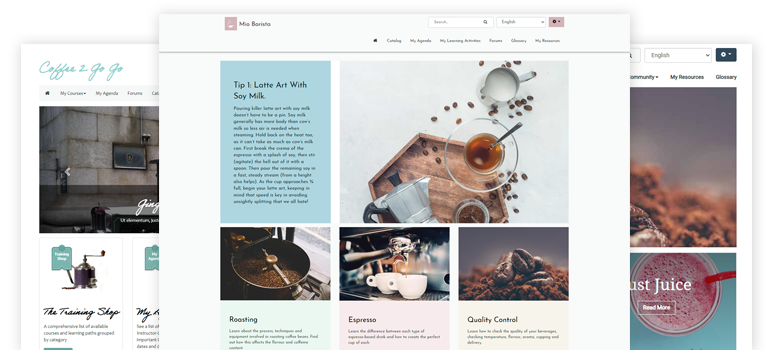


> Thinking Cap delivered for me. It has something for every learner, regardless if they are an employee or customer. A big win in my book.
**Craig Weiss**
CEO and Lead Analyst, The Craig Weiss Group, LLC.
Sell your learning to individuals or in bulk, with a myriad of promotional pricing options through many payment processors.
## Commerce
While most Learning Management Systems allow you to change the logo and palette, Thinking Cap provide full control over your learner journey that goes beyond cookie cutter pages. In fact, did you know you were in the Thinking Cap LMS right now?
[Learn more](https://www.thinkingcap.com/commerce)
Continue your audience’s education through a crediting system, certificates and badges.
## Certification
Certification is complicated. Making sure you can trust in the skills and competencies in your organization is one of the great drivers of LMS adoption. Thinking Cap has served Associations and Highly regulated Medical and Pharmaceutical Organizations for over a decade. This experience shows in the rich Certification tools we can provide.
[Learn more](https://www.thinkingcap.com/certification)
#### Automated Certification
Accreditation and certification program management, including automated re-enrollment and notifications.
#### Credit Issuing and Reporting
Upload videos (MP4s) and Thinking Cap will convert it to a SCORM-compliant elearning course.
#### Certificates of Completion
Customizable certificate templates and control over how they are issued.
#### Open Badges
Grant badges for completing activites or actions with the LMS.
#### Prerequisites
Restrict access to activities until requirements have been met.
Foster communications through automated notifications, announcements, discussion forums and live chat.
## Communication
Every great learner journey is augmented with a communication strategy. Collaboration, knowledge transfer, team building, notifications and reminders.... so are so many reasons to communicate with your learners. What's ever better, is that you can choose to send these messages either by email or SMS.
[Learn more](https://www.thinkingcap.com/communication)
#### Collaboration
Foster cooperation and knowledge transfer using discussion forums, chat rooms, blogs, and more
#### Notifications and digests
Drive completions and next step through emails and text messages at key moments in their learning journey.
#### Announcements and alerts
Ad hoc email messaging to your learners and timeline alerts help keep your audience on track.
Your LMS should not have to live in a vacuum.
## Integration
Wouldn't be nice if we all got along? Well at least you can count on Thinking Cap to play well with others. Below is a comprehensive list of systems we have active integrations with. Don't see what you're looking for, then ask us. It may already be on our roadmap.
[Learn more](https://www.thinkingcap.com/integrations)
#### Webinar providers
Foster cooperation and knowledge transfer using discussion forums, chat rooms, blogs, and more
#### Payment providers
Drive completions and next step through emails and text messages at key moments in their learning journey.
#### Single Sign On (SSO)
Ad hoc email messaging to your learners and timeline alerts help keep your audience on track.
#### Certification (credit reporting)
Ad hoc email messaging to your learners and timeline alerts help keep your audience on track.
#### Content libraries
Ad hoc email messaging to your learners and timeline alerts help keep your audience on track.
#### Learner experience
Ad hoc email messaging to your learners and timeline alerts help keep your audience on track.
#### User synchronization
Ad hoc email messaging to your learners and timeline alerts help keep your audience on track.
#### Cloud services
Ad hoc email messaging to your learners and timeline alerts help keep your audience on track.
Visualize your data through a comprehensive collection of activity or program-wide report options
## Reporting and Analytics
Customize each of your reports and auto-generate them to be sent to a targeted group of users. Simply view them on-screen, print or export your LMS reports as Excel or XML — and you’re ready for reporting success!
[Learn more](https://www.thinkingcap.com/reporting)
Work smarter with automation that takes care of the busywork.
## Intelligent Automation
From enrollments to content delivery and user management, Thinking Cap’s automation engine streamlines your admin workflows—so you can focus on strategy, not repetitive tasks.
[Learn more](https://www.thinkingcap.com/automation)
#### Account Automation
Automate user creation, updates, and deactivation based on your business rules or external system syncs.
#### Activity Management
Streamline the creation, cloning, and scheduling of activities with repeatable, rule-based automation.
#### Enrollments
Auto-enroll learners based on roles, completions, deadlines, or any custom logic you define.
#### Achievements
Trigger certifications, badges, and completions the moment learners hit milestones or finish programs.
#### Communications
Send targeted, automated messages and reminders based on learner progress or system events.
#### Dashboards
Keep teams in the loop with live dashboards and automated report delivery to key stakeholders.
Live up to your ideal privacy and security policies.
## Security
Lock down your LMS security and privacy with our single-sign-on integrations, user permissions, and account and password management.
[Learn more](https://www.thinkingcap.com/integrations)

#### SOC 2 Certified
Independently audited to meet the SOC 2 standard for security, availability, and confidentiality of customer data.

#### Title 21 CFR Part 11
Supports electronic records and signatures in compliance with FDA Title 21 CFR Part 11 requirements.
#### GDPR, PIPEDA & HIPAA Compliant
Fully compliant with GDPR, PIPEDA, and HIPAA standards to ensure learner data privacy, security, and regulatory alignment across healthcare, Canadian, and EU jurisdictions.
#### Information Security
Physical, network and application-level security protocals and compliance.
#### Information Integrity
Policies and procedures in place to to prevent data corruption and unauthorized access.
#### System Availability
Thinking Cap maintains a Service Level Agreement with all clients for 99.9% System uptime.
Delve a little deeper into our comprehensive feature lists
## Thinking Cap Features in Depth
With 385 discreet functions (and growing), Thinking Cap is a robust, dependable and flexible LMS that can deliver everything your company or industry demands of it. Here’s how.
[It grows and changes with you](#accordian1_collapseOne)
- Move Domains in the tree as your organization changes.
- Hold courses, assessments, and learning paths in the global domain and distribute them to individual domains using custom fields matching.
- Share certificates, locations, custom fields, series, locations, activities, and objectives with the entire organization from the global domain.
- Create domains that own their own sets of certificates, locations, custom fields, series, locations, activities, and objectives.
- Gateway to any domain via its own URL.
- Create your own unique look and feel by using Learner View to brand each gateway belonging to your domain. Options include graphics, slideshows, fonts, sizes, colours, and custom CSS and JavaScript.
- Define the categories and sub-categories for learners to browse courses and learning paths in a domain’s learner view.
- Set time zone and time display on a domain-by-domain basis.
- Turn LMS services off or on so that only the LMS functions you need display in the user interface. Just flip them back on when you need them and they become available again.
[You’ll always know what’s happening](#accordian1_collapseTwo)
- View important upcoming events and reminders using the Agenda tab.
- Use My Courses and My Learning Paths to show learners their courses and learning paths according to the following categories: those in which they are actively enrolled; those they have completed; those that have expired, and; those that are currently available to learners for enrollment or purchasing.
- Browse courses, assessments, and learning paths hierarchically by category or sub-category using the Catalogue view.
- View and participate in all your forums and chat rooms in one place using the Social tab.
- Schedule personal availability and set exception weeks to control when a user can be enrolled in an ILT or set as the moderator or teaching assistant for an ILT.
- Search full text of courses, learning paths, and related content.
- Add a personal profile or give permission to share your LinkedIn or Facebook profiles.
- Explore glossaries of terms manually built by administrators or dynamically generated by glossary terms found in imported course packages.
- Use My Learners tab to administer your direct reports without the need to go into the administrative functions of the LMS. This function is perfect for line managers and mentors and includes: enrolling learners in courses; authenticating learners’ activities; proctoring learners’ courses, and; viewing learners’ transcripts.
[You’re in charge of who gets in](#accordian1_collapseThree)
- Assign roles to users at the domain level for targeted control of learning data.
- Add users individually or in bulk from a file.
- Enroll users in courses, assessments, and learning paths individually or in bulk.
- Assign supervisors to learners to define reporting structures beyond the organizational structure of your domain tree.
- View or export learner transcripts for detailed views of learner’s activities.
[The communication is always open](#accordian1_collapseFour)
- Create discussion forums at every learning level, including: global LMS-wide; domain, and; course/learning path levels.
- Provide moderated and non-moderated options.
- Post to forums via email replies.
- Add attachments to forum posts.
- Allow votes for posts and replies.
- See dynamically generated user reputation scores based on vote and viewing tracking.
- View dynamic ordering of posts and replies based on quality score.
- Maintain always-on or scheduled chat rooms at every level, including: global LMS-wide; domain, and; course/learning path levels.
- Use mailboxes for internal messaging.
- Tie internal mailbox to your external email to hide your personal information. (ideal for large classes).
[It’s easy to get paid](#accordian1_collapseFive)
- Set up an integrated shopping cart for selling courses, assessments, and learning paths to learners.
- Clear credit card transactions on the backend via: PayPal; PayPal Payflow; Braintree; Authorize.net; Transactional, or; Internet Secure.
- Conduct transactions in any currency.
- Allow supervisors to purchase for their learners individually or in bulk.
- Set any number of pricing rules, as well as the order in which rules for price reduction and increase apply, based on custom fields.
- Generate tokens for sales via purchase order (PO) and other sales channels.
- View and export sales reports and token usage reports.
- Connect Thinking Cap directly to your accounting system via Web Services for instant access to sales data.
Stay on top of everything with automated notifications
## Notifications by email or SMS
Your Thinking Cap LMS helps you keep an eye on everything with a robust system of 21 notifications, many of which you can select to turn off globally or set on a course-by-course basis. You can even define the text for the subject and body and personalize them with “power tags.”
[Course, Assessment or Learning Path Notifications](#accordian2_collapseOne)
- Purchase notification
- Enrollment notification
- Enrollment request pending notification
- Enrollment declined notification
- Withdrawal approved notification
- Withdrawal declined notification
- Due date reminder (three definable time intervals)
- Past-due notification
- Completion notification
- Accreditation expiry reminder
[eLearning Course Notifications](#accordian2_collapseTwo)
- Assignment submitted receipt
- Assignment reviewed notification
[Instructor-Led Training (ILT) Course Notifications](#accordian2_collapseThree)
- Instructor-Led session is Starting notification (Learner)
- Instructor-Led session is Starting (moderator/teaching assistant)
[Learning Path Notifications](#accordian2_collapseFour)
- Activity completion required reminder
- Evidence document rejected
[Account Notifications](#accordian2_collapseFive)
- Account created notification
- Forgotten password helper
- Password changed by learner notification
[Report Notifications](#accordian2_collapseSix)
- Scheduled report ready notification
- Ad Hoc report ready notification
## Want to find out more?
Book a session today for a personalized demo and Q&A.
[Book a Demo](https://www.thinkingcap.com/Book-a-demo)
---
---
title: Key Benefits
description: Built for training teams who expect more from their LMS
created: 2026-11-19
updated: 2026-11-19
authors: ThinkingCap
topics: [Archive]
status: published
canonical: https://console.thinkingcap.com/guest/Archive/key-benefits
type: page
source_url: "https://www.thinkingcap.com/key-benefits"
scraped: 2026-08-19
order: 60
subtitle: Built for training teams who expect more from their LMS
heroimage: "https://cdn.thinkingcap.com/medialibrary/00000000-0000-0000-0000-000000000000/8ed5673a-d4c1-4484-8171-10700a259ffb/1/8ed5673a-d4c1-4484-8171-10700a259ffb.jpg"
- label: See It in Action
href: "https://www.thinkingcap.com/book-demo"
style: secondary
---

# Key Benefits
Built for training teams who expect more from their LMS
Whether you're managing compliance, selling courses, or rolling out internal training across departments, Thinking Cap helps you do it your way. You get real flexibility, clear control, and support that sticks with you.
[Explore Features](https://www.thinkingcap.com/features)
[See It in Action](https://www.thinkingcap.com/book-demo)
Thinking Cap LMS is designed for teams who need more than a basic box-checking platform. Whether you’re delivering training to a single department or across multiple business units, you’ll get the flexibility to shape the experience around your goals, learners, and brand.
Below are some of the benefits our clients rely on most.
Your brand. Your learners. Their way.
## Learner Experience
Deliver a branded, intuitive experience that supports real learning, not just completion. Thinking Cap’s learner view is fully customizable, so you can create a training space that reflects your organization, meets accessibility standards, and guides each learner clearly.
#### Responsive, branded learner interface
A clean, mobile-friendly layout with your colors, logos, and language.
#### Accessible and inclusive by design
Compliant with WCAG 2.1 AA so every learner can participate confidently.
#### Earn certificates, credits, and badges
Recognize milestones and progress with personalized, downloadable credentials.
#### Stay informed with built-in communication tools
Use targeted announcements, reminders, and optional discussion forums.
#### Create custom pages for learners
Add landing pages, resource hubs, or audience-specific content directly into the learner view.
#### Tailor paths based on roles, tags, or teams
Serve each learner a personalized dashboard with relevant activities, links, and reminders.
**See how learners experience Thinking Cap in the real world.**
Explore how SickKids’ IEMHP built an accessible, branded learner journey, or try it for yourself in a guided demo.
[Read the Sick Kids' IEMHP Story](https://www.thinkingcap.com/blog-sickkids-iemhp-launches-new-website)
[Book a Demo](https://www.thinkingcap.com/book-demo)

Everything you need to build, deliver, and manage training at scale.
## LMS Management & Features
Thinking Cap gives you the **flexibility and control** most platforms can't. From building complex learning paths to automating assignments, managing multiple audiences, and selling your courses, you’ll have the tools to shape your LMS around the way your organization actually works, not the other way around.
#### Create flexible learning paths
Combine SCORM, ILT, videos, quizzes, surveys, and more into structured programs with prerequisites and adaptive logic.
#### Support multiple audiences in one LMS
Serve different brands, departments, or regions with fully segmented user groups, content, settings, and dashboards.
#### Automate tasks and workflows
Trigger enrollments, emails, progress rules, and assignments based on roles, tags, completions, or time-based events.
#### Customize admin roles and permissions
Define exactly who can see, edit, and manage content, reports, and learners with fine-grained access control.
#### Sell courses with advanced commerce tools
Enable individual and group purchases, promo codes, subscription models, and tax-handling with built-in checkout support.
#### Track training impact with detailed reports
Create dashboards, export templates, and schedule reports to monitor progress across programs, teams, and individuals.
#### Integrate with your existing systems
Connect to your HRIS, ERP, webinar platform, or analytics tools using APIs, SSO, and data sync options.
#### Protect data with enterprise-grade security
Control access with role-based permissions, session settings, and SSO — all hosted in secure Canadian data centers.
**Want a closer look at how the platform works behind the scenes?**
Explore the full feature set or book a demo to see how Thinking Cap supports your admins, content, and data.
[Explore Features](https://www.thinkingcap.com/features)
[Book a Demo](https://www.thinkingcap.com/book-demo)

Expert guidance. Responsive support.
## Support & Services
Thinking Cap isn’t a plug-and-play platform where you’re left to figure it out alone. From onboarding to training and beyond, we provide real people, structured guidance, and ongoing mentorship to help your LMS grow with you.
#### Hands-on onboarding and admin training
Start strong with a dedicated setup specialist, guided configuration, and practical launch prep tailored to your use case.
#### Mentorship that goes beyond help tickets
Work with a named support lead who knows your setup, goals, and audience — not a rotating support queue.
#### Responsive help desk and resources
Get quick answers from our support team, plus access to admin documentation, best practices, and training videos.
#### Strategic services when you need them
From content migration to LMS audits and redesigns, we offer optional services to help you scale or reset as you grow.
**Thinking Cap support goes beyond help tickets.**
Learn how we onboard, train, and partner with our clients, or connect with our team to talk about your goals.
[See Our Services](https://www.thinkingcap.com/services)
[Book a Demo](https://www.thinkingcap.com/book-demo)
---
---
title: Multi-Tenant
description: "Define Custom Administrative Roles for your Partners and assign them Roles just in their own Branches Use Inheritance of Branding and other Settings to reduce the Administrative setup time for each new group. Control…"
created: 2025-03-24
updated: 2025-03-24
authors: ThinkingCap
topics: [Archive]
status: published
canonical: https://console.thinkingcap.com/guest/Archive/multi-tenant
cover: https://cdn.thinkingcap.com/medialibrary/00000000-0000-0000-0000-000000000000/90a12c14-2e79-4911-bab5-58aa15a6940c/1/90a12c14-2e79-4911-bab5-58aa15a6940c.jpg
type: page
source_url: "https://www.thinkingcap.com/multi-tenant"
lastmod: 2025-03-24
scraped: 2026-08-19
order: 13
heroimage: "https://cdn.thinkingcap.com/medialibrary/00000000-0000-0000-0000-000000000000/90a12c14-2e79-4911-bab5-58aa15a6940c/1/90a12c14-2e79-4911-bab5-58aa15a6940c.jpg"
---
# Multi-Tenant

### Do you need to host an LMS with many partners each with their own unique needs? Thinking Cap is an LMS structured as a tree of Domains where each domain is almost its own stand alone LMS.
## Features
- Define Custom Administrative Roles for your Partners and assign them Roles just in their own Branches
- Use Inheritance of Branding and other Settings to reduce the Administrative setup time for each new group.
- Control License Use at the Domain level so Partners are constringed in how many resources they use
- Assign Custom URLs to each Partner Domain to allow for Multiple Entry points customized for each Partner.
## FAQ
**Is there a limit to the number of Partner Domains I can create?**
No limit exists. You can create a near endless number of Domains and even create complex Domain tree structures to group Partners together.
**Can Partners See each other?**
Never. When they log in to the LMS Administrators only see the Domains in which they have been assigned Administrative Roles.
**Do I have to give each Domain a unique URL?**
No. While multiple branded gateways is a common pattern we see we see also the single gateway where the domains are used to segment Users and Partner Admins are given their own domain so they can manage their users but where they share the same Learner Experience system wide.
## Want to learn more?
Book a demo to see Multi Tenant solutions in action or to learn how Framework Home Ownership delivers training with more than 100 banking partners or how the Canadian Manufacturing Network hosts Industry spanning programs involving partners who are themselves competitors.
## Ready to take the next step?
Start my free trial!
[Book a demo](https://www.thinkingcap.com/Book-a-demo)
---
---
title: PIPEDA
description: "In today’s digital world, data privacy and security are top concerns for organizations handling sensitive personal information. In Canada, the Personal Information Protection and Electronic Documents Act (PIPEDA)…"
created: 2025-03-24
updated: 2025-03-24
authors: ThinkingCap
topics: [Archive]
status: published
canonical: https://console.thinkingcap.com/guest/Archive/pipeda-compliant
cover: https://www.priv.gc.ca/wet/gcweb-opc/assets/opc-blk-en.png
type: page
source_url: "https://www.thinkingcap.com/pipeda-compliant"
lastmod: 2025-03-24
scraped: 2026-08-19
order: 14
herotitle: Personal Information Protection and Electronic Documents Act (PIPEDA)
subtitle: Your PIPEDA-Compliant Learning Solution
heroimage: "https://cdn.thinkingcap.com/medialibrary/00000000-0000-0000-0000-000000000000/023697fa-127e-42f4-b89c-143f58d1754e/1/023697fa-127e-42f4-b89c-143f58d1754e.jpg"
---
## Why PIPEDA Compliance Matters for Canadian Organizations

In today’s digital world, data privacy and security are top concerns for organizations handling sensitive personal information. In Canada, the **Personal Information Protection and Electronic Documents Act (PIPEDA)** governs how businesses collect, use, and disclose personal data. Organizations choosing a Learning Management System (LMS) must ensure that their platform complies with PIPEDA to protect learner data and meet regulatory requirements.
Thinking Cap LMS is designed with data privacy and security in mind. We ensure **full PIPEDA compliance**, allowing organizations to train their employees, students, and partners with confidence.
So what's required to ensure PIPEDA Compliance?
## From Compliance Awareness to Action
Understanding why PIPEDA compliance matters is only the first step. The next crucial consideration is how organizations can ensure compliance while maintaining seamless training experiences. By adopting the right LMS—one that is built with privacy, security, and transparency at its core—businesses can confidently meet their obligations under PIPEDA. Below, we outline how Thinking Cap LMS integrates key compliance features to safeguard personal information and uphold the highest standards of data protection.
### 1. Data Residency: Keeping Your Information in Canada
While PIPEDA does not explicitly require data to be stored in Canada, organizations in government, healthcare, and financial services often mandate Canadian data residency to mitigate risks associated with foreign data access laws, such as the U.S. CLOUD Act.
According to Section 4.1.3 of PIPEDA, "personal information that is transferred to a third party for processing remains the responsibility of the organization that transferred it." By keeping data within Canadian jurisdiction, organizations maintain stronger control over compliance and security.
#### Secure Canadian Data Hosting
Thinking Cap LMS hosts data in secure Canadian data centers, ensuring that sensitive learner information remains under Canadian jurisdiction.
### 2. Secure Data Collection and Storage
Under PIPEDA, organizations must limit the collection of personal data to what is strictly necessary for the intended purpose and ensure it is stored securely to prevent unauthorized access or misuse.
According to Section 4.4 of PIPEDA, "organizations shall not collect personal information indiscriminately; both the amount and the type of information shall be limited to that which is necessary for the identified purposes."
#### Role-based data access
Thinking Cap LMS allows role-based data collection, ensuring that only relevant user information is gathered.
#### Secure data transfer
Encryption in transit and at rest protects user credentials, learning history, and other sensitive information.
#### Custom metadata retention
Organizations can define custom data retention policies to meet compliance needs.
### 3. User Consent & Transparency
PIPEDA requires organizations to obtain clear and informed consent before collecting, using, or disclosing personal data, ensuring individuals understand how their information will be handled. As stated in Section 4.3 of PIPEDA, "the knowledge and consent of the individual are required for the collection, use, or disclosure of personal information, except where inappropriate."
#### Customizable consent forms
Thinking Cap LMS provides customizable consent forms, ensuring that users explicitly agree to data collection and privacy policies.
#### Transparent privacy settings
Privacy settings are transparent, allowing learners to understand how their data is used.
#### Easy privacy policy updates
Administrators can easily update privacy policies and require renewed consent when necessary.
### 4. User Access and Data Control
Under PIPEDA, individuals have the right to access their personal data and request corrections if the information is inaccurate, incomplete, or outdated. Section 4.9 of PIPEDA states, "upon request, an individual shall be informed of the existence, use, and disclosure of their personal information and shall be given access to that information."
#### Learner data access
Thinking Cap LMS allows learners to view their stored data within their profiles.
#### Quick data retrieval
Administrators can quickly retrieve user data and provide exports upon request.
#### Self-service profile updates
Learners can update personal information (e.g., email, name, preferences) without IT intervention.
### 5. Data Protection and Security Measures
PIPEDA mandates that organizations implement strong security measures to protect personal information from unauthorized access, breaches, and misuse by employing robust administrative, physical, and technological safeguards. Section 4.7 of PIPEDA states, "personal information shall be protected by security safeguards appropriate to the sensitivity of the information."
#### Multi-factor authentication (MFA)
Adds an extra layer of security for login access.
#### Granular access controls
Granular role-based permissions ensure that only authorized personnel can access sensitive learner data.
#### Regular security audits
Security audits and vulnerability testing maintain system integrity and prevent breaches.
### 6. Data Breach Notification & Incident Response
In the event of a data breach, PIPEDA requires organizations to notify affected individuals and the Privacy Commissioner of Canada if there is a risk of significant harm resulting from the incident.
According to the Breach of Security Safeguards Regulations under PIPEDA, "organizations must determine the real risk of significant harm based on factors such as the sensitivity of the information and the likelihood of misuse." PIPEDA, organizations must **limit the collection of personal data** to what is necessary and ensure it is stored securely.
#### Automated breach alerts
Thinking Cap LMS includes automated breach detection alerts and logs security events.
#### Dedicated incident response
Our incident response team ensures that breaches are handled swiftly and in compliance with Canadian laws.
#### Detailed audit logs
Administrators can generate detailed audit logs to track data access and modifications.
### Secure Your Training with a PIPEDA-Compliant LMS
Ensuring data privacy and compliance is critical for any organization using an LMS. With **Thinking Cap LMS**, you get a secure, flexible, and fully PIPEDA-compliant learning platform that protects your learners’ personal information while delivering an exceptional training experience.
---
---
title: Guest Probe
description: ""
created: 2026-11-19
updated: 2026-11-19
authors: ThinkingCap
topics: [Archive]
status: published
canonical: https://console.thinkingcap.com/guest/Archive/probe-guest-mu3a9v22
type: page
order: 67
---
# Guest Probe
---
---
title: Quick Tour
description: Demonstration of Thinking Cap
created: 2025-03-24
updated: 2025-03-24
authors: ThinkingCap
topics: [Archive]
status: published
canonical: https://console.thinkingcap.com/guest/Archive/quicktour
type: page
source_url: "https://www.thinkingcap.com/quicktour"
lastmod: 2025-03-24
scraped: 2026-08-19
order: 16
subtitle: Demonstration of Thinking Cap
heroimage: "https://cdn.thinkingcap.com/medialibrary/00000000-0000-0000-0000-000000000000/8c83c74f-e7c5-41eb-8834-dbcffc044f0a.jpg"
---

# Quick Tour
Demonstration of Thinking Cap
Thinking Cap is happy to share a quick tour of our learning management system. Watch this video to learn more about the features and explore the possibilities.
## Start watching...
Skip hours of phones calls and emails with sales people just to see what the LMS looks like. We won't make you do that!
Sit back and relax while we walk you through a quick overview of the Thinking Cap LMS.... Right here, right now.
```feature
icon: tools
title: Admin View
description: Navigating our LMS's administrative view
```

#### Activities
Managing activities and enrollments
```feature
icon: users
title: Users
description: Managing user accounts
```
```feature
icon: video
title: Resources
description: Managing media and other resources
```
```feature
icon: chart-line
title: Reports
description: Available report templates
```
```feature
icon: comments
title: Communications
description: Discussion forums, notifications and more
```
```feature
icon: plus
title: More
description: And so much more...
```
Quick Tour
## Thinking Cap LMS Administrator's Demo
[](https://stable.b-cdn.net/medialibrary/00000000-0000-0000-0000-000000000000/intro.mp4)
## Want to find out more?
Book a session today for a personalized demo and Q&A.
[Book a Demo](https://www.thinkingcap.com/Book-a-demo)
---
---
title: Reporting and Analytics
description: Visualize your data through a comprehensive collection of activity or program-wide report options.
created: 2026-11-19
updated: 2026-11-19
authors: ThinkingCap
topics: [Archive]
status: published
canonical: https://console.thinkingcap.com/guest/Archive/reporting
type: page
source_url: "https://www.thinkingcap.com/reporting"
scraped: 2026-08-19
order: 70
subtitle: Visualize your data through a comprehensive collection of activity or program-wide report options.
heroimage: "https://thinkingcap.blob.core.windows.net/learnerview/00000000-0000-0000-0000-000000000000/advanced/banner-reporting.jpg"
---

# Reporting and Analytics
Visualize your data through a comprehensive collection of activity or program-wide report options.
Finding the “best” learning management system (LMS) reporting tools are useless if they can’t meet the specific data needs of your business. After all, what’s the use of reporting and analytics if you can’t act on them?
That’s why our LMS reports are completely customizable! View learner activity, analyze descriptive data pertaining directly to your organization, track employee training and more through one-of-a-kind reporting tools.
Most importantly, you can customize each of your reports and auto-generate them to be sent to a targeted group of users. Simply view them on-screen, print or export your LMS reports as Excel or XML — and you’re ready for reporting success!
## What is LMS reporting?
An LMS is designed to streamline eLearning for administrators, users and learners alike. LMS reporting is the tool that allows you to leverage that information to collect valuable insight. It specifically shows you who’s using the platform, how they’re using it and ways to improve.
Thinking Cap collects the metrics that matter for your company to give a clear insight into what will drive success for your online training and accreditation. Data can be cut and dry, but intuitive reporting features are the key to optimizing the learning experience — and your bottom line.
Advanced reporting tools at your fingertips
## Comprehensive report templates
Thinking Cap’s inbuilt learning analytics engine gives a deeper insight into your learning program so that you can demonstrate value and support key decisions with accurate data. Our reporting system allows you to efficiently track training, its effectiveness and engagement in real-time.
Explore our various reports.
```feature
icon: check-circle
title: Completion Report
description: This report provides information on the completion status for learners in an activity or learning path. This includes their completion results (score and success) and selected information about these learners.
```

#### System Access Report
The System Access Report allows LMS owners to filter specific results for learner activity. Discover how learners are using the system, how often and more. Target individuals and groups with this report to take a deeper look into system use and traffic patterns.
```feature
icon: users
title: Demographic Report
description: The System Access Report allows LMS owners to filter specific results for learner activity. Discover how learners are using the system, how often and more. Target individuals and groups with this report to take a deeper look into system use and traffic patterns.
```
```feature
icon: cash-register
title: E-Commerce Report
description: These reports give a list of courses purchased by selected learners or a list of learners in the selected domains.
```
```feature
icon: award
title: Certification Expiry Report
description: These reports give a list of courses purchased by selected learners or a list of learners in the selected domains.
```
```feature
icon: wallet
title: Global Tokens Report
description: These reports give a list of global tokens created or redeemed by the selected users.
```
```feature
icon: clipboard-check
title: Prerequisites Report
description: Easily generate a report on which users have completed the prerequisites for the selected courses or learning paths. Additionally, this report can be used to showcase which courses and learning paths are available to specific users based on the prerequisites they have already completed.
```
```feature
icon: signature
title: Demonstration Authentication Report
description: These reports give a list of sign-off activities for the selected learning paths, learners who completed them and whoever signed off for each activity.
```
```feature
icon: robot
title: Exceptions Report
description: Track users’ progress and see what users completed a course in a certain time interval or with a specified score.
```
Recipients, data to include, cadence
## Customize your reports
Thinking Cap's reports are highly customizable. Once you have chosen a template, further apply one of the following customizations.
```feature
icon: check-circle
title: Recipients
description: Reports need to be disseminated to a variety of audiences. Select different recipients for each report.
```

#### Data options
Each report's dataset is different. What you need may only be a part of what is available, or perhaps add some of your custom data, either way, you end up with the report you want.
```feature
icon: users
title: View, print, export
description: Our streamlined system enables owners to seamlessly view reports on-screen, print or export them as Excel or XML.
```
## Advantages of LMS reporting
Thinking Cap LMS empowers you to make the most of your training programs. It gives you:

Seamless [integration](https://www.thinkingcap.com/integrations) capabilities

Clear-cut performance metrics

[Branding segmentation](https://www.thinkingcap.com/experience)

Data-driven insights into learner engagement

Up-to-date [certification](https://www.thinkingcap.com/certification)

An all-in-one, streamlined learning platform.
## Why does LMS reporting matter?
Data is the heart of good business, but what use does it have if you don’t know what you’re looking at?
LMS reporting is the jumping point between collecting important data and making actionable decisions to drive success. With Thinking Cap LMS, you can paint a detailed picture, with quantifiable data, of all the ways your learning and accreditation programs are affecting your company. Without an LMS, you can’t do that.
Right and left, new regulations, skillsets and expectations are being thrust upon all industries — and if you and your employees can’t keep up, you’ll be left behind.
It’s not enough to simply collect system-wide numbers and metrics unless they act in service to your business goals and needs. If you’re only as strong as your weakest link, LMS reporting can help you identify that pain point and address the issue from the start. With advanced reporting tools, employers can also pinpoint trends and patterns as they occur, boosting employee engagement and effectiveness.
You may want an LMS that simply does its job, but you need an LMS that teaches you to make the most of its capabilities.
Fundamentally, LMS reporting is the key to not only keeping up with the market but actively taking the lead.
## Chat one-on-one with Thinking Cap
It’s easy to point at our advanced reporting tools, throw around adjectives like “vital” and tell you that “you need this!” But seeing is believing — so let us walk you through it. Speak with our team, and we can show you that the proof is in the actual system.
Reach out today and [book a demo](https://www.thinkingcap.com/Book-a-demo).
## Want to find out more?
Book a session today for a personalized demo and Q&A.
[Book a Demo](https://www.thinkingcap.com/Book-a-demo)
---
---
title: Resources
description: Use our comprehensive list of industry conferences to plan your professional development. Speak. Listen. Attend. All the important dates are here.
created: 2025-03-24
updated: 2025-03-24
authors: ThinkingCap
topics: [Archive]
status: published
canonical: https://console.thinkingcap.com/guest/Archive/resources
cover: https://thinkingcap.blob.core.windows.net/demolearnerview/00000000-0000-0000-0000-000000000000/advanced/banner_resources.jpg
type: page
source_url: "https://www.thinkingcap.com/resources"
lastmod: 2025-03-24
scraped: 2026-08-19
order: 18
herotitle: Helpful Resources
heroimage: "https://thinkingcap.blob.core.windows.net/demolearnerview/00000000-0000-0000-0000-000000000000/advanced/banner_resources.jpg"
---
# Helpful Resources

### At Thinking Cap, we’re committed to our community. That’s why we’ve put together a wealth of resources that can help boost your knowledge, skills and confidence, whether you’re new to the industry or a veteran of the trade. Take a moment to explore topics that cover technology, networking, conferences, best practices, training and awards.
## Conference listing
Use our comprehensive list of industry conferences to plan your professional development. Speak. Listen. Attend. All the important dates are here.
[Conferences](https://www.thinkingcap.com/conferences)
## Join an eLearning organization
Discover a friendly and informative eLearning community near you or around the world.
[Organizations](https://www.thinkingcap.com/organizations)
## Advancement of best practices in public education
We believe that public education has an important role to play in bringing positive change to the world. To help create that change, we want to give Thinking Cap to educators who want to try new things and deliver innovative content to our children, focusing especially on at-risk children and those with dyslexia.
[Giving Back](https://www.thinkingcap.com/giving)
## Explore instructional design programs
Thinking Cap is the premier tool set for online learning, but it relies on smart and creative instructional designers to give it content. Check out our list of instructional design programs to help you train and update your skills.
[Instructional Design Programs](https://www.thinkingcap.com/Instructional-Design-Programs)
## Learn about Title 21 CFR Part 11
See how Thinking Cap works closely with members of the medical community to craft a Title 21 CFR Part 11 strategy.
[Title 21 CFR Part11](https://www.thinkingcap.com/Title21-CFR-Part11)
## Win an eLearning Award
Do you have what it takes to win an eLearning award? Get the recognition you deserve with some of our industry’s most prestigious awards.
[Awards](https://www.thinkingcap.com/awards)
## Ready to take the next step?
Start my free trial!
[Book a demo](https://www.thinkingcap.com/Book-a-demo)
---
---
title: Sell Your Learning
description: "Integration with National and International, Payment Gateways like Pay Pal, Authorize.Net, BrainTree, GOPI, HSBC, Moneris, Transnational and others. Support for multiple Currencies and Taxation. Pricing Rules based on…"
created: 2025-03-24
updated: 2025-03-24
authors: ThinkingCap
topics: [Archive]
status: published
canonical: https://console.thinkingcap.com/guest/Archive/selling
cover: https://cdn.thinkingcap.com/medialibrary/00000000-0000-0000-0000-000000000000/3c5d3ce3-5cd6-4a4e-beef-7123bf612326/1/3c5d3ce3-5cd6-4a4e-beef-7123bf612326.jpg
type: page
source_url: "https://www.thinkingcap.com/selling"
lastmod: 2025-03-24
scraped: 2026-08-19
order: 20
herotitle: Selling Learning
heroimage: "https://cdn.thinkingcap.com/medialibrary/00000000-0000-0000-0000-000000000000/3c5d3ce3-5cd6-4a4e-beef-7123bf612326/1/3c5d3ce3-5cd6-4a4e-beef-7123bf612326.jpg"
---
# Selling Learning

### Many Learning Projects are around generating income. If you are an established eLearning Marketplace or looking to become one Thinking Cap can support you. Thinking Cap gives you the tools you need out of the box to design an excellent Learning Retail environment. And when there is money involved security must to top notch. Thinking Cap is hosted exclusively in PCI Level 1 and SOC2 Certified DataCenters.
## Features
- Integration with National and International, Payment Gateways like Pay Pal, Authorize.Net, BrainTree, GOPI, HSBC, Moneris, Transnational and others.
- Support for multiple Currencies and Taxation.
- Pricing Rules based on User Custom Fields or Dates with the ability to apply multiple discounts
- Support for any commerce model including Bunded Sales, Buy for Others, Passes, Subscriptions, Coupons and Tokens.
- Integrated Sales and Registration to get Customers signed up and into he system quickly.
- Integration with SalesForce so LMS customers flow into your central Sales Management System.
- Simple Self-Serve Sales Reporting
## FAQ
**Do I have to use your Shopping Basket if I want to sell courses?**
No. While we have a low friction buying process built into he LMS we can easily integrate with your existing Shopping Basket and pass sale there.
**Do you store Credit Cards?**
No. In keeping with PCI standards the customer credit card is never stored on our servers.
**Are there any costs in addition to my license if I want to sell on the Thinking Cap platform?**
No. Many LMS charge for Commerce as an add-on module or take a small fee for each transaction. Thinking Cap does not.
## Ready to take the next step?
Start my free trial!
[Book a demo](https://www.thinkingcap.com/Book-a-demo)
---
---
title: SOC2
description: Certified Service Organization Control 2 LMS
created: 2025-03-24
updated: 2025-03-24
authors: ThinkingCap
topics: [Archive]
status: published
canonical: https://console.thinkingcap.com/guest/Archive/soc2
type: page
source_url: "https://www.thinkingcap.com/soc2"
lastmod: 2025-03-24
scraped: 2026-08-19
order: 22
herotitle: SOC 2 Certification
subtitle: Certified Service Organization Control 2 LMS
heroimage: "https://cdn.thinkingcap.com/medialibrary/00000000-0000-0000-0000-000000000000/4e2184ae-c4db-4ada-8989-5bb9ee757419.jpg"
---

# SOC 2 Certification
Certified Service Organization Control 2 LMS
Thinking Cap’s SOC2-certification builds on our commitment to data security and privacy. Every LMS admin knows that maintaining your trust is about the everyday measures we put in place to protect your information.

Understanding the certification
## What is SOC2 Compliance?
SOC 2, or Service Organization Control 2, is crucial for a Learning Management System (LMS) due to the inherent significance of security, confidentiality, integrity, and privacy in an educational environment. A SOC 2 report ensures that the LMS has implemented robust controls and safeguards to protect sensitive student data, such as personal information, grades, and learning progress. By adhering to SOC 2 standards, an LMS demonstrates its commitment to maintaining the privacy and security of student records and preventing unauthorized access or data breaches.
Why Thinking Cap LMS is certified
## The importance of certification
This certification instills confidence in educational institutions, teachers, students, and parents, assuring them that the LMS platform they are using meets stringent industry standards for data protection. Additionally, SOC 2 compliance also promotes accountability and transparency, as it requires the LMS provider to regularly assess and improve their security practices, ensuring the ongoing protection of student information throughout their learning journey.
Thinking Cap serves diverse audiences that include sensitive corporate information as well as at-risk populations of Children and Patients. Thinking Cap has always been a leader in the EdTech community and our efforts in obtaining our SCO2 Type 1 underscore this commitment.
Our SOC2 is available to clients and prospects under NDA. For more information, please contact security@thinkingcap.com.
The many steps to achieving certification
## SOC 2 Certification Process
Obtaining a SOC 2 certification involves several key steps. While the specific process may vary depending on the organization and the chosen certification body, here are some general steps typically involved in getting a SOC 2.
```feature
icon: image
title: Define Scope
description: Determine the scope of the SOC 2 assessment, identifying the systems and services that will be evaluated for compliance.
```
```feature
icon: list-alt
title: Select Trust Services Criteria (TSC)
description: Choose the applicable Trust Services Criteria for the SOC 2 report. The TSC includes security, availability, processing integrity, confidentiality, and privacy.
```
```feature
icon: arrows-alt-h
title: Perform Gap Analysis
description: Conduct a thorough gap analysis to assess the current state of your organization's controls and identify areas that need improvement to meet the TSC requirements.
```
```feature
icon: bullseye
title: Develop Controls
description: Develop and implement controls and procedures to address any gaps identified during the gap analysis. These controls should align with the selected TSC.
```
```feature
icon: book-open
title: Documentation and Policies
description: Create comprehensive documentation and policies that outline the controls, procedures, and processes implemented to meet the TSC requirements.
```
```feature
icon: check
title: Testing and Evaluation
description: Perform testing and evaluation of the controls to ensure they are operating effectively and in compliance with the TSC. This may involve conducting internal audits or engaging a third-party auditor.
```
```feature
icon: sync-alt
title: Remediation
description: Address any identified issues or deficiencies through remediation activities. This may include implementing additional controls or improving existing ones.
```
```feature
icon: check-double
title: Readiness Assessment
description: Conduct a readiness assessment to evaluate the organization's preparedness for the SOC 2 audit. This step helps identify any remaining gaps or areas for improvement before the formal assessment.
```
```feature
icon: user-shield
title: Select an Auditor
description: Choose an independent, qualified auditor to perform the SOC 2 examination. The auditor should be experienced in conducting SOC 2 assessments and have the necessary expertise in the relevant industry.
```
```feature
icon: microscope
title: SOC 2 Examination
description: Undergo the SOC 2 examination conducted by the chosen auditor. The examination involves testing the effectiveness of controls and verifying compliance with the selected TSC.
```
```feature
icon: circle-check
title: Receive SOC 2 Report
description: Once the examination is complete, the auditor will issue a SOC 2 report. This report includes an opinion on the organization's controls and their compliance with the TSC. There are two types of SOC 2 reports:Type I, which assesses the design of controls, and Type II, which evaluates the operating effectiveness of controls over a specified period.Type I, which assesses the design of controls, and Type II, which evaluates the operating effectiveness of controls over a specified period.
```
---
---
title: Employee Training and Compliance
description: But not everything is prescriptive. For self discovery Thinking Cap supports the creation of custom catalogues, again with many options for configuration and filtering.
created: 2025-03-24
updated: 2025-03-24
authors: ThinkingCap
topics: [Archive]
status: published
canonical: https://console.thinkingcap.com/guest/Archive/Solutions---old/compliance
cover: https://cdn.thinkingcap.com/medialibrary/00000000-0000-0000-0000-000000000000/9938be8f-cf70-42d2-8844-623ef94fe4fa/1/9938be8f-cf70-42d2-8844-623ef94fe4fa.jpg
type: page
source_url: "https://www.thinkingcap.com/compliance"
lastmod: 2025-03-24
scraped: 2026-08-19
order: 16
heroimage: "https://cdn.thinkingcap.com/medialibrary/00000000-0000-0000-0000-000000000000/9938be8f-cf70-42d2-8844-623ef94fe4fa/1/9938be8f-cf70-42d2-8844-623ef94fe4fa.jpg"
---
# Employee Training and Compliance

### Training your staff is one of the primary uses of any LMS. But all LMS are not created equal. Thinking Cap is capable of onboarding tens of thousands of users a day and making sure each gets enrolled into the right Activities based on User Custom Fields and Sophisticated and Reusable Rule sets.
But not everything is prescriptive. For self discovery Thinking Cap supports the creation of custom catalogues, again with many options for configuration and filtering.
And once a user is enrolled and completed their work we can set a Certification Period for a group of Activities or a single one and maintain a notification period as well so Learners can reenroll in items before they expire. We can trigger autoenrollment based on a date in the Learner’s profile. We can also stager enrollments so groups of users get enrolled at the same time. Working with our clients, and in particular, with Amazon we have created the most robust Enrollment systems available in an LMS.
## Features
- Reusable Rules for Enrollment including Exclusion Rules and Auto Withdrawal Rules.
- Advanced Certification Management and Reporting
- Multiple configurable Notifications to drive Learners to Completion
- Many Activity Types and the ability to create your own custom types.
- Learning Paths to create elaborate curriculum
- Custom Surveys and Feedback
## FAQ
**Can I have multiple ways for a Learner to achieve my objectives?**
Yes, Equivalencies allow for many ways for many Activities to stand in for a single objective. Equivalences also reduce the management time updating Learning Paths when new instances of ILTs are created.
**How many Learners can Thinking Cap manage in a single instance?**
We have clients with a few thousand learners and some with well over a million. The Scaling Thinking Cap is capable of means no limit to the size organization we can manage or the number of simultaneous accesses we can support.
**Can individual Supervisors be involved in the Learning life of their direct reports?**
Absolutely, we have tools for Supervisors to have complete visibility over their learners and to assign adhoc training as required. In addition, all reports can be cc’d to supervisors and Supervisors can get weekly or month digests of Learner progress.
## Want to learn more?
Sign up for a Demo to learn how Amazon uses Thinking Cap to mage over 40 distinct departments worldwide or how California and the Association for Regional Centers delivers training to those safeguarding mental health.
## Ready to take the next step?
Start my free trial!
[Book a demo](https://www.thinkingcap.com/Book-a-demo)
---
---
title: Contact Us
description: "If you’ve got a question, comment or would like to set up a demo, get in touch. We’d love to hear from you."
created: 2025-03-24
updated: 2025-03-24
authors: ThinkingCap
topics: [Archive]
status: published
canonical: https://console.thinkingcap.com/guest/Archive/Solutions---old/contact-us
cover: https://thinkingcap.blob.core.windows.net/learnerview/00000000-0000-0000-0000-000000000000/advanced/banner_contact.jpg
type: page
source_url: "https://www.thinkingcap.com/contact-us"
lastmod: 2025-03-24
scraped: 2026-08-19
order: 15
---
# Contact Us

## Let’s talk
If you’ve got a question, comment or would like to set up a demo, get in touch. We’d love to hear from you.
[416-977-4675](tel:416-977-4675) local
[1-800-975-5492](tel:1-800-975-5492) toll-free in North America
[sales@thinkingcap.com](mailto:sales@thinkingcap.com)
## Ready to take the next step?
Start my free trial!
[Book a demo](https://www.thinkingcap.com/Book-a-demo)
---
---
title: GDPR Compliance
description: We are partners in compliance with GDPR
created: 2025-03-24
updated: 2025-03-24
authors: ThinkingCap
topics: [Archive]
status: published
canonical: https://console.thinkingcap.com/guest/Archive/Solutions---old/gdpr-compliance
type: page
source_url: "https://www.thinkingcap.com/gdpr-compliance"
lastmod: 2025-03-24
scraped: 2026-08-19
order: 19
herotitle: GDPR-Compliance
subtitle: We are partners in compliance with GDPR
heroimage: "https://cdn.thinkingcap.com/medialibrary/00000000-0000-0000-0000-000000000000/c9a29e19-2bec-416e-a0f5-746d92c4d69c/1/c9a29e19-2bec-416e-a0f5-746d92c4d69c.jpg"
---

# GDPR-Compliance
We are partners in compliance with GDPR
Thinking Cap is committed to protecting your business and your data. As your data processor, we ensure that your information is safeguarded responsibly against inappropriate disclosure in an accurate, timely and attributable manner, and made available to those who should be available to access it.
We are continuing to build on our existing, robust data privacy practices in order to continue catering to our clients and providing them with effective solutions, whilst supporting data privacy practices. We also provide our clients with the tools and knowledge to be GDPR compliant with their customers.
## What is the GDPR Compliance?
GDPR stands for the General Data Protection Regulation. The GDPR is the new European Union (“EU”) law that regulates the personal data of individuals in the EU. It replaces the EU Data Protection Directive, the EU’s current privacy law, which was been in place since 1995. The GDPR harmonises data protection law across Europe and introduces sweeping changes that require companies to make significant updates to their privacy and security policies and practices. It was enforced on May 25, 2018.
The very definition of personal data has changed, EU. Personal data is defined as any type of information that identifies or can be linked to an individual. Below are six categories to be aware of.
```feature
icon: calendar
title: Historical
description: An individual’s history
```
```feature
icon: money-bill
title: Financial
description: Financial accounts, ownership, transactions or credit information.
```
```feature
icon: share-alt
title: Social
description: Personal or professional networks, family members, public life and communication.
```
```feature
icon: map-marker
title: Tracking
description: Computer devices, contacts and location.
```
```feature
icon: external-link
title: External
description: Identifying information including ethnicity, sexuality, behavior, medical history, etc.
```
```feature
icon: external-link
title: Internal
description: Knowledge and beliefs, passwords and identifiers and personal preferences.
```
## New Rights customers have under GDPR
```feature
icon: envelope-open-text
title: Breach Notification
description: Notified about data breaches in a more timely manner, within 72 hours.
```
```feature
icon: universal-access
title: Right to Access
description: Customers have a right to access all data, free of charge.
```
```feature
icon: eraser
title: Right to be Forgotten
description: Ability to request erasure of all collected personal data.
```
```feature
icon: share-alt
title: Data Portability
description: Customers can request that data be changed into a usable format to transmit to another provider.
```
```feature
icon: key
title: Privacy by Design
description: Expectation that providers will minimize data collection, retaining only what’s essential for task completion.
```

##### Data Collection Officer
Standardization of record keeping, and the potential appointment of a Data Protection Representative.
## New Requirements For Organizations
```feature
icon: map-pin
title: Increased Geographic Scope
description: The new rules apply to any entity dealing with customers located in the European Union. It no longer matters where your company is located.
```

##### Higher Penalties
Non-compliance is expensive, with fines totaling up to 4% of annual global turnover or 20 Million Euros, whichever is greater.
```feature
icon: handshake
title: Required User Consent
description: Stronger consent requirements, and greater rights for individuals, mean significant planning for those collecting data.
```
## Reach Out
At Thinking Cap, it is of vital importance to fulfill our privacy and data security commitments. If you have any questions about how Thinking Cap can help you with compliance, or you have any privacy-related concerns, please reach out by contacting us at: [gdpr@thinkingcap.com](mailto:gdpr@thinkingcap.com).
---
---
title: Engaging training programs
description: Making learners want to learn more and more.
created: 2026-11-19
updated: 2026-11-19
authors: ThinkingCap
topics: [Archive]
status: published
canonical: https://console.thinkingcap.com/guest/Archive/solutions-engaging-training-programs
type: page
source_url: "https://www.thinkingcap.com/solutions-engaging-training-programs"
scraped: 2026-08-19
order: 52
subtitle: Making learners want to learn more and more.
heroimage: "https://cdn.thinkingcap.com/medialibrary/00000000-0000-0000-0000-000000000000/59b2f60b-992d-4b2c-854f-9d42149215de/1/59b2f60b-992d-4b2c-854f-9d42149215de.jpg"
---

# Engaging training programs
Making learners want to learn more and more.
Boosting employee engagement is the key to unlocking your team’s potential and driving organizational success. By making learning exciting and relevant, you can transform your workforce into a powerhouse of motivated and skilled individuals.
Objective
## Improve learner engagement
According to Gartner HR, employees who are engaged at work are more likely to stay, put in the extra effort and contribute more. Yet almost 70% of employees don't feel engaged. It's no wonder that organizations are looking for new ways to help re-energize and connect with their employees.
Designing a more dynamic training program, with gamification and interactivity, aims to boost employee engagement and encourage active participation. These initiatives cultivate a culture of continuous learning and growth. Immersive experiences inspire learners to seek out more learning opportunities, and drive their professional development.

Experience
## Ideal journey
While an LMS may not inherently make your content more engaging, it can enhance the overall learning experience by making it more collaborative and gamified. Consider an approach that captivates your learners and guides them in accessing additional support resources effectively.
### Step 1

#### Learner receives hook email
*The learner is enrolled in a learning path and sent an automated enrollment notification. The content of the email should be written as a hook, drawing them into the content.*
### Step 2

#### Learner views the learning path
*The learner views the learning path with a creative theme and contains various microlearning activities, from videos, skill demonstrations, elearning courses, etc.*
### Step 3

#### Learner completes the first activity
*After completing the first activity, the learner is awarded learning points and a badge. They are then given a hint to the password to unlock the next activity.*
### Step 4

#### Learner unlocks the second activity
*After solving the clue, the learner enters the password and enters the second activity.*
### Step 5

#### Learner completes the second activity
*After completing the second activity, the learner is awarded learning points and a badge. They are then given a hint to the password to unlock the next activity.*
### Step 6

#### Learners view their rankings
*Learner views the leaderboard on the LMS home page to see where they rank against their fellow learners.*
### Step 7

#### Learner seeks help in the forums
*Learner posts in the forums asking for help to solve the clue for the password to unlock the third activity.*
### Step 8

#### Learner completes the third activity
*After completing the third activity, the learner is awarded learning points and a badge. They are then given a hint to the password to unlock the next activity.*
### Step 9

#### Learner collaborates with other learners
*The learner connects with other learners taking the same learning path to solve the clue for the password to unlock the fourth activity.*
### Step 10

#### Learner completes the fourth activity
*After completing the fourth activity, the learner is awarded learning points and a badge. They are then given a hint to the password to unlock the next activity.*
### Step 11

#### Learner connects with their mentor
*The learner messages their mentor to get help solving the clue for the password to unlock the last activity.*
### Step 12

#### Learner completes the last activity
*After completing the last activity, the learner is awarded learning points and a badge.*
### Step 13

#### Learner completes the learning path
*After completing the last activity, the learner has completed the learning path and is awarded a stacked badge, certificate of completion and a reward (i.e., 3-month gym membership or free coffee coupon).*
### Step 14

#### Learner is presented with recommendations
*After completing the learning path, recommendations appear for which activities to start next.*
Implementation
## Thinking Cap LMS features make this possible

#### Learning paths
Bundle all of the onboarding activities, regardless of the type of activity, into a learning path, presenting employees with a clear road to completion.

#### Activity types
Create a variety of different types of activities from elearning and in-person/webinars ILT essions to videos, PowerPoint, skill demonstration, comprehension, external training and more.

#### Enrollmentnotification
Customize your enrollment notification to send an email to your learner that entices them into the LMS to start the learning path.

#### Learner view customizations
Customize the layout of your learning path to include themes from your content.

#### Learning points
Award different types of learning points (i.e. topic-based, skill-based) upon completion of content that helps assess how much content they have consumed.

#### Badges
Award custom badges upoming completing an activity that may be shared to LinkedIn and other platforms. (Note: OpenBadge-compliant)

#### Access codes
Lock activities so a passcode is required to access the activity.

#### Leanderboards
Display a ranked list of learners based on their performance metrics, such as points earned, badges achieved, or progress made in courses.

#### Forums
Add a forum to your learning path to encourage collaboration between learners, allowing them to post questions and answers. Particpation improves your forum reputation score.

#### Collaboration
Allow learners to collaborate directly by sending requests to fellow learners and messaging withthem once approved.

#### Connections
Automatically pair your learners with mentors and coaches to nurture their development and encourage continuous growth.

#### Certificate
Customize your certificte templates, which generates a PDF for each learner as they complete the activity.

#### Rewards
Integrate with a reconition and reward service to provide rewards to learners as they complete activities.

#### Recommendations
Automatically present recommendations to learners as they complete activities. .

#### Onboarding services
Our onboarding team will set all of this up for you, while they onboard you into Thinking Cap LMS.
Benefits
## Thinking Cap will make your life easier
There are many benefits to implementing these changes that go beyond the obvious.

#### Boosted Knowledge Retention
Engaging learning experiences help learners retain information more effectively. Active participation and interest in the material lead to better memory retention.

#### Enhanced Learner Motivation
Creating interactive and captivating content that fuels learners’ motivation and enthusiasm for their education journey.

#### Superior Academic Performance
Engaged learners achieve better academic outcomes, mastering subjects through active involvement and practical application.

#### Advanced Critical Thinking Skills:
Engaging and challenging activities foster the development of learners' critical thinking and problem-solving abilities.

#### Improved Collaboration and Communication
Promoting interactive group work and discussions, building strong collaboration and communication skills among learners.

#### Higher Learner Satisfaction
Delivering an enjoyable and fulfilling learning experience increases satisfaction and positive learning attitudes.

#### Reduced Dropout Rates
Keeping learners engaged and invested in their education significantly lowers dropout rates and boosts course completion.

#### Higher Return on Investment (ROI)
Organizations see better ROI from their training programs as engaged learners are more likely to apply what they have learned, contributing to business goals and outcomes.
Share the Solution
## You're going to love what Thinking Cap can do for you
Share this solution with your team, stakeholder or connections.
Resources
## Looking for more insights?
Explore the possibilities of automating your new employee onboarding with us. Discover streamlined processes, efficient training, and enhanced tracking, ensuring a standardized onboarding experience for all employees. We're here to help you elevate your onboarding practices.


[##### LMS Software and Remote Work: Empowering Distributed Teams
Strategies for effectively supporting a fully remote or hybrid workforce to harness the benefits of enhanced flexibility, access to global talent, and reduced commuting stress.
Learn more](https://www.thinkingcap.com/blog-empowering-distributed-teams)


[##### Thinking Cap LMS Features
It’s easy to set up, customizable beyond anything you've seen, and completely secure. It’s flexible enough to handle as many learners as you need it to – and robust enough to deliver detailed tracking and reporting on each and every one of them.
Learn more](https://www.thinkingcap.com/lms)


[##### Administrative Quick Tour
Sit back and relax while we walk you through a quick overview of the Thinking Cap LMS.... Right here, right now.
Learn more](https://www.thinkingcap.com/quicktour)


[##### Personalized Demo
Tell us your objectives and requirements, and we'll walk you through the related features... it's that simple.
Learn more](https://www.thinkingcap.com/Book-a-demo)
---
---
title: Sell Your Training Your Way
description: "Coupons, passes, subscriptions oh my!"
created: 2026-11-19
updated: 2026-11-19
authors: ThinkingCap
topics: [Archive]
status: published
canonical: https://console.thinkingcap.com/guest/Archive/solutions-sell-your-training-your-way
type: page
source_url: "https://www.thinkingcap.com/solutions-sell-your-training-your-way"
scraped: 2026-08-19
order: 72
subtitle: "Coupons, passes, subscriptions oh my!"
heroimage: "https://cdn.thinkingcap.com/medialibrary/00000000-0000-0000-0000-000000000000/8213a4b6-a849-4fab-8bd3-62f579872085/1/8213a4b6-a849-4fab-8bd3-62f579872085.jpg"
---

# Sell Your Training Your Way
Coupons, passes, subscriptions oh my!
Are you exploring ways to expand your course offerings and reach new markets to boost sales revenue? Your LMS should support subscription models, bundled courses, or partnership programs, enabling you to tap into diverse audiences and maximize your course profitability.
Objective
## Create new possible sales options for my courses
TBD
TBD
TBD

Experience
## Sales journeys
Dive into our vision, and step through the ideal approach to meeting this goal.

Coupons
#### Learner purchases an activity at full price
Create custom catalog page(s) that list your activities and control how they are browsed, with options for searching, sorting and filtering.


Alternative prices
#### Learner purchases an activity at a discounted rate
Automatically apply discounted pricing to learners based on your organization's custom metadata (i.e., location, profession, partner).


Coupons
#### Learner uses a coupon code to purchase an activity at a discount
Learners has a coupon code, which may be used to apply a discunt to the activity. These coupons may last forever or expire.


Promo Codes
#### Influencer uses a coupon code to enrol into the activity at no-charge
Provide influencers and media with coupons for free access to an activity. These learners can use the promottional coupon for a 100% discount, skipping the cart entirely and enrolling them into the activity.


Bulk purchases
#### Customer purchases an activity for a group of learners
Bulk purchases allow for a complete B2B channel, whether customers bulk purchase via the LMS or through your organization directly. Allow customers to manage the distribution of their purchases and track their learners' progress.


Passes
#### Learner purchases a pass, giving them limited-time access to a group of your activities
Bundle activities into a pass, to simplify limited-time purchases of bundled activities.


Subscriptions
#### Learner purchases a subscription, giving them limited-time access to all of your activities
Bundle activities into a pass, to simplify limited-time purchases of bundled activities.

Implementation
## Thinking Cap LMS features make this possible
```feature
icon: sitemap
title: Sitemap + Pages
description: Create store fronts with custom pages, listing any activities, searching, sorting and filtering you choose.
```
```feature
icon: swatchbook
title: Custom branding
description: Customize your purchase experience completely to match your company's branding. Go beyond logo and color choices, and apply your own custom design (pst... like we have with our website).
```
```feature
icon: brain
title: AI Purchase tile
description: Add this tile to your home and watch it streamline your purchases. Learners enter a code, and the LMS determines which type of code (coupon, promo, bulk purchase enrollment) and automatically either adds the activity to the cart with the appropriate discount, or enrols the learner.
```
```feature
icon: server
title: Custom metadata
description: Describe your learners and your activities however you wish using custom metadata or a variety of types.
```
```feature
icon: sign-in
title: Single Sign On (SSO)
description: Allow learners to sign-in using their Google or Facebook account.
```
```feature
icon: square-check
title: Registration
description: Control the registration process down to the form fields to be included. Don't want to make them fill in all of the fields before they purchase? Opt to present the remaining fields after they have logged in for the first time.
```
```feature
icon: road
title: Learning paths
description: Bundle all of the onboarding activities, regardless of the type of activity, into a learning path, presenting employees with a clear road to completion.
```
```feature
icon: book-medical
title: Content Libraries
description: Integrate content from external suppliers, such as our partner content providers: ezector, GO1, LinkedIn Learning, OpenSesame and more.
```
```feature
icon: inbox
title: Due date notification
description: Customize your due date-related notifications to send an email to your new employees (and possibly their managers and skip-level managers) who have not completed their activities directing them to the LMS.
```
```feature
icon: triangle-exclamation
title: Overdue repeating notifications
description: Customize your overdue notifications to send a different email at repeating cadences to your new employees, their managers and skip-level managers who have not completed their activities directing them to the LMS.
```
```feature
icon: file-lines
title: Certificate
description: Customize your certificte templates, which generates a PDF for each learner as they complete the activity.
```
```feature
icon: gauge-high
title: Completions reports
description: Reports can be generated either on an ad-hoc basis or scheduled to run regularly, catering to the needs of both your team and stakeholders.
```
```feature
icon: user-check
title: Sync completions
description: Integrating your LMS with with your internal systems or shared data store (i.e., AWS Aurora) will send near-realtime enrollment completions data.
```
```feature
icon: people-carry
title: Onboarding services
description: Our onboarding team will set all of this up for you, while they onboard you into Thinking Cap LMS.
```
Benefits
## Thinking Cap will make your life easier
There are many benefits to implementing these changes that go beyond the obvious.
```feature
icon: rocket
title: Accelerates onboarding
description: A streamlined onboarding process reduces the time it takes for new employees to become proficient.
```
```feature
icon: equals
title: Consistent training
description: Standardized and approved onboarding ensures consistency for all employees.
```
```feature
icon: user-shield
title: Compliance and risk management
description: Employees complete required training faster, meeting your compliance, ploicy and safety requirements sooner.
```
```feature
icon: user-clock
title: Time saving
description: Removes the manual tasks such as account mangement, enrollment, notifications, escalations and reporting.
```
```feature
icon: users
title: Manager involvement
description: The sooner a manager knows an employee has training to do, the faster it gets done.
```
```feature
icon: chart-line
title: Improved reporting
description: Enhanced tracking enables more effective reporting on training and compliance.
```
```feature
icon: seedling
title: Scability
description: Scales to accommodate an increasing volume of new hires and new levels of management.
```
Share the Solution
## You're going to love what Thinking Cap can do for you
Share this solution with your team, stakeholder or connections.
[Facebook](https://www.facebook.com/sharer/sharer.php?u=https://www.thinkingcap.com/solutions-new-employee-onbaording&&t=Thinking Cap LMS: Automating the new employee onboarding process! #thinking-cap-lms #new-employee-onboarding #automated-onboarding) [Twitter](https://twitter.com/intent/tweet?url=https://www.thinkingcap.com/solutions-new-employee-onbaording&via=ThinkingCap&text=Thinking Cap LMS: Automating the new employee onboarding process! @thinkingcaplms #thinking-cap-lms #new-employee-onboarding #automated-onboarding) [LinkedIn](https://www.linkedin.com/shareArticle?mini=true&url=https%3A//www.thinkingcap.com/solutions-new-employee-onbaording&title=Thinking Cap LMS: Automating the new employee onboarding process! @thinkingcaplms #thinking-cap-lms #new-employee-onboarding #automated-onboarding&summary=&source=https://www.thinkingcap.com/solutions-new-employee-onbaording) [Email](mailto:?subject=Thinking Cap LMS: Automating the new employee onboarding process!&body=Please visit Thinking Cap LMS: Automating the new employee onboarding process at https://www.thinkingcap.com/solutions-new-employee-onbaording)
Resources
## Looking for more insights?
Explore the possibilities of automating your new employee onboarding with us. Discover streamlined processes, efficient training, and enhanced tracking, ensuring a standardized onboarding experience for all employees. We're here to help you elevate your onboarding practices.

```feature
icon: blog
title: LMS Software and Remote Work: Empowering Distributed Teams
description: Strategies for effectively supporting a fully remote or hybrid workforce to harness the benefits of enhanced flexibility, access to global talent, and reduced commuting stress.
link: https://www.thinkingcap.com/blog-empowering-distributed-teams
linkText: Learn more
```

```feature
icon: tools
title: Thinking Cap LMS Features
description: It’s easy to set up, customizable beyond anything you've seen, and completely secure. It’s flexible enough to handle as many learners as you need it to – and robust enough to deliver detailed tracking and reporting on each and every one of them.
link: https://www.thinkingcap.com/lms
linkText: Learn more
```

```feature
icon: map-signs
title: Administrative Quick Tour
description: Sit back and relax while we walk you through a quick overview of the Thinking Cap LMS.... Right here, right now.
link: https://www.thinkingcap.com/quicktour
linkText: Learn more
```


[##### Personalized Demo
Tell us your objectives and requirements, and we'll walk you through the related features... it's that simple.
Learn more](https://www.thinkingcap.com/Book-a-demo)
---
---
title: Phase 1 Markdown Style Showcase
description: Visual review of the Markdown typography, content blocks, tables, feature cards, and Mermaid styling implemented in Phase 1A.
created: 2026-11-19
updated: 2026-11-19
authors: Thinking Cap
topics: [Archive]
status: published
canonical: https://console.thinkingcap.com/guest/Archive/Style-sampler
type: page
abstract: A practical test page for reviewing the shared Markdown styles in light and dark modes, including responsive layouts and graceful fallback behaviour.
# hero.variant: auto (default)
icon: palette
category: Design System
publishedat: 2026-10-28
updatedat: 2026-10-28
sharing: true
bookmarking: true
subtitle: Visual review of the Markdown typography, content blocks, tables, feature cards, and Mermaid styling implemented in Phase 1A.
order: 78
---
# Phase 1 Markdown Style Showcase
This page demonstrates the **Phase 1A Markdown content styling**. Review it in both **light and dark modes**, and at desktop, tablet, and mobile widths. It is a *content-style showcase*, not a demonstration of the separately held Console shell redesign or Phase 2 operational components.
## 1. Headings and paragraph rhythm
Headings should establish a clear hierarchy without overwhelming the page. Paragraphs should be comfortable to read, with consistent line height and spacing between blocks.
### H3 — Section within a topic
This paragraph follows an H3. It contains enough text to reveal line wrapping and the vertical rhythm of the article. The purpose is to check that long-form reading feels natural rather than crowded or excessively spaced.
#### H4 — Supporting detail
A supporting paragraph with **strong emphasis**, *italic emphasis*, and ***combined emphasis***.
##### H5 — Smaller subheading
Supporting details can be nested without introducing decorative boxes.
###### H6 — Smallest heading
Even the smallest heading should remain legible and visually distinct from body text.
## 2. Inline text, links, and calls to action
Use **bold** for importance, *italics* for emphasis, and `inline code` for technical identifiers such as `buildTheme` or `theme.semantic`. A normal [Thinking Cap website link](https://thinkingcap.com/) should be recognizable, keyboard-focusable, and readable in both themes.
You can also review an automatic link: https://thinkingcap.com/
> **Review tip:** Use the Tab key to check visible focus indicators on links and interactive controls.
## 3. Standard blockquote
> Good interface design makes the next action obvious without making every element compete for attention.
>
> — Thinking Cap Design Principles
A standard blockquote is distinct from the larger editorial pull quote below.
## 4. Editorial pull quote
```pullquote
The best design system makes consistency feel effortless, without flattening the personality of the experience.
— Thinking Cap Experience Team
```
## 5. Notices and semantic alerts
```note
**Note:** This is a neutral informational message. It can contain **formatted text**, links, and multiple sentences.
```
```notice
**Notice alias:** This should render with the same visual treatment as `note`.
```
```tip
**Tip:** Keep instructional content short, specific, and actionable.
```
```warning
**Warning:** Review changes to shared styles in both light and dark mode before release.
```
```important
**Important:** A shared theme change may affect more than one work surface.
```
```caution
**Caution:** Confirm existing behaviour before modifying operational components.
```
## 6. Code: inline and fenced
Use inline code for names like `MDXContent.tsx`, `remarkFeatureGroups`, and `surface.subtle`.
```ts
interface ThemeReview {
mode: 'light' | 'dark';
component: string;
approved: boolean;
}
const review: ThemeReview = {
mode: 'dark',
component: 'markdown-table',
approved: false,
};
```
```bash
npm run typecheck
npm run build
```
The code frames should show their language labels and **Copy** controls.
## 7. Lists and task lists
An unordered list:
- Clear typography and spacing
- Accessible links and focus indicators
- Responsive layouts without horizontal page overflow
- Nested item one
- Nested item two
An ordered list:
1. Review the page in light mode.
2. Review the page in dark mode.
3. Narrow the viewport and verify wrapping.
A task list:
- [x] Review typography
- [x] Review alerts
- [ ] Check the smallest viewport
- [ ] Approve the production presentation
## 8. Compact, banded tables
Both editorial Markdown tables and operational tables use a **compact visual density**. This is an ordinary Markdown table, so it is not expected to provide operational sorting or filtering.
| Component | Phase 1 treatment | Review status |
|:---|:---|---:|
| Headings | Clear hierarchy and rhythm | Ready |
| Links | Underline and visible focus | Ready |
| Alerts | Semantic colours and icons | Ready |
| Tables | Compact cells and subtle banding | Ready |
| Feature cards | Responsive grouping | Ready |
| Mermaid | Theme-aware diagrams | Ready |
A wider table tests responsive horizontal scrolling rather than forcing the whole page wider:
| Content type | Primary presentation | Keyboard expectation | Mobile expectation | Dark-mode expectation | Notes |
|:---|:---|:---|:---|:---|:---|
| Markdown table | Compact banded rows | Readable content | Horizontal scroll if necessary | Clear row contrast | No sorting controls |
| Feature group | Equal-height cards | Links focusable | One column at narrow widths | Legible card surface | Preserve source order |
| Code block | Framed code | Copy button accessible | Code scrolls within frame | Legible syntax | Show language label |
## 9. Images and captions
The image below is an external test asset. If the site's image policy blocks external assets, use an approved local image path instead; that is an asset-policy issue rather than a Markdown styling failure.

*Figure 1. Example image caption: verify image scaling, caption spacing, and contrast.*
## 10. Standalone feature card
```feature
title: Accessible by default
description: Design decisions should support **readability**, visible focus, and predictable interaction.
icon: universal-access
link: https://thinkingcap.com/
linkText: Explore Thinking Cap
```
## 11. Automatic feature groups and responsive layout
The three adjacent feature fences below should automatically form **one group**. At narrower widths, the cards should rearrange without changing their source order.
```feature
title: Consistent
icon: layer-group
description: Shared content patterns provide a recognizable visual language.
```
```feature
title: Responsive
icon: mobile-screen-button
description: Cards adapt to the available space without awkward overflow.
```
```feature
title: Accessible
icon: eye
description: Contrast, focus, and readable typography remain priorities.
```
A separate group of **five** cards tests the 3+2 layout at wider widths:
```feature
title: One
icon: 1
description: First card in source order.
```
```feature
title: Two
icon: 2
description: Second card in source order.
```
```feature
title: Three
icon: 3
description: Third card in source order.
```
```feature
title: Four
icon: 4
description: Fourth card in source order.
```
```feature
title: Five
icon: 5
description: Fifth card in source order.
```
## 12. Mermaid diagrams
This diagram should render as a theme-aware diagram in the **published Console**. CapCom's authoring preview may display the Mermaid source code, as it did before Phase 1.
```mermaid
flowchart LR
A[Author Markdown] --> B{Valid content?}
B -->|Yes| C[Render styled content]
B -->|No| D[Show safe code fallback]
C --> E[Review light and dark modes]
D --> E
```
## 13. Dividers and footnotes
The horizontal rule below should separate sections without creating an unnecessary visual container.
---
This is a short paragraph after the divider. Footnote syntax can be tested here.[^review]
[^review]: Footnote presentation depends on the enabled Markdown parser and renderer configuration; confirm the behaviour in the actual Console.
## 14. Authoring validation and fallback
The following intentionally invalid feature block should **remain visible as code**, rather than produce a broken or partially rendered card:
```feature
title: Missing required description
icon: circle-info
unsupportedKey: this-should-fail-validation
```
Likewise, an unrecognized fenced language should fall back to an ordinary code block:
```unrecognized-example
This block has no registered custom renderer.
```
## 15. Final review checklist
- [ ] Light mode: text, links, alerts, tables, and diagrams have sufficient contrast
- [ ] Dark mode: surfaces and semantic colours remain readable
- [ ] Tables: compact spacing, subtle banding, no page-level overflow
- [ ] Feature groups: one, three, and five-card layouts work at different widths
- [ ] Code: language labels, Copy control, and long-line overflow work
- [ ] Keyboard: focus rings appear on links and controls
- [ ] Invalid custom fences: fail safely to readable code
- [ ] Existing Admin/Guest shell and operational work surfaces remain unchanged
---
---
title: Test Page
description: "Intro paragraph — this becomes the hero copy. test2"
created: 2026-10-29
updated: 2026-10-29
authors: ThinkingCap
topics: [Archive]
status: published
canonical: https://console.thinkingcap.com/guest/Archive/Test-page
type: page
lastmod: 2026-10-29
subtitle: "Intro paragraph — this becomes the hero copy."
order: 76
---
# Test Page
Intro paragraph — this becomes the hero copy.
test2
---
---
title: "Activity Connections — The Complete Guide"
description: "How to choose, design, and operate connections that give non-admin people powers over learning activities — decision framework first, full mechanics second. v1, internal."
created: 2026-11-19
updated: 2026-11-19
authors: ThinkingCap
topics: [Archive]
status: published
canonical: https://console.thinkingcap.com/guest/Archive/Thinkign-Cap-Concepts/Connections/Activity-Connections-Guide
type: page
subtitle: "How to choose, design, and operate connections that give non-admin people powers over learning activities — decision framework first, full mechanics second. v1, internal."
order: 2
---
# Activity Connections — The Complete Guide
Some people in your organization need power over a **course, a session, or a
program** — not over other people. The instructor who starts the webinar and takes
attendance. The coordinator who approves enrollment requests for one compliance
course. The guest lecturer whose name should appear on the session without ever
needing an LMS account. The teaching assistant who marks assignments in a single
program.
Activity Connections is how you give them that power. You define a **connection
type** — a named bundle of powers over a chosen set of activity types — and then
attach people to **individual activities** under that type. The connected people
work through the same Connection Hub your supervisors use, but their authority
comes from the activity, not from a reporting line.
This feature **replaced the legacy Speaker, Facilitator, and Moderator roles** in
October 2024. If you remember those roles — or still see those
words everywhere — §3.10 explains what happened to them and why the vocabulary
survived the mechanism.
This guide is organized the way you should approach the feature:
- **Part 1 — Choosing your model.** The decision framework. Read this first.
- **Part 2 — Use cases.** Five worked examples, drawn from real deployment patterns.
- **Part 3 — The mechanics.** The complete reference: the type wizard, attaching
people, powers, inheritance, notifications, surfaces, and lifecycle.
- **Part 4 — Gotchas.** The traps teams most often hit, with the fix for each.
---
## Part 1 — Choosing your model
### 1.1 The mental model
```mermaid
flowchart LR
subgraph T["One connection type ="]
W["WHO
internal LMS users
and/or external contacts"]
A["WHAT
which activity types
(courses, ILTs, sessions,
LPs, assessments, …)"]
P["POWERS
permission bundle
(start webinar, approve
enrollments, attendance, …)"]
end
T --> S1["Session staffing pool
one type, many activities"]
T --> S2["Program overseer
a few people over a catalog"]
T --> S3["Course team
named staff on one program"]
T --> S4["Guest faculty
names on sessions, no accounts"]
```
A *connection type* is a reusable, branch-level definition: "people attached under
this name get these powers over these kinds of activities." A *connection* (the
assignment) is the link between one person and one activity under one type. Types
are commonly named after the role they represent — "Speaker", "Facilitator",
"Teaching Assistant" — but **the name is just a label**. There is no fixed role
enum; the powers are the type.
Three properties make the model different from its sibling, User Connections:
1. **Attachments are per-activity, always manual.** There is no auto-matching, no
request/accept lifecycle, no pools. An admin (or someone holding the admin
permission) attaches each person to each activity — or uses an activity
template's *Connected Users* preset to seed new activities (§3.11).
2. **Sessions are first-class targets.** You can attach people to an ILT session
directly, not only to its parent activity — a third of all connections in
production sit on sessions (§3.4). Activity-level and session-level attachments
are **separate lists that do not sync** — the most common day-one surprise.
3. **People can be external contacts.** A contact is a name, email, bio, and photo
with no LMS account — they appear on sessions and receive notification email,
but cannot log in, so powers mean nothing for them (§1.3).
### 1.2 Decision 0 — is this the right feature at all?
The single most common confusion (it fills the ticket queue) is reaching for
Activity Connections when the need belongs elsewhere:
| What you actually need | Use instead |
|---|---|
| A person oversees **people** — approves their enrollments, sees their transcripts, pulls reports on their team | **User Connections** (supervisor/mentor types) |
| A person administers a whole **branch** — all activities in it, by virtue of their admin role | **Branch role permissions** (e.g. the "Registration Facilitate" branch permission — the canonical mix-up) |
| A person needs power over **specific activities** — start this webinar, take attendance in this course, approve enrollments for this program | **Activity Connections** (this guide) |
| A person's **name** should appear on a session (guest lecturer, SME) and maybe get calendar/notification email — no system access | **Activity Connections with an external contact** |
| A person facilitates ILT sessions for **credits/pay** | Facilitator Credits was a legacy-roles construct; it has no rows in any current deployment — treat it as retired |
The tell: Activity Connections authority is **granted per activity** and **travels
with the activity** — if you remove the person from the activity, the power is
gone, and it never extends to anything else they can see.
### 1.3 Decision 1 — internal users or external contacts?
Both can be attached under the same type, and both count against the type's
per-activity cap.
| | Internal user | External contact |
|---|---|---|
| What they are | A real LMS account | A `Contact` row: name, email, bio, photo — **no account, no login, no invite flow** |
| What they can do | Everything the type's powers allow, worked through the **Connection Hub** | Appear on the activity/session; receive notification email. Nothing else — every power requires logging in |
| Managed at | Users | Branch menu → Resources → **Contacts** (the Contact Library; removing a contact from an activity does not delete the contact) |
| Best for | Instructors, coordinators, TAs, markers | Guest lecturers, one-off speakers, partner SMEs |
### 1.4 Decision 2 — which activities does the type apply to?
Each type carries an **Applying learning activity types** checklist: courses, ILT,
sessions (a pseudo-type under ILT), learning paths, assessments, assignments,
attestations, surveys, and your custom types. The checklist is filtered to what
your branch (and its parents) allows.
Two scoping rules to internalize:
- **Sessions are opted into separately.** If your speakers attach to sessions,
"Session" must be ticked — ticking ILT alone attaches only at the activity
level. (Behind the scenes the checklist is matched by substring, so "Attestation"
and "Attestation (New)" currently match each other — harmless today, noted in
§4.6.)
- **Activity-level and session-level attachments are separate lists.** Attaching a
speaker to the ILT activity does *not* put them on any session, and vice versa —
the most common day-one surprise. Decide which level your workflow needs; most
staffing models
want the session level, with the activity level for standing course teams.
### 1.5 Decision 3 — powers: what should connected people be able to do?
Every capability is a checkbox on the type, off until turned on. The live set:
| Power (wizard label) | What it unlocks |
|---|---|
| View transcripts | Connected people's transcripts (gradebook transcript views) |
| Start webinar session | Hub → Activities → Manage → **Open Webinar** (Zoom), from 1h before start to 1h after end |
| Approve/decline enrollment requests | Enrollment requests for the activity land in the Hub **Tasks** tab and on the approval pages |
| Approve/decline withdrawal requests | Same, for withdrawals |
| Activity reports | Pull completion reports over the activity |
| Extend due date | Adjust learners' due dates |
| Mark attendance | Record session attendance (requires the session's own attendance settings to allow it) |
| Enroll learners | Enroll learners into the activity from the Hub |
| Approve Attestations | Evaluate attestation evidence, score, certify |
| Withdraw learners | Withdraw learners from the activity |
| Moderate forums | Approve pending forum posts for the activity's forums from the Hub **Tasks** tab |
Practical guidance:
- **Start minimal.** The deployments that work run two-to-four powers (a
transcript view plus one or two verbs). Every power you grant is a support
question later.
- **Approvals need routing.** Approve/decline powers only receive requests when
the activity's enrollment settings route them — *Require permission from* on the
activity can name the connection type directly (§3.7).
- **Mark attendance is not self-service.** It does nothing until the session's
attendance settings (record attendance, who records) are configured too.
### 1.6 Decision 4 — limits, inheritance, and the end of life
Decide up front, because these are all per-type settings:
- **Cap.** *Allow a maximum of N connections per activity*: Unlimited (the default
for a new type), or 1–10. The cap is enforced **only in the attach dialog** — bulk paths
(template application, course copy) can exceed it (§4.6). Fleet practice: the
only scaled deployment runs Unlimited and self-limits to ~1.5 per activity; the
cap is for discipline, not load.
- **Deny inheritance.** Types are visible in their branch **and all
sub-branches** by default; *Deny inheritance* confines the type to its own
branch. Note what it does *not* do: it doesn't stop a sub-branch from seeing
connections already attached to activities, and it is not a privacy boundary
(§4.6). Fleet usage to date: effectively zero outside QA.
- **End of life.** Deactivating a type blocks *new* attachments but leaves
existing ones working; **deleting a type deletes every attachment under it,
permanently** (the admin list's "in use" flag is informational — delete is not
blocked). Removing a person from an activity is a hard delete with no replace
flow — remove and re-add.
### 1.7 The decision tree
```mermaid
flowchart TD
A["What do they need power over?"] --> B{"PEOPLE or ACTIVITIES?"}
B -- "People (their team, mentees)" --> UC["User Connections
(sibling feature)"]
B -- "A whole branch" --> BR["Branch role permissions"]
B -- "Specific activities" --> C{"Do they need to LOG IN
and do things?"}
C -- "No — name on session + email" --> EXT["Attach as external contact
(Contact Library)"]
C -- "Yes" --> INT["Attach as internal user"]
EXT & INT --> D{"Which activities?"}
D -- "Sessions (day-of-show staff)" --> SES["Type applies to session
⚠ session attaches are a separate list"]
D -- "Activities / LPs / assessments" --> ACT["Type applies to those activity types"]
SES & ACT --> E["Set the POWER bundle (§1.5)
+ cap, inheritance (§1.6)"]
E --> F{"Approvals in the bundle?"}
F -- Yes --> R["Route requests to the type:
activity self-enrollment →
Require permission from = the connection"]
F -- No --> G["Attach people per activity
(or seed via activity template)"]
R --> G
```
---
## Part 2 — Use cases
Five patterns, each with a goal, the recommended configuration, a short story of a
fictitious organization using it, and the watch-outs. (Every pattern is drawn from
a real deployment shape — the names are invented, the ratios are not.)
### 2.1 The ILT session-staffing pool (the scaled model)
**Goal.** A training operation runs hundreds of ILT courses and sessions with a
standing bench of ~200 instructors. Admins need to staff each session from the
bench without handing out branch admin rights; instructors need to start their
webinars, handle enrollment approvals, and see who is in their session.
**Configuration.** One type — "Speaker" — at the **root** branch, applying to
**ILT + Session**, cap **Unlimited**. Powers: Start webinar session,
Approve/decline enrollment, Approve/decline withdrawal, View transcripts. Enable
the *Learning Activity Connection Assigned* notification so every staffing sends a
calendar-ready email. Attach speakers per session (and standing speakers per
course). As regional centers mature, let each mint its **own** Speaker/Facilitator
type on its own branch — the model federates naturally.
**Story — Cascadia Regional Training Alliance.** Cascadia is a consortium of
training centers running compliance academies across six regions. Their root
"Speaker" type holds roughly two thousand attachments across thirteen hundred
activities — about 40% of them directly on sessions. On a Monday, staffing
coordinator Ruth opens a new batch of October sessions and attaches speakers from
the bench; each speaker's assignment email arrives with the session details and an
.ics. Guest instructor Dan logs in that evening, sees the session on his agenda,
and an hour before start his Connection Hub lights up the **Open Webinar** button.
The newest wrinkle: the North Valley center now runs its own Facilitator type with
a "full deputy" power set — enroll, withdraw, reports, due dates, attendance — so
regional coordinators can run their sessions end to end without calling Ruth.
**Watch-outs.** One unlimited root type is the proven shape, but it makes the type
name your only reporting dimension — name it well on day one. The assignment
notification is on by default in most sites; verify it before the first staffing
wave (your speakers' inboxes will tell you otherwise). At ~10k supervised activities the Hub slows down for power users — plan branch-level
federation before you need it.
### 2.2 The program-catalog overseer (the light model)
**Goal.** A small facilitation team watches over a whole catalog of learning paths
— not approving anything, just visibility: transcripts and progress across every
program.
**Configuration.** One type — "Facilitator" — at root, applying to **Learning
Paths** (plus your custom LP types), cap Unlimited. Power: **View transcripts
only**. Attach the team to every LP — do it as one bulk wave when you adopt, then
maintain as new LPs appear (1–2 connections per LP is plenty).
**Story — Brightpath Early Learning.** Brightpath runs forty professional
development paths for a network of early-education centers. Program director Sofia
and three regional facilitators don't approve enrollments and never will — they
coach. In March they attached the four of them to every learning path in one
sitting; since then, a new path gets its two facilitators as part of the launch
checklist. Sofia's week starts in the Hub: she opens a path, pulls the transcript
view, and spots the center that's stalling on module two. The whole deployment is
forty-four attachments and has needed no attention since.
**Watch-outs.** Read-only models live or die on the *View transcripts* power —
without it the connection is decorative. LP-completion notifications do **not**
currently fan out to activity connections (the course path does; §3.7) — if the
team expects completion email, that's a known gap, not misconfiguration.
### 2.3 The course team (the small-academy model)
**Goal.** One flagship program has named staff: a lead instructor who appears as
speaker, and teaching assistants who mark work — with headcount discipline (never
more than two TAs on the program).
**Configuration.** Two types on the production branch: "Speaker" (Start webinar,
View transcripts) and "Teaching Assistant" (**cap 2**; Mark attendance, Extend due
date). Attach per activity. If assistants must evaluate attestation evidence,
grant Approve Attestations — and read §4.2 first, because the adjacent *Mark
assignments* power cannot currently be granted through the UI.
**Story — St. Alden's Health Academy.** St. Alden's runs one well-known infant
mental health program a few cohorts a year. Education coordinator Tom keeps the
setup deliberately tiny: the program's "Speaker" type has two attachments (the
lead and her understudy), and "Teaching Assistant" is capped at two so the
program can never sprawl. When a third clinician asked to be added "just in
case," the cap forced the conversation Tom wanted to have: TAs mark attendance and
extend due dates, and two is the program's rule. The cap said no for him.
**Watch-outs.** Small models fail by sprawl, not by scale — the cap is your
friend, but remember it is enforced only in the attach dialog (§4.6), so audit
occasionally. An empty "Activity Connection" tab can haunt learner transcripts
even with zero connections — cosmetic, but expect the question.
### 2.4 Guest faculty (the external-contact model)
**Goal.** Outside experts appear on sessions — name, bio, photo — and get the
session details by email, without accounts, licenses, or any access to the LMS.
**Configuration.** One type — "Guest Lecturer" — applying to ILT + Session, **no
powers at all**. Keep the experts in the branch **Contact Library** (Resources →
Contacts), and attach them to sessions as contacts. The assignment notification is
their only touchpoint — make sure its template reads well for a non-user (it has
smart tags for session name, dates, location, and .ics).
**Story — Aldergrove College.** Aldergrove's continuing-ed division brings in
working professionals for one-off sessions: a labor lawyer for the HR certificate,
a fire-safety engineer for the facilities course. Program assistant Bea keeps
about thirty contacts in the library and attaches them as Guest Lecturer on their
sessions. The lawyer's name and bio render on the session details; her inbox gets
the session date, the room, and the calendar file. She has never logged in, never
needed to, and — Bea checks every term — nearly every contact in the library is
attached to at least one session, because attaching is the whole point.
**Watch-outs.** Do not grant powers on a contact-only type — contacts cannot log
in, so powers are fiction; if a guest needs to *do* something, they must become
an internal user. The attach dialog has a "Deny inheritance" checkbox inside its
Add New Contact tab that does nothing (inheritance is a type property) — ignore it
(§4.6). Deleting a contact cascades to their attachments.
### 2.5 The sandbox that stayed a sandbox (the cautionary tale)
**Goal.** Evaluate the feature at low risk before committing.
**What actually happens.** Organizations mint Speaker/Moderator/Facilitator types
during evaluation week, attach a handful of people on a branch named Sandbox (or
attach one pilot speaker and mean to come back) — and never return. Across the
fleet, four of ten deployments are exactly this: seven attachments or fewer, all
dated within weeks of the feature's launch, then silence.
**Story — Halloran Industries.** Halloran's LMS team spent one curious afternoon
with Activity Connections the month it launched: three types, five attachments, a
test webinar started from the Hub, smiles all around. Then the quarter happened.
Two years on, the types are still there, the pilot speaker is still attached to a
retired course, and nobody remembers the evaluation's verdict. When Halloran
finally staffed its new academy, the team rebuilt from this guide — and deleted
the sandbox types first, because a stale type list reads like a decision nobody
made.
**Watch-outs.** An evaluation without a date is a decoration. The three
organizations that never touched the feature at all are all ILT-heavy operations
whose sessions are staffed by branch admins — which is a legitimate choice: if
your admins already do the work and your instructors need no self-service, you may
not need this feature. Decide that *on purpose* (§1.2), not by default.
---
## Part 3 — The mechanics
### 3.1 The data model
```mermaid
erDiagram
ActivityConnection ||--o{ ActivityConnectionUsers : "type has many attachments"
ActivityConnection {
guid ID PK
string Name "the label: Speaker, Facilitator, TA…"
guid DomainID "owning branch"
bool Active "inactive = no new attachments"
bool DenyInheritance "confine to own branch"
int MatchMaxCount "per-activity cap, 0 = unlimited"
string AppliedActivityTypes "pipe-delimited: course|iled|session|lp|…"
bit PowerBits "11 power bits (CanStartWebinar, CanViewTranscripts, …)"
}
ActivityConnectionUsers {
guid CourseID PK "POLYMORPHIC: activity ID or ILT SessionID"
guid ConnectionID PK,FK
guid DomainID PK
guid UserID PK "POLYMORPHIC: Users.UserID or Contact.ID"
string MatchMode "repurposed: 'internal' | 'external'"
}
Users ||--o{ ActivityConnectionUsers : "internal attachments"
Contact ||--o{ ActivityConnectionUsers : "external attachments (cascade on delete)"
```
Two tables carry the whole feature: the **type** (`ActivityConnection`) and the
**attachments** (`ActivityConnectionUsers`). There are no match tables, no request
rows, no status fields — an attachment exists or it doesn't. Note the two
polymorphic keys: `CourseID` holds an activity *or* a session (§3.4), and `UserID`
joins to `Users` or `Contact` depending on `MatchMode`. Orphan cleanup is by
convention, not constraint: deleting an activity leaves its attachments behind
(about 5% of fleet rows point at deleted activities — harmless but visible in
audits).
### 3.2 Anatomy of the connection-type wizard
Branch menu → **Connections → Activity Connections → [Add Connections]**. The
wizard has three live steps (a fourth, Notifications, was cloned from User
Connections and is **dead** — its code is commented out; the feature has no
per-type templates):
1. **Basic settings** — Name (this becomes the label learners see, e.g. on
session details), Description, **Deny inheritance**, and *Allow a maximum of
[N] connections per activity* (Unlimited — the default — or 1–10).

2. **Applying learning activity types** — the checklist of activity kinds this
type can attach to (filtered to what your branch allows; Session nests under
ILT; custom types appear by name).

3. **Permissions** — the power checkboxes (§1.5). The list tailors itself to the
activity types you ticked: *Approve Attestations* appears only with an
attestation type; *Start webinar session* and *Mark attendance* only with ILT
or Session.

**Apply** finishes. New types are **born Active** — unlike User Connections types,
there is no separate activation step, and attachments can begin immediately — and more than one admin has been surprised by it. Editing later reopens the same three
pages as a single form (no wizard). The type list shows Name, Apply To, an
**in-use** flag, and a status toggle; Remove deletes the type **and every
attachment under it** after a confirm.
### 3.3 Attaching people to an activity
Activity settings dropdown → **Connections** (also a step in the course wizard).
The manager (`ManageCourseConnections.aspx`) lists current attachments; **Add**
opens the attach dialog:

- Pick the **connection type first** — search and browse stay disabled until you
do (the dialog filters types to those applying to this activity's kind).
- Then **Search** (by name/email), **Browse**, or **Metadata** (rule-pick internal
users), or **Add New Contact** (external: first/last name, email, bio, photo).
- **Connect Selected** writes the attachments. The remaining-cap count is shown
and enforced here — client-side only (§4.6).
- Guest accounts can never be attached (by design).

The admin per-user view (Users → More → Connections → **Activity Connections**
tab) is the other direction: every activity a person is attached to, with a
break/remove action.
### 3.4 Sessions: the other attachment target
`ActivityConnectionUsers.CourseID` holds either an activity ID **or an ILT
SessionID** — that is how session staffing is stored (a purpose-built second
table exists in the schema but is unused; sessions were folded into the main
table). In production, a third of all attachments are on sessions.
- Attach at the **session** from the session's add/edit page (*Connected user*)
or the session details **Connected Users** tab (appears when session-typed
connections exist).
- Attach at the **activity** for standing teams.
- **The two lists do not sync**: attaching a speaker to the ILT
activity does not staff any session, and a session attach does not appear on the
activity's list. Day-of-show staff belong on sessions; the course team belongs
on the activity.
### 3.5 The power set, precisely
Where each power is actually enforced (verified against source, October 2026):
| Wizard label | Enforced at |
|---|---|
| Enroll learners | Hub Activities → Manage → Enroll Learners; waitlist/enroll notification fan-out |
| Withdraw learners | Hub Manage → Withdraw Learners |
| Approve/decline enrollment requests | Recipients on `ApproveEnroll` + enrollment-request fan-out; **Require permission from** routing (`ac_` tokens) |
| Approve/decline withdrawal requests | `ApproveUnenroll` — ⚠ recipient selection currently reads the *enrollment* bit (§4.2) |
| Approve Attestations | Attestation sign-off UI + proctor resolution |
| Activity reports | Report wizard over the activity |
| Moderate forums | Unapproved-posts task queries for the activity's forums → Hub Tasks |
| Start webinar session | Hub webinar start lists; window **1h before start → 1h after end** |
| Extend due date | Due-date adjustment on the activity's learners |
| View transcripts | Gradebook transcript views |
| Mark attendance | Hub attendance actions — also requires the session's attendance settings (record = TA/both) |
### 3.6 Inheritance and branch scoping
- A type defined on branch D is visible in D **and every descendant**, unless
*Deny inheritance* is set on the type. Reads walk the branch path upward.
- Types from a parent branch apply to activities in child branches — that is the
feature (define once at root, attach everywhere).
- *Deny inheritance* confines the **type** to its branch. It is **not** a
visibility or privacy boundary: connected users can see their attachments in the
Hub regardless of branch (an unresolved `ToDo` in the code says exactly this),
and a branch-permission version of this surprise — "why can't I change the
facilitator? it's inherited" — is the canonical lesson: check whether
what you're fighting is a connection at all, or an inherited **branch role
permission**.
- The Hub admin dropdown historically lacked an Activity Connections filter, and
inherited types didn't always render in every Hub view — if a type "doesn't
show," check the branch it was born on.
### 3.7 Notifications
One event is specific to this feature; the rest are connection-targeted flags on
existing events.
- **Learning Activity Connection Assigned** — fires per person when attached via
the activity's Connections page (seeded **enabled**, branch-overridable, in
every deployment checked). Smart tags: `<%LMSName%>` `<%RecipientName%>`
`<%ActivityConnectionName%>` `<%BranchName%>` `<%CourseName%>` `<%CourseCode%>`
`<%SessionName%>` `<%SessionDate%>` `<%SessionStartTime%>` `<%SessionEndTime%>`
`<%SessionLocation%>` `<%LoginLink%>` `<%DownloadSessionICS%>` — the .ics tag
renders only in ILT contexts. This notification is the day-of-show lifeline —
trainers get no calendar invite without it.
- **Per-activity recipient flags** on enrollment/completion/due/withdraw events:
"Learning activity's connections" and "Learner's connections" — these reused the
old per-course Moderator/Supervisor columns at migration (the launch script
zeroed the legacy flags; §3.10). Course completion fan-out to connections is
live; **learning-path completion fan-out is commented out in code** — a known
gap, not a setting (§4.2).
- **Approval-result emails** go to connected users with the acting approver named.
- Requests route **to** a connection type when the activity's self-enrollment
settings say *Require permission from* = that connection (the `ac_`/`uc_`
routing tokens) — approvals don't find your type by magic.
- **Zombie warning:** if ex-moderators still receive mail, see §4.4 — legacy
role recipients survived the migration in some sites and there is no UI to
remove them.
### 3.8 Where connected people work: the Connection Hub
The Hub (also labeled *My Learners* / Supervisor page) merges User and Activity
Connections. For activity-connected people:
- **Activities tab** — everything they are attached to, with Manage actions per
power: View Learners, Enroll Learners, Withdraw Learners, Mark Attendance,
Start Webinar.
- **Tasks tab** — the work queue: enrollment and withdrawal approvals, attestation
sign-offs, assignment marks, forum-post approvals, sessions awaiting attendance,
webinars they can start (with the 1h± window).
- They do **not** get the Members tab (that belongs to User Connections), and the
**View Learners** modal lists only learners relevant to their powers — for
activity-only connections it can render empty, which surprises everyone the
first time (KB caveat).
```mermaid
flowchart TD
subgraph HUB["Connection Hub"]
AT["Activities tab
(what I'm attached to)"] --> M1["Manage:
start webinar · attendance
enroll / withdraw · reports"]
TT["Tasks tab
(what needs action)"] --> M2["approve enrollments/withdrawals
sign-offs · marks · forum queue"]
end
NOTE["One Hub, two sources:
user connections (people powers)
+ activity connections (activity powers)"]
HUB --- NOTE
```
Scale ceiling: the Hub degrades for a user supervising very large populations
(a ~10k-activity supervisor crashed a browser tab). Federate types
across branches before one person's Hub carries the world.
### 3.9 Where learners see connections
- **Session/activity details** — attached people listed as "First Last —
*ConnectionType*" (catalog and details pages). Show/hide per connection is a
requested feature; speakers were invisible pre-enrollment
historically (§4.5).
- **Learner View agenda** — sessions appear on a connected person's agenda because
of the attachment; every connection's people render under the label
**"Speaker(s)"** regardless of the type's name (a hard-coded label — your
"Teaching Assistant" shows as Speaker).
- **My Connections page** — an "Activity Connections" card with the activity,
session date/time, code, and connection name; plus an "Email Connected User"
path.
- **Profile & Transcript** — an Activity Connections section/tab (admin transcript
shows the permission list). The tab can render when empty and the admin view can
show "Undefined" permission strings — cosmetic.
### 3.10 The feature family (don't confuse the siblings)
| Construct | What it links | Status |
|---|---|---|
| **Activity Connections** (this guide) | people ↔ activities, via designed types | Current |
| **User Connections** | people ↔ people (supervision, mentoring, pools) | Sibling; shares the Hub, My Connections page, and admin per-user view — **no shared tables** |
| **Legacy Speaker / Facilitator / Moderator roles** | people ↔ sessions, fixed roles | **Replaced by this feature (Oct 2024)**; write paths are commented out, but the old tables were never migrated — they fossilized in place (§4.4) |
| **Branch role permissions** (e.g. Registration Facilitate) | admins ↔ branches | The thing Activity Connections is most often confused with |
| **"Facilitator" the role-permission level** | admin roles → full CRUD on connection types/contacts | Same word, different universe — the LMS permission *Activity Connection: Facilitator* grants admin control of the feature itself |
The legacy vocabulary survived on purpose: customers recreated "Speaker",
"Facilitator", "Moderator" as **type names** (13 of 15 production types use one
of the three words). When a ticket says "moderator," translate: they mean a
connection type now — or a zombie legacy row (§4.4).
### 3.11 Lifecycle operations
- **Seed new activities from a template.** Activity templates have a *Connected
Users* preset: new activities created through the course-settings path inherit
the template's attachments automatically; "Apply to existing" pushes them via a
background job. (One create path — the quick Add Activity page — silently skips
template connections; §4.6.)
- **Copy/import carries connections.** Course copy and bulk import bring the
attachments; notification flags reset on clone.
- **Replace a person** = remove + add (no replace flow).
- **Deactivate a type** = no new attachments; existing attachments keep working.
- **Delete a type** = every attachment under it is deleted with it, permanently.
- **Delete a person** — blocked while they have any activity attachments ("remove
the user from the activity connections first"), so offboarding has an order:
detach, then delete.
### 3.12 APIs, bulk, and reporting
- **No dedicated report** exists for "who is connected to what" (a standing ask). The admin per-activity manager and the per-user admin view
are the pair listings; audits beyond that need the database (Appendix A has the
shapes).
- **No bulk-attach UI** per se — the bulk paths are activity templates
(§3.11) and the per-activity attach dialog's multi-select.
- **API surface:** withdrawal-approval permission is honored in the Users API;
enrollment routing tokens (`ac_…`) appear anywhere *Require permission from* is
settable (self-enrollment, express start, LP enrollment).
---
## Part 4 — Gotchas and troubleshooting
Symptom → cause → fix, grouped by phase.
### 4.1 Setup traps
| Symptom | Cause | Fix |
|---|---|---|
| "Where do I attach people — the user or the activity?" | The mental model is backwards on day one (the launch announcement even linked to a 404) | Attach at the **activity** (settings → Connections) or the **session**; the per-user admin view is for review/removal |
| Attached to the activity but "not on the session" | Activity-level and session-level attachments are **separate lists** | Attach at the level you mean; day-of-show staff go on sessions |
| "Deny Inheritance doesn't save" | The flag silently failed to persist in early builds (since fixed); related: inherited types showed a dead Connections menu on excluded activity types | Re-save on current build; verify on a sub-branch |
| New type "went live by itself" | Activity Connection types are **born Active** — no activation step (unlike User Connections) | Expect it; deactivate to park a type |
| Can't attach a guest account | Guests are excluded by design | Use a real account or an external contact |
### 4.2 Powers traps
| Symptom | Cause | Fix |
|---|---|---|
| Connected user "can't approve/decline anything" | The 2024-25 checkbox cluster: powers not saving / Process button dead (since fixed) | On current builds: re-save the type; if it persists, ticket it with the type name |
| Withdrawal approvals land with the wrong people | Live defect: the withdrawal-approval page filters recipients by the **enrollment** approval bit | Grant both bits together until fixed |
| "Mark assignments" can't be granted anywhere | Its wizard checkbox is commented out, but the attestation engine still resolves proctors through it | Grant **Approve Attestations** (the supported path); the bit is DB-only today |
| Attestation "approval request" toggle won't save | Pure display bug — it saved; the toggle re-renders disabled (the evaluate button on the alert modal is similarly dead) | Trust the notification, not the toggle face |
| LP completions never CC the connection | The LP/Personal-Path completion fan-out is **commented out in code** (course path is live) | Known gap; route LP completion needs through branch notifications |
| View Learners modal is empty for my connected staff | For activity-only connections the modal lists no enrolled learners (documented caveat; early rendering bugs fixed) | Use the activity's own learner lists; the Hub modal is member-oriented |
### 4.3 Tasks-tab traps
| Symptom | Cause | Fix |
|---|---|---|
| "Tasks says 6 — the list is empty" | The longest-running wound: counts render, items don't — forum-post approvals hit hardest (still open, high priority) | Approve via the forum's own moderation queue; escalate the ticket if it's your workflow |
| Hub dropdown has no "Activity Connections" filter | The dropdown predates the feature; inherited types didn't render in one Hub view either | Filter by "All"; check the type's home branch |
| Duplicate Supervisor/Manual Supervisor rows split the Activities view | A rendering split between the two connection sources | Cosmetic; the attachments are intact |
### 4.4 Notification traps (incl. the zombies)
| Symptom | Cause | Fix |
|---|---|---|
| Ex-**moderators** still get email; no UI to remove them | Legacy role recipients survived the migration; deleting rows in the database doesn't stop the mail | Support-assisted cleanup; translate "moderator" → connection type going forward |
| Trainers got no calendar invite | Assignment notification missing or disabled historically — the event was built for exactly this | Enable **Learning Activity Connection Assigned**; verify the template |
| `<%DownloadSessionICS%>` renders blank | The tag is ILT-only; it does nothing in branch-level templates | Use it only in ILT-addressed templates |
| Recipient labels say "Facilitator"/"Moderator" | Notification recipient options kept legacy names after roles were replaced (renamed "Connected User" where fixed) | Read legacy labels as "the activity's connections" |
### 4.5 Day-of-show traps (the speaker experience)
| Symptom | Cause | Fix |
|---|---|---|
| Speaker can't find the Zoom link | Trainers start from **Connection Hub → Activities** or the Upcoming page — not My Training | Train the two clicks; the start window is 1h before → 1h after |
| Docs disagree: 1 hour vs 15 minutes | Two different links: the leader **start** window (1h±) vs learner **join** links (15 min) | Both are right; cite this guide |
| Speaker invisible on the session page pre-enrollment | Historical; a per-connection show/hide setting is still in the works | Current builds render "First Last — Type" on details; agenda shows connections' sessions |
| Session missing from speaker's My Agenda | Older rendering bugs (since fixed); recent builds can still report "Speaker field not available" | Verify the attach is on the **session**, not only the activity |
### 4.6 Admin & scale traps
| Symptom | Cause | Fix |
|---|---|---|
| Cap exceeded after a template rollout / course copy | The cap is enforced **only in the attach dialog** — bulk paths bypass it (server-side defect) | Audit after bulk operations |
| Attendance dropdown withdrew the learner | Most options in that dropdown are withdrawal codes; picking one withdraws silently (still open) | Warn markers; set score **after** attendance (reversed order stamps a withdrawal date); proctor attendance has no score entry |
| Supervisor saw **all** learners, not their team | LP-context modal dropped the scoping filter (a privacy-flavored bug, since fixed) | Verify on current build; treat as a regression alarm |
| Hub dies for a power user | ~10k activities / 1,300 tasks crash the tab | Federate types across branches; split the bench |
| Template connections missing on new activities | The quick **Add Activity** path silently skips template Connected Users (the course-settings path honors them) | Create via course settings when templates matter |
| "Failed to retrieve the learning activity connected users!" alert on an activity's Connections page | The manager page's load query is hardwired to the 'course' type — non-course activity types alert on every load (courses can flakily alert too) | Cosmetic; dismiss it — the page works |
| Connections on deleted activities still count | No cascade cleanup (~5% of fleet rows are orphans) | Cosmetic; ignore or clean by script |
| "Attestation" type matches "Attestation (New)" activities | Substring matching of activity-type codes | Harmless today; know it when a type "over-applies" |
| Account can't be deleted | It still has activity attachments (guard by design) | Detach first, then delete |
---
*Guide v1 (internal), 2026-10-03. Companion to "User Connections — The Complete
Guide". Verified against the running product on stable.thinkingcap.com, the
Stable source tree, three years of tickets, and read-only aggregates over ten
client databases.*
---
---
title: "User Connections — The Complete Guide"
description: "How to choose, design, and operate supervisor, mentor, peer, and pool relationships in ThinkingCap — decision framework first, full mechanics second. v2, customer-facing."
created: 2026-11-19
updated: 2026-11-19
authors: ThinkingCap
topics: [Archive]
status: published
canonical: https://console.thinkingcap.com/guest/Archive/Thinkign-Cap-Concepts/Connections/user-connections-guide-v2
type: page
subtitle: "How to choose, design, and operate supervisor, mentor, peer, and pool relationships in ThinkingCap — decision framework first, full mechanics second. v2, customer-facing."
order: 1
---
# User Connections — The Complete Guide
Every organization has relationships between its people that shape how learning
happens. A manager who approves a team member's enrollment. A mentor guiding a
new hire through their first ninety days. A study group of peers working through
a program together. A facilitation team watching over a whole district of
learners.
User Connections is how you bring those relationships into ThinkingCap — **whatever
shape they take.** One flexible feature lets you model almost any user relationship
your organization needs: you decide who leads and who is led, how people get
connected, and what leaders are allowed to do for their members. Supervision,
mentorship, coordination, community — if you can describe the relationship, you
can almost certainly build it here, and you can build as many different ones as
you need, each with its own name, rules, and powers.
This guide is organized the way you should approach the feature:
- **Part 1 — Choosing your model.** The decision framework. Read this first.
- **Part 2 — Use cases.** Six worked examples, one per relationship pattern.
- **Part 3 — The mechanics.** The complete reference: the setup wizard, requests,
matching, pools, surfaces, notifications, forums, reporting, and APIs.
- **Part 4 — Gotchas.** The traps teams most often hit, with the fix for each.
---
## Part 1 — Choosing your model
### 1.1 The mental model
```mermaid
flowchart LR
subgraph T["One connection type ="]
W["WHO
Leader group & Member group
(everyone, or a metadata rule)"]
H["HOW
Matching method
(manual · auto · semi-auto)"]
P["POWERS
Permission bundle
(enroll, approve, attest,
report, accounts, …)"]
end
T --> S1["Supervisor hierarchy
1 leader : N members"]
T --> S2["Mentorship
curated pairs, accept/decline"]
T --> S3["Pool
M leaders : N members, shared space + forum"]
T --> S4["Peer community
everyone a leader, or co-members"]
```
A *connection type* is a reusable definition: "people like X lead people like Y, paired
by method Z, and leaders get these powers." You can have as many types as you need,
scoped to branches. A user can be a leader in one type and a member in another, and can
appear in several types at once.
The two sides of a connection have formal names:
| Side | Default UI label | Commonly renamed to |
|---|---|---|
| The overseeing side | **Leader** | Supervisor, Mentor, Manager, Coordinator, Facilitator, Coach |
| The overseen side | **Member** | Learner, Mentee, Direct report, Teacher |
Labels are customizable per type (*Custom Group Labels*), so the same feature presents
as "Mentor/Mentee" in one program and "Facilitator/Teacher" in another. Older screens
say **Source/Target**; current screens say **Leader/Member**. They are the same two
sides.
### 1.2 Decision 1 — Shape: what does the relationship look like?
| If the reality you need to model is… | Shape to choose |
|---|---|
| Each person has a manager/coordinator who oversees their training | **One-to-one type** (one leader : many members) |
| People should be deliberately paired, with consent, for a program (mentoring, coaching) | **One-to-one type with requests on** (pending → accept/decline lifecycle) |
| A team of leaders *shares* oversight of a group — no fixed pairs, everyone in one space, usually with a forum | **Pool** (many leaders : many members) |
| Peers learning from each other as equals | **Pool** (everyone a leader = full peer mesh) |
| Someone needs powers over an *activity* (facilitate a session, moderate its forum), not over *people* | **Activity Connections** — a sibling feature, not a user-to-user connection (see §3.9) |
The pool decision deserves emphasis, because it is the most mis-chosen shape. A pool is
**not** "a one-to-one type with extra members." In a pool there are no pairs at all:
every leader is connected to every member, all leaders see all leaders *and* all
members, and removing one member breaks that member's link to every leader at once.
Pools carry their own notification set and size limits (max leaders, max members).
Forums, by contrast, are **not** pool-specific — any connection type, one-to-one or
pool, can attach one (§3.6). Once users are connected, a type **cannot be flipped
between one-to-one and pool** — conversion requires help from ThinkingCap support.
Choose the shape before you populate.
```mermaid
flowchart TD
subgraph 1to1["One-to-one type"]
L1["Leader A"] --- M1["Member 1"]
L1 --- M2["Member 2"]
L2["Leader B"] --- M3["Member 3"]
end
subgraph pool["Pool"]
PL1["Leader A"] --- PM["shared space"]
PL2["Leader B"] --- PM
PM --- P1["Member 1"]
PM --- P2["Member 2"]
PM --- P3["Member 3"]
end
```
### 1.3 Decision 2 — Matching: how do connections form?
Five methods exist. Four appear in the product UI; the fifth (semi-automated by
leader) is rare.
| Method | How it works | Choose when |
|---|---|---|
| **Manual** | No criteria. Admins (or leaders, if allowed) assign people by hand, one by one or in bulk. | You want exact control, the population is small, or membership comes from an external system of record (HRIS export → bulk import). **This is how most deployments run.** |
| **Automated** | The system matches on shared metadata values when the type is activated, and re-matches on every relevant metadata/branch change. Members can only decline (if allowed), never pick. | Your user metadata is clean and authoritative, and the rule "everyone with the same value in field X reports to the person flagged Y" genuinely expresses your org. |
| **Semi-automated by matching admin** | Background jobs *propose* matches; a designated matching admin curates them in **Process Matches**. Matches are pending until accepted. | You want machine suggestions with human judgment on top — typical for mentorship programs. |
| **Semi-automated by learner** | At login, the learner completes metadata, sees up to 25 candidates, and picks (up to the type's max). Unpicked candidates auto-decline; the mentor may keep final decline rights. | Mentees should choose their own mentor from a qualified pool. |
| **Semi-automated by leader** | The leader side chooses from proposed candidates. | Rare; pilot programs. |
Two practical notes before you choose:
- **Start manual, grow into automation.** Manual matching works with zero metadata
discipline, and you can always add automated types later once your metadata is clean
enough to express the rules. Many organizations run manual for years quite happily.
- **Auto-match traps are semantic, not technical.** The engine matches people who
*share a value* in the criteria fields; it cannot express "members whose Supervisor
field equals *this specific person*." Multiple criteria are combined with AND only.
Read §4.2 before your first automated type.
### 1.4 Decision 3 — Powers: what should leaders be able to do?
Every capability is an individual checkbox **on the connection type**, off until you
turn it on. "Supervisors can't do X" is almost always a permission checkbox, not a bug.
The current set:
| Power (as labeled in the wizard) | What it unlocks for leaders |
|---|---|
| Enroll learners | Enroll connected members into self-enrollable activities from the Hub (validates eligibility, prior enrollment, prerequisites; LP-context activities and past ILT sessions excluded) |
| Withdraw learners | Withdraw connected members |
| Approve/decline enrollment requests | Members' enrollment requests land in the Hub **Tasks** tab |
| Approve/decline withdrawal requests | Same, for withdrawals |
| Approve Attestations | Sign off members' attestation statements |
| Activity reports | The report wizard over own members only (Hub **Report** tab) |
| Extend due date | Adjust members' due dates |
| View transcripts | Member transcripts |
| Add Action Plans | Personal action plans for members |
| Reset Password | Reset members' passwords |
| Allow Leaders to create user accounts | Leaders add new user accounts as their members |
| Allow Leaders to edit user account | Light account editing of members |
| Add Simplified Attestation activities | Add attestation activities on behalf of members |
| Mute connection / Un-mute connection | Mute the connection (hides it from leader views) and bring it back |
(Older documentation also lists *mark assignments*, *mark attendance*, *view
survey/assessment results*, *pull attestation documents*, *view certificates*, and
*approve forum posts*; those checkboxes were retired from the type wizard — forum post
approval is now configured on the type's forum settings. Types created before the
retirement may still carry those powers. If a help article promises one of these
checkboxes and you can't find it, that is why.)
Limits, break rights, and decline rules live one step later in the wizard —
**Connection settings** (§3.1, step 5).
### 1.5 Decision 4 (the one people forget) — Lifecycle: how do connections end?
Decide up front, because these are all per-type settings:
- **Request lifecycle** (if requests are on): do requests expire? After how long? On
expiry or decline, does the engine process the next match automatically?
- **Break rights**: can members break? Can leaders? (If neither, only admins can.)
- **Automatic breaking**: on member inactivity (after N units), and/or when matching
criteria stop being true.
- **Deactivation behavior**: *Remove connections to inactive users* is destructive —
connections broken this way are **not** restored on reactivation, except for
automated types, which simply re-match. Manual types must be rebuilt.
### 1.6 The decision tree
```mermaid
flowchart TD
A["What are you modeling?"] --> B{"Powers over PEOPLE
or over an ACTIVITY?"}
B -- "An activity (facilitate, moderate, attend)" --> AC["Activity Connections
(sibling feature — §3.9)"]
B -- "People" --> C{"Fixed pairs
or a shared group?"}
C -- "Shared group / community" --> POOL["POOL type
many leaders × many members"]
POOL --> POOL1["⚠ one-way door:
no flip back to 1:1 once populated"]
C -- "Pairs" --> D{"How should pairs form?"}
D -- "By hand / bulk file / external system" --> MAN["Manual type"]
D -- "By shared metadata at scale" --> AUTO["Automated type
⚠ read §4.2 first"]
D -- "Human curation of system proposals" --> SAA["Semi-auto by admin
+ Process Matches"]
D -- "Mentee self-selects" --> SAL["Semi-auto by learner
+ request lifecycle"]
MAN & AUTO & SAA & SAL --> E{"Consent needed
before active?"}
E -- Yes --> REQ["Turn requests ON:
pending → accept/decline,
expiry, next-match"]
E -- No --> ACT["Connections activate immediately"]
REQ & ACT --> F["Set the PERMISSION bundle
(§1.4) + lifecycle rules (§1.5)"]
F --> G["Optional: attach a FORUM —
any type, 1:1 or pool (§3.6)"]
```
---
## Part 2 — Use cases
Six patterns, each with a goal, the recommended configuration, a short story of a
fictitious organization using it, and the watch-outs.
### 2.1 The supervisor hierarchy (the default starting point)
**Goal.** Every employee has a manager; managers approve enrollments, sign off
attestations, and pull completion reports on their own people only.
**Configuration.** One manual one-to-one type — or simply use the built-in
**"Supervisor"** type every site starts with (see §3.8). Powers: approve/decline
enrollment, sign off attestations, view transcripts, pull completion reports, extend
due dates. Break allowed from both sides. Populate from your HRIS via the API or a
bulk user import.
**Story — Northmark Retail, a national retailer.** When Northmark rolled out
compliance training across 220 stores, L&D lead Priya needed every store manager to
see only their own people. She didn't build anything custom: she renamed the built-in
Supervisor type's labels to "Manager / Team Member" and imported the reporting lines
from the HR system. Twenty thousand employees landed under roughly six hundred store
and district managers overnight. On Monday mornings, district manager Carla opens her
Connection Hub, approves the weekend's enrollment requests from her Tasks tab, and
pulls a completion report on her own stores before the ops call. When a store
transfers districts, the HR import re-points the connection the following night.
**Watch-outs.** If supervisors "lose" people after org changes, check whether the team
is split across several types (the Hub defaults to showing *one* type — set the default
view to *All*). Deactivating a user with *remove connections on inactive* set is
permanent for manual types.
### 2.2 The mentorship program with self-selection
**Goal.** A structured program: qualified mentors, mentees choose their own mentor,
both sides can decline, unmatched mentees roll to the next candidate automatically.
**Configuration.** One-to-one type, **semi-automated by learner**, requests **on**.
Match Group Of = a metadata rule defining qualified mentors; Match Group To = mentees.
Per-mentor match cap; expiry on requests with *process next match* enabled; learner may
decline and skip; mentor keeps final decline. Custom labels "Mentor / Mentee".
Notification set: match request, accepted, declined, reminder, expired.
**Story — the Meridian Professional Association.** Every spring, Meridian opens its
mentorship intake. Senior members opt in by completing a "Mentor profile" metadata
section — and that is the only gate, because the type's Match Group Of is a rule over
that section: opting in is what makes someone matchable. New member Theo finishes
registration and is shown up to fifteen candidate mentors; he picks Amara, a project
director in his sector. Amara gets the request notification and has the final say —
she accepts within the day. When another mentee's first choice doesn't respond, the
two-week expiry passes the request along to her second choice automatically, no staff
involved. Nobody at Meridian touches a spreadsheet; the type runs the program.
**Watch-outs.** Candidates are capped at 25 shown. Matching is asynchronous — proposals
appear after background processing runs, not instantly. If a mentor's metadata changes
mid-session, a fresh login may be needed before recalculation sees it.
### 2.3 Learning-community pools at scale (the cohort/community model)
**Goal.** Hundreds of facilitated learning communities — each a program cohort,
school district, or regional group — where a small facilitation team shares oversight
of many learners, with a discussion forum per community.
**Configuration.** One pool **per community**. Leaders = facilitators (a handful per
community); members = learners (tens to hundreds; the largest communities can reach
the thousands). Forum enabled on creation. Pool notifications on, with **pool smart
tags** (`{{PoolUserName}}`, `{{PoolUserRole}}`, … — not the mentor tags). Adopt a
naming convention from day one, e.g. `STATE: Program name` ("GA: Early Childhood
Champions", "WI: Lakeshore District Cohort").
**Story — Lumen Learning Collective, a distance-education nonprofit.** Lumen runs
eight hundred study communities for early-education teachers. Each community is one
pool, named by convention — "GA: Early Childhood Champions", "WI: Lakeshore District
Cohort". Facilitator Dana and her three co-leaders share oversight of about twenty
learners in their community; nobody is paired with anyone, because in a pool every
leader is connected to every member. Growth is invite-driven: Dana pastes a
comma-separated list of email addresses — including teachers who don't have accounts
yet — and the invitations go out. Introductions, questions, and wins all live in the
community's own forum. Lumen's reports always separate pending invites from active
members, because in an invite-driven model a large pending population is normal.
**Watch-outs.** Pools are a one-way door (no flip back to 1:1). Leaders deliberately
appear inside member lists — explain this in facilitator training so it isn't reported
as duplication. Re-adding someone already in a pool can create duplicates (§4.5) —
prefer the UI add paths that check, and audit periodically.
### 2.4 Employer coordinators with purchasing power
**Goal.** A coordinator at each customer organization enrolls their own staff,
withdraws them, pulls compliance reports on their people only, and buys seats on their
behalf — with the receipt naming the learner, not the coordinator.
**Configuration.** One-to-one manual type "Coordinator" per employer grouping (or one
type with metadata matching once employer metadata is clean). Powers: enroll, withdraw,
pull completion reports, purchase-for-others. Later, when organizations consolidate,
the 1:1 connections can be migrated into **employer-named pools** ("ACME Utilities
crew").
**Story — Sentinel Compliance Training, a safety-course provider.** Sentinel sells
safety courses to forty municipal utilities. Each utility names a training
coordinator — at Harbourview Water, that's Marcus — and Sentinel connects the
utility's crew to Marcus on a manual "Coordinator" type. Marcus enrolls his own
operators, withdraws them when they leave, pulls compliance reports on his people
only, and buys seats on their behalf — with the receipt naming the operator, not
Marcus. When Sentinel later streamlined administration, the one-to-one connections
were consolidated into one pool per utility — but only after a data-cleanup pass:
company-name metadata had spelling variants, a few coordinators were missing theirs,
and overlapping crew lists had to be untangled by hand.
**Watch-outs.** Conversions 1:1 → pool are support-assisted migrations (§4.5). Receipt
naming for purchase-for-others is a per-type concern; verify it in a test purchase.
### 2.5 Volunteer compliance sign-off (the auto-match cautionary tale)
**Goal.** Volunteer supervisors sign off mandatory attestation courses for the
volunteers on their shift/team.
**Configuration.** Automated one-to-one type: Match Group Of = the supervisor group;
Match Group To = volunteers; criterion = shared team/shift metadata value. Power: sign
off attestations.
**Story — Second Chance Animal Rescue.** The rescue runs on volunteers, and every
volunteer must complete a mandatory attestation course signed off by a shift
supervisor. Admin Jo built an automated type: Match Group Of = the "Sunday Day
Supervisors" group, Match Group To = volunteers, criterion = shared shift value. Then
nothing appeared in anyone's My Teams. The bug was subtle and instructive: Jo had put
the *same* group on both sides of the match, so the engine faithfully connected
supervisors to each other. Once the two sides were distinct — supervisors on the
left, volunteers on the right, matched where their shift values agree — twelve
correct matches formed within the hour. Sign-offs now route to the right supervisor
automatically, and new volunteers are matched the day their metadata is filled in.
**Watch-outs.** §4.2 is required reading before any automated type: distinct groups on
the two sides; shared-*value* semantics (you cannot pick a specific value as the
criterion); AND-only criteria; no recompute while the type is inactive.
### 2.6 Teachers as supervisors (the inverted ratio) and peer models
**Goal.** In a tutoring-school model, every teacher supervises a handful of learners —
nearly as many leaders as members — and teachers also learn from each other.
**Configuration.** For teacher→learner oversight: a manual or metadata-matched 1:1
type; expect ratios near 1:1.5 (a school might run ~6,500 teachers to ~9,800 learners).
For **peer-to-peer** learning, model it one of two ways:
1. **A pool where everyone is a leader.** Leaders see all leaders and all members, so
an all-leader pool is a full peer mesh with a shared forum. Best for communities of
practice.
2. **A pool where peers are co-members under a facilitator.** Peers interact via the
forum; the facilitator (leader) moderates. Best for cohorts.
**Story — Parlance Language School, an online language school.** Parlance teaches in
eleven time zones, and its numbers look wrong until you understand the model: roughly
6,500 teachers lead 9,800 learners — nearly one leader per one and a half members,
because every tutor supervises a handful of students. Oversight runs on a manual
one-to-one type: tutors read transcripts, extend due dates, and sign off
speaking-practice attestations for their own students. The teachers themselves learn
from each other in "The Staff Room" — a pool where every teacher is a leader. Because
leaders see all leaders and all members, an all-leader pool is a full peer mesh: its
forum is where a tutor in São Paulo trades lesson ideas with one in Seoul, with no one
person in charge.
**Watch-outs.** Members can never initiate a connection to a leader — membership is
always managed from the leader/admin side, by design. In pools, peers-as-members see
leaders but not each other's activities; the forum is the peer space.
---
## Part 3 — The mechanics
### 3.1 Anatomy of the connection-type wizard
Branch menu → **Connections → User Connections → [Add Connections]**. The wizard walks
you through up to eight steps; which ones you see depends on the matching method you
pick (manual types skip the matching steps). For a new type, **Apply becomes available
from the Connection settings step onward** — use it, because abandoning the wizard
loses work.
1. **Basic Settings** — name, short code (an optional admin identifier used in bulk
user files), description (shown on the Hub), marquee image (330×194), matching
method, Match Group Of / Match Group To, custom Leader/Member labels, and for pools
the *Connection is a pool* checkbox.

2. **Permissions** — the leader power checkboxes (§1.4).

3. **Semi-Automated Matching Admins** (only for semi-auto by admin) — who curates the
proposed matches.

4. **Matching Criteria** (auto and semi-auto modes) — random, or rule-based on
metadata fields; multi-select fields match N-of values; date fields support Exact
or Threshold matching.

5. **Connection Settings** (requests & limits) — per-leader connection limits with
*take other connection types into account*; requests on/off with expiry and
process-next-match; decline and break rights for each side; auto-break on
inactivity or when criteria no longer match; member emails on the Hub; show
Dashboard in the Hub; muting after inactivity.

6. **Forum** (any type) — activate the connection forum (presented to members as
"Group Discussion"); *posts need approval*; notify leaders and/or members on new
posts.

7. **Notifications** — per-event templates (§3.5) with smart tags, each addressed to
members, leader candidates, and/or matching admins.

8. **Metadata fields** — final step: values for any metadata fields defined for
connection types themselves (most sites have none; Apply here to finish).

After creation, the type is **inactive** until activated from the Connections page —
the moment auto/semi types actually compute matches.
### 3.2 The request lifecycle
When requests are on, links pass through a real lifecycle:
```mermaid
stateDiagram-v2
[*] --> pending : match proposed / invite sent
pending --> active : both sides accept
pending --> declined : either side declines
pending --> expired : request expiry reached
(daily processing)
declined --> nextmatch : if "process next match"
expired --> nextmatch : if "process next match"
nextmatch --> pending : next candidate proposed
pending --> invited : non-LMS email invite
(awaiting registration)
invited --> active : invitee registers & accepts
active --> broken : break by member/leader/admin,
inactivity, or criteria loss
broken --> [*]
```
Notes:
- Accept is recorded per side; the mentor side can hold first or final decline rights
depending on configuration.
- **Invited** rows carry the invitee's email and name with a placeholder until the
person registers — this is how you can populate pools with people who don't have
accounts yet.
- Break semantics differ by matching method: **manual** types remove the link;
**auto/semi** types mark it declined and queue a recalculation (so the system may
propose a replacement).
### 3.3 Where people see their connections
| Surface | Who | What it shows |
|---|---|---|
| **Connection Hub** | Leaders | Tabs: **Dashboard** (opt-in per type), **Activities**, **Members** (enroll, transcripts, message, reset password), **Tasks** (approvals: enrollments, withdrawals, sign-offs, forum posts), **Discussion** (the type's forum), **Report** (full report wizard over own members). An *All Connection Types* aggregate view exists — and the default single-type view is a classic "half my team disappeared" trap. |
| **My Connections** | Everyone | "Users Connected to Me" + "My Activity Connections"; search by email, filter by type; break (if the type allows); **Add/Invite Connections** — connect an existing user, invite a non-registered person by email, or bulk-invite a comma list; revoke invitations. |
| **Profile page** | Everyone | "My User Connections" section. |
| **Login / registration** | Everyone | *Complete Connection Setup* page when matches await confirmation; an optional mentorship step during registration. |
| **Learner View "My Connections"** (new) | Everyone | A menu listing the learner's pools; each opens a pool dashboard — pool details, member chips (leaders first), and the pool forum. Leaders get a full tool set here — see §3.12. |
| **Admin — Connections page** (branch menu → Connections → User Connections) | Admins | Per-type columns: Name, Method, Matched, Unmatched, Undermatched, Pending, status toggle; Settings, **Process Matches**, Remove. The **Manage** view (auto/semi types) shows connections, filters connected/not, and the match log. *Undermatched* = has some matches but fewer than the cap. |
| **Admin — per user** (Users → More → Connections) | Admins | Leader/Member sections (add a supervisor or mentee by hand) and the **Pool Connections** section (add/remove from pools with role pick; includes inherited parent-branch connections). |
### 3.4 The matching engine, precisely
- **Match groups.** *Match Group Of* (who can be a leader) and *Match Group To* (who
can be a member) are each either **Everyone** or a rule-based group on metadata.
Groups are evaluated per branch: types are branch-scoped and inherited down the
branch tree.
- **Criteria.** In rules mode, a match requires the two users to **share values** in
the criteria fields (multi-select fields match N-of; dates match Exactly or within a
Threshold). Multiple criteria are **AND**-ed. There is no OR and no
"equals-this-specific-value" form — the value must be present on both users.
- **Caps.** Per-type max matches per leader, optionally counting other mentorship
types toward the cap; up to 25 candidates are shown for selection flows.
- **Triggers.** Matches compute: (1) when a type is activated; (2) on user metadata
change, branch add, and branch remove; (3) when an admin forces **Recalculate** from
the Connections page; (4) daily, for expiry, reminders, and next-match processing.
Nothing recomputes while the type is **inactive**.
- **Always asynchronous.** Recalculation runs as background work — never in the web
request. Consequence: changes are not instant.
### 3.5 Notifications
Per type, per language, with smart tags.
- **Events**: Connection Added; Connection Removed; Match Request — Pending, Accepted,
Declined, Pending Reminder, Expired, Match Removed/Broken. Each can target members,
leader candidates, and/or matching admins.
- **Pools get their own semantics**: leader-added emails *all* leaders and members;
member-added emails all leaders plus the new member. Use pool smart tags —
`{{PoolUserName}}`, `{{PoolUserRole}}`, `{{PoolUserEmail}}`, `{{RecipientName}}`,
`{{ConnectionName}}`, `{{MentorName}}`, `{{MenteeName}}`, `{{BranchName}}`,
`{{LMSName}}`. Using `{{MenteeName}}` in a pool template renders wrong.
- **Connection Notification** is separately a *branch* notification type governing
leader→learner messaging (the email-member button); sub-branches can override.
- **Blocking inherits**: if a learner has notifications blocked, the supervisor copy is
suppressed too — a silent-failure gotcha. Test accounts with fake email addresses
silently swallow all connection mail.
### 3.6 Forums
- One forum per type, enabled in the wizard or later via Settings → Forum — available
to **any** connection type, one-to-one or pool.
- *Posts need approval* (members' posts only) routes approvals to the Hub **Tasks**
tab; leaders act as moderators.
- *Notify leaders on new post*: for one-to-one types, only that learner's leaders; for
pools, **all** leaders (including, currently, the poster). A separate *Notify
members on new post* option also exists. On screen the forum is presented as
**Group Discussion**.
- The forum surfaces in the Hub **Discussion** tab, the learner social page, and the
Learner View pool dashboard with deep-linkable threads.
### 3.7 Reporting
- **User Connections Actions report** (Reports → wizard → filter by Connection Hub +
Actions): summary plus a workbook per hub; counts of supervisor actions.
- **Hub Report tab**: the full report wizard scoped to the leader's own members —
activity selection (including metadata), time period, learner/enrollment status,
metadata filters, nested learning-path activities, overdue workbooks.
- Note: there is no built-in "who is connected to whom" pair listing report; the
Actions report counts *actions*. The Manage view per type is the closest pair view.
### 3.8 The built-in "Supervisor" type
Every site starts with exactly one connection type named **Supervisor** — manual, no
requests, ready to use. Small deployments often live entirely on it: assign managers,
give them the default power bundle (enroll, attest, transcripts, reports,
approve-enrollment, withdraw, extend-due-date), and you're done. Create additional
types when you need different labels, rules, or powers — not before.
### 3.9 The feature family (don't confuse the siblings)
User Connections sits among related but distinct constructs:
| Construct | What it links | Use it for |
|---|---|---|
| **User Connections** (this guide) | user ↔ user, via designed types incl. pools | Supervision, mentoring, coordination, communities |
| **Activity Connections** (Connections → Activity Connections) | user ↔ activity | Grant non-admins powers over specific activities: approve enrollments/withdrawals, attestations, forum-post approval, start webinars, take attendance. Roles: **Speaker, Moderator, Facilitator**; internal or external contacts. Has *Deny Inheritance* for sub-branches and a per-activity connection cap. Feeds the same Hub (Activities/Tasks tabs) and My Connections page. |
A related piece: **Connection Notification** (§3.5) — the branch notification type
gating leader→learner messaging.
### 3.10 APIs and integrations
- **Users API**: supervised-employees queries honor connection types.
- **External-database user synch**: connection changes are included in user synch
events, so HRIS-style integrations stay in sync.
- **Learner View connections API**: data and write operations for the Learner View
connections surface (gated by deployment, fail-closed).
- **RegisterUser API** accepts User Connections at account creation.
### 3.11 Branch scoping and inheritance
- Every type belongs to a branch; reads walk the branch path, so types defined on a
parent are **visible/inherited** in child branches.
- A type defined on a parent is **not usable for matching from a child branch
context** in some flows — "error retrieving the matching user list" usually means no
active type exists in *your* branch. When in doubt, define the type at the branch
where matching happens.
- Activity Connections have explicit *Deny Inheritance*; user connection types do not
have an equivalent switch.
### 3.12 Group-leader tools in the Learner View
The Learner View's **My Connections** surface is where connections turn into day-to-day
work. Everyone sees their own connections there; **leaders get a working set of tools**
on top. Open it from the Surfaces launcher: the **My Connections** row has a flyout
listing every pool you belong to or lead, and picking one opens that pool's dashboard
in its own tab. The **All connections** button (top of any pool dashboard) takes you to
the full dashboard — that is where the leader tools live.
**The full dashboard, panel by panel:**
| Panel | Who | What's in it |
|---|---|---|
| **My connections** | Everyone | The connections you belong to, with your leaders listed. A **Break** button appears if the type allows members to break. |
| **Connections I lead** | Leaders | One chip per connection you lead: member count, invited count, muted state — plus quick actions (add/invite, mute). |
| **Groups I lead** | Leaders | Per group: the member list and any invited/pending people (first 8, then "+N more"), an **Add / invite** button, and a per-person **remove** (pools) or **break** (other types) link. |
| **People** | Everyone | A directory of everyone connected to you — search by name or email, filter by connection, 25 per page. A **message** icon per person (if connection messaging is enabled in your branch). |
| **Activity connections** | Everyone | The activities you are attached to as instructor/supervisor/reviewer (read-only). |
**The leader tools, one by one:**
1. **Add / invite people.** In *Groups I lead*, click **Add / invite** on the group.
Enter one or more entries, comma-separated — the email, an optional `*` to make the
person a **leader** (pools only), and an optional display name after a `|`:
```
jane@example.com|Jane Doe, bob@example.com*|Bob Boss
```
Up to 50 entries at a time. People who already have accounts are added directly —
*awaiting acceptance* if the type uses requests — and everyone else is emailed an
invitation (you are copied). The dialog reports a result per entry: added, added
(awaiting acceptance), invitation emailed, already connected, or invalid.
2. **Remove someone (pools) / Break a connection (other types).** Click **remove** or
**break** next to the person (visible when the type lets leaders break connections)
and confirm. Removing a pool member breaks their link to every leader at once.
Breaking in an automatically matched type marks the connection declined and queues a
background recalculation — the confirmation toast tells you when that is happening.
Every break is written to the connection's audit log.
3. **Mute / unmute a connection.** The speaker icon in *Connections I lead* mutes a
connection you lead (if the type permits it). A muted connection disappears from
*Groups I lead* but stays in the tile (grayed) and in your launcher flyout; unmute
brings it back.
4. **Message a connected person.** If connection messaging is enabled for your branch,
the *People* directory shows a mail icon on each row. Click it, write a subject and
message, send — it goes out as a connection notification.
5. **Work the pool forum.** The pool dashboard (the tab a flyout pick opens) is the
shared participant view — deliberately the same for leaders and members: pool name
and description, member chips (leaders first and filled, members outlined), and the
pool's forum panel with **Latest posts** and **Most popular**. Click any thread to
open it in **My Forums**, where reading and posting happen.
**Good to know:**
- The leader actions live on the **full dashboard** (*Groups I lead*), not on the pool
dashboard itself.
- People who have been invited but have not joined appear in your leader panels as
*(invited)*; they appear on the pool dashboard only after they accept.
- Every write action checks two permissions: the connection type must allow the action
(leader breaks, muting, inviting), and the deployment must have connection writes
enabled. If an action fails with "not granted to this deployment," ask ThinkingCap
support.
- The member list in *Groups I lead* shows the first 8 people with a "+N more" counter —
use *People* for the full directory.
---
## Part 4 — Gotchas and troubleshooting
Symptom → cause → fix, grouped by phase.
### 4.1 Setup traps
| Symptom | Cause | Fix |
|---|---|---|
| "My Teams" empty despite correct matches | **Same group on both sides** of an auto-match → supervisors connected to each other | Use distinct leader and member match groups |
| "Error retrieving the matching user list" | No **active** type exists in *your* branch (types are branch-scoped) | Create/activate the type at the branch where matching happens |
| Vocabulary confusion: "Supervisors" vs "Connections" vs "Groups" | UI renamed over time; labels customizable per type | Map: Source/Target = Leader/Member; "pool connection" = "group" in learner UI |
| Break option missing for a user | Break rights are per-type checkboxes | Enable member/leader break on the type (or accept admin-only breaks) |
### 4.2 Matching traps (read before your first automated type)
| Symptom | Cause | Fix |
|---|---|---|
| Matches go to the wrong org/unit | Criteria compare **shared values**; one shared unit value wires a learner to *every* leader carrying it; criteria are **AND**-only | Design criteria fields so shared values are unique to the intended pair-set; split types per org unit |
| "Everyone whose Supervisor field = Smith" doesn't work | The engine cannot **pick a value**; both sides must carry the same value | Put the shared key on both users (e.g. both carry `Unit = West`) |
| Nothing recomputes after fixes | Type is **inactive** — no recompute while inactive | Activate; then edit/save one user to force recalculation |
| Learner-side changes match but leader-side don't | Only learner-side edits reliably triggered recalc historically | Force recalc from the Connections page after bulk leader changes |
| Metadata change not reflected | Mid-session cache + asynchronous recalc | Fresh login; recalc runs in the background regardless |
### 4.3 Lifecycle traps
| Symptom | Cause | Fix |
|---|---|---|
| Reactivated user lost all connections | *Remove connections on inactive* broke them; **only automated types re-match** | Rebuild manual connections by hand; consider leaving that flag off for manual types |
| Half the team "disappeared" from the Hub | Hub defaults to showing **one** type; the team is split across types | Default the Hub view to *All*; consolidate types |
| Pending invites never resolve | Requests require acceptance; invite-heavy pools accumulate pending links | Expected for invite-driven growth; report pending vs active separately, and consider whether requests should be on at all |
### 4.4 Notification traps
| Symptom | Cause | Fix |
|---|---|---|
| Supervisor never copied on learner emails | Learner has notifications **blocked** — the block suppresses the copy too | Unblock the learner, or accept the silence |
| Pool emails render wrong names | Mentor tags used in pool templates | Use pool smart tags (`{{PoolUserName}}`, `{{PoolUserRole}}`) |
| No connection mail at all in testing | Test accounts have fake email addresses; everything is silently swallowed | Use deliverable test addresses |
| Admins get nothing | Only the type's designated **matching admins** are notified | Set matching admins on the type |
### 4.5 Pool traps
| Symptom | Cause | Fix |
|---|---|---|
| Can't flip a type between 1:1 and pool | Different storage formats; flip is disabled once users are connected | Plan shape up front; conversions are support-assisted migrations |
| Duplicate members / inflated counts after bulk ops | Re-added an existing member — some add paths lack a duplicate check | Prefer the UI add paths; ask ThinkingCap support to audit for duplicates |
| Leaders listed among members | **Deliberate**: leaders see all leaders + members | Train facilitators — it is not duplication |
| A leader invited via the Learner View shows up as a member | Display quirk in the invite path | Harmless to counts; a display-only fix is being tracked |
| Pool's forum notify-all too noisy | Pool new-post notification goes to **all** leaders, including the poster | Current behavior; set expectations |
---
*Guide v2, 2026-10-02. For article-level how-tos, see the Connections section of the
ThinkingCap knowledge base: creating connection types, connection settings and
permissions, matching (manual, automated, semi-automated), requests and process
matches, pools (create, invite, manage, forum, notifications), the Connection Hub,
and Activity Connections.*
---
---
title: Seven tips for creating an unbreakable SCORM course
description: Thinking Cap Blog 2023-04-18
created: 2024-04-18
updated: 2024-04-18
authors: ThinkingCap
topics: [Blog]
status: published
canonical: https://console.thinkingcap.com/guest/Blog/blog-7-tips-unbreakable-scorm-course
type: article
source_url: "https://www.thinkingcap.com/blog-7-tips-unbreakable-scorm-course"
lastmod: 2024-04-18
scraped: 2026-08-19
order: 7
herotitle: Seven tips for creating an unbreakable SCORM course
heroimage: "https://cdn.thinkingcap.com/medialibrary/00000000-0000-0000-0000-000000000000/9be30409-3c44-4b35-b958-c06a62deaed2/1/9be30409-3c44-4b35-b958-c06a62deaed2.jpg"
kicker: Blog
subtitle: Practical ways to make packaged learning more reliable across systems.
abstract: "Seven SCORM development practices prevent broken courses and lost learner data: define course objectives, send interactions and commits frequently, report progress measure, respect case-sensitive filenames on CDN-delivered content, optimize media file sizes, and trigger Terminate when the course closes so completion and scores are never lost."
---

# Seven tips for creating an unbreakable SCORM course
Thinking Cap Blog | 2023-04-18
Unleash the true potential of SCORM. Overlooking these key features can lead to broken, slow courses and sparse debugging data. Elevate your courses by implementing these essential standards for a seamless, high-performance learning experience.
cmi.objectives.
## 1. Identify course objectives
You can’t rely on the course’s Suspend Data to determine where the learner has reached in your course; it’s not human-readable anyway. Instead, implement course objectives (cmi.objectives) to identify the key touchpoints of your course and save the learner’s progress through each of them.
**Objectives:** SCORM's cmi.objectives are data elements designed to articulate specific learning objectives within a course, providing a structured framework for tracking learner progress. By identifying key touchpoints and milestones, cmi.objectives enable more effective monitoring and evaluation of learner achievement throughout the course.
*Objectives are human-readable. A good LMS can report on this data, providing more useful insights than the suspend data ever could.*

cmi.interactions
## 2. Send interactions frequently
Sending updates (i.e., cmi.interactions) to the LMS and committing these are essential for both saving progress and debugging course issues.
**Commit:** SCORM's cmi.interactions are data elements used to capture learner interactions within a SCORM course, such as completing quizzes, submitting answers, or interacting with multimedia content. These interactions provide valuable insights into learner engagement and performance, aiding in-course assessment and feedback mechanisms.
*These interactions are sent frequently enough and can provide a better, more human-readable insight into the learner’s progress in the course.*

Commit
## 3. Commit frequently
Saving the updates to the course by calling Commit will tell the LMS to save the data sent previously, preventing data loss if a learner is cut off mid-way through the course.
**Commit:** SCORM's commit function saves learner data to the LMS, ensuring that progress and interactions are properly recorded and stored. By invoking the commit function, course developers prevent potential data loss and ensure the integrity of the learner's experience within the SCORM course.
*Commits should be triggered frequently, preventing anything a learner has completed since the previous Commit from being lost.*

cmi.progress\_measure
## 4. Send progress status
When the course is closed, calculate and send the current percentage completed to the LMS (cmi.progress\_measure).
**Progress Measure:** SCORM's cmi.progress\_measure is a data element that indicates the current completion percentage for a SCORM course. It allows the LMS to track and display the learner's progress accurately throughout the course, providing valuable feedback on their advancement.
*Without this, your LMS can only use a 'best guess' on the percentage of the course completed. It would be much better to display the percentage completed provided by the course outside the course to the learner.*
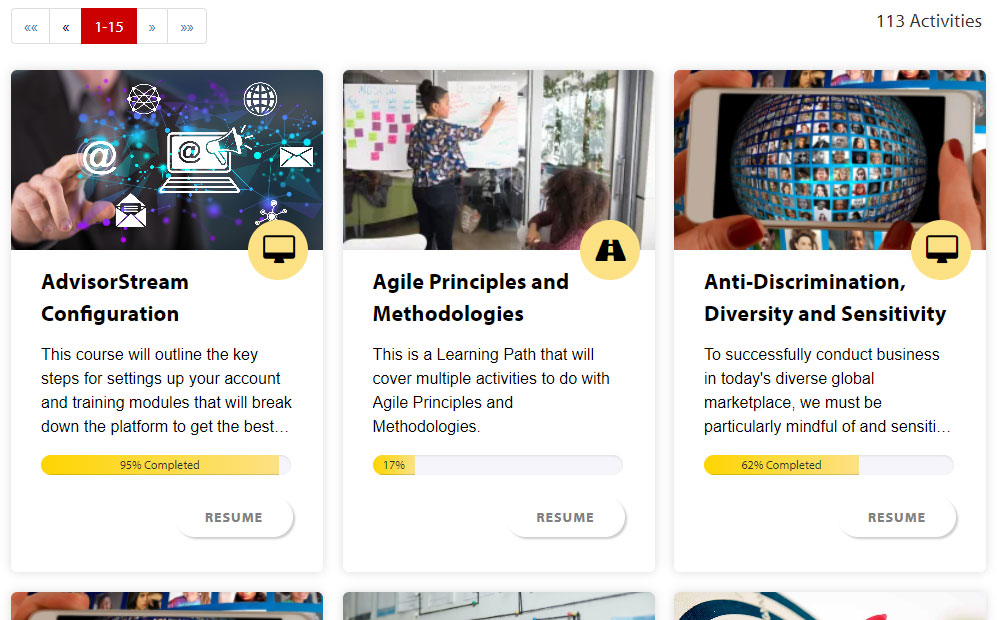
CDN
## 5. Correctly reference files using the correct case
If your LMS is optimized to deliver content through a content delivery network (CDN), then filenames will be case-sensitive. Any calls you make to your files (e.g., JavaScript, CSS, images, videos, and audio) will need to match the case of the file's name.
**Case sensitive:** A CDN (Content Delivery Network) is case sensitive because it treats filenames and paths as distinct entities, meaning that variations in capitalization can lead to different file retrievals. This sensitivity ensures accurate file delivery and helps maintain consistency in content distribution across diverse platforms and systems.
*Only some LMSs deliver content from a CDN. Therefore, testing packages on platforms like SCORM Cloud may not catch this problem.*

Optimization
## 6. Optimize your media files
Learners rarely need a 4K-quality video for learning. Take the time to optimize your media file sizes, including your images, audio and video files.
**Optimization:** Optimizing image, video, and audio files involves reducing file sizes without compromising quality and enhancing website performance. Popular tools like Adobe Photoshop for images, HandBrake for videos, and Audacity for audio offer comprehensive features to efficiently optimize media files for web usage.
*Just because an LMS can support the importing of SCORM packages larger than a two-hour movie doesn't mean your learners can, especially if they're trying to take the course on a mobile network.*

Terminate
## 7. Send Terminate when the course is closed
Add a Close button that triggers a Terminate and call a Terminate after the final section of your course before telling them they have finished the course. This will catch anyone exiting the course midway through it and anyone finishing it. If you don't, you could miss sending the last update and/or the completion status and results.
**Terminate:** The Terminate method signals to the LMS that content communication is completed for all SCOs. While technically, its call doesn't always signify the user's completion, implementing it judiciously ensures better compatibility and usability, especially when content is ready to be removed from the user.
*Course developers often miss these Terminate triggers, which causes learners' progress to not show either their completion or their complete progress.*

These tips underscore the importance of attention to detail in SCORM course development and highlight the potential benefits of adopting best practices. For those interested in exploring these concepts further and ensuring the creation of robust SCORM courses, discovering more about Thinking Cap, a platform that supports these principles, could be beneficial
---
Share this article
---
---
title: "Want to learn a dirty secret about Activity Inheritance? It’s a lie! ;-)"
description: "Thinking Cap’s greatest party trick is the tree of domains that allow you to define complex organizations and allows for any number of these Domains to have their own URL and unique Learner Experiences. Using…"
created: 2021-01-12
updated: 2021-01-12
authors: ThinkingCap
topics: [Blog]
status: published
canonical: https://console.thinkingcap.com/guest/Blog/blog-activity-inheritance
cover: https://thinkingcap.blob.core.windows.net/learnerview/00000000-0000-0000-0000-000000000000/advanced/blog-activity-inheritance_1444363565_lg.jpg
type: article
source_url: "https://www.thinkingcap.com/blog-activity-inheritance"
lastmod: 2021-01-12
scraped: 2026-08-19
order: 12
heroimage: "https://thinkingcap.blob.core.windows.net/learnerview/00000000-0000-0000-0000-000000000000/advanced/blog-activity-inheritance_1444363565_lg.jpg"
kicker: Blog
subtitle: A closer look at the assumptions and tradeoffs behind reusable learning activities.
abstract: "Thinking Cap''s domain tree inherits resources, settings, and branding downward, but activities are the exception: the Parent items shown in a child domain''s Explorer are read-only, not truly inherited. Because membership travels upward, local learners can still enroll in parent activities, which can also be used in local learning paths and reports."
---
# Thinking Cap Blog
# Want to learn a dirty secret about Activity Inheritance? It’s a lie! ;-)

## Want to learn a dirty secret about Activity Inheritance? It’s a lie! ;-)
Posted: 2021-01-12
---
Thinking Cap’s greatest party trick is the tree of domains that allow you to define complex organizations and allows for any number of these Domains to have their own URL and unique Learner Experiences. Using Inheritance allows you to keep a wide and evolving tree of Domains while minimising duplicate administrative tasks and lets you make administrative choices they can be enforced to lower domains in the tree.
Things we can inherit from one domain to another include Resources and Settings like “Security Roles”, “Assessment Questions”, “Feedback Surveys”, “Custom Fields”, “Activity Defaults”, “Virtual Rooms”… the list is in the dozens. Thinking Cap even support inheritance of “Branding” settings so common brand elements don’t need to be constantly updated yet leaving the ability to branch out some branding elements in child domains.
We also provide the ability to set some things to “Deny Inheritance” like in the case of a “Room” that can be used for “Instructor Led Training” in the "Custom Filed” associated to Learning Paths that is import to the Parent domain but makes no sense in the Child domains.
The flip side to Inheritance is where we use this to prohibit a Child from overriding the settings made at a parent level. For example, if “Log In” requires a password of a certain defined strength or freshness at a Parent level no domain under that domain can reduce these requirements. Or, where “Nomenclature” has been set up in a parent to rename an “Elearning” to a “Course” or “Virtual Room” to “Webinar” that Parent can dictate that Child domains may not rename those items.
> ### This is a long way of saying…. Things trickle down the Domain tree.
But what about Activities? Does an eLearning Course in a Parent domain inherent to the lower domain?
When you are looking at the “Explorer”, our name for the main administrative view of Thinking Cap one of the filters in the Activity lists is “Activity Origin” and the options are “Local”, “Shared” and “Parent”. In the case of local and shared we are looking at things that are actually in the current domain. But when you select Parent what we show you are the items from up the tree. You can’t change them in any way and the Settings button is completely greyed out because they are not real in your domain. We show this to you because while everything in the LMS including Security Permissions travel down the tree Membership in a domain travel up! As a member of the Philosophy Department, I am also a Member of the Liberal Arts Department and also of the University. As a member of the Toronto Baggage Handlers, I am also a member of the Canadian Division and North American Region.
We show you Parent items because, while you don’t control them, they impact you. You can use these items to create Learning Paths. You can Enroll you local users into them. You can run reports on the subset of Activity users that are from your domain. So while not in your domain, pretending these are in some way inherited from the parent is a useful fiction.
### Share
[Facebook](https://www.facebook.com/sharer/sharer.php?u=https://www.thinkingcap.com/blog-activity-inheritance&&t=Thinking Cap Blog: Want to learn a dirty secret about Activity Inheritance? It’s a lie!) [Twitter](https://twitter.com/intent/tweet?url=https://www.thinkingcap.com/blog-activity-inheritance&via=ThinkingCap&text=Thinking Cap Blog: Want to learn a dirty secret about Activity Inheritance? It’s a lie!) [LinkedIn](https://www.linkedin.com/shareArticle?mini=true&url=https%3A//www.thinkingcap.com/blog-activity-inheritance&title=Thinking Cap Blog: Want to learn a dirty secret about Activity Inheritance? It’s a lie!&summary=&source=) [Pinterest](https://pinterest.com/pin/create/button/?url=https://www.thinkingcap.com/blog-activity-inheritance&description=Thinking Cap Blog: Want to learn a dirty secret about Activity Inheritance? It’s a lie!&media=https://thinkingcap.blob.core.windows.net/learnerview/00000000-0000-0000-0000-000000000000/advanced/blog_301162325.jpg) [Email](mailto:?subject=Thinking Cap Blog: Why do I want to build custom activity types?&body=Please visit Thinking Cap Blog: Want to learn a dirty secret about Activity Inheritance? It’s a lie! at https://www.thinkingcap.com/blog-activity-inheritance)
---
---
title: "AI Course Authoring Tools: Moving Beyond the Basics"
description: Thinking Cap Blog 2025-09-09
created: 2026-11-19
updated: 2026-11-19
authors: ThinkingCap
topics: [Blog]
status: published
canonical: https://console.thinkingcap.com/guest/Blog/blog-ai-course-authoring-tools
type: article
source_url: "https://www.thinkingcap.com/blog-ai-course-authoring-tools"
scraped: 2026-08-19
order: 17
herotitle: "AI Course Authoring Tools: Moving Beyond the Basics"
heroimage: "https://cdn.thinkingcap.com/medialibrary/00000000-0000-0000-0000-000000000000/d3c6ba52-15d3-4920-bb63-39ed1afcaef6/1/d3c6ba52-15d3-4920-bb63-39ed1afcaef6.jpg"
kicker: Blog
subtitle: Consider where generative tools help and where thoughtful design still matters.
abstract: AI now supports every stage of course production, from drafting objectives, storyboards, and scripts to generating avatars, imagery, video, and branded designs. The tool catalog spans general assistants like ChatGPT and Claude, media generators like HeyGen, Midjourney, and Runway, and SCORM authoring platforms such as Articulate, Captivate, and Elucidat with AI features built in.
---

# AI Course Authoring Tools: Moving Beyond the Basics
Thinking Cap Blog | 2025-09-09
For years, instructional designers have relied on familiar authoring platforms like *Articulate
Rise*, *Storyline*, or *Adobe Captivate*. These tools made it possible to package
training into professional, interactive courses without custom code. But while they provide structure,
they leave a gap: the actual content creation is still slow, resource-heavy, and often limited to static
formats.
AI is now reshaping that workflow. From drafting content to building entire modules and adding engagement
layers like avatars, videos, and dialogue. AI is turning L&D teams into rapid content studios.
Building courses the manual way
## The Traditional Starting Point: Authoring Tools
Traditionally, course authoring relied on software that could reliably create SCORM or xAPI
packages for delivery through an LMS. These platforms offered responsive design, templates, and
interactivity, but the process was still manual, requiring hours of drafting, media production,
and design work.
The following are some of the most popular course authoring tools that shaped digital learning
before AI enhancements became mainstream
- [Articulate Rise](https://articulate.com/360/rise?utm_source=thinkingcap&utm_medium=blog&utm_campaign=ai-authoring&utm_term=articulate-rise) – Rapid authoring with responsive design
- [Articulate Storyline](https://articulate.com/360/storyline?utm_source=thinkingcap&utm_medium=blog&utm_campaign=ai-authoring&utm_term=articulate-storyline) – Slide based interactivity and branching
- [Adobe Captivate](https://www.adobe.com/products/captivate.html?utm_source=thinkingcap&utm_medium=blog&utm_campaign=ai-authoring&utm_term=adobe-captivate) – Simulations and mobile ready courses
- [Lectora](https://www.trivantis.com/lectora/?utm_source=thinkingcap&utm_medium=blog&utm_campaign=ai-authoring&utm_term=lectora) – Advanced authoring with accessibility features
Today, AI has introduced a wealth of new tools that support every stage of the process, from
course creation and authoring to engagement and media production, transforming how quickly and
effectively teams can deliver learning.

From blank page to first draft in minutes
## Drafting Smarter: AI for Course Content Creation
Turning learning objectives into a syllabus, storyboards, and written content has traditionally required
weeks of work. These AI tools accelerate the early stages of course design so instructional designers
can focus on alignment, creativity, and learner engagement.
#### AI for Learning Objectives and Syllabus
*Translate business goals into measurable objectives and course outlines.*
[ChatGPT](https://chatgpt.com/?utm_source=thinkingcap&utm_medium=blog&utm_campaign=ai-authoring&utm_term=chatgpt) – Generate learning objectives and syllabus drafts from prompts.
[Claude](https://claude.ai/?utm_source=thinkingcap&utm_medium=blog&utm_campaign=ai-authoring&utm_term=claude) – Create structured outlines and learning paths with context-rich prompts.
[Notion AI](https://www.notion.so/product/ai?utm_source=thinkingcap&utm_medium=blog&utm_campaign=ai-authoring&utm_term=notion-ai) – Organize notes and research into draft-ready course outlines.
#### AI for Storyboarding and Scenarios
*Transform outlines into storyboards, flowcharts, and scenario drafts.*
[Claude](https://claude.ai/?utm_source=thinkingcap&utm_medium=blog&utm_campaign=ai-authoring&utm_term=claude) – Drafts branching dialogues and case studies for storyboards.
[Miro AI](https://miro.com/?utm_source=thinkingcap&utm_medium=blog&utm_campaign=ai-authoring&utm_term=miro-ai) – Generates flowcharts and collaborative storyboard diagrams.
[Taskade AI](https://www.taskade.com/ai?utm_source=thinkingcap&utm_medium=blog&utm_campaign=ai-authoring&utm_term=taskade-ai) – Breaks down ideas into hierarchical outlines and workflows.
#### AI for Drafting and Written Content
*Speed up the writing process for scripts, lessons, and assessments.*
[ChatGPT](https://chatgpt.com/?utm_source=thinkingcap&utm_medium=blog&utm_campaign=ai-authoring&utm_term=chatgpt) – Drafts lessons, knowledge checks, and case study narratives.
[Copy.ai](https://www.copy.ai/?utm_source=thinkingcap&utm_medium=blog&utm_campaign=ai-authoring&utm_term=copy-ai) – Generates concise instructions, microcopy, and learner tips.
[Writesonic](https://writesonic.com/?utm_source=thinkingcap&utm_medium=blog&utm_campaign=ai-authoring&utm_term=writesonic) – Produces blog-style course text and email copy variations.
#### AI for Editing and Refinement
*Polish drafts for readability, clarity, and professional tone.*
[QuillBot](https://quillbot.com/?utm_source=thinkingcap&utm_medium=blog&utm_campaign=ai-authoring&utm_term=quillbot) – Rewrites content for clarity and tone consistency.
[Grammarly](https://www.grammarly.com/?utm_source=thinkingcap&utm_medium=blog&utm_campaign=ai-authoring&utm_term=grammarly) – Provides grammar checks, readability scoring, and tone adjustments.
[Jasper](https://www.jasper.ai/?utm_source=thinkingcap&utm_medium=blog&utm_campaign=ai-authoring&utm_term=jasper) – Optimizes copy for brand voice and learner engagement.
Add the human touch without the human cost
## Beyond Building: AI Tools for Engagement and Cost Savings
Once the core content is ready, polish and engagement make the difference. These AI tools extend courses
with media and interactive quality that used to require studio budgets.
#### AI Avatars and Video Presenters
*Bring a human presence into courses without hiring presenters.*
[HeyGen](https://heygen.com/?utm_source=thinkingcap&utm_medium=blog&utm_campaign=ai-authoring&utm_term=heygen) – Generate consistent characters and detailed illustrations.
[Synthesia](https://www.synthesia.io/?utm_source=thinkingcap&utm_medium=blog&utm_campaign=ai-authoring&utm_term=synthesia) – Create icons, backgrounds, and on-demand artwork.
#### AI Imagery and Characters
*Expand your visual library with custom characters and graphics.*
[Midjourney](https://midjourney.com/?utm_source=thinkingcap&utm_medium=blog&utm_campaign=ai-authoring&utm_term=midjourney) – Generate consistent characters and detailed illustrations.
[Stable Diffusion](https://stability.ai/?utm_source=thinkingcap&utm_medium=blog&utm_campaign=ai-authoring&utm_term=stable-diffusion) – Create icons, backgrounds, and on-demand artwork.
#### AI Dialogue and Scripts
*Write realistic conversations and learning scenarios quickly.*
[Claude](https://claude.ai/?utm_source=thinkingcap&utm_medium=blog&utm_campaign=ai-authoring&utm_term=claude) – Drafts branching dialogues, podcasts, and scripts.
[ChatGPT](https://chatgpt.com/?utm_source=thinkingcap&utm_medium=blog&utm_campaign=ai-authoring&utm_term=chatgpt) – Generates roleplays and compliance scenarios.
#### AI Design Automation
*Turn text into branded designs and course visuals instantly.*
[Figma](https://figma.com/?utm_source=thinkingcap&utm_medium=blog&utm_campaign=ai-authoring&utm_term=figma) + [ChatGPT](https://chatgpt.com/?utm_source=thinkingcap&utm_medium=blog&utm_campaign=ai-authoring&utm_term=chatgpt) – Create thumbnails and banners from templates.
[Beautiful.ai](https://www.beautiful.ai/?utm_source=thinkingcap&utm_medium=blog&utm_campaign=ai-authoring&utm_term=beautiful-ai) – Auto-design slide decks for ILT or blended programs.
[Canva](https://www.canva.com/?utm_source=thinkingcap&utm_medium=blog&utm_campaign=ai-authoring&utm_term=canva) – Transform text outlines into on-brand course graphics.
#### AI Video and Animation
*Produce engaging course videos without a studio budget.*
[Runway](https://runwayml.com/?utm_source=thinkingcap&utm_medium=blog&utm_campaign=ai-authoring&utm_term=runway) – Convert scripts into AI-generated videos.
[Pictory](https://pictory.ai/?utm_source=thinkingcap&utm_medium=blog&utm_campaign=ai-authoring&utm_term=pictory) – Turn long text or video into short narrated highlights.
[Descript](https://www.descript.com/?utm_source=thinkingcap&utm_medium=blog&utm_campaign=ai-authoring&utm_term=descript) – Edit audio/video with overdub and transcription tools.
The hub where content, media, and AI converge
## Bringing It All Together: AI-Powered SCORM Authoring Tools
The real strength of AI in learning design comes from using it at every stage of the process. Drafting
tools help turn objectives into written content. Engagement tools add avatars, videos, and visuals. All
of these pieces come together in SCORM-compliant authoring platforms that now also support their own
AI-powered features.
The result is a faster, smarter workflow where instructional designers can build, brand, and export
courses directly from the tools they already know.
#### [Articulate Rise and Storyline](https://articulate.com/360?utm_source=thinkingcap&utm_medium=blog&utm_campaign=ai-authoring&utm_term=articulate)
*AI Assistant and content generation*
Includes inline AI editing, Magic Import from documents, quiz and outline generation,
and AI image creation for responsive course design.
#### [Adobe Captivate](https://www.adobe.com/products/captivate.html?utm_source=thinkingcap&utm_medium=blog&utm_campaign=ai-authoring&utm_term=adobe-captivate)
*AI narration and scenarios*
Supports AI voice narration, prompt-driven scenarios and scripts, plus media generation
for audio, images, and branching interactions.
#### [Elucidat](https://www.elucidat.com/?utm_source=thinkingcap&utm_medium=blog&utm_campaign=ai-authoring&utm_term=elucidat)
*AI Assist for layouts and quizzes*
Provides AI-assisted layouts, copy suggestions, and quiz generation to accelerate
course creation in a cloud-based platform.
#### [Easygenerator](https://www.easygenerator.com/?utm_source=thinkingcap&utm_medium=blog&utm_campaign=ai-authoring&utm_term=easygenerator)
*Intuitive authoring with AI support*
Drag-and-drop course builder with SCORM/xAPI export, AI-powered text generation,
translation, and knowledge check creation.
#### [Evolve](https://www.intellum.com/platform/evolve?utm_source=thinkingcap&utm_medium=blog&utm_campaign=ai-authoring&utm_term=evolve)
*HTML5 authoring with AI assistance*
Creates responsive SCORM packages with AI-enabled templates, content generation, and
rapid prototyping for modern eLearning.
#### [Gomo](https://www.gomolearning.com/?utm_source=thinkingcap&utm_medium=blog&utm_campaign=ai-authoring&utm_term=gomo)
*Cloud-based collaborative authoring*
SCORM/xAPI compliant tool with AI-assisted copywriting, responsive templates,
translation workflows, and multi-author collaboration.
#### [CogniSpark AI](https://www.cognispark.ai/?utm_source=thinkingcap&utm_medium=blog&utm_campaign=ai-authoring&utm_term=cognispark-ai)
*AI-driven content and media creation*
AI studio for building SCORM-compliant courses with generated text, quizzes, video,
audio, and translations, ready for LMS delivery.
By combining AI drafting tools, media generators, and engagement enhancers with the built-in AI features of
authoring platforms like Articulate Rise, Adobe Captivate, Elucidat, and Easygenerator, L&D teams can now create
polished SCORM-compliant courses faster and with more creativity than ever before.
Customizable solutions for impactful learning
## See How Thinking Cap Can Support Your Organization
AI-powered authoring tools make it faster and easier to create engaging, SCORM-compliant courses, but authoring is only the first step. To deliver these courses at scale, track learner progress, ensure compliance, and measure impact, you need an LMS built to support modern training.
Thinking Cap LMS is the hub where AI-authored content comes to life. With seamless SCORM and xAPI compatibility, you can publish courses directly, automate enrollment and notifications, personalize learning paths, and report on outcomes with precision.
**Ready to connect AI-enhanced authoring with delivery and reporting in your LMS strategy?** Request a personalized demo and see how Thinking Cap LMS supports rapid course creation, publishing, compliance, and analytics.
[Request a personalized demo](https://www.thinkingcap.com/Book-a-demo)
---
Share this article
---
---
title: Attestations can replace Demonstrations, Comprehensions and Portfolios
description: "What is the point of an LMS? First and foremost, it is not about Learning. I know that is shocking but if you want the worlds greatest learning machine go to YouTube, they can teach you anything. While a great deal of…"
created: 2020-10-01
updated: 2020-10-01
authors: ThinkingCap
topics: [Blog]
status: published
canonical: https://console.thinkingcap.com/guest/Blog/blog-attestations
cover: https://thinkingcap.blob.core.windows.net/learnerview/00000000-0000-0000-0000-000000000000/advanced/blog-attestations_1022495629_lg.jpg
type: article
source_url: "https://www.thinkingcap.com/blog-attestations"
lastmod: 2020-10-01
scraped: 2026-08-19
order: 13
heroimage: "https://thinkingcap.blob.core.windows.net/learnerview/00000000-0000-0000-0000-000000000000/advanced/blog-attestations_1022495629_lg.jpg"
kicker: Blog
subtitle: Explore where learner declarations fit within different approaches to evidence.
abstract: An LMS is fundamentally in the trust business, recording that learning actually happened. Thinking Cap's Attestation activity type generalizes Demonstrations, Comprehensions, and Portfolios into one configurable model where administrators define whether the learner, a proctor, or both attest, and whether evidence is a textual affirmation or uploaded documentation.
---
# Thinking Cap Blog
# Attestations can replace Demonstrations, Comprehensions and Portfolios

## Attestations can replace Demonstrations, Comprehensions and Portfolios
Posted: 2020-10-01
---
What is the point of an LMS? First and foremost, it is not about Learning. I know that is shocking but if you want the worlds greatest learning machine go to YouTube, they can teach you anything. While a great deal of learning is going on, LMSs are in the trust business. We record log ins, course progress, outcomes, feedback, all in the name of declaring that you have completed the material. At the core, a Demonstration is an attestation by someone in authority that you performed some task. A Comprehension is a Learner stipulating that they did in fact read or watch the material and understood it. Portfolios are evidence of something done in the real world. Each of these incudes hard coded assumptions about the relation of the Learner to the method of confirming their achievements.
> ### To let you break out of these assumptions we adding a new Activity Type called an Attestation.
To let you break out of these assumptions we adding a new Activity Type called an Attestation. When you create a new one in the LMS it is very similar to other activity types but it allows you to set the rules for how an Attestation is made. First off you select if the Attestation is made by the Learner or a Proctor or both. If the Attestation is required from a Learner, we let you select any Content that must be reviewed by the Learner. Next you set if evidence is required or just a sign off. If evidence is required we ask you to define if evidence is supplied in a textual affirmation or uploaded documentation. If Proctor Attestations are required we let you define instructions for a Proctor to make a determination.
Because the LMS lets you create your own Activity types you can create as many Attestations as you wish. While Demonstrations, Comprehensions and Portfolios are still there to be used the flexibility of Attestations lets you do more.
### Share
[Facebook](https://www.facebook.com/sharer/sharer.php?u=https://www.thinkingcap.com/attestations) [Twitter](http://twitter.com/share?url=https://www.thinkingcap.com/attestations&via=ThinkingCap&text=Thinking Cap Blog: Attestations can replace Demonstrations, Comprehensions and Portfolios) [LinkedIn](http://www.linkedin.com/shareArticle?mini=true&url=https://www.thinkingcap.com/attestations&title=Thinking Cap Blog: Attestations can replace Demonstrations, Comprehensions and Portfolios) [Pinterest](https://pinterest.com/pin/create/button/?url=https://www.thinkingcap.com/attestations&media=&description=Thinking Cap Blog: Attestations can replace Demonstrations, Comprehensions and Portfolios) [Email](mailto:?subject=Thinking Cap Blog: Attestations can replace Demonstrations, Comprehensions and Portfolios&body=Please visit Thinking Cap Blog: Attestations can replace Demonstrations, Comprehensions and Portfolios at https://www.thinkingcap.com/attestations)
---
---
title: "Building a Safer Future: The Role of Training in Construction Safety"
description: Thinking Cap Blog 2025-01-20
created: 2025-01-20
updated: 2025-01-20
authors: ThinkingCap
topics: [Blog]
status: published
canonical: https://console.thinkingcap.com/guest/Blog/blog-building-safer-future
type: article
source_url: "https://www.thinkingcap.com/blog-building-safer-future"
lastmod: 2025-01-20
scraped: 2026-08-19
order: 4
herotitle: "Building a Safer Future: The Role of Training in Construction Safety"
heroimage: "https://cdn.thinkingcap.com/medialibrary/00000000-0000-0000-0000-000000000000/d4c45e79-15ca-4e0a-bbaf-9bed02be830b/1/d4c45e79-15ca-4e0a-bbaf-9bed02be830b.jpg"
kicker: Blog
subtitle: How practical education can help strengthen safety culture on the job.
abstract: Construction workers face daily hazards, and an LMS helps firms standardize safety training across sites, automate certification and expiry tracking, deliver mobile-accessible courses, and sustain engagement through gamification. Industry research on training outcomes and BuildForce Canada's e-learning platform illustrate the approach in practice.
---

# Building a Safer Future: The Role of Training in Construction Safety
Thinking Cap Blog | 2025-01-20
Safety is a top priority in the construction industry, where workers face hazardous conditions daily.
Ensuring compliance with safety regulations, reducing accidents, and maintaining an informed workforce
are crucial to protecting both employees and the success of construction projects. A Learning Management
System (LMS) plays a vital role in streamlining safety training, tracking certifications, and
reinforcing a culture of compliance.
Training for safety
## Importance of Safety Training in Construction
Construction sites are inherently risky, with potential dangers including falls, equipment-related
injuries, and exposure to hazardous materials. Proper training helps mitigate these risks by:
#### Safety compliance
Educating workers on OSHA compliance and safety protocols
#### Prevent accidents
Reducing the likelihood of workplace injuries and fatalities
#### Standard Operating Procedures (SOPs)
Ensuring that employees use protective gear and follow procedures correctly
#### Meeting Regulations
Keeping construction companies in line with legal requirements
Improving Workplace Safety Through Effective Training
## Solving Safety Training Challenges and Ensuring Compliance
Ensuring safety compliance in the construction industry is crucial, but many companies face challenges
that hinder effective training. A Learning Management System (LMS) provides structured solutions that
address these issues and ensure workers remain compliant with safety regulations.
### Standardized & Consistent Safety Training Across Sites
Ensuring all workers receive the same safety training helps eliminate knowledge gaps and reinforces industry best practices.
#### SCORM Compliance & Multimedia Support
Deliver interactive SCORM courses, videos, and PDFs for OSHA, WHMIS, and other safety training.
#### Custom Learning Paths
Assign sequential training (e.g., WHMIS first, followed by site-specific procedures).
### Certification Tracking & Compliance Management
Automated tracking of certifications and renewals reduces compliance risks and ensures workers meet safety requirements.
#### Automated Certification & Expiry Tracking
Ensure workers stay certified with automatic reminders for renewals.
#### Customizable Reports & Audit-Ready Compliance Logs
Generate real-time reports on course completions, certifications, and expiring credentials for regulatory audits.
### Mobile & On-Site Training Accessibility
Providing mobile-friendly safety training allows workers to complete courses anytime, anywhere, minimizing downtime.
#### Mobile-Optimized LMS
Workers can complete safety training on-site via tablets or smartphones, reducing downtime.
#### Accessible for All Workers
WCAG-compliant design, screen reader compatibility, and adjustable font sizes ensure inclusive safety training.
### Limiting Training Gaps & Boosting Engagement
Interactive learning tools like quizzes and gamification enhance engagement and improve knowledge retention.
#### Gamification & Interactive Elements
Use quizzes, leaderboards, badges and more to keep workers engaged.
#### Progress Auto-Resume
Learners can pause training and resume where they left off, even on different devices.
### Reducing Risk & Enhancing Accountability
Secure access controls and compliance reporting help organizations maintain accountability and regulatory adherence.
#### Single Sign-On (SSO) & Role-Based Access
Control who accesses which safety training, ensuring the right training for the right personnel.
#### Multi-Factor Authentication (MFA) & Secure Login
Protect sensitive training records and compliance data.
Improving Workplace Safety Through Effective Training
## Key Benefits of an LMS for Construction Safety
### Standardized Training Across Job Sites
Ensuring workers receive the same level of training across multiple job sites is essential for maintaining safety, compliance, and operational efficiency.
> #### A centralized LMS ensures consistent training delivery, reducing knowledge discrepancies. In 2021, 77% of construction employers assessed training impacts on performance, up from 50% in 2018.
>
> Construction Industry Training Board (CITB): [Skills and Training in the Construction Industry 2021](https://www.citb.co.uk/media/wnpb2l0k/citb-skills-and-training-report-2021.pdf)
### Enhanced Engagement & Retention
Keeping workers engaged in training can be challenging, but interactive, modern learning formats significantly improve participation and retention.
> #### Laing O'Rourke, a global construction firm, increased training engagement from 35% to 95% by using bite-sized learning modules inspired by TikTok and Instagram.
>
> The Australian: [Building Giant Shakes Up Staff Training to Stay Ahead](https://www.theaustralian.com.au/business/technology/laing-orourke-turns-to-tiktok-and-instagram-for-training-revolution/news-story/375e8bdbc56f332f3ecf7ac18f01e0a5)
### Automated Certification Tracking
A study on automated compliance checking found that digitized certification tracking reduces administrative workload by up to 30% and improves regulatory compliance by ensuring real-time updates on worker qualifications.
> #### Implementing an LMS with automated certification tracking streamlines compliance management, reducing administrative burdens.
>
> Cardiff University: [Towards Automated Compliance Checking in the Construction Industry](https://link.springer.com/chapter/10.1007/978-3-642-40285-2_32)
### Mobile Accessibility
Many construction workers rely on mobile learning for safety training, but accessibility barriers can limit its effectiveness.
> #### A study of 4,068 mobile apps found that 94% had at least one accessibility issue, making navigation difficult for workers relying on screen readers.
>
> Apple Inc., CHI ’21: [Screen Recognition: Creating Accessibility Metadata for Mobile Applications from Pixels](https://doi.org/10.1145/3411764.3445186)
Case Study
## Enhancing Safety Training with BuildForce Canada's E-Learning Platform
[**BuildForce Canada**](https://www.buildforce.ca/?utm_source=grow&utm_medium=email&utm_campaign=thinking-cap&utm_content=textlink&utm_term=blog ), a national organization dedicated to developing a highly skilled construction workforce, offers a comprehensive E-Learning Centre designed to promote the professional development of individuals in the Canadian construction and maintenance industry.
Through partnerships with local distributors, BuildForce Canada provides accessible online training courses that cover a wide range of topics, including safety standards, project management, and supervisory skills. These courses are tailored to meet the evolving needs of the construction sector, ensuring that workers receive up-to-date and relevant training.
By leveraging [**BuildForce Canada's E-Learning platform**](https://elearning.buildforce.ca/?utm_source=grow&utm_medium=email&utm_campaign=thinking-cap&utm_content=textlink&utm_term=blog ), construction companies can **standardize safety training** across all job sites, reducing knowledge discrepancies and ensuring compliance with national safety standards. This centralized approach not only enhances worker safety but also contributes to operational efficiency, aligning with the industry's commitment to maintaining a highly skilled and safe workforce.

Conclusion
## Final Thoughts: Prioritizing Safety Through Effective Training
Ensuring safety compliance in the construction industry requires consistent training, proper certification tracking, and accessible learning opportunities for workers. By standardizing training across job sites, companies can minimize knowledge gaps, improve retention through interactive learning, and ensure workers stay certified with automated tracking systems. Mobile accessibility further enhances flexibility, allowing employees to complete training without disrupting job site productivity.
A proactive approach to safety training not only reduces workplace incidents but also strengthens overall operational efficiency. As the industry continues to evolve, leveraging digital tools to streamline training and compliance will be key to maintaining a well-prepared and safety-conscious workforce.
Now is the time to implement an LMS that ensures your workforce receives the proper training to
stay safe on the job. Investing in structured safety training today can prevent accidents, save
lives, and boost productivity in the long run.
[Request a personalized demo](https://www.thinkingcap.com/Book-a-demo)
---
Share this article

---
---
title: "Why do I want to build Custom Activity types?"
description: "Thinking Cap started with support for eLearning Activities and Learning Paths. Later we added Instructor Led Activities. Our clients needed to support other Learning Activities, so we added them:"
created: 2020-06-05
updated: 2020-06-05
authors: ThinkingCap
topics: [Blog]
status: published
canonical: https://console.thinkingcap.com/guest/Blog/blog-custom-activity-types
cover: https://thinkingcap.blob.core.windows.net/learnerview/00000000-0000-0000-0000-000000000000/advanced/blog_301162325.jpg
type: article
source_url: "https://www.thinkingcap.com/blog-custom-activity-types"
lastmod: 2020-06-05
scraped: 2026-08-19
order: 16
heroimage: "https://thinkingcap.blob.core.windows.net/learnerview/00000000-0000-0000-0000-000000000000/advanced/blog_301162325.jpg"
kicker: Blog
subtitle: What specialized interactions can add beyond standard learning formats.
abstract: Activities of the same type often need different metadata and presentation, and earlier answers such as branching custom fields and type-wide default settings added administrative burden and branding complexity. Thinking Cap's solution lets customers define their own activity types using built-in types as archetypes, each with its own fields, defaults, and look and feel.
---
# Thinking Cap Blog
# Why do I want to build custom activity types?

## Why do I want to build custom activity types?
Posted: 2020-06-05
---
Thinking Cap started with support for eLearning Activities and Learning Paths. Later we added Instructor Led Activities. Our clients needed to support other Learning Activities, so we added them:
- Demonstrations
- Portfolios
- Comprehensions
Finally, we added support for things that were traditionally part of an Activity to become stand alone Activity types themselves. These were:
- Assessments
- Assignments
- Feedback / Surveys
This was a lot of choice.
But all Activities, even of the same type, are not always the same. A Learning Path in one context is describing a curriculum of material towards a Certification. Other times a Learning Path represents the sessions of a Conference. These differences effect both the custom Fields of Metadata we collect about each type and how the Client wishes to visually present these Activities to Learners.
Our first attempt to bridge these gaps relied on Custom Fields to allow the differences to be defined and we added Custom Filed Branching to accommodate data difference within an Activity Type. This was a strong first attempt but it had flaws. Firstly, the branching fields added to administrative load and added to the possibility of human error. Secondly, the rules for how to display each Activity type ballooned the custom CSS used for the Learner View branding and made the Learner Experience difficult to manage and make changes.
In 2017 we added the ability for Administrators to add Default Values for any of the dozens of settings for Activities. This meant that if you always wanted the Video scrubber to be disabled or if you always wanted a Completion Notification sent or you always wanted the Learner to complete the Stand Feedback you could set that in one place and it would be applied to all Activities of that type. We also allowed you to set if that setting could be overridden or not. These were great new tools to streamline the administrative load of managing many new Activities. But we quickly learned that the subtle differences between Activities greatly diminished the wide use of these time saving tools.
> ### The Solution was to allow Customers to define their own Activity Types using the Built-In base types as Archetypes.
The Solution was to allow Customers to define their own Activity Types using the Built-In base types as Archetypes. Doing this meant we could allow Custom Fields and Activity Defaults to belong to one variant of an Activity and not another. Also, we could cleanly define Look and Feel for each type and not make a mess of the Branding tools to get there.
Like custom Nomenclature and Translations that make the wording of the LMS accommodate how you refer to all aspect of your Learning ecosystem, having custom activity types means Thinking Cap adapts to how you work and not how we want you to. Helping you identify the types of Activities you support and how they should be set up is the job of our Onboarding team. Give us a call to learn more.
### Share
[Facebook](https://www.facebook.com/sharer/sharer.php?u=https://www.thinkingcap.com/blog-custom-activity-types&&t=Why do I want to build custom activity types?) [Twitter](https://twitter.com/intent/tweet?url=https://www.thinkingcap.com/blog-custom-activity-types&via=ThinkingCap&text=Thinking Cap Blog: Why do I want to build custom activity types?) [LinkedIn](https://www.linkedin.com/shareArticle?mini=true&url=https%3A//www.thinkingcap.com/blog-custom-activity-types&title=Why%20do%20I%20want%20to%20build%20custom%20activity%20types?&summary=&source=) [Pinterest](https://pinterest.com/pin/create/button/?url=https://www.thinkingcap.com/blog-custom-activity-types&description=Thinking Cap Blog: Why do I want to build custom activity types?&media=https://thinkingcap.blob.core.windows.net/learnerview/00000000-0000-0000-0000-000000000000/advanced/blog_301162325.jpg) [Email](mailto:?subject=Thinking Cap Blog: Why do I want to build custom activity types?&body=Please visit Thinking Cap Blog: Why do I want to build custom activity types? at https://www.thinkingcap.com/blog-custom-activity-types)
---
---
title: "Data Hydration and Dehydration: Safeguarding Privacy"
description: Thinking Cap Blog 2024-11-12
created: 2024-11-12
updated: 2024-11-12
authors: ThinkingCap
topics: [Blog]
status: published
canonical: https://console.thinkingcap.com/guest/Blog/blog-data-hydration-dehydration-safeguarding-privacy
cover: https://cdn.thinkingcap.com/medialibrary/00000000-0000-0000-0000-000000000000/f867bd4c-d700-49ee-a6e6-a8958e73ad7b/1/f867bd4c-d700-49ee-a6e6-a8958e73ad7b.jpg
type: article
source_url: "https://www.thinkingcap.com/blog-data-hydration-dehydration-safeguarding-privacy"
lastmod: 2024-11-12
scraped: 2026-08-19
order: 5
heroimage: "https://cdn.thinkingcap.com/medialibrary/00000000-0000-0000-0000-000000000000/f867bd4c-d700-49ee-a6e6-a8958e73ad7b/1/f867bd4c-d700-49ee-a6e6-a8958e73ad7b.jpg"
kicker: Blog
subtitle: A closer look at handling sensitive information across connected systems.
abstract: Data hydration makes learner information available when needed while dehydration removes it from active systems without deleting it, limiting exposure in line with GDPR data-minimization principles. Thinking Cap LMS uses both processes to keep personal data active only when necessary while preserving it securely for audits and access requests.
---

# Data Hydration and Dehydration: Safeguarding Privacy
Thinking Cap Blog | 2024-11-12
In today’s digital age, data privacy is more important than ever. Learning Management Systems (LMS) store vast amounts of personal information about learners, administrators, and educators. As privacy regulations like the GDPR (General Data Protection Regulation) continue to evolve, it's critical for LMS providers to not only ensure the safety of this data but also to find intelligent ways to manage its lifecycle. That's where concepts like data hydration and dehydration come into play.
## What Are Data Hydration and Dehydration?
**Data hydration** and **data dehydration** are processes that help manage data efficiently, specifically by controlling when and how data is accessible. Think of data hydration as the process of "filling up" the LMS with necessary user information, making it accessible when needed for specific learning activities, analytics, or reporting. In contrast, data dehydration is about "removing the water," or making the data inaccessible without actually deleting it. By doing so, dehydrated data is no longer part of active processes but remains stored securely for compliance and potential future rehydration.
In simpler terms, hydration makes data available, while dehydration tucks it away safely—almost like putting items into storage until you need them again. These practices play a key role in reducing data exposure risks while still maintaining the ability to restore information as needed.
## Why Data Hydration and Dehydration Are Important for Privacy?
Data hydration and dehydration techniques are particularly crucial when it comes to user privacy in an LMS. By managing data visibility, you limit the amount of personal information that is accessible at any given time, significantly lowering the risk of data breaches or unauthorized access.
For example, let’s consider a scenario where a user completes a training course. After the course is completed, data hydration allows that user’s learning history to be accessed for certification purposes or compliance checks. However, after a certain retention period or when the data is no longer actively needed, data dehydration can be employed to remove the sensitive information from active systems, minimizing exposure. This way, user data is only active when necessary, adhering to privacy principles.
## Ensuring GDPR Compliance
The GDPR mandates that companies handle personal data with care, only storing information that is absolutely necessary, and for as long as it is needed. The dehydration of data is a smart way to adhere to [GDPR requirements](https://www.thinkingcap.com/gdpr-compliance), as it limits data processing to only what is relevant at the time. By dehydrating data, you minimize the surface area that could be targeted by malicious actors, helping to ensure data privacy and compliance.
Moreover, data hydration enables flexibility and transparency, giving the LMS the ability to rehydrate data only when a valid reason arises. For example, rehydration can occur if a user requests access to their training history or when needed for a regulatory audit. With this approach, the LMS provides robust support for the rights of data subjects under GDPR, such as the right to access and the right to erasure.
## How Thinking Cap LMS Uses Data Hydration and Dehydration
In Thinking Cap LMS, we use data hydration and dehydration processes as a core strategy for privacy management. When user data is no longer actively needed—such as after learners complete their training and certifications—we dehydrate that data, effectively removing it from immediate accessibility. However, it remains securely stored and can be rehydrated if required by an authorized process, such as auditing or compliance checks.
By leveraging hydration and dehydration, we ensure that your LMS has minimal exposure to sensitive data, which significantly reduces risk. This balance between accessibility and privacy provides a robust framework for adhering to compliance standards, meeting both organizational needs and protecting user privacy.
## Conclusion
Data hydration and dehydration are powerful strategies for safeguarding privacy and ensuring compliance in an LMS. By actively managing the lifecycle of data, you not only protect user information from potential threats but also align your processes with stringent regulations like GDPR. Thinking Cap LMS employs these methods to strike the perfect balance between usability, security, and compliance—giving you and your learners peace of mind in an increasingly privacy-conscious world.
If you're interested in learning more about how we implement privacy-first features in our LMS, feel free to reach out. We're here to help make learning both accessible and secure!
Share this article
## Want to find out more?
Book a session today for a personalized demo and Q&A.
[Book a Demo](https://www.thinkingcap.com/Book-a-demo)
---
---
title: Electrical Safety Authority Launches New Learning Program on Thinking Cap LMS
description: Thinking Cap Blog 2025-03-26
created: 2026-11-19
updated: 2026-11-19
authors: ThinkingCap
topics: [Blog]
status: published
canonical: https://console.thinkingcap.com/guest/Blog/blog-electrical-safety-authority-lms-launch
type: article
source_url: "https://www.thinkingcap.com/blog-electrical-safety-authority-lms-launch"
scraped: 2026-08-19
order: 18
herotitle: Electrical Safety Authority Launches New Learning Program on Thinking Cap LMS
heroimage: "https://cdn.thinkingcap.com/medialibrary/00000000-0000-0000-0000-000000000000/5057e017-9c80-4ecf-8262-369ff6e3f647/1/5057e017-9c80-4ecf-8262-369ff6e3f647.jpg"
kicker: Blog
subtitle: A customer story about delivering professional learning in a regulated field.
abstract: The Electrical Safety Authority has launched its new learning program on Thinking Cap LMS, bringing Ontario electrical safety training into a fully branded learner experience with automated notifications and multi-format content. The onboarding project imported ESA's course library and historical completions, and ESA plans to expand its offerings and audiences on the platform.
---

# Electrical Safety Authority Launches New Learning Program on Thinking Cap LMS
Thinking Cap Blog | 2025-03-26
We’re proud to announce that **Electrical Safety Authority (ESA)** has officially launched their new learning program on **Thinking Cap LMS**!
Championing Electrical Safety Across Ontario
## About ESA
[**Electrical Safety Authority**](https://esasafe.com/) is an Ontario-based organization dedicated to enhancing public electrical safety across the province. Through regulation, education, and collaboration, ESA works to reduce electrical-related harm and promote awareness among homeowners, businesses, and industry professionals.
Training plays a central role in this mission—ensuring that licensed electrical contractors, inspectors, and workers have access to the knowledge and tools they need to work safely and stay up to date with codes and best practices.
With that mission in mind, ESA has now launched a powerful, user-friendly learning environment to better support their learners.

Personalized, Branded, and Ready to Scale
## Designed with Electrical Safety Authority in Mind
ESA’s new platform leverages a fully custom-branded learner view, designed to reflect their unique identity and deliver an intuitive, accessible experience.
They’ve also implemented automated notifications to keep learners informed and on track—from enrollment to completion reminders and everything in between.

A Collaborative Launch from Day One
## Onboarding ESA Into Thinking Cap LMS
The ESA onboarding project was a focused, fast-paced collaboration designed to get their new learning environment up and running without disrupting service to their users. With a tight timeline and a clear vision, both teams worked side by side to bring the program to life inside Thinking Cap LMS.
Key project tasks included:
#### Importing Activities & Course Structure
ESA’s existing course library—including SCORM modules, evaluations, and supporting materials—was mapped and imported into Thinking Cap’s course architecture, preserving the logic of their existing programs while preparing for future growth..
#### Migrating Historical Completions
To ensure learner progress was uninterrupted, historical completion data was brought into the new system, giving users credit for past training and allowing ESA to maintain compliance records and transcripts.
#### Setting Up the Learning Experience
We configured navigation, content visibility, enrollment rules, and learner dashboards to reflect ESA’s workflows and support a clear, intuitive experience across all roles.
#### Branding the Learner View
ESA’s learner interface was fully customized to align with their visual identity, providing a professional, on-brand experience that made the new LMS feel like a natural extension of their organization.
#### Testing, Admin Training & Go-Live Support
With the platform built, we worked together on quality checks, trained ESA’s internal team, and provided hands-on support through the launch to ensure a smooth transition for all learners.
Partnering for a Safer, Smarter Learning Experience
## Hear What Electrical Safety Authority Has to Say
Alejandro Gonzalez, Manager of the Training Program at Electrical Safety Authority, has led the charge in transitioning ESA’s training into a modern, learner-focused platform with Thinking Cap LMS.

> Switching LMS providers is no small task—but Thinking Cap truly helped us stay grounded throughout the transition. With a tight and ambitious timeline, they delivered outstanding support migrating our users, data, and training content. Their team was responsive, collaborative, and energized every step of the way. Thanks to their partnership, ESA’s new LMS went live without a hitch, giving our learners a streamlined, user-friendly experience—and most importantly, continuity of service. Thinking Cap definitely brought the spark we needed.
>
> Alejandro Gonzalez Manager, Training Program, Electrical Safety Authority
Alejandro brings deep expertise in adult education and digital learning strategy to ESA’s mission of advancing electrical safety through training. With a hands-on approach and a strong commitment to learner outcomes, he ensures ESA’s programs are not only compliant and current—but also engaging, scalable, and designed to meet the evolving needs of industry professionals. His leadership has been central to creating a platform that supports ESA’s long-term vision for impact and growth.
Flexible Tools for Real-World Training Needs
## Key Features Powering ESA’s Learning Program
Key features of the Activity Connections system include:
#### Custom-Branded Learner View
ESA’s learner interface is uniquely designed to match their brand, providing a seamless and professional experience that feels like an extension of their organization.
#### Automated Notifications
Built-in messaging keeps learners engaged with timely updates about course assignments, deadlines, and completions—no manual follow-ups required.
#### Multi-Format Content Support
From SCORM packages to videos, assessments, and reference documents, the Electrical Safety Authority can deliver training in the format that works best for each topic and audience.
Expanding Services, Growing Impact
## Looking Ahead: Building on a Strong Foundation
Launching their LMS was just the beginning. ESA is already planning to expand their offerings within Thinking Cap to deliver even more value to their learners.
In the coming months, they’ll be rolling out new services, broadening their content library, and introducing additional training opportunities to reach wider audiences—including new learners, industry partners, and internal teams.
With scalable infrastructure and a growing roadmap, ESA is poised to transform their learning ecosystem into a comprehensive digital hub for electrical safety education in Ontario—and beyond.
---
We’re thrilled to be part of ESA’s digital learning transformation.
**Welcome to the Thinking Cap community, Electrical Safety Authority!**
Curious how Thinking Cap could work for your organization?
Whether you're moving from another LMS or building a learning program from scratch, we're here to help. [Book a demo](https://www.thinkingcap.com/book-demo) to see how Thinking Cap can bring your vision to life—with the flexibility, support, and features your team needs to thrive.
[Request a personalized demo](https://www.thinkingcap.com/book-demo)
---
Share this article
---
---
title: "LMS Software and Remote Work: Empowering Distributed Teams"
description: Thinking Cap Blog 2023-09-08
created: 2023-09-27
updated: 2023-09-27
authors: ThinkingCap
topics: [Blog]
status: published
canonical: https://console.thinkingcap.com/guest/Blog/blog-empowering-distributed-teams
type: article
source_url: "https://www.thinkingcap.com/blog-empowering-distributed-teams"
lastmod: 2023-09-27
scraped: 2026-08-19
order: 9
heroimage: "https://cdn.thinkingcap.com/medialibrary/00000000-0000-0000-0000-000000000000/7cec3a9c-e723-4bb8-a8a4-005fe53d7b60.jpg"
kicker: Blog
subtitle: Ways to support learning and connection across dispersed workforces.
abstract: "The growth of remote work makes LMS software central to keeping distributed teams trained and cohesive. Six practices anchor the approach: a centralized learning hub, multilingual localization, role-based customized learning paths, collaboration and community features, manager visibility into onboarding progress, and continuous professional development with certified credits."
---

# LMS Software and Remote Work: Empowering Distributed Teams
Thinking Cap Blog | 2023-09-08
In recent years, remote work has become increasingly prevalent, emphasizing the crucial role of technology. Learning Management System (LMS) software is increasingly valuable in this context. This article will delve into how LMS software empowers and boosts the productivity of remote teams.
TBD
## The Remote Work Landscape
Remote work offers numerous benefits, such as increased flexibility, access to a global talent pool, and reduced commuting stress. However, it also presents unique challenges, including communication barriers, isolation, and maintaining a sense of cohesion among team members spread across different locations and time zones.
```feature
icon: house
title: Increase in Remote Worker
description: [LinkedIn](https://www.linkedin.com/pulse/digital-onboarding-vs-offline-which-better-uknowvaplatform/)
```
Remote work is projected to experience a 30% growth in demand by the year 2030.
```feature
icon: calendar-check
title: Increase in Hybrid Model
description: [The Guardian](https://www.theguardian.com/technology/2023/aug/07/zoom-tells-staff-to-come-into-the-office-at-least-two-days-a-week)
```
Companies like Zoom have instructed their staff to come into the office at least two days a week
```feature
icon: magnet
title: Retention
description: [GITNUX](https://blog.gitnux.com/employee-onboarding-statistics/)
```
Employees working remotely and benefiting from thorough onboarding support demonstrate a 69% higher likelihood of remaining with the company for a minimum of three years.
```feature
icon: dollar-sign
title: Reduced Hiring Costs
description: [LinkedIn](https://www.linkedin.com/pulse/digital-onboarding-vs-offline-which-better-uknowvaplatform/)
```
Implementing remote preboarding processes increases the likelihood of organizations achieving a 1.6 times lower cost per hire.
```feature
icon: user-clock
title: Optimize Salaries
description: [Harvard Business Review](https://hbr.org/2023/07/a-guide-to-onboarding-new-hires-for-first-time-managers)
```
Employers save 18% of employee salaries through increased engagement and enhanced productivity as a result of effective onboarding practices.
```feature
icon: cash-register
title: Increased Revenue
description: [Northpass](https://www.northpass.com/blog/onboarding-statistics)
```
Companies with a structured onboarding process experienced a 60% year-over-year revenue boost.
```feature
icon: paintbrush
title: Recognition Motivates
description: [Northpass](https://www.northpass.com/blog/onboarding-statistics)
```
Recognition serves as a primary motivator for enhancing productivity in 37% of employees.
LMS software emerges as a potent solution, and below, we outline essential steps for a successful onboarding program.
Centralized content and resources in one learning hub
## 1. Centralized Learning Hub
Remote workers may struggle to access resources efficiently. Establishing a central repository for all learning materials, including courses, training modules, documents, videos, and other resources, simplifies access for these workers. Employees can easily locate and engage with the relevant learning content through this hub.
An LMS plays a pivotal role in modern organizations, serving as a central hub for training materials and resources. This consolidation streamlines employee learning, providing easy access to up-to-date information, courses, and reference materials, eliminating the need for scattered folders or physical manuals.
#### For example:
A global retailer wants to meet the needs of its entire workforce, no matter where they are. By centralizing all training materials, resources, discussions, announcements, and mentorship programs in one place through the LMS Learning portal, employees can easily access information and collaborate with other employees virtually.
**Steps to transform your LMS into the ultimate learning hub:**
- Import all of your required training content
- Link to all external resources
- Start and seed group discussions
- Present regular webinars, ideally on topics requested by your employees
- Visualize learner profiles and their successes
- Set up a catalog of additional training content
- Reward learners for their participation using badges, learning points or certificates
Find out more about our [learner experience options](https://www.thinkingcap.com/experience).

Consistent onboarding and training across time zones and languages
## 2. Localization

In the current global and remote work environment, teams are located in different places and speak different languages. Ensuring equal access to training materials and resources is crucial.
An LMS bridges the geographical gap, offering an even playing field for all employees, no matter their location. This promotes consistent knowledge sharing and fosters inclusivity among remote teams, leading to improved performance and organizational success.
#### For example:
A multinational corporation with sales teams in North America, Europe, and Asia faces the challenge of training employees with different language preferences and market conditions. They use an LMS to provide training content in multiple languages, allowing employees in different locations to choose their language, time, and place for learning. This ensures that team members can enhance region-specific skills, leading to improved sales effectiveness.
**Strategies for nurturing geographically diverse teams:**
- Schedule webinars at times that work for all team members or a separate webinar for different time zone block
- Translate your learning hub interface into your employees' chosen languages
- Allow employees to filter content by their chosen language
- Send notifications in the employee's chosen language
- Seek feedback from employees from each region
Customized learning plans based on their job role and location
## 3. Customized Learning Paths
Remote employees engage with content differently. Some attend sessions in real-time, while others prefer recorded versions. Content may be differ based on the employee's job role, seniority, language, and location. To address these differences, onboarding must be flexible and personalized.
With an LMS, remote employees can be enrolled into learning paths tailored for remote employees, and aligned with their roles, skills, and career objectives. This flexibility supports self-directed learning, empowering team members to enhance their skills and acquire knowledge independently.
#### For example:
In an organization with newly hired remote employees across the United States, compliance training like Workplace Violence and Harassment training needs customization based on the state where each employee works. This is crucial due to state regulations, ensuring the right training for each employee.
**Crafting customized learning plans for your employees:**
- Identify regional-specific content, and assign them accordingly.
- Set the onboarding learning path to accommodate regional-specific versions of content.
- Set the onboarding learning path to accommodate different dates/times for events (both in-person or virtual).
- Enrol remote workers in training content specific to working remotely.
- Incorporate assignments with recorded submissions.
- Incorporate collaboration activities into your learning path.
Find out more about our [learning paths](https://www.thinkingcap.com/activities).

Fostering innovation through cross team collaboration
## 4. Team Collaboration

Remote workers often struggle to connect with their team due to physical distance, potentially leading to isolation and hindering their integration and commitment. To address this, companies should actively foster remote employees' sense of belonging through virtual team building, video meetings, and open communication channels, ensuring their engagement and value in the team's success.
LMS platforms often have social features like discussion boards and quizzes that promote interaction among remote team members, recreating the sense of community from physical offices.
#### For example:
A tech startup with a growing remote team from diverse locations faces challenges in building strong connections among employees. In a fast-paced startup environment without in-person interactions, remote workers may feel isolated and disconnected from the company culture.
**Methods to foster team bonding and collaboration:**
- Build and seed focused discussion groups in online communities.
- Implement a mentorship program.
- Schedule virtual coffee breaks.
- Incorporate training activities that require team collaboration
- Collect feedback.
- Match the employee to a mentor.
- Schedule optional virtual social gatherings.
- Set-up team-specific gamification (i.e., leaderboards and treasure hunts).
- Implement employee recognition program.
Find out more about our [communication and collaboration tools](https://www.thinkingcap.com/communication).
Monitor employee progress and performance
## 5. Tracking Performance
Effective onboarding can be trickier without daily in-person contact. While providing managers with a dashboard for tracking is a valuable tool, guiding and mentoring these remote employees demands a more comprehensive approach to monitoring and support. Managers need to track how well the new employee is fitting in with the team, and whether they understand the company's culture and values.
#### For example:
A tech company hires a skilled remote software developer from another state and gives the manager a dashboard to monitor the developer's onboarding progress, including training modules and policy reviews. However, the manager recognizes that effective onboarding involves more than just completing tasks.
**Monitoring the onboarding progress of remote workers:**
- Enable a dashboard for managers.
- Give managers visibility over employee feedback.
- Integrate managers into the training content grading.
- Schedule one-on-one video check-in sessions into the onboarding plan.
- Include milestone goals into the onboarding plan.
Find out more about our [reporting and dashboards](https://www.thinkingcap.com/reporting-analytics).

Promote continuous professional self-development
## 6. Continuous Professional Development

As organizations evolve, it's important to keep employees informed about developments, including new product offerings, service expansions, or updated tools and procedures. However, this is only on part. But this is just the beginning. As the organization grows, employees must continuously improve their skills through ongoing professional development, which is a fundamental part of the organization's values.
#### For example:
For instance, pharmacists and pharmacy technicians are mandated to complete ongoing continuing education (CE) hours. This requirement ensures they stay informed, skilled, and able to provide top-notch pharmaceutical care while adjusting to changing healthcare practices and regulations. An association of these professionals can deliver this ongoing training and track awarded credits (CEUs) through their LMS.
**Ways to enhance continuous professional development:**
- Notify new employees of the expectation for continued professional development during their onboarding.
- Schedule regular webinars.
- Apply for certified credits (CEU) by the appropriate agencies.
- Promote new training through notifications.
- Visualize their continued training on the learning hub home page.
Find out more about our [continuing education credits options](https://www.thinkingcap.com/certification).
Evolve remote-working policies and practices
## Embracing the Future of Work
LMS software is a vital investment in remote team success, offering a virtual space for learning and collaboration. It plays a crucial role in fostering growth and cohesion among distributed teams, making it a key asset as organizations adapt to remote work challenges and opportunities.
Are you ready to embrace the future of work? Take the next step in empowering your distributed workforce with the support of cutting-edge LMS technology. Request a demo of your solutions today and discover how we can transform the way your organization learns, grows, and thrives in the digital age. Join us in shaping the future of remote work with the power of LMS software. Request your demo now and unlock the potential of your remote teams.
[Request a personalized demo](https://www.thinkingcap.com/Book-a-demo)
---
Share this article
[Facebook](https://www.facebook.com/sharer/sharer.php?u=https://www.thinkingcap.com/blog-empowering-distributed-teams&&t=Thinking Cap Blog: Protecting the value of data while living up to the privacy your learners are guaranteed. #thinking-cap-lms #learner-privacy #learner-data) [Twitter](https://twitter.com/intent/tweet?url=https://www.thinkingcap.com/blog-empowering-distributed-teams&via=ThinkingCap&text=Thinking Cap Blog: Protecting the value of data while living up to the privacy your learners are guaranteed. #thinking-cap-lms #learner-privacy #learner-data) [LinkedIn](https://www.linkedin.com/shareArticle?mini=true&url=https%3A//www.thinkingcap.com/blog-empowering-distributed-teams&title=Thinking Cap Blog: Protecting the value of data while living up to the privacy your learners are guaranteed. @thinkingcaplms #thinking-cap-lms #learner-privacy #learner-data&summary=&source=) [Email](mailto:?subject=Thinking Cap Blog: Protecting the value of data while living up to the privacy your learners are guaranteed?&body=Please visit Thinking Cap Blog: Protecting the value of data while living up to the privacy your learners are guaranteed at https://www.thinkingcap.com/blog-empowering-distributed-teams)
## Want to find out more?
Book a session today for a personalized demo and Q&A.
[Book a Demo](https://www.thinkingcap.com/Book-a-demo)
---
---
title: "Exciting Changes Coming to Thinking Cap: Unlocking Greater Flexibility with Connections!"
description: Thinking Cap Blog 2024-10-22
created: 2024-10-22
updated: 2024-10-22
authors: ThinkingCap
topics: [Blog]
status: published
canonical: https://console.thinkingcap.com/guest/Blog/blog-introducing-connections
type: article
source_url: "https://www.thinkingcap.com/blog-introducing-connections"
lastmod: 2024-10-22
scraped: 2026-08-19
order: 6
herotitle: "Exciting Changes Coming to Thinking Cap: Unlocking Greater Flexibility with Connections"
heroimage: "https://cdn.thinkingcap.com/medialibrary/00000000-0000-0000-0000-000000000000/3d161bdf-e4e4-47cf-b3f3-4e7158b67f41/1/3d161bdf-e4e4-47cf-b3f3-4e7158b67f41.jpg"
kicker: Blog
subtitle: How a more flexible relationship model can open up new learning experiences.
abstract: Thinking Cap's new User Connections and Activity Connections systems replace the rigid Supervisor role and fixed activity roles with customizable, permission-driven relationship types created manually or automatically from user metadata. Connections are branch-based and inheritable through the domain tree, and existing supervisor, facilitator, and speaker data migrates automatically.
---

# Exciting Changes Coming to Thinking Cap: Unlocking Greater Flexibility with Connections
Thinking Cap Blog | 2024-10-22
At Thinking Cap, we’re always looking for ways to make your learning experience more dynamic and customizable. That’s why we’re thrilled to announce the upcoming release of **User Connections** and **Activity Connections**—two powerful new tools designed to take your organizational workflows to the next level. Whether it’s streamlining supervisory relationships or fine-tuning activity roles, these enhancements are built to adapt to your needs without adding complexity. Ready to explore greater flexibility while maintaining the simplicity you love? Read on to discover how we’re evolving!
TBD
## User Connections
Traditionally, Learning Management Systems (LMS) focus on connecting users to learning activities. However, there are many situations where it’s essential to connect individuals within an organization for different purposes. In the past, Thinking Cap’s LMS addressed this need through a Supervisor role. Supervisors had the ability to review user transcripts, manually enroll learners in activities, and provide sign-offs on assignments. While effective in certain situations, the static nature of this model quickly revealed its limitations. Not all relationships fit neatly into the Supervisor-Supervisee structure. Mentors, coaches, peers, and other roles required more flexibility in their interactions and permissions, and the manual assignment of roles proved cumbersome as organizational needs changed.
To address these challenges, we developed the User Connections system. This new framework supports a much broader range of relationship types and methods for connecting users, providing the flexibility to meet diverse organizational needs. Key features of the User Connections system include:

#### Flexible Methods for Creating Connections
Manual Connections: Roles are assigned directly by administrators, similar to the previous system.

#### Automatic Connections
The system automatically creates connections based on user metadata, such as job roles, skills, or learning goals.

#### Customizable Permissions for Each Connection Type
Each connection type can have its own unique set of permissions, ensuring that individuals in supervisory, mentoring, or collaborative roles have the appropriate level of access without the constraints of a one-size-fits-all model.

#### Integrated Workflows and Notifications
The system includes comprehensive workflows for managing connections as roles and responsibilities change. Notifications keep all participants informed as connections are created, modified, or dissolved.
At the heart of the User Connections system is the Source and Target framework. The Source is the individual who holds responsibility or oversight in the connection, while the Target is the individual receiving guidance, support, or collaboration. This structure allows for clarity and flexibility, accommodating a wide range of interaction types, from traditional supervision to peer support.
TBD
## Activity Connections
In addition to improving user connections, we have also reimagined how users are linked to activities. Previously, roles such as Moderator, Teaching Assistant, Facilitator, and Speaker were rigidly defined for activity-related tasks. These roles served a purpose but didn’t always align with the diverse requirements our clients had for activity facilitation.
To resolve this, we introduced the Activity Connections system, which allows clients to define the types of connections users can have with activities and the specific permissions granted to each role. This new flexibility enables organizations to better match their unique workflows and needs.
Key features of the Activity Connections system include:

#### Customizable Activity Roles
Instead of using predefined roles, clients can now create and name their own connection types for activities. These connections can involve existing LMS users or external contacts, such as guest speakers who don’t require system permissions but can still be named for their contributions.

#### Definable Powers for Each Role
When creating a new activity connection type, clients can define the specific powers or permissions that role has over the activity. This allows for a tailored experience that fits the specific requirements of different activities.

#### Integration with Activity Settings
Once a new activity connection type is created, it becomes available in the Connections menu within the settings of each applicable activity. This allows for easy assignment and management of roles as activities evolve over time.
Just like with User Connections, the Activity Connections system represents another step forward in our goal to replace rigid, monolithic functions with rich, customizable systems. These features give organizations the ability to shape the learning process to fit their unique needs, providing a more dynamic and tailored learning experience.
## Putting It Into Practice
The addition of the **User Connections** and **Activity Connections** systems is part of Thinking Cap’s continuous evolution toward greater flexibility and customization. By moving away from rigid, predefined roles and embracing a more adaptable, metadata-driven approach, we enable organizations to create stronger, more effective learning relationships and deliver activities with precision. These systems ensure that relationships, roles, and responsibilities can evolve naturally, allowing for a more personalized and responsive learning experience. Also, Connections are Branch based and like other functions can be set up anywhere in the tree and can be inherited to child branches. The Old Supervisor system was set at the Root branch and was used systemwide. Having a system that can be defined at any level allows for organizations to support multiple teams with their own business rules.
### Next Steps
Nothing will change for you in terms of data migration. When this update is rolled out, all your existing data will seamlessly upgrade to the new system. Your current Supervisors will automatically appear as a Manual Connection Group within User Connections, and Moderators, Speakers, and Facilitators will be added to Activity Connections. In planning these changes, our top priority was ensuring that while we’re giving you powerful new tools, we’re not giving you new headaches. Everything will be where you expect it, just with enhanced functionality.
Please connect support if you have any questions, concerns or if you wish to book some one-on-one training on how this all works and to brainstorm on ways you could use it in your organization.
## Where Will I See These Changes?
Here is a list of where to find the many changes that are part of this work.
### Administrative View Changes

#### Branch Menu > Settings > Activities:
"Activity Connections" are now available for Defaults and Wizards like other activity settings.

#### Branch Menu >Settings > Instructor Led:
The "Session Wizard" tab now includes Activity Connections, which replace the previous Speaker and Facilitator roles.

#### Branch Menu > Resources > Contacts (new):
A new section called Contacts lists external users known to the system. These can be added from an activity's Activity Connection or directly here.

#### Branch Menu > Security > Supervisors (deprecated):
The Supervisors option has been removed.

#### Branch Menu > Connections (new):
A new "Connections" menu sits between "Security" and "Experience," containing User Connections and Activity Connections where all connections can be managed.

#### Branch Menu > Experience > Branding > Navigation:
The "My Connections" tab now lets you show or hide this page, which displays all User Connections and Activity Connections a user is involved in.

#### Branch Menu >Communications > Notifications:
The Manage Recipients section now supports Activity and User Connections as notification recipients. The "Supervisor Digest" option has been replaced with the ability to select from all defined connection types.

#### Branch Menu > Integrations > User Synchronization:
You can now map fields to all User Connections that allow explicate connections, not just Supervisors.

#### Explore View > Activities > Activity Settings:
If any Activity Connections are defined for an activity, you’ll now see a Connections setting to manage these.

#### Explorer View > Activities > Activity Settings (ILT and Custom Activities based on ILT):
For ILTs, the session settings now show Session-Level Activity Connections with an option to modify them.

#### Explorer View > Users > User Settings
The setting for Supervisors has been replaced with Connections. From here you can view a User’s User Connections and Activity Connections. If explicit connections are allowed for a User Connection Type you can adjust them for the user here.
### Learner View Changes

#### Supervisor View > Learners Tab
The "Supervisor View" page is now called Connections Hub. Tabs for "Learners" are renamed Connections and reflect all users with whom you have connections. Available actions depend on the connection type.

#### Supervisor View > Tasks Tab
The Tasks tab now includes actions like approving enrollment requests or signing off on attestations, based on permissions from the Activity Connections.

#### Supervisor View > Connections Tab
The "Supervisor View" page is now called Connections Hub. Tabs for "Learners" are renamed Connections and reflect all users with whom you have connections. Available actions depend on the connection type.

#### My Profile
The My Profile Page has been updated to show both User Connections and Activity Connections.

#### My Connections
The My Connections Page has been updated to show both User Connections and Activity Connections.
The introduction of **User Connections** and **Activity Connections** brings greater flexibility to Thinking Cap, allowing you to customize roles and relationships within your organization. These tools streamline workflows, enhance collaboration, and adapt to your specific needs without complicating your current setup. Want to learn more or explore how these updates can benefit your team?
[Request a personalized demo](https://www.thinkingcap.com/Book-a-demo)
---
Share this article
## Want to find out more?
Book a session today for a personalized demo and Q&A.
[Book a Demo](https://www.thinkingcap.com/Book-a-demo)
---
---
title: "Measuring Success: Key Performance Indicators (KPIs) for Training Programs"
description: Thinking Cap Blog 2023-11-02
created: 2023-11-02
updated: 2023-11-02
authors: ThinkingCap
topics: [Blog]
status: published
canonical: https://console.thinkingcap.com/guest/Blog/blog-kpis-key-performance-indicators
type: article
source_url: "https://www.thinkingcap.com/blog-kpis-key-performance-indicators"
lastmod: 2023-11-02
scraped: 2026-08-19
order: 8
heroimage: "https://cdn.thinkingcap.com/medialibrary/00000000-0000-0000-0000-000000000000/a2bc637c-6a50-4a61-b407-4cc40d566491.jpg"
kicker: Blog
subtitle: Which signals can help teams understand whether training is working.
abstract: Tracking training KPIs turns program data into decisions about content, resources, and learner support. Eight suggested metrics each come with a benchmark and an improvement tip, covering engagement, completion rates, assessment scores, learner progress, satisfaction, content usage, training ROI, compliance rates, and support resolution time.
---

# Measuring Success: Key Performance Indicators (KPIs) for Training Programs
Thinking Cap Blog | 2023-11-02
Tracking Key Performance Indicators (KPIs) provides valuable insights into the effectiveness of your training programs, allowing you to identify areas of success and areas needing improvement.
Start making data-driven decisions, better allocate resources, and improve your training content and strategies to meet organizational goals and learner needs better.
TBD
## Why do we track KPIs?
There are many reasons to identify and start tracking your organization’s KPIs.
```feature
icon: puzzle-piece
title: Identify Performance Gaps
description: KPI tracking allows you to pinpoint areas where learners are underperforming or struggling, helping you target specific content or modules for improvement and ensuring that training aligns with organizational standards.
```
```feature
icon: bullseye
title: Enhance Content Relevance
description: By analyzing KPIs, you can determine which training materials and modules are most relevant and engaging to your audience, allowing you to optimize content and keep learners motivated.
```
```feature
icon: pen-alt
title: Customize Training Content
description: KPI data enables the customization of course content and learning paths, tailoring training experiences to individual needs and skill levels, which leads to more effective and efficient learning.
```
```feature
icon: people-arrows
title: Optimize Resource Allocation
description: Efficient allocation of resources, including time and budget, is possible by focusing on what works and eliminating less effective training components, maximizing the program's overall impact.
```
```feature
icon: user-check
title: Evaluate Trainer Performance
description: KPIs provide insights into the effectiveness of trainers and instructors, allowing for targeted coaching and professional development to enhance the quality of instruction.
```
```feature
icon: align-left
title: Align Training with Organizational Goals
description: Tracking KPIs ensures that your training program remains aligned with the evolving needs and strategic objectives of your organization, contributing to the overall success and growth of the business.
```
Selecting which metrics to track will depend on the nature and goals of your training program. Below is a list of some suggested KPIs.
Measures the frequency of learner logins to the LMS.
## 1. User Engagement
```feature
icon: bell
title: Benchmark:
description: A monthly login rate of 80% or higher is a good target.
```
```feature
icon: bell
title: Example:
description: 90% of registered learners logged into the LMS at least once in the past month.
```
```feature
icon: lightbulb
title: Tip to Improve:
description: Encourage consistent use by sending regular email reminders about upcoming courses and offering rewards for engagement.
```
Find more information on Thinking Cap’s many [notifications](https://www.thinkingcap.com/communication).

The percentage of learners who successfully finish a course.
## 2. Course Completion Rate
```feature
icon: bell
title: Benchmark:
description: A course completion rate of 80% is considered a reasonable benchmark.
```
```feature
icon: bell
title: Example:
description: 85% of enrolled employees completed the compliance training course.
```
```feature
icon: lightbulb
title: Tip to Improve:
description: Create a completion threshold to alert you when it dips below your target. Also, create engaging content, and provide additional motivations such as certificates, badges, credits and learning points.
```
Find more information on Thinking Cap’s [certificates, credits, and badging](https://www.thinkingcap.com/certification).

Measures the average performance of learners in assessments or quizzes.
## 3. Assessment Scores
```feature
icon: bell
title: Benchmark:
description: Aim for an average score of 80% or higher.
```
```feature
icon: bell
title: Example:
description: The average score on the final quiz for the safety training module is 87%.
```
```feature
icon: lightbulb
title: Tip to Improve:
description: Offer feedback on incorrect answers, provide opportunities for re-taking assessments, and ensure clarity in questions.
```
Find more information on Thinking Cap’s many [assessment options](https://www.thinkingcap.com/activities).

Tracks the percentage of completed modules or courses compared to those started.
## 4. Learner Progress
```feature
icon: bell
title: Benchmark:
description: Strive for a completion rate of 70-80% or more.
```
```feature
icon: bell
title: Example:
description: 75% of learners who started Module 1 went on to complete it.
```
```feature
icon: lightbulb
title: Tip to Improve:
description: Simplify course navigation, provide clear learning paths, and offer guidance on where to start.
```
Find more information on Thinking Cap’s [customized learner experience](https://www.thinkingcap.com/experience) and [learning path options](https://www.thinkingcap.com/activities).

Gauges learner satisfaction through ratings and surveys.
## 4. User Feedback and Satisfaction
```feature
icon: bell
title: Benchmark:
description: Aim for a satisfaction rating of 4 out of 5 or higher.
```
```feature
icon: bell
title: Example:
description: The LMS received an average satisfaction rating of 4.2 out of 5 in the latest user survey.
```
```feature
icon: lightbulb
title: Tip to Improve:
description: Act on user feedback, make improvements based on suggestions, and communicate changes to users.
```
Find more information on Thinking Cap’s [survey activity and feedback options](https://www.thinkingcap.com/activities).

Tracks which content is most and least frequently accessed within the LMS.
## 5. Content Usage
```feature
icon: bell
title: Benchmark:
description: Ensure a balanced distribution of content usage with key resources frequently accessed.
```
```feature
icon: bell
title: Example:
description: The company's onboarding video is the most accessed resource, with 95% of new hires viewing it.
```
```feature
icon: lightbulb
title: Tip to Improve:
description: Promote underutilized resources, create engaging content, and keep content up-to-date.
```
Find more information on Thinking Cap’s many [learning activities supported](https://www.thinkingcap.com/activities).

©2023 [National Community Pharmacists Association](https://ncpa.org/)
Assesses the return on investment from LMS implementation, considering costs and benefits.
## 6. Training ROI (Return on Investment)
```feature
icon: bell
title: Benchmark:
description: A positive ROI is the goal, indicating that the benefits outweigh the costs.
```
```feature
icon: bell
title: Example:
description: The organization saved $50,000 in training expenses after implementing the LMS, resulting in a positive ROI.
```
```feature
icon: lightbulb
title: Tip to Improve:
description: Continuously assess the impact on costs and productivity to identify areas for improvement.
```
Find more information on Thinking Cap’s many [reporting options](https://www.thinkingcap.com/reporting-analytics).

Measures the percentage of employees meeting compliance or certification requirements.
## 7. Compliance and Certification Rates
```feature
icon: bell
title: Benchmark:
description: Achieving 90-95% or higher compliance rates is a common goal for regulated industries.
```
```feature
icon: bell
title: Example:
description: 92% of employees completed the mandatory cybersecurity training, meeting compliance standards.
```
```feature
icon: lightbulb
title: Tip to Improve:
description: Offer regular compliance reminders, automate certification tracking, and provide ongoing compliance training.
```
Find more information on Thinking Cap’s many [certification and certificate options](https://www.thinkingcap.com/certification).

Measures the average response and resolution times for support tickets or learner issues.
## 8. Support and Issue Resolution Time
```feature
icon: bell
title: Benchmark:
description: Strive for prompt responses and resolutions, ideally within 24-48 hours.
```
```feature
icon: bell
title: Example:
description: Streamline support processes, provide self-help resources, and prioritize urgent issues for quicker resolution.
```
```feature
icon: lightbulb
title: Tip to Improve:
description: Offer regular compliance reminders, automate certification tracking, and provide ongoing compliance training.
```
Find more information on Thinking Cap’s [Support services](https://www.thinkingcap.com/services).

Evolve remote-working policies and practices
## Embracing the Future of Work
LMS software is a vital investment in remote team success, offering a virtual space for learning and collaboration. It plays a crucial role in fostering growth and cohesion among distributed teams, making it a key asset as organizations adapt to remote work challenges and opportunities.
Are you ready to embrace the future of work? Take the next step in empowering your distributed workforce with the support of cutting-edge LMS technology. Request a demo of your solutions today and discover how we can transform the way your organization learns, grows, and thrives in the digital age. Join us in shaping the future of remote work with the power of LMS software. Request your demo now and unlock the potential of your remote teams.
[Request a personalized demo](https://www.thinkingcap.com/Book-a-demo)
---
Share this article
[Facebook](https://www.facebook.com/sharer/sharer.php?u=https://www.thinkingcap.com/blog-protecting-privacy-and-value-data&&t=Thinking Cap Blog: Protecting the value of data while living up to the privacy your learners are guaranteed. #thinking-cap-lms #learner-privacy #learner-data) [Twitter](https://twitter.com/intent/tweet?url=https://www.thinkingcap.com/blog-protecting-privacy-and-value-data&via=ThinkingCap&text=Thinking Cap Blog: Protecting the value of data while living up to the privacy your learners are guaranteed. #thinking-cap-lms #learner-privacy #learner-data) [LinkedIn](https://www.linkedin.com/shareArticle?mini=true&url=https%3A//www.thinkingcap.com/blog-protecting-privacy-and-value-data&title=Thinking Cap Blog: Protecting the value of data while living up to the privacy your learners are guaranteed. @thinkingcaplms #thinking-cap-lms #learner-privacy #learner-data&summary=&source=) [Email](mailto:?subject=Thinking Cap Blog: Protecting the value of data while living up to the privacy your learners are guaranteed?&body=Please visit Thinking Cap Blog: Protecting the value of data while living up to the privacy your learners are guaranteed at https://www.thinkingcap.com/blog-protecting-privacy-and-value-data)
## Want to find out more?
Book a session today for a personalized demo and Q&A.
[Book a Demo](https://www.thinkingcap.com/Book-a-demo)
---
---
title: "Learning Path Flow Control…. We can do this the easy way, or we can do it the hard way."
description: "I have built a Learning Path with 10 courses. I want the learner to take each in succession. The easy way to do this is by setting up Prerequisite rules and defining that to do the second course you have to have…"
created: 2020-08-17
updated: 2020-08-17
authors: ThinkingCap
topics: [Blog]
status: published
canonical: https://console.thinkingcap.com/guest/Blog/blog-learning-path-flow-control
cover: https://thinkingcap.blob.core.windows.net/learnerview/00000000-0000-0000-0000-000000000000/advanced/blog-learning-path-flow-control_563328376_lg.jpg
type: article
source_url: "https://www.thinkingcap.com/blog-learning-path-flow-control"
lastmod: 2020-08-17
scraped: 2026-08-19
order: 14
heroimage: "https://thinkingcap.blob.core.windows.net/learnerview/00000000-0000-0000-0000-000000000000/advanced/blog-learning-path-flow-control_563328376_lg.jpg"
kicker: Blog
subtitle: Why the structure of a learning journey affects both flexibility and complexity.
abstract: "Sequencing courses with prerequisite rules creates system-wide relationships that can block offering a course stand-alone later. A simpler alternative sits in the Learning Path editor: marking activity groups as sequential delivers local flow control inside the path without hard-coding relationships between the courses themselves."
---
# Thinking Cap Blog
# Learning Path Flow Control…. We can do this the easy way, or we can do it the hard way.

## Learning Path Flow Control…. We can do this the easy way, or we can do it the hard way.
Posted: 2020-11-24
---
I have built a Learning Path with 10 courses. I want the learner to take each in succession. The easy way to do this is by setting up Prerequisite rules and defining that to do the second course you have to have completed the first course in the path. Tied to Auto Enrollment rules the Learner gets each item unlocked as they move through the path. The downside is you have created hard relationships between these courses and set up a chain of relationships that must be respected system wide.
> ### This provides local flow control in your learning path without making any system wide relationships that might be problematic.
Tomorrow you wake up and want to offer the third course as a stand-alone course for Learners to enroll into and you find you can only offer this to those that have done the first two items in that Learning Path you built. This might be a good thing. As an administrator you have defined this chain and now everyone must respect it and that might be pedagogically correct. Or you might have set up relationships that only make sense in the context of the Learning path you were building.
As an alternative think about going into the Learning Path editor and in the settings for any group select “Learners must complete these activity groups in sequential order”. This provides local flow control in your learning path without making any system wide relationships that might be problematic.
### Share
[Facebook](https://www.facebook.com/sharer/sharer.php?u=https://www.thinkingcap.com/learning-path-flow-control) [Twitter](http://twitter.com/share?url=https://www.thinkingcap.com/learning-path-flow-control&via=ThinkingCap&text=Thinking Cap Blog: Learning Path Flow Control…. We can do this the easy way, or we can do it the hard way.) [LinkedIn](http://www.linkedin.com/shareArticle?mini=true&url=https://www.thinkingcap.com/learning-path-flow-control&title=Thinking Cap Blog: Learning Path Flow Control…. We can do this the easy way, or we can do it the hard way.) [Pinterest](https://pinterest.com/pin/create/button/?url=https://www.thinkingcap.com/learning-path-flow-control&media=&description=Thinking Cap Blog: Learning Path Flow Control…. We can do this the easy way, or we can do it the hard way.) [Email](mailto:?subject=Thinking Cap Blog: Learning Path Flow Control…. We can do this the easy way, or we can do it the hard way.&body=Please visit Thinking Cap Blog: Learning Path Flow Control…. We can do this the easy way, or we can do it the hard way. at https://www.thinkingcap.com/learning-path-flow-control)
---
---
title: Not AI. Just Decorated.
description: Thinking Cap Blog 2026-01-19
created: 2026-11-19
updated: 2026-11-19
authors: ThinkingCap
topics: [Blog]
status: published
canonical: https://console.thinkingcap.com/guest/Blog/blog-no-ai-just-decorated
type: article
source_url: "https://www.thinkingcap.com/blog-no-ai-just-decorated"
scraped: 2026-08-19
order: 19
herotitle: Not AI. Just Decorated.
heroimage: "https://cdn.thinkingcap.com/medialibrary/00000000-0000-0000-0000-000000000000/13282f57-a7bf-4782-8ed7-4d586704d4f2/1/13282f57-a7bf-4782-8ed7-4d586704d4f2.jpg"
kicker: Blog
subtitle: A critical look at the difference between genuine intelligence and cosmetic features.
abstract: "Most AI features sold in learning systems are cosmetic layers on an unchanged core, not transformation. Real AI changes first principles: understanding learner intent rather than just content, discovering outcomes rather than declaring them, and acting as an agent in the learning process, a capability that must be native and cannot be bolted on later."
---

# Not AI. Just Decorated.
Thinking Cap Blog | 2026-01-19
Right now, **“AI-first”** has become the most overused phrase in the LMS market. Every platform claims it. Very few mean it.
What is being sold as AI in learning systems today is mostly cosmetic. A layer of generative features bolted onto an unchanged core. Smarter autocomplete. Better grammar correction. A chatbot trained on help docs. Grammarly on steroids.
Useful? Sometimes. Transformative? No. This is not what AI in an LMS is supposed to be. **Decoration is not reimagination.**
Most LMS platforms today are still built on the same assumptions they had ten or fifteen years ago. Courses are static. Learning paths are predefined. Assessment is fixed in advance.
## Real AI Changes the Shape of the System.
True AI in an LMS is not about adding features. It is about changing first principles. It asks different questions:
- What if the system understood **intent**, not just content?
- What if outcomes were **discovered**, not declared?
- What if the LMS stopped being a container and started behaving like an **agent**?
When you take AI seriously, the LMS is no longer a place where learning happens. It becomes an active participant in the learning process. You cannot bolt that on later.

“AI-First” is not a label. It is a constraint. It means the system reasons before it renders and adapts before the user asks. It forces uncomfortable tradeoffs—which is why most platforms avoid it.
We are reimagining what an LMS is allowed to be when intelligence is native, not ornamental. When the system understands learning as a living process rather than a sequence of screens. When AI is not something you turn on… but something the platform **cannot function without.**
That is the promise of AI in learning. Everything else is just decoration.
---
---
title: Pricing, Tension, and Trust
description: Thinking Cap Blog 2026-02-04
created: 2026-11-19
updated: 2026-11-19
authors: ThinkingCap
topics: [Blog]
status: published
canonical: https://console.thinkingcap.com/guest/Blog/blog-pricing-tension-trust
type: article
source_url: "https://www.thinkingcap.com/blog-pricing-tension-trust"
scraped: 2026-08-19
order: 20
herotitle: Pricing, Tension, and Trust
heroimage: "https://cdn.thinkingcap.com/medialibrary/00000000-0000-0000-0000-000000000000/d6891509-836b-4bd8-9dbe-79fe7fe00149/2/d6891509-836b-4bd8-9dbe-79fe7fe00149.jpg"
kicker: Blog
subtitle: Explore how commercial decisions shape long-term customer relationships.
abstract: "CEO Douglas Wallace lays out Thinking Cap''s pricing philosophy: the tension between customer flexibility and vendor predictability is real, and both sides are right. Public baseline pricing, three models matched to different kinds of uncertainty, a no-penalty mid-term true-up, and pre-negotiated contracts aim to keep pricing fair, transparent, and boring."
---

# Pricing, Tension, and Trust
Thinking Cap Blog | 2026-02-04
## How We Think About Pricing, Tension, and Trust
We spend most of our time building.
Engineering. Reliability. Support. R&D. Automation. Compliance workflows. Integrations with the systems our clients already run. That is where our energy goes.
Every so often we step out of the lab and look around, and almost every time we do, the LMS industry has grown three new acronyms; right now it seems to be LXP, and yes, we do that too… always have… we just thought that was what an LMS was supposed to do.
The labels change. The work does not.
What does change, and what we have to confront from time to time, is pricing. Not the numbers themselves; those are published and easy to explore, and if you want to get a feel for how things land in your world you can play around with our calculator.
## This post is not about the pricing tables.
It is about the tension underneath them… and how we try to manage that tension without breaking trust on either side.
The tension is real, and both sides are right
Clients want frictionless service. They want to come and go as they wish. They want flexibility. They want to pay as little as they reasonably can. They do not want to think about contracts, tiers, or billing models more than absolutely necessary. All of that is rational.
LMS vendors want something different. We want predictability. We want to know roughly what our budget looks like next year. We want to know how many resources we need to run the system well.
And yes, while I need predictability, so does my hosting provider. If you think I am a stickler for predictable loads, you should meet the people billing us for processors, bandwidth, and storage.
That tension does not go away by pretending one side is wrong. Both sides are right. The only real question is how you deal with it honestly.
Transparency instead of choreography
One thing we are very deliberate about is removing sales choreography from pricing.
#### No "Car Dealership" Games:
You won’t find us running back and forth to "the manager" for special pricing.
#### No Sticker Shock Management:
We don't believe it's our right to be in the room when you first see the price. We aren't there to "ease" you into the numbers.
#### No Marriage Proposals:
Asking “how much does this cost?” shouldn't trigger a discovery call, a demo, and a legal review.
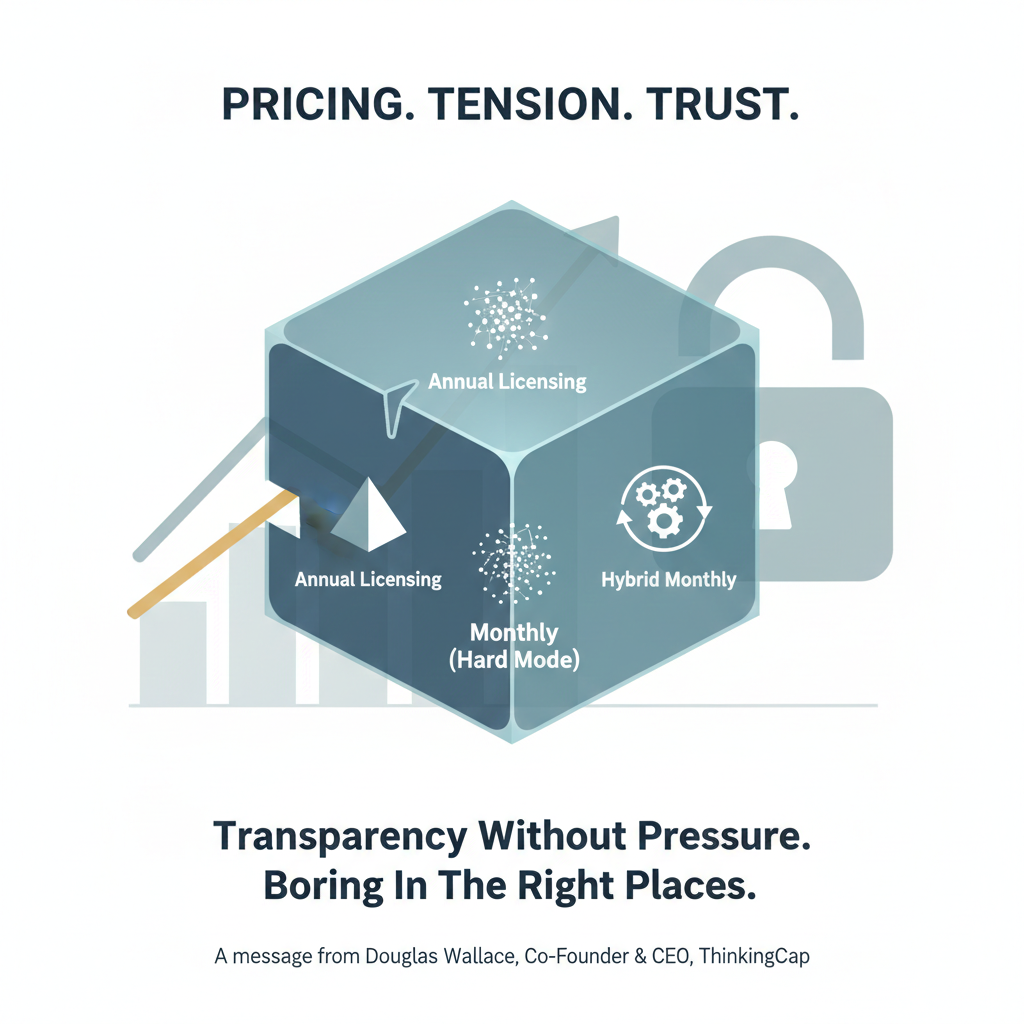
We really want you as a client, but your budget is your business. We have no idea what you can afford, but we do know exactly what it costs us to provide this service, build a system for the future, and make a couple of well-earned shekels in the process.
We use three models because uncertainty comes in different forms.
We do not believe there is one "correct" pricing model. What we see instead are three different kinds of uncertainty.
1
#### Annual Licensing: “We know who is here”
This is the easy one. You have a stable population—accreditation bodies, associations, or regulated workforces.
**The Deal:** You commit to a floor; you get our lowest per-seat cost. This is the most economical option for long-term users.
2
#### Monthly (Hard Mode): “We don’t know who is coming”
This is the no-holds-barred version of monthly pricing. You pay only for what happens each month.
**The Reality:** This model is intentionally unforgiving at low volume because flexibility has a literal cost. You are paying for the ability to be surprised.
3
#### Hybrid Monthly: “We know they’re coming, just not who”
This is where most rotating programs land. You commit to a larger monthly floor for a much better per-learner price.
**The Truth:** If the same learners use the system for months, annual licensing is cheaper. We will tell you that. The calculator will tell you that.
Bending over backwards for balance
For a long time, we let annual clients slide into cheaper tiers mid-term as soon as their usage crossed a threshold. It felt friendly, but it actually taught clients to underestimate their needs on purpose. It created a disincentive for honesty, which isn't healthy for a partnership.
So we changed the structure to protect our side, but then we bent over backwards to make sure it was fair to yours.
**Now, we allow one no-penalty "true-up" mid-renewal**. If you realize you should have bought at a higher level, you can jump to that level mid-term without a penalty—you just pay the difference you would have paid anyway. We always allow changes at the annual renewal, but this mid-term option brings the balance back. We took away what was unfair to us and added an option that ensures it's never unfair to you.
Even our contract is designed for balance
We don’t want to talk to your lawyers. We really don’t.
To avoid that, we’ve designed our contracts to be as close to "yes" as possible before they even reach your desk. We’ve already pushed the edge of what we can give in terms of protections and fairness. We pre-negotiated with ourselves so that we wouldn't have to spend weeks debating a simple sale.
We want to spend that time on your implementation, not on redlines.
What we actually want:
We want to talk about money once a year. If not less.
We want the rest of the conversations to be about learning, outcomes, automation, and data. We want pricing to disappear into the background. That only happens when trust exists on both sides.
Twenty years changes how you think about this. It’s long enough to see pricing fads come and go, and long enough to know that clarity beats novelty every time.
We are not trying to be the cheapest LMS. We are trying to be **fair, transparent,** and boring in the right places, so the contract is never the reason you don't pick us.
So go ahead and pick us already :-)
Signed,
Douglas Wallace Co-Founder and CEO
## No More Hide-and-Seek
Our baseline pricing is now public and predictable. Compare our Account-based and Activity-based models to see which fits your learner flow.
[View Our 2026 Pricing](https://www.thinkingcap.com/pricing)
---
---
title: Protecting privacy and the value of data
description: Thinking Cap Blog 2023-07-04
created: 2023-07-24
updated: 2023-07-24
authors: ThinkingCap
topics: [Blog]
status: published
canonical: https://console.thinkingcap.com/guest/Blog/blog-protecting-privacy-and-value-data
type: article
source_url: "https://www.thinkingcap.com/blog-protecting-privacy-and-value-data"
lastmod: 2023-07-24
scraped: 2026-08-19
order: 10
herotitle: Guaranteed privacy, while protecting the value of data
heroimage: "https://cdn.thinkingcap.com/medialibrary/00000000-0000-0000-0000-000000000000/e7145361-f75b-4081-91f7-1afbf1f8263c.jpg"
kicker: Blog
subtitle: Why thoughtful data practices matter to learners and organizations.
abstract: Privacy regulations such as GDPR, PIPEDA, and CCPA demand field-by-field data handling rather than a cookie-cutter policy. Thinking Cap supports one-click user anonymization and per-field Time To Live rules that progressively dehydrate an inactive user's personal data while preserving the demographic and learning records behind training investments.
---

# Guaranteed privacy, while protecting the value of data
Thinking Cap Blog | 2023-07-04
## Protecting the value of data while living up to the privacy your learners are guaranteed
The [General Data Protection Regulation (GDPR)](https://www.thinkingcap.com/gdpr) is a European standard but as it was the first to be so comprehensively defined and enforced it has quickly come to be a started used throughout the world. Regional standards like The Personal Information Protection and Electronic Documents Act (PIPEDA) in Canada or The CCPA (California Consumer Privacy Act) in the US all have similar goals.
Custom fields for users and activities
## Metadata
Thinking Cap is a system that runs on data. We use metadata about Users and Activities to drive a ton of automation and reporting. It is the uniqueness of the data types each of our clients uses that make their solution bespoke to them. So, with so many types of data and the relationship to privacy unique to each type Thinking Cap can’t employ a cookie-cutter approach to safeguarding privacy.

User-identifiable data
## Anonymizing data
Does your organization get requests to anonymize data from users? We have a built-in function to allow you to anonymize any user with a single click.

Requests are easy to track and but what about the day-to-day ongoing management of users who have become inactive? When a user goes inactive is defined by you and could be due to inactivity or the result of a message to the LMS from your User Management System. Regardless of how it is triggered, each metadata field has its own defined “Time To Live” after which the system will delete that data. This allows each organization to reflect on the information it is keeping and to make the appropriate choice as to when to remove data.
Following these principles, a user’s data is slowly and precisely dehydrated till in the end, all we have is a unique identifier demographic data, learner records and logs without any personal data.
The timelines and fields affected will be correctly forgotten to follow the spirit and letter of the [GDPR](https://www.thinkingcap.com/gdpr) while maintaining the hard-won demographic and Learning data needed to protect the training investments made by our clients.
Promoting stronger data security practices, while helping to prevent data breaches and unauthorized access will be key to the success of your training program going forward. If you're looking to implement an LMS that enforces these requirements, book a demo of these features.
[Request a personalized demo](https://www.thinkingcap.com/Book-a-demo)
---
Share this article
[Facebook](https://www.facebook.com/sharer/sharer.php?u=https://www.thinkingcap.com/blog-protecting-privacy-and-value-data&&t=Thinking Cap Blog: Protecting the value of data while living up to the privacy your learners are guaranteed. #thinking-cap-lms #learner-privacy #learner-data) [Twitter](https://twitter.com/intent/tweet?url=https://www.thinkingcap.com/blog-protecting-privacy-and-value-data&via=ThinkingCap&text=Thinking Cap Blog: Protecting the value of data while living up to the privacy your learners are guaranteed. #thinking-cap-lms #learner-privacy #learner-data) [LinkedIn](https://www.linkedin.com/shareArticle?mini=true&url=https%3A//www.thinkingcap.com/blog-protecting-privacy-and-value-data&title=Thinking Cap Blog: Protecting the value of data while living up to the privacy your learners are guaranteed. @thinkingcaplms #thinking-cap-lms #learner-privacy #learner-data&summary=&source=) [Email](mailto:?subject=Thinking Cap Blog: Protecting the value of data while living up to the privacy your learners are guaranteed?&body=Please visit Thinking Cap Blog: Protecting the value of data while living up to the privacy your learners are guaranteed at https://www.thinkingcap.com/blog-protecting-privacy-and-value-data)
## Want to find out more?
Book a session today for a personalized demo and Q&A.
[Book a Demo](https://www.thinkingcap.com/Book-a-demo)
---
---
title: "Website to LXP: Launching SickKids'' New Infant and Early Mental Health Promotion Website"
description: Thinking Cap Blog 2025-02-11
created: 2026-11-19
updated: 2026-11-19
authors: ThinkingCap
topics: [Blog]
status: published
canonical: https://console.thinkingcap.com/guest/Blog/blog-sickkids-iemhp-launches-new-website
type: article
source_url: "https://www.thinkingcap.com/blog-sickkids-iemhp-launches-new-website"
scraped: 2026-08-19
order: 21
herotitle: "Website to LXP: Launching SickKids' New Infant and Early Mental Health Promotion Website"
heroimage: "https://cdn.thinkingcap.com/medialibrary/00000000-0000-0000-0000-000000000000/bcf1d3b4-e442-496c-9a66-01ec36761178/1/bcf1d3b4-e442-496c-9a66-01ec36761178.jpg"
kicker: Blog
subtitle: How a specialist knowledge destination became a more connected learning experience.
abstract: The Hospital for Sick Children has launched its Infant and Early Mental Health Promotion website on Thinking Cap, pairing a public site with a connected LMS and a membership program offering exclusive training, discounts, webinars, and networking. Featured offerings include a five-module series for early childhood educators and a 15-lecture international series on infant mental health.
---

# Website to LXP: Launching SickKids' New Infant and Early Mental Health Promotion Website
Thinking Cap Blog | 2025-02-11

The Hospital for Sick Children (SickKids) has taken a significant step forward in advancing mental health awareness and education with the launch of its [**Infant and Early Mental Health Promotion (IEMHP)**](https://www.iemhp.ca/?utm_source=grow&utm_medium=email&utm_campaign=thinking-cap&utm_content=textlink&utm_term=blog) website, now delivered into Thinking Cap (LMS/LXP). This new digital hub serves as a vital resource for professionals, caregivers, and educators dedicated to supporting the mental well-being of infants and young children.
Exclusive benefits for early mental health professionals
## A New Membership Program for Expanded Access
With the launch of the new website, SickKids has introduced a membership program that provides exclusive access to a wealth of educational resources, research materials, and training modules. This membership ensures that professionals working in early childhood mental health have the latest evidence-based knowledge at their fingertips.
Through the Thinking Cap LXP, SickKids is able to offer **exclusive discounts and additional resources to members**. By leveraging Thinking Cap passes, members can unlock special pricing on courses, gain priority access to new content, and receive tailored learning recommendations that best suit their professional need

Exclusive perks for members
## Benefits of the Membership Program
```feature
icon: graduation-cap
title: Specialized Training
description: Access to specialized training modules on infant and early childhood mental health
```
```feature
icon: lightbulb
title: Expert Insights
description: Exclusive research insights and best practices from SickKids experts
```
```feature
icon: video
title: Live Webinars
description: Invitations to live webinars and Q&A sessions with specialists
```
```feature
icon: people-arrows
title: Professional Networking
description: Opportunities for networking and collaboration with other professionals in the field
```
Comprehensive learning for early mental health professionals
## Training Opportunities Available Through the LMS
The integration of the IEMHP website into our LMS allows seamless access to various training programs designed to enhance the skills of practitioners in early mental health intervention. Some of the key training offerings include:

##### Big Ideas for the Care of Tiny Humans: A Resource for Early Childhood Educators on Infant Mental Health
Learning Path
This five-module series equips Early Childhood Educators with essential knowledge on infant mental health, emphasizing wellness through pedagogy and featuring expert insights from Dr. Jean Clinton and Lorrie McGee Baird.
[Find out more](https://www.iemhp.ca/student/MyCourse.aspx?id=4b0dc23f-8e40-4394-901f-49a75d08c9d3&categoryid=&programid=00000000-0000-0000-0000-000000000000?utm_source=grow&utm_medium=email&utm_campaign=thinking-cap&utm_content=button&utm_term=blog)

##### Lecture Series: Laying the Path for Lifelong Wellness
Lecture Series
A 15-lecture series in partnership with WAIMH and Tampere University, providing global practitioners with foundational science, prevention strategies, and evidence-based interventions in infant mental health.
[Find out more](https://www.iemhp.ca/student/MyCourse.aspx?id=4926b4ae-7d89-447b-96bd-1276f6bbd78a&categoryid=&programid=00000000-0000-0000-0000-000000000000?utm_source=grow&utm_medium=email&utm_campaign=thinking-cap&utm_content=button&utm_term=blog)

##### The Importance of Supporting Social-Emotional Development in Chronic/Severe Medical Conditions
Webinar
This session explores the intersection of chronic medical conditions, trauma, and attachment in children, offering strategies to support mental and physical well-being within affected families.
[Find out more](https://www.iemhp.ca/student/MyCourse.aspx?id=ba612cac-6fad-43c3-8cf3-3706ba0af9bd&categoryid=&programid=00000000-0000-0000-0000-000000000000&lastPageTitle=Learning|61583397-b344-41c9-d1dc-50aee146f75a&returnUrl=ContentPage.aspx?PageID=61583397-b344-41c9-d1dc-50aee146f75a?utm_source=grow&utm_medium=email&utm_campaign=thinking-cap&utm_content=button&utm_term=blog)
Leadership and expertise driving innovation
## Enhancing Early Childhood Mental Health Training
Dr. Chaya Kulkarni, BAA, M.Ed, Ed.D (She/Her), Director of Infant and Early Mental Health Promotion (IEMHP) at SickKids Learning Institute, has spearheaded this initiative to expand access to high-quality mental health training.

> With Thinking Cap we were able to create a professional space for learners where they could access and participate in learning opportunities, track their learning, access resources and obtain their certificates. In addition, in a commitment to creating a seamless learning experience we pushed TC to create a website that would also connect visitors to our website to the learning management system. It was a tremendous amount of work but TC rose to the challenge and today we have a website and LMS that are connected!
>
> Dr. Chaya Kulkarni, BAA, M.Ed, Ed.D Director of Infant and Early Mental Health Promotion (IEMHP) at SickKids Learning Institute
Dr. Chaya Kulkarni envisions Infant and Early Mental Health Promotion (IEMHP) as a catalyst for systemic change, ensuring that every child from prenatal to age six has access to mental health resources and support. With a strong background in education and policy, including leadership roles as VP at Invest in Kids and Senior Policy Analyst at Queen’s Park, she is well poised to direct this vision. As an adviser to Dolly Parton’s Imagination Library and an active board member at Gateway Community Health Centre, she prioritizes strong community partnerships, evidence-based training, and policy influence, reinforcing the importance of early intervention in shaping lifelong well-being
Empower yourself with expert-led training
## Join the Movement: Become an IEMHP Member Today
The SickKids IEMHP website and membership program provide invaluable tools for those committed to improving early childhood mental health outcomes. Whether you are a healthcare professional, educator, or caregiver, joining this initiative will empower you with the knowledge and skills needed to make a lasting impact.
Visit the new [IEMHP website](https://www.iemhp.ca/?utm_source=grow&utm_medium=email&utm_campaign=thinking-cap&utm_content=textlink&utm_term=blog) through our LMS today and explore how you can be part of this transformative movement in early mental health education.

Customizable solutions for impactful learning
## See How Thinking Cap Can Support Your Organization
Are you ready to embrace the future of work? Take the next step in empowering your distributed workforce with the support of cutting-edge LMS technology. Request a demo of your solutions today and discover how we can transform the way your organization learns, grows, and thrives in the digital age. Join us in shaping the future of remote work with the power of LMS software. Request your demo now and unlock the potential of your remote teams.
[Request a personalized demo](https://www.thinkingcap.com/Book-a-demo)
---
Share this article
---
---
title: "Why did the LMS mark this student as Failed when he got 100%? Spoiler alert… we didn’t."
description: "Once upon a time there was a vison for LMSs managing the journey through course materials. There was an idea of Courses as collections of Shareable Content Objects (SCOs) with rules around each SCO where how you…"
created: 2020-08-17
updated: 2020-08-17
authors: ThinkingCap
topics: [Blog]
status: published
canonical: https://console.thinkingcap.com/guest/Blog/blog-student-success
cover: https://thinkingcap.blob.core.windows.net/learnerview/00000000-0000-0000-0000-000000000000/advanced/blog-student-success_1714213678_lg.jpg
type: article
source_url: "https://www.thinkingcap.com/blog-student-success"
lastmod: 2020-08-17
scraped: 2026-08-19
order: 15
heroimage: "https://thinkingcap.blob.core.windows.net/learnerview/00000000-0000-0000-0000-000000000000/advanced/blog-student-success_1714213678_lg.jpg"
kicker: Blog
subtitle: Untangling the difference between assessment scores and completion rules.
abstract: "When a learner scores 100% but shows as Failed, the course, not the LMS, reported that status. Single-SCO courses control everything they send and authoring tool gaps often leave stale or missing values; administrators can find the truth in the SCORM API log through cmi.completion_status, cmi.success_status, and cmi.score.scaled."
---
# Thinking Cap Blog
# Why did the LMS mark this student as Failed when he got 100%? Spoiler alert… we didn’t.

## Why did the LMS mark this student as Failed when he got 100%? Spoiler alert… we didn’t.
Posted: 2020-08-17
---
Once upon a time there was a vison for LMSs managing the journey through course materials. There was an idea of Courses as collections of Shareable Content Objects (SCOs) with rules around each SCO where how you performed in a SCO would determine your next step. It allowed for defining remediation paths, it let you set Objectives… it was great. It was designed by Instructional Designers for Instructional Designers. And the entire eLearning Authoring tool world ignored it.
Authoring tool manufacturers don’t trust the LMSs people put the packages in. The idea of supporting the small variations of interpretation made by all the LMS vendors and the resulting “he said, she said” that would come by relying on an LMS to interpret your sequencing rules correctly…. Well, it was too big an ask. Add to this that very few of their customers wanted to learn Sequencing or to design their SCOs for reuse and you can see why we live in a world of Single SCO courses.
> ### At the end of the day the LMS does what it is told.
This didn’t mean they didn’t want all the bells and whistles. Authoring tools still offered sequence control between the pages and chapters in the course you create, and some might even let you manage objectives and interactions. But control over how a leaner moves through this content is 100% controlled by the course itself. The course keeps track of you across visits by writing a number of values back to the LMS. Some we can read and understand like Completion and Success and Score. But most of the good stuff is hidden inside “Suspend Data” and it is proprietary to the Course Authoring tool and often obfuscated to hide what is going on.
With nearly 20 years in this business, I can tell you it is very common that they didn’t think out all the possible interactions of where a leaner is in the course with what their current status is. For instance, we see users who launch the course and are taken to the last page and told congratulations you have completed and the message sent to the LMS is “Incomplete” or the user got a failing grade then improved it and the Course sends the LMS the new grade but never updates “Failed” to “Passed”. I also have seen customers irate because the course report does not tell them how many people got question 3 wrong because the course never sent the LMS any interaction information.
Sometimes it isn’t bad Authoring tools so much as the tool giving the Author enough rope to hang themselves. Often, I’ve seen the Author has not taken into account that they gave the Learner a way to skip a page they defined as required but never gave them a way to get back to it once skipped. Most of these issues can be fixed by making a few small adjustments to the rules in the tool or by sending Suspend Data examples to the Support team of the Authoring tool.
At the end of the day the LMS does what it is told. As an Administrator learn how to read the SCORM API Log we provide. We can do a whole Post on just what do they all mean but for our purposes you are looking for these three: cmi.completion\_status, cmi.success\_status cmi.score.scaled. These three control the Completion Status, Success and Score for a learner and none are defined by the LMS.
### Share
[Facebook](https://www.facebook.com/sharer/sharer.php?u=https://www.thinkingcap.com/student-success) [Twitter](http://twitter.com/share?url=https://www.thinkingcap.com/student-success&via=ThinkingCap&text=Thinking Cap Blog: Why did the LMS mark this student as Failed when he got 100%? Spoiler alert… we didn’t.) [LinkedIn](http://www.linkedin.com/shareArticle?mini=true&url=https://www.thinkingcap.com/student-success&title=Thinking Cap Blog: Why did the LMS mark this student as Failed when he got 100%? Spoiler alert… we didn’t.) [Pinterest](https://pinterest.com/pin/create/button/?url=https://www.thinkingcap.com/student-success&media=&description=Thinking Cap Blog: Why did the LMS mark this student as Failed when he got 100%? Spoiler alert… we didn’t.) [Email](mailto:?subject=Thinking Cap Blog: Why did the LMS mark this student as Failed when he got 100%? Spoiler alert… we didn’t.&body=Please visit Thinking Cap Blog: Why did the LMS mark this student as Failed when he got 100%? Spoiler alert… we didn’t. at https://www.thinkingcap.com/student-success)
---
---
title: 10 tips to upskill your manufacturing workforce
description: Thinking Cap Blog 2022-09-06
created: 2022-09-06
updated: 2022-09-06
authors: ThinkingCap
topics: [Blog]
status: published
canonical: https://console.thinkingcap.com/guest/Blog/blog-upskill-your-manufacturing-workforce
type: article
source_url: "https://www.thinkingcap.com/blog-upskill-your-manufacturing-workforce"
lastmod: 2022-09-06
scraped: 2026-08-19
order: 11
heroimage: "https://cdn.thinkingcap.com/medialibrary/00000000-0000-0000-0000-000000000000/612f4faf-6a3a-4941-bc3e-b98bee7cdc07.jpg"
kicker: Blog
subtitle: Practical ideas for building capability in a changing industrial environment.
abstract: "Ten practical tips for upskilling a manufacturing workforce, drawn from two decades of sector experience: automate enrollment around skill gaps, send targeted reminders, gamify learning paths, capture in-house expertise through webinars and supervisor attestations, localize content, segment departments, offer just-in-time access, and certify safety compliance."
---

# 10 tips to upskill your manufacturing workforce
Thinking Cap Blog | 2022-09-06
At Thinking Cap we know a thing or two about the challenges of running a successful upskilling and reskilling training program for the manufacturing sector. We should; we’ve been at this for over 20 years.
Enrollment
## 1. Automate enrollment based on skill gaps
Enrol your employees into the training they need automatically based on their job role, experience, equipment they will be using. Ideally the second an employee starts they are onboarded into your training program and are automatically enrolled into their required training. But it doesn't have to stop there. Once they have completed the basics, they can be automatically enrolled into the next tier of training, whether more advanced training related to their jobs, or leadership training.

Notifications
## 2. Send targeted reminders to keep them on track

Keep your learners top-to-speed on the training they need by notifying them of upcoming training or training they have been enrolled into. Notifications should be sent to their email or phone, whichever they are more likely to read. Prepare a communication strategy to help drive your employees to both complete their assigned training, and promoting elective training.
Thinking Cap supports many notifications sent by either email or text.
[More about notifications](https://www.thinkingcap.com/communication)
Gamification
## 3. Develop gamified learning paths to maintain interest
Training doesn't have to be boring. Attracting and retaining employees is easier when gamification is incorporated into your training programs. Whether awarding badges upon completing training tasks, granting certificates upon completing a learning path, or creating competitive boards between your manufacturing plants on the number of learning points, there are many strategies that work.
Thinking Cap is co-presenting a webinar on Gamification with Brandon Hall:
**Playing to Win: Adopting Gamification to Achieve Your Learning Goals**
10/11/22 - Join us for a discussion on the benefits of gamification, the role it can play in learning, and strategies for implementation within your LMS.
[Register for the Webinar ↗](https://us06web.zoom.us/webinar/register/1016607467022/WN_A6vVvfGZT0uzH2lFIDFH7g)

Topical
## 4. Schedule relevant live in-person and webinar events

There's always an employee who has tips and tricks on how to use specific equipment, so take advantage of this knowledge and have them host a webinar. Better yet, record this webinar and re-use it to share with new employees or employees that couldn't attend.
Thinking Cap supports instructor-led activities.
[More about activity types](https://www.thinkingcap.com/experience)
In-person
## 5. On-the-job training sessions with their supervisor
Safety is important. Sometimes, you can develop courses on how to use a piece of equipment, but before they can use it, you want to double check they understand how to use it safely. For this, we recommend having them demonstrate their new sill to their supervisor. This can be tracked in the LMS, with notes from the supervisor on how they did and advice going forward.
Thinking Cap supports demonstration options in our attestation-type activities.
[More about activity types](https://www.thinkingcap.com/experience)

Localization
## 6. Offer training in multiple languages

Speak their language whenever and wherever possible. This includes in your courses and in the LMS. Make sure your LMS can support all languages you need and where possible translate your training content.
Thinking Cap supports many localization features as part of our highly customizable learner experiences.
[More about localization](https://www.thinkingcap.com/experience)
Collaboration
## 7. Create knowledge networks using forums
So much knowledge and skills are transferred on the job. Capture as much of the tips they share through the LMS to benefit employees in different locations or shifts. Track the employees people find to be the most useful as they could be resources you can tap for other training projects.
Thinking Cap supports many communication and collaboration features.
[More about collaboration](https://www.thinkingcap.com/communication)

Segment
## 8. Segment departments for more specific training needs

Different locations may have different policies and equipment. Don't lock all of your employees into the same training and waste their time taking courses that are irrelevant to them. Employees can be segmented using different enrollment rules, or by grouping them into separate domains. This will also give you a chance to build a community within each group and provide them with resources specific to their needs.
Anytime
## 9. Offer 24 access to training for just-in-time learning
Provide access to training anytime. Make sure your employees going into a new position have access to training so if they need to use a new machine or follow a new procedure, they have access to training real-time.

Certification
## 10. Provide certification for safety compliance

Certify your employees as they complete learning paths for core skills. This will help identify employees ready for promotion and encourages learners to complete both their required training, but also enroll into elective training.
Thinking Cap supports many certification features.
[More about certification](https://www.thinkingcap.com/certification)
## Want to find out more?
Book a session today for a personalized demo and Q&A.
[Book a Demo](https://www.thinkingcap.com/Book-a-demo)
---
---
title: Why We Are Discontinuing Support for Studio
description: Thinking Cap Blog 2025-03-03
created: 2025-03-03
updated: 2025-03-03
authors: ThinkingCap
topics: [Blog]
status: published
canonical: https://console.thinkingcap.com/guest/Blog/blog-why-we-are-discontinuing-support-for-studio
cover: https://cdn.thinkingcap.com/medialibrary/00000000-0000-0000-0000-000000000000/02260faa-2a2b-4127-8aaa-1ad4757a6bd0/1/02260faa-2a2b-4127-8aaa-1ad4757a6bd0.jpg
type: article
source_url: "https://www.thinkingcap.com/Blog-Why-We-Are-Discontinuing-Support-for-Studio"
lastmod: 2025-03-03
scraped: 2026-08-19
order: 2
heroimage: "https://cdn.thinkingcap.com/medialibrary/00000000-0000-0000-0000-000000000000/02260faa-2a2b-4127-8aaa-1ad4757a6bd0/1/02260faa-2a2b-4127-8aaa-1ad4757a6bd0.jpg"
kicker: Blog
subtitle: The thinking behind a product transition and what it means for customers.
abstract: Thinking Cap is ending support for Studio, its structured authoring tool, as customers shifted to freeform content creation and AI-generated lessons displaced manual authoring. The company is refocusing its LMS on content curation and AI-driven personalization rather than course creation.
---

# Why We Are Discontinuing Support for Studio.
Thinking Cap Blog | 2025-03-03
For years, our internally developed authoring tool, Studio, played a crucial role in our LMS, setting a high standard for structured instructional design. However, the evolving edtech landscape has shifted towards freeform content creation, driven by demand for ease of use over rigid instructional models. With the rise of AI-powered content generation, the need for traditional authoring tools has diminished, prompting our decision to discontinue support for Studio.
## The Changing Landscape of Content Creation
Initially, Studio provided a structured, semantically driven approach to course design. However, the market gravitated towards freeform tools, prioritizing ease of use and flexibility over instructional rigor.
#### Shift to Flexible Course Creation
Organizations moved away from structured content models, favoring tools with fewer technical constraints.
#### Decline in Studio's Demand
The preference for flexible tools reduced interest in Studio’s template-based approach.
#### Rise of PowerPoint-style Tools
Institutions adopted easier, slide-based authoring tools over Studio’s structured methodologies.
## Deregulation and Compliance Changes
AI's rapid evolution has fundamentally changed content creation, making it faster and more efficient than traditional authoring methods.
### Potential Impacts:
#### AI-Powered Lesson Creation:
AI-driven tools now enable instant generation of high-quality lessons, reducing the need for manually authored content.
#### Declining Value of Traditional Tools:
Traditional authoring tools like Studio no longer provide the same level of value as AI-based alternatives.
#### Instant Professional Training Materials:
AI content platforms allow educators and businesses to create professional-grade training materials in seconds, eliminating delays associated with manual course development./p>
## The Future of LMS: From Content Creation to Curations
The role of LMS platforms is shifting from content creation to content curation, focusing on delivering the right learning experiences rather than developing original course materials.
#### Evolving LMS with AI Integration:
Modern LMS solutions aggregate and contextualize learning materials from various sources, integrating AI-driven personalization.
#### Shift to Curated Learning:
Businesses are moving away from pre-built content libraries, favoring a more flexible, curated learning experience.
#### AI vs. Traditional Content Libraries:
Platforms like Open Sesame and LinkedIn Learning offer vast catalogs, but AI-generated content now matches or exceeds their quality, making content curation more relevant than ever.
## AI's Impact on Business & Educationg
Organizations are shifting from content creation to AI-powered curation, enabling personalized learning experiences. This evolution opens new opportunities for LMS providers, while those slow to adapt risk falling behind in an AI-driven industry.
## Looking Ahead: Adapting to a Changing Landscape
As AI continues to revolutionize education, institutions and businesses must adapt to new technologies that enhance learning experiences. This shift is reshaping how content is delivered, personalized, and accessed.
#### Emerging AI Trends:
The rapid advancement of AI-generated learning materials is transforming the education landscape, making adaptive learning experiences more effective.
#### Strategic Adaptation:
Organizations should pivot towards AI-driven content curation and personalized learning approaches to remain competitive.
#### Future Industry Shifts:
The education sector must evolve by prioritizing outcome-based methodologies over traditional, rigid course structures.
**Discontinuing support for Studio marks a strategic pivot for Thinking Cap. By focusing on content curation rather than creation, we are aligning with the future of edtech, where learning experiences are personalized, flexible, and AI-powered. The transition may be challenging for some, but it represents an exciting evolution in delivering education. We look forward to shaping this ne**
---
---
title: Blog
description: Radical transparency means you get the pricing info you need without the song and dance required by traditional LMS sales tactics.
created: 2026-11-19
updated: 2026-11-19
authors: ThinkingCap
topics: [Blog]
status: published
canonical: https://console.thinkingcap.com/guest/Blog/blog
type: page
source_url: "https://www.thinkingcap.com/blog"
scraped: 2026-08-19
order: 1
herotitle: Thinking Cap Blog
heroimage: "https://cdn.thinkingcap.com/medialibrary/00000000-0000-0000-0000-000000000000/ed6ebce9-d41c-489b-8001-cd46292fdd9e.jpg"
kicker: Ideas and Stories
subtitle: Stories, ideas and practical insights from the people behind our work.
---

# Thinking Cap Blog
## Recent Articles

##### Pricing, Tension, and Trust
2026-02-04
Radical transparency means you get the pricing info you need without the song and dance required by traditional LMS sales tactics.
[Find out more](https://www.thinkingcap.com/blog-pricing-tension-trust)

##### Not AI. Just Decorated.
2026-01-19
Most "AI-first" LMS platforms are just adding cosmetic layers. Explore why real AI advantage comes from architecture, not just decoration.
[Find out more](https://www.thinkingcap.com/blog-no-ai-just-decorated)

##### Building a Safer Future: The Role of Training in Construction Safety
2025-01-20
Effective safety training reduces risks and ensures compliance—see how standardized learning keeps construction workers safe.
[Find out more](https://www.thinkingcap.com/blog-building-safer-future)

##### Data Hydration and Dehydration: Safeguarding Privacy
2024-11-12
Explore how data hydration and dehydration enhance privacy protection and GDPR compliance in Thinking Cap LMS for secure, compliant data management.
[Find out more](https://www.thinkingcap.com/blog-data-hydration-dehydration-safeguarding-privacy)

##### Exciting Changes Coming to Thinking Cap: Unlocking Greater Flexibility with Connections
2024-10-22
Unlock the full potential of your SCORM course—beyond just content—by leveraging key features that ensure seamless experiences, faster performance, and actionable insights, essential for success.
[Find out more](https://www.thinkingcap.com/blog-introducing-connections)

##### Seven tips for creating an unbreakable SCORM course
2024-04-18
Unlock the full potential of your SCORM course—beyond just content—by leveraging key features that ensure seamless experiences, faster performance, and actionable insights, essential for success.
[Find out more](https://www.thinkingcap.com/blog-7-tips-unbreakable-scorm-course)

##### Measuring Success: Key Performance Indicators (KPIs) for Training Programs
2023-11-02
Tracking Key Performance Indicators (KPIs) provides valuable insights into the effectiveness of your training programs, allowing you to identify areas of success and areas needing improvement.
[Find out more](https://www.thinkingcap.com/blog-kpis-key-performance-indicators)

##### LMS Software and Remote Work: Empowering Distributed Teams
2023-09-27
Strategies for effectively supporting a fully remote or hybrid workforce to harness the benefits of enhanced flexibility, access to global talent, and reduced commuting stress.
[Find out more](https://www.thinkingcap.com/blog-empowering-distributed-teams)

##### Guaranteed privacy, while protecting the value of data
2023-07-24
Protecting the value of data while living up to the privacy your learners are guaranteed.
[Find out more](https://www.thinkingcap.com/blog-protecting-privacy-and-value-data)

##### 10 tips to upskill your manufacturing workforce
2022-09-06
Working with manufacturing clients we have found there are key steps to deliver a successful training program.
[Find out more](https://www.thinkingcap.com/blog-upskill-your-manufacturing-workforce)

##### Want to learn a dirty secret about Activity Inheritance? It’s a lie! ;-)
2021-01-12
Thinking Cap’s greatest party trick is the tree of domains that allow you to define complex organizations and allows for any number of these Domains to have their own URL and unique Learner Experiences...
[Find out more](https://www.thinkingcap.com/blog-activity-inheritance)

##### Learning Path Flow Control... We can do this the easy way, or we can do it the hard way
2020-08-17
I have built a Learning Path with 10 courses. I want the learner to take each in succession...
[Find out more](https://www.thinkingcap.com/blog-learning-path-flow-control)

##### Attestations can replace Demonstrations, Comprehensions and Portfolio
2020-10-01
What is the point of an LMS? First and foremost, it is not about Learning...
[Find out more](https://www.thinkingcap.com/blog-attestations)

##### Why did the LMS mark this student as Failed when he got 100%?
2020-08-17
Spoiler alert... we didn’t.
[Find out more](https://www.thinkingcap.com/blog-student-success)

##### Why do I want to build custom activity types?
2020-06-05
You shouldn't have to limit yourself to the standard list of activity types.
[Find out more](https://www.thinkingcap.com/blog-custom-activity-types)
---
---
title: "The Changing LMS Landscape: How Recent U.S. Policy Shifts Could Impact Fair Competition in Education Technology"
description: Thinking Cap Blog 2025-02-25
created: 2025-02-25
updated: 2025-02-25
authors: ThinkingCap
topics: [Blog]
status: published
canonical: https://console.thinkingcap.com/guest/Blog/changinglmslandscape
cover: https://cdn.thinkingcap.com/medialibrary/00000000-0000-0000-0000-000000000000/456682b8-5795-4dba-8cbf-97743cbcc32b/1/456682b8-5795-4dba-8cbf-97743cbcc32b.jpg
type: article
source_url: "https://www.thinkingcap.com/ChangingLMSLandscape"
lastmod: 2025-02-25
scraped: 2026-08-19
order: 3
herotitle: "The LMS Industry in the Wake of Trump’s Executive Orders."
heroimage: "https://cdn.thinkingcap.com/medialibrary/00000000-0000-0000-0000-000000000000/456682b8-5795-4dba-8cbf-97743cbcc32b/1/456682b8-5795-4dba-8cbf-97743cbcc32b.jpg"
kicker: Blog
subtitle: Consider how policy and market changes may reshape competition in education technology.
abstract: "Recent U.S. executive orders reversing Biden-era education policies carry direct consequences for the LMS industry: reduced federal funding, deregulation of privacy and accreditation standards, restrictions on DEI-related content, and a pivot toward corporate and international markets. Agile providers can adapt through private-sector partnerships, AI personalization, and close tracking of state-level rules."
---

# The LMS Industry in the Wake of Trump’s Executive Orders.
Thinking Cap Blog | 2025-02-25
The Learning Management System (LMS) industry is navigating significant changes following recent executive orders from former President Donald Trump. These orders, reversing many Biden-era policies, have direct implications for educational institutions and the platforms that support them. The key areas affected include federal funding, regulatory compliance, and shifts in educational priorities.
## Impact on Federal Funding for LMS Providers
One of the most immediate concerns is the potential redirection of federal funding. Under the Biden administration, education technology saw strong federal support, with grants and subsidies allocated for digital learning infrastructure. Trump's policy shift prioritizes cost-cutting measures and a reduction in federal involvement in education, which could mean fewer funding opportunities for public institutions relying on LMS solutions.
### For private LMS vendors, this could result in:
#### A slowdown in contracts from public universities and K-12 schools.
#### Increased competition for remaining federal grants.
#### A pivot towards corporate training markets where federal policies have less influence.
## Deregulation and Compliance Changes
Trump’s orders also emphasize deregulation, aiming to reduce government oversight on educational programs. This change could be a double-edged sword for LMS platforms. While decreased regulation may lower compliance costs, it also introduces uncertainty regarding standards for accessibility, data privacy, and accreditation.
### Potential Impacts:
#### Less Oversight on Student Data Protection:
A rollback of strict privacy regulations may shift responsibility to individual institutions, increasing the compliance burden on LMS providers.
#### Relaxed Accreditation Requirements:
If federal education standards are loosened, more non-traditional learning providers may enter the market, increasing competition.
#### State-Level Variability:
Without strong federal guidelines, states may develop their own LMS-related compliance rules, forcing vendors to navigate a patchwork of regulations.
## DEI Initiatives and Content Restrictions
A significant shift is occurring in diversity, equity, and inclusion (DEI) policies. Trump’s order restricts federal funding for DEI initiatives in education, which could affect:
#### LMS-hosted courses that include DEI-related content:
Schools and corporations receiving federal funding may be hesitant to include certain training modules.
#### Bias detection and AI-driven personalization:
Some AI-based LMS platforms that tailor content to diverse learners might face challenges in securing public-sector contracts.
#### EdTech Partnerships with Public Institutions:
Companies known for promoting inclusivity may find themselves in politically sensitive situations when contracting with federally funded schools.
## Market Shift Toward Private and Corporate Learning
Given the uncertainty in public education funding, LMS companies are likely to shift their focus toward private-sector learning. This could result in:
#### An increase in corporate training solutions:
As government contracts become more unpredictable, companies may invest in workforce training and compliance-driven LMS solutions.
#### Growth in direct-to-consumer education:
With public universities potentially scaling back online course offerings, there may be more demand for independent e-learning platforms.
#### Greater reliance on international markets:
Companies may expand globally to offset potential revenue losses from U.S. policy changes.
## Looking Ahead: Adapting to a Changing Landscape
While Trump’s executive orders create uncertainty, they also open opportunities for agile LMS providers that can adapt to the new environment. Key strategies for success include:
#### Strengthening partnerships with private companies to mitigate reliance on public education funding.
#### Investing in AI-driven personalization to meet corporate training needs.
#### Exploring international expansion to tap into markets less affected by U.S. policy changes.
#### Staying ahead of state-level policy shifts to ensure compliance with evolving regional regulations.
**The coming months will determine the extent of these changes, but one thing is clear:
the LMS industry must be prepared for a period of rapid adaptation.**
---
---
title: "ThinkingCap LMS | Home"
description: "Your browser does not support the video tag. ](/media/home-hero-poster.jpg)](https://cdn.thinkingcap.com/medialibrary/00000000-0000-0000-0000-000000000000/f0b86ab3-8bdc-4ac4-ab2b-f…"
created: 2025-03-24
updated: 2025-03-24
authors: ThinkingCap
topics: []
status: published
canonical: https://console.thinkingcap.com/guest/index
type: page
source_url: "https://www.thinkingcap.com/"
lastmod: 2025-03-24
scraped: 2026-08-19
order: 23
herotitle: Put on your thinking cap
subtitle: Deliver beautiful, scalable, and role-specific training experiences with full control over branding, automation, and audience segmentation.
- label: Quick Tour
href: "https://www.thinkingcap.com/quicktour"
style: secondary
---
[](https://cdn.thinkingcap.com/medialibrary/00000000-0000-0000-0000-000000000000/f0b86ab3-8bdc-4ac4-ab2b-f8bbdde9f16b/1/f0b86ab3-8bdc-4ac4-ab2b-f8bbdde9f16b.mp4)
# Put on your thinking cap
Deliver beautiful, scalable, and role-specific training experiences with full control over branding, automation, and audience segmentation.
Match your learner view to your website — to the pixel.
[Book a Demo](https://www.thinkingcap.com/book-demo)
[Quick Tour](https://www.thinkingcap.com/quicktour)
## Explore Our Solutions
### Train Your Extended Enterprise
Deliver **branded learning** to partners, customers, franchises, and vendors — all from one LMS.
[Explore](https://www.thinkingcap.com/extended-enterprise)
### Scale with Multi-Tenant Learning
Manage **multiple audiences** and branded portals in a single platform — with zero duplication.
[Explore](https://www.thinkingcap.com/multi-tenant)
### Power Member Education
Offer **CE and certification programs** with automated tracking, credit awards, and transcripts.
[Explore](https://www.thinkingcap.com/solutions-professional-associations)
### Sell Your Training with Ease
Launch **e-commerce-ready learning** with storefronts, subscriptions, bundles, and coupons.
[Explore](https://www.thinkingcap.com/selling)
### Simplify Compliance Training
Automate **role-based training**, recurring certifications, and progress audits with confidence.
[Explore](https://www.thinkingcap.com/compliance)
#### Not sure which solution fits best?
Let us guide you through the right setup for your audience, content, and goals.
[Book a Personalized Demo](https://www.thinkingcap.com/book-demo)
Delve deeper
## Thinking Cap Features

[##### Activities
From SCORM 1.2 or 2004 courses, instructor-led to custom interactive types all bundled in learning paths.
Learn more](https://www.thinkingcap.com/activities)

[##### Experience
Deliver your training materials your way in a branded, mobile-friendly, accessible learner experience.
Learn more](https://www.thinkingcap.com/experience)

[##### Commerce
Sell your learning to individuals or in bulk, with a myriad of promotional pricing options through many payment processors.
Learn more](https://www.thinkingcap.com/commerce)

[##### Certification
Continue your audience’s education through a crediting system, certificates and badges.
Learn more](https://www.thinkingcap.com/certification)

[##### Communication
Foster communications through automated notifications, announcements, discussion forums and live chat.
Learn more](https://www.thinkingcap.com/communication)

[##### Integration
Integrate your LMS with internal and specialized applications including ERPs, webinar providers, payment processors, analytics and more.
Learn more](https://www.thinkingcap.com/integrations)

[##### Reports
Visualize your data through a comprehensive collection of activity or program-wide report options.
Learn more](https://www.thinkingcap.com/reporting)

[##### Security
Lock down your LMS security and privacy with our single-sign-on integrations, user permissions, and account and password management.
Learn more](https://www.thinkingcap.com/security)
```feature
icon: shield-halved
title: Security
description: Lock down your LMS security and privacy with our single-sign-on integrations, user permissions, and account and password management.
```
```feature
icon: palette
title: Experience
description: Deliver your training materials your way in a branded, mobile-friendly, accessible learner experience.
```
```feature
icon: hand-holding-usd
title: Commerce
description: Sell your learning to individuals or in bulk, with a myriad of promotional pricing options through many payment processors.
```
```feature
icon: comments
title: Communication
description: Foster communications through automated notifications, announcements, discussion forums and live chat.
```
```feature
icon: file-lines
title: Certification
description: Continue your audience’s education through a crediting system, certificates and badges.
```
```feature
icon: chart-line
title: Reports
description: Visualize your data through a comprehensive collection of activity or program-wide report options.
```
Quick Tour
## Thinking Cap LMS Administrator's Demo
Skip hours of phones calls and emails with sales people just to see what the LMS looks like. We won't make you do that!
Sit back and relax while we walk you through a quick overview of the Thinking Cap LMS.... Right here, right now.
- Navigating our LMS's administrative view
- Managing activities and enrollments
- Managing user accounts
- Managing media resources
- Available report templates
- Discussion forums
- and more...
[](https://stable.b-cdn.net/medialibrary/00000000-0000-0000-0000-000000000000/intro.mp4)
## Want to find out more?
Book a session today for a personalized demo and Q&A.
Book a Demo
Webinar
## Playing Smart: Implementing Your Gamification Strategy
Thinking Cap co-presented a webinar on Gamification with Brandon Hall:
**Playing to Win: Adopting Gamification to Achieve Your Learning Goals**
We recently hosted a discussion on the benefits of gamification, its role in learning, and strategies for effective implementation within an LMS.

**David Wentworth**
Principal Learning Analyst
Brandon Hall Group

**Isobel Wallace**
General Manager
Thinking Cap
[View the Webinar](https://www.thinkingcap.com/webinars)

Articles
## From our blog

##### Pricing, Tension, and Trust
2026-02-04
Radical transparency means you get the pricing info you need without the song and dance required by traditional LMS sales tactics.
[Find out more](https://www.thinkingcap.com/blog-pricing-tension-trust)

##### AI Course Authoring Tools: Moving Beyond the Basics
2025-09-09
Explore AI course authoring tools that go beyond Articulate Rise. Discover how AI accelerates content drafting, develops courses, and enhances learner engagement.
[Find out more](https://www.thinkingcap.com/blog-ai-course-authoring-tools)

##### Website to LXP: New Era for SickKids’ IEMHP Training
2025-03-27
SickKids’ IEMHP program debuts a new Thinking Cap LMS site to expand access to early mental health training and resources for professionals in Canada.
[Find out more](https://www.thinkingcap.com/blog-sickkids-iemhp-launches-new-website)

##### Electrical Safety Authority Launches New Learning Program on Thinking Cap LMS
2025-03-26
Discover how the Electrical Safety Authority launched their new training program with Thinking Cap LMS—custom-branded, user-friendly, and ready to grow.
[Find out more](https://www.thinkingcap.com/blog-electrical-safety-authority-lms-launch)
Testimonials
## Our dear customers...

> I Thinking Cap
>
> 20,000 learners that we manage and we've never had a problem. It's reliable, and dependable. Our non-technically people find it easy to use. Robust in the sense that it hasn't given us any problem. Functions reliability. Extensible Flexible Good Reporting, learner searchability. Nice to see that they listen to customer feedback, addressing needs with each release.
>
> Tim Bolger Project Manager, Learning Innovation for Buildforce Canada
---
---
title: Pricing
description: Transparency is our foundation. Choose the model that aligns with your audience's behavior.
created: 2026-11-19
updated: 2026-11-19
authors: ThinkingCap
topics: []
status: published
canonical: https://console.thinkingcap.com/guest/pricing
type: page
source_url: "https://www.thinkingcap.com/pricing"
scraped: 2026-08-19
order: 8
subtitle: Find a model shaped around your organization, audiences and ambitions.
kicker: Plans and Possibilities
- label: Start a Conversation
href: "https://www.thinkingcap.com/contact-us"
style: primary
---
# Thinking Cap LMS Pricing
Transparency is our foundation. Choose the model that aligns with your audience's behavior.
Transparency in LMS pricing is rare. A plan that isn’t stacked against you is even rarer.
We don’t nickel and dime. We charge a fair price and offer multiple models that reflect the real ways a learning management system is used.
Legacy giants play a shell game. A low entry price, followed by a mountain of add-on fees for features you assumed were included. It’s exhausting.
At Thinking Cap, your license fee covers our entire ecosystem. No feature tolls. No surprise upgrades. Your budget goes to learners and outcomes, not software activation.
### One price, Everything Included
#### Onboarding, Included.
We handle onboarding properly. That means importing historical data, setting up your organisational structure, integrating external systems, and connecting your LMS to SSO and your system of record for users. A strong onboarding sets the foundation for everything that follows. Many vendors charge extra for this. We include it because shared outcomes require shared commitment.
#### No Upsell Features.
There are no surprise modules or gated essentials. Advanced reporting, certifications, multi-tenant branches, e-commerce, and badging are all included. You are not renting fragments of a platform. You are licensing a complete LMS.
#### Training and Ongoing Partnership
Your team training, ongoing support, and day-to-day guidance are part of the relationship. We do not disappear after implementation. We operate as a long-term partner, and we price accordingly. We have heard about Premium Support as an add-on... we think it's an essential element.
Interactive Pricing Calculator
### Simple Pricing, Flexible Models.
See exactly what ThinkingCap will cost with **no demo required**. Build your own scenario or let AI do it for you.
- Drag bars to model your monthly usage
- Compare Annual, Monthly & Hybrid side by side
- AI consultant recommends your best-fit model
- Download a custom pricing PDF instantly
[Try the Pricing Calculator](https://pricing.thinkingcap.com)
No signup needed — fully transparent
## Choose the Model that Fits Your Audience
Thinking Cap offers three distinct commercial models, each aligned to how your audience actually uses the platform. This lets us right-size your contract while giving you predictable performance, transparent billing, and efficient use of your budget.
#### Annual Model
Choose this model when you have a stable, internal workforce with consistent, year-round training requirements.
[Learn more](https://www.thinkingcap.com/ContentPage.aspx?PageID=257a5f4d-fafd-c0ce-8c81-577cdb1bb366#Annual)
#### Monthly Model
Choose this model when participation levels are unpredictable but you want the freedom to scale usage up or down month to month.
[Learn more](https://www.thinkingcap.com/ContentPage.aspx?PageID=257a5f4d-fafd-c0ce-8c81-577cdb1bb366#Monthly)
#### Hybrid Model
Choose this model when you know roughly how many users you will have each month, but the individuals change. The overall volume is reasonably consistent, even though participation rotates.
[Learn more](https://www.thinkingcap.com/ContentPage.aspx?PageID=257a5f4d-fafd-c0ce-8c81-577cdb1bb366#Hybrid)
## Annual Model
Choose this model when you have a stable, internal workforce with consistent, year-round training requirements.
### How it Works
You reserve a fixed number of seats for the year at our best rate. If you need more, extra licenses are discounted rather than repriced.
#### Billing Signal
A unique user account that is in an “Active” status for three months or more during the 12-month license period. In this case, the annual license is the most cost-effective option.
#### Reset Cadence
Active seat counts reset annually on the contract anniversary date. At renewal, users set to inactive or deleted are removed from your count, and the new term reflects only your current active users. At that point, you may upsize or downsize as needed.
### Advantages of this model
#### Audit-Ready Archiving
Even if a user is deactivated to free up a seat for a new hire, their historical transcripts and compliance records remain fully accessible for reporting at no extra cost.
#### Total Budget Predictability
You pay one flat fee with zero monthly fluctuations, regardless of how many training hours your team consumes or how often they log in.
#### No "Activation Tax"
Unlike the giants, we don't charge you a setup fee just to turn on the seats. Onboarding and technical setup are included in your base rate.
#### Rules-Based Automation of Enrollments
Exclusively available on the Annual User Model, this ensures system integrity and transparent upgrades by managing continuously active users.
### Who This Model Is Best For
This model works best for organizations with predictable staffing and ongoing training obligations.
Typical fits include:
#### Mid to large corporations
with stable internal teams and mandatory annual training programs …especially in regulated or compliance-heavy environments.
#### Professional associations
delivering member education, certification, or continuing education year-round.
#### Government departments and public agencies
with fixed headcounts and budget cycles.
#### Healthcare networks and hospital systems
where staff training is continuous and audit readiness matters.
#### Education providers and internal academies
supporting faculty, staff, or long-term cohorts
#### Enterprises with strong HR or L&D governance
that value budget certainty, reporting continuity, and minimal license churn.
This model favors stability, predictability, and long-term record keeping over short-term flexibility.
### Pricing Scenario
A national insurance firm manages a stable, full-time workforce with recurring internal requirements and high-frequency touchpoints.
#### The Audience
These permanent employees, including adjusters, underwriters, and administrative staff, are required to consume regular professional development modules, compliance updates, and multi-week leadership tracks.
#### The Pulse:
Continuous engagement throughout the year, as employees return for their upskilling and compliance training.
#### Ideal Alignment:
The Seat-Based Model is the ideal plan as it keeps a seat warm for each employees every month.
[Back to top](https://www.thinkingcap.com/ContentPage.aspx?PageID=257a5f4d-fafd-c0ce-8c81-577cdb1bb366#top)
## Monthly Model
Choose this model when participation levels are unpredictable but you want the freedom to scale usage up or down month to month.
### How it Works
This is a fully usage-based, transactional model with a minimal annual entry point and no baseline commitment beyond the first 100 users. A fee for the initial 100 users is billed at the start of the term. Each month thereafter, you pay only for users above that threshold.
Usage is billed in volume blocks, with the per-user rate improving as usage increases. For example, if the first 100 users are billed at $7.70 per user, users 101 to 400 are billed at $6.65 per user, and users beyond 400 are billed at $6.23 per user.
This model includes a premium for flexibility. You are not committing to capacity beyond the initial minimum, and pricing reflects that optionality. The goal is efficiency. In many cases, it is better to pay a slightly higher rate for a small number of users than to secure a lower rate on capacity you do not need or use.
#### Billing Signal
Any unique user who triggers a usage signal (login, enrollment, content interaction, or system notification) within a calendar month.
#### Reset Cadence
Active user counts reset monthly on the 1st of every month.
### Advantages of this model
#### Zero Waste on "Shelfware"
You have a $0.00 baseline liability during quiet months with no learner activity, ensuring you only pay for real pulses.
#### Massive Scalability
Transactional rates drop significantly as your volume increases, making this ideal for national-scale external training.
#### External Learning Support
Perfectly suited for B2B or B2C sales where learner volume is high but individual frequency is low.
### Who This Model Is Best For
A monthly minimum of 100 users is billed at the start of the term. Beyond that baseline, usage is billed monthly based on actual activity, with no upper limit and no long-term lock-in.
Best for organizations with variable or evolving usage patterns.
Typical fits:
#### Training providers and program operators
delivering short-term, rolling, or cohort-based programs.
#### Organizations running pilots, trials, or phased rollouts
where participation grows over time
#### Seasonal employers
with fluctuating training demand.
#### Nonprofits and NGOs
operating on grant cycles or time-bound initiatives.
#### Enterprises
launching new programs before usage stabilizes.
#### Enterprises with strong HR or L&D governance
that value budget certainty, reporting continuity, and minimal license churn.
This model emphasizes flexibility while establishing a clear, predictable baseline.
### Pricing Scenario
A professional certification body issues mandatory bi-annual credentials to a large, external membership base with no consistent daily usage.
#### The Audience
Professionals are required to continue their education throughout their career with a minimum number of credits (e.g., CEs, CEUs, contact hours) that must be earned every two years. Instructor-led sessions and high-stakes 3-hour recertification exams are being offered at various times during the year with various levels of audience interest.
#### The Pulse:
Training is highly episodic and transactional, meaning the vast majority of users log in only once every 24 months to finish their specific task and do not return until their next renewal cycle. But you cannot anticipate the interest in the training, making it nearly impossible to predict the population each month.
#### Ideal Alignment:
The Pure MAU-Based Model solves the unpredictability problem by offering complete flexibility. Starting with the base of 200 professionals taking training per month, the number beyond that may differ entirely and costs are only incurred when a professional purchases their training.
[Back to top](https://www.thinkingcap.com/ContentPage.aspx?PageID=257a5f4d-fafd-c0ce-8c81-577cdb1bb366#top)
## Hybrid Model
Choose this model when you know roughly how many users you will have each month, but the individuals change. The overall volume is reasonably consistent, even though participation rotates.
### How it Works
We combine a committed annual baseline with a "reset" every month. This allows new cohorts of learners to use baseline slots without incurring extra seat costs.
#### Billing Signal
Any unique user who triggers a usage signal (login, enrollment, content interaction, or system notification) within a calendar month.
#### Reset Cadence
Active user counts reset monthly on the 1st of every month.
### Advantages of this model
#### Audience Elasticity
If 1,000 people finish training in June and 1,000 new people start in July, you only pay for your 1,000-user baseline, not 2,000 unique seats.
#### Usage Fairness
You are never billed for "ghost users" who were invited but never actually logged in or engaged with a learning activity.
#### Automated Efficiency
Deactivating accounts once training is complete instantly stops them from counting toward your next month's total, maximizing your baseline utility.
### Who This Model Is Best For
This model is commonly adopted once organizations observe a repeatable usage pattern, though some organizations will continue to operate with uneven traffic and prefer other models.
You establish a monthly usage floor, billed at a preferred rate. All users up to that floor are charged at the same discounted rate. Usage beyond the floor is billed monthly, and rotating users do not require annual licenses.
Best for organizations with steady monthly volumes and rotating participants.
Typical fits:
#### Organizations with recurring programs
and rotating participants.
#### Employers with predictable staffing levels
but regular turnover.
#### Associations with consistent monthly engagement
and rolling enrollment.
#### Enterprises balancing budget
discipline with operational flexibility
This model rewards consistency without penalizing rotation or variability.
### Pricing Scenario
A regional transit agency manages a permanent operations team alongside a large, revolving population of seasonal and contract drivers.
#### The Audience
The year-round operations staff (e.g., dispatchers, diesel mechanics, and safety inspectors) and seasonal drivers are required to consume regular professional development modules, compliance updates, and multi-week leadership tracks. Seasonal drivers are hired during the summer months and therefore require more rapid onboarding and compliance training.
#### The Pulse:
While there is continuous engagement with the permanent employee throughout the year, there is a hiring free each November, causing a dip in training that month. The seasonal employees hired for the summer cause a natural spike every summer in their training.
#### Ideal Alignment:
The Hybrid MAU-Based model addresses the mix of a continuous flow of employees, the summer hiring of seasonal staff, and the hiring free dip result in two periods of change in the usual flow of learners. While keeping a base level of active learners per month, it also allows for the once-a-year spike and dip.
[Back to top](https://www.thinkingcap.com/ContentPage.aspx?PageID=257a5f4d-fafd-c0ce-8c81-577cdb1bb366#top)
## Frequently Asked Questions
### Choosing Your Model
#### [1. How do I choose between Seat-Based, Hybrid MAU, and Pure MAU?](#collapseOne)
The right choice depends on the **rhythm of your training cycle**:
- **Seat-Based (Constant Presence):** Best for internal employees who touch the system throughout the year—onboarding in Q1, safety in Q2, and reviews in Q4. Securing a permanent seat is the most economical way to provide 365-day access.
- **Hybrid MAU (The Revolving Door):** Best for high-turnover groups. If you train 500 people in the Spring and a different 500 in the Fall, you only need capacity for 500 at a time. The monthly reset ensures you don't pay for the Spring staff once they've left.
- **Pure MAU (The Episodic Visitor):** Best for "one-and-done" learners, like public certification. If a user logs in once to take an exam and doesn't return for three years, you shouldn't pay for them to occupy a seat for the other 11 months of the year.
#### [2. Why would I choose Hybrid MAU over Pure MAU (or vice versa)?](#collapseTwo)
It comes down to **Predictability vs. Total Elasticity**:
- **Pick Hybrid** if you have a "Known Minimum." By committing to an annual baseline, you secure a much lower "Additional User" rate. It is the "wholesale" version of activity-based pricing.
- **Pick Pure** if your audience is unpredictable. At higher tiers, Pure MAU has a $0.00 annual baseline. If nobody logs in during August, you pay nothing. You trade a slightly higher per-user rate for the safety of only paying for actual pulses.
#### [3. How exactly is a "Monthly Active User" (MAU) defined?](#collapseThree)
If the system has to "work" for a user during a calendar month, they are active. This includes:
- **System Access:** Any authenticated login.
- **Learning Activity:** Starting, resuming, or completing any course, assessment, or survey.
- **Administrative Actions:** Being marked as "Attended" for an instructor-led session or any change in enrollment status.
- **Platform Engagement:** Interacting with resources, downloading media, or receiving automated system notifications.
Note: A user is only counted **once per month** regardless of how many actions they perform.
#### [4. How is a "Seat" defined in the Seat-Based Model?](#collapseFour)
A seat is a **reserved spot on the bench**. Once you activate a user, they "own" that spot for the remainder of your contract year. This trades "usage-counting" for "access-certainty," ensuring your core team always has 365-day access without monthly fluctuations.
#### [5. What if I have fewer than 250 or 500 users?](#collapseFive)
To provide the level of mentorship we promise, we focus on partnerships at the **250 (MAU) or 500 (Seat) level** and above. We don't use chatbots; we provide human experts who know your project by name. To sustain that high-touch model, we maintain these enterprise minimums.
#### [6. Does automated enrollment count toward my monthly active user (MAU) total?](#collapseSix)
**Yes.** Because a "Monthly Active User" is defined by the system having to "work" for a user—including learning activity, system notifications, or administrative actions—any enrollment triggered by rules-based automation that results in a user engagement signal will be counted as an active pulse for that month[cite: 110, 111]. While automation is available across all models, it is most cost-predictable in the **Annual User Model** where seats are already fully accounted for[cite: 108].
### The Partnership Model & Service
#### [7. Why do organizations choose Thinking Cap over the legacy "Big LMS" vendors?](#collapseSeven)
Organizations switch to our **Partnership Model** because they are tired of being "just another ticket." People pick Thinking Cap for Integrity (no hidden fees), Technical Accuracy (reporting you can trust), and Direct Access (a dedicated Canadian mentorship team that stays with you for years).
#### [8. Are there any one-time setup, implementation, or module fees?](#collapseEight)
**No.** We fold onboarding, branding, and technical setup into the license. We also don't "gate" features—you don't have to pay extra for essential tools like E-commerce, Certification, or the Reporting engine. You get the whole toolbox on day one.
#### [9. What exactly does the "Service is Built-In" promise include?](#collapseNine)
It means your budget is protected from "scope creep." If you hire a new Admin and they need training, or if you have a complex reporting question, we don't send you an invoice. Unlimited support, ongoing mentorship, and all system upgrades are included.
#### [10. Why is your pricing so public when your competitors hide theirs?](#collapseTen)
Because if a vendor hides their price, they are usually waiting to see how much they can charge you based on the size of your logo. We provide rates upfront to start our relationship on a foundation of **Integrity**. We want long-term partners, not one-time transactions.
### Scale, Security & Terms
#### [11. Can Thinking Cap handle my large-scale enterprise needs?](#collapseEleven)
**Absolutely.** Our "Partnership Model" refers to our service philosophy, not our system's capacity. We provide the infrastructure of a global giant—high-availability AWS hosting and SOC 2 Type II security—supporting 200,000+ learners for highly regulated government and financial institutions.
#### [12. Can Thinking Cap integrate with my existing HRIS or CRM?](#collapseTwelve)
**Yes.** We support Enterprise SSO (SAML/OAuth) and our robust API allows for automated user syncing with platforms like Workday, ADP, or Salesforce. We ensure your data flows seamlessly without manual entry.
#### [13. Who owns my data if I decide to leave?](#collapseThirteen)
**You do. Always.** We don't hold data hostage. If you ever choose to move to a different platform, we provide tools to export your user records and completions. We want you to stay because of our service, not because you're trapped.
#### [14. Is there special pricing for Non-Profits or Charities?](#collapseFourteen)
**Yes.** For registered charities and 501(c)(3) organizations, we offer specialized structures that account for unique funding cycles and volunteer audiences. Contact us for a tailored NPO quote.
#### [15. What happens if I exceed my seat or user cap?](#collapseFifteen)
We maintain a **No-Lockout Policy**. Your learners are never blocked. Overages are billed at the end of the month (MAU) or year (Seat) at your pre-agreed "Additional" rate. No penalties, just transparent scaling.
#### [16. Is there a discount for long-term commitments?](#collapseSixteen)
**Yes.** A three-year commitment earns a fixed **8% discount** on base licensing. We also provide **Price Protection**: your renewal rate is capped at a maximum 5% increase, protecting your budget from "bait and switch" price hikes.
---
---
title: Privacy Policy
description: Thinking Cap Website
created: 2026-11-19
updated: 2026-11-19
authors: ThinkingCap
topics: []
status: published
canonical: https://console.thinkingcap.com/guest/privacy
cover: https://thinkingcap.blob.core.windows.net/medialibrary/00000000-0000-0000-0000-000000000000/4c1ce7ea-fda5-465a-83f5-e8fe7936f207.jpg
type: page
source_url: "https://www.thinkingcap.com/privacy"
scraped: 2026-08-19
order: 9
herotitle: Privacy Policy and Terms of Use
heroimage: "https://thinkingcap.blob.core.windows.net/medialibrary/00000000-0000-0000-0000-000000000000/4c1ce7ea-fda5-465a-83f5-e8fe7936f207.jpg"
kicker: Privacy
subtitle: Understand what information we collect, how it is used and the choices available to you.
---

# Privacy Policy and Terms of Use
Thinking Cap Website
This policy describes the privacy practices on our website “[thinkingcap.com](http://thinkingcap.com/)”. Thinkingcap.com uses cookies to assist us with personalization of content, improvements to the website and its development, and to create relevant online marketing activities. When you visit our website, you agree to the use of such cookies.
\* A cookie is a small file that a website transfers to your computer to allow your browser to remember information about your last session on that website. Your computer only shares information in the cookie with the specific website that provided it, and no other website can request that information. The Thinking Cap website also uses third-party analytics services (like Google Analytics) to gather this information for analysis.
### The following information is collected in these cookies
1. The domain you access our website from
2. Your computer’s IP address
3. The date and time you accessed the site
4. The operating system of your computer
5. The browser you’re using to access our site
6. The Universal Resource Locators (URLs) of the pages you visit on our website.
7. Your username, if you’ve logged into the site
8. The URL of site you came from, if you clicked a link there that brought you to our website.
### Website Development
The information collected via cookies aides us in understanding when and how visitors discover our website, interact with our website and leave our website. We then proceed to use this information to:
- improve the visibility and usability of our sites,
- locate and address technical issues you might experience,
- deliver customized and relevant content, to you, and
- direct you to the most relevant localized web page (based on geographic IP address).
By default, we do not use cookies to identify the individuals who visit our websites. However, if you have voluntarily submitted your contact information to Thinking Cap — when purchasing a product, downloading a product trial, completing a survey or entering a contest, for example — we may, with your consent, tie your website usage to your individual record through the use of cookies. If you are a visitor interested in our corporate-oriented communication, this will also include your previous browsing on Thinking Cap websites. If you already have a business relationship with Thinking Cap, this will be combined with the pre-existing information we have about you stored in our Customer Relations Management platform.
### Web Marketing Activities
The data we collect can also be used for marketing purposes. Information about the pages you have visited or the products you bought in the past helps us market more services to you in the future.
We also work with Google Adwords to provide targeted advertising to our customers. In practice, this means that when you visit our site or click an advertisement for Thinking products or services, your activity may be tracked through cookies.
### Security
Thinking Cap takes your security very seriously.
We take many precautions to ensure that the information we collect is secure and inaccessible by anyone outside of our organization. These precautions include advanced access controls to limit access to that information to only internal personnel who require access to that information. We also use numerous security technologies to protect all data stored on our servers and related systems. Our security measures are regularly upgraded and tested to ensure they are effective.
We take the following specific steps to protect your information:
1. Use internal access controls so only limited personnel have access to your information.
2. Anyone with access to user information is trained on all relevant security and compliance policies.
3. Servers that store visitor information are regularly backed up to protect against loss.
4. All information is secured through modern security technologies like secure socket layer (SSL), encryption, firewalls, and secure passwords.
All access safeguards described above are in place to prevent unauthorized access by outsiders to information stored on or transmitted by our systems.
### Opting Out
You can discontinue cookie-based data collection at any time, by adjusting your browser settings. Do note that some features of our website rely on cookies to function. There are many sites, such as [aboutcookies.org](http://www.aboutcookies.org/), that give advice related to cookie settings and how to change them.
\*Please note that these opt-out mechanisms work by placing a cookie on your browser. Therefore, your browser must be configured to accept cookies for your preference to take effect. If you delete your cookies or switch to a different web browser, you will need to set your preferences again.
### Data Deletion
Users can request complete deletion of their personal data by contacting us at **support@thinkingcap.com**. Upon request, we will permanently delete all personal data associated with your account.
---
Last updated: 2023-04-17
---
---
title: Capcom
description: "Capcom is the internal operating environment we are building for Thinking Cap. We refer to it as our Company OS because its purpose is to provide a common layer across the people, AI models, software services,…"
created: 2026-09-14
updated: 2026-11-19
authors: ThinkingCap
topics: [Research And Development]
status: published
canonical: https://console.thinkingcap.com/guest/Research-and-Development/CapCom/Capcom_-The-Thinking-Cap-Company-OS
type: article
date: 2026-09-14
publishedat: 2026-09-14
---
# Capcom
Capcom is the internal operating environment we are building for Thinking Cap. We refer to it as our **Company OS** because its purpose is to provide a common layer across the people, AI models, software services, knowledge and workflows involved in operating the company.
It is explicitly an **AI-human system**.
Our objective is not to progressively remove people from the company. We want AI and conventional software to do the work they are good at while preserving deliberate human gates where judgment, responsibility and quality matter.
All software deployments, for example, remain human-gated. AI can investigate a problem, propose a solution, write code, run tests, review evidence and prepare a deployment. A person decides whether that change reaches production.
We apply the same principle throughout Capcom. Automation can dramatically increase the amount of work a small team can accomplish, but increased output is useful only if the operating system surrounding it maintains or improves quality.
## A common operating environment
Like most software companies, Thinking Cap has accumulated many systems over time. Source code lives in repositories, customer conversations arrive through email and support systems, infrastructure produces monitoring data, documentation describes parts of the product, and employees carry considerable operational knowledge.
Capcom provides a common environment across these systems.
The objective is not to reproduce every application inside one large application. Source control can remain source control, email can remain email, and specialized systems can continue doing the jobs they are good at.
Capcom connects the work occurring within them.
An incoming email, support request, code change, monitoring event or conversation can become information that the system understands and, where appropriate, acts upon.
## AI and humans in the same workflow
We don't think of AI work and human work as separate processes.
They are stages within the same workflows.
A person may describe a problem. AI can investigate it. Deterministic software can gather evidence. AI can propose a change. Automated systems can test it. Another AI may review it. A human can inspect the evidence, question the reasoning and approve or reject the result.
The workflow determines where each is appropriate.
This is particularly important in software development. Capcom can allow AI to move surprisingly far through an engineering task without giving it unilateral authority to change production.
The human gate is intentional.
We are interested in increasing the amount of useful work that reaches that gate while also increasing the quality of the evidence available to the person making the decision.
## Reinforcing quality through workflow
One of the important ideas behind Capcom is that workflows should become better as the system learns how work is actually performed.
When something goes wrong, the lesson should not live only in someone's memory.
If a reviewer repeatedly catches the same class of problem, we should ask whether that check can become part of the workflow.
If a deployment requires a particular piece of evidence before a person is comfortable approving it, perhaps future deployments should produce that evidence automatically.
If an AI makes a poor assumption, we should be able to identify where that assumption entered the process and improve the surrounding instructions, capabilities, tests or gates.
Over time, these lessons can reinforce the workflow itself.
This is different from simply asking an AI to "do better next time." We want improvements to become part of the system around the AI.
Quality becomes something the workflow produces deliberately rather than something we hope emerges from a sufficiently capable model.
## Messages and intent
One area of current work is understanding incoming messages.
Natural language is useful as an interface because people should be able to describe what they want without first learning the structure of the software underneath it. However, we do not want natural language itself to become our internal operating model.
When a message arrives, Capcom attempts to determine the intent behind it and translate that into a structured representation.
A single message may contain several requests. It may be missing required information, refer to previous context or require permissions the sender does not have.
Conceptually, the process looks something like:
**Message → Intent → Capabilities → Jobs → Evidence → Human/Automated Gates → Result**
Language models are particularly useful where human language, ambiguity and reasoning are involved. Between those points, we prefer deterministic software wherever practical.
## Capabilities and jobs
Capcom is being built around discrete capabilities.
A capability might search, match records, count results, generate a report, retrieve information, test software, communicate with another system or perform another defined operation.
Each capability has requirements. It expects particular inputs, produces particular outputs and operates within defined permissions.
Rather than asking a model to invent a process every time, we want it to determine which capabilities are required and whether they actually exist.
If the requested operation requires something Capcom cannot currently do, the correct response is to identify the missing capability rather than allow a model to improvise one.
These capabilities are assembled into jobs and workflows. This gives different parts of Capcom a common way of requesting, executing, reviewing and tracking work.
## The message envelope
A message is more than its text.
There is a sender, identity, conversation, intent, permissions, model context, tools, jobs, evidence, telemetry and history associated with it.
We refer to this surrounding structure as the **message envelope**.
We are experimenting with measuring and recording this envelope turn by turn. This gives us a much richer view of an AI-mediated interaction than simply retaining the original question and final answer.
We can examine what the system believed someone was asking, which capabilities were selected, which tools were used, what evidence was gathered, where AI reasoning was involved and where a human decision was required.
This observability becomes increasingly important as Capcom is trusted with more work.
## Tapestry and company knowledge
Capcom also needs an evolving understanding of the company and its capabilities.
This is the role of **Tapestry**, another part of our R&D work.
Tapestry examines sources such as repositories and documentation to build a continuously evolving map of our software and its capabilities. We are extending that idea to other sources of company knowledge as well.
A useful company knowledge system cannot depend entirely on people remembering to update documentation whenever something changes.
Code changes, conversations, support activity, reviews and decisions all contain potential signals about how the company and product actually work.
We are exploring how those signals can update our understanding while preserving evidence about where that knowledge came from.
## Attention
Another part of Capcom is the **Attention** system.
We don't want AI to create an even larger notification problem.
An event should reach a person because that person needs to know something, make a judgment or take an action, not simply because something happened.
An incoming email might be answered automatically. Another might update company knowledge. Another might create a job. Another might be handled entirely by an existing workflow.
Something uncertain, consequential or requiring judgment can instead be brought to a person's Attention page with the relevant context and evidence already assembled.
The goal is not to keep humans involved in every mechanical step. It is to involve them deliberately at the points where they add value.
## Human gates
As Capcom becomes more capable, we think explicit human gates become more important rather than less.
Not every operation needs one. Generating a report and deploying software have very different consequences.
The workflow should reflect that difference.
For consequential operations, the system can perform substantial work before the gate. It can investigate, prepare, test, compare and assemble evidence.
But passing the gate requires a person.
Software deployment is our clearest example. **There are no autonomous deployments in Capcom.**
The AI can bring the change to the door.
A human opens it.
## Why we call it a Company OS
Capcom is gradually becoming the common operating layer between otherwise independent parts of Thinking Cap.
It observes activity, interprets requests, invokes capabilities, coordinates jobs, gathers evidence, involves people when required and records what happened.
The longer-term research question is what a company looks like when people, deterministic software and AI models participate in the same continuously improving operating environment.
We are not trying to build an autonomous company.
We are trying to build a company in which AI and humans can accomplish substantially more together, while making the processes surrounding that work more observable, repeatable and increasingly resistant to mistakes.
The measure of Capcom is therefore not how often we can remove a human.
It is whether each iteration of the system helps us do better work.
---
---
title: "The Creator — Architecture & How It Works"
description: "One line: the Creator is Terraform for capcom's control plane — the single door through which every new worker, service, scheduled service, helper, work surface and LV service is born. Live since 2026-09-20; it has…"
created: 2026-09-20
updated: 2026-11-19
authors: ThinkingCap
topics: [Research And Development]
status: published
canonical: https://console.thinkingcap.com/guest/Research-and-Development/CapCom/creator-architecture
type: article
date: 2026-09-20
publishedat: 2026-09-20
---
# The Creator — Architecture & How It Works
**One line:** the Creator is Terraform for capcom's control plane — the single
door through which every new worker, service, scheduled service, helper, work
surface and LV service is born. Live since 2026-09-20; it has already birthed
and retired its first proofs.
**The rule it answers (DOUG-0726, proposed):** *"Workers, services, scheduled
services, helpers, work surfaces, LV services — all of it is made by a request
to the Creator. You do not build these by hand; you ask, and the Creator
births them."*
---
## 1. The model — Declare → Plan → Apply → State
Terraform's loop, specialized to the estate:
1. **DECLARE** — an AI (loom, agent, Claude) or a human says what should exist:
`{kind, name, spec}`. Six kinds: `worker`, `service`, `scheduled-service`,
`helper`, `work-surface`, `lv-service`.
2. **PLAN** — the Creator computes the ordered provisioning steps for that kind
and checks collisions (name regexes, port uniqueness, the dev/live
image-name SEVERE gate, existing rows). Planning is free, read-only, and
available to every door.
3. **APPLY** — executes the steps idempotently, recording each one in a step
ledger; resume-safe after failure. **There is no approval gate** (Douglas,
2026-09-20: "no controls. nothing they create goes live without a human
anyway"). Safety is structural — see §6.
4. **STATE** — one table, `creator_resources`, remembers everything the
Creator birthed: spec, plan, per-step results, and an **operator digest**
(the exact commands/SQL for anything that still needs a human). This is
the teardown breadcrumb trail and the audit log in one.
## 2. The island
The Creator is itself a textbook estate island (the tc-svc-book pattern):
- **Repo:** `tc-svc-creator` (bare `/srv/git/tc-svc-creator.git`, clone
`/srv/tc-repos/tc-svc-creator`), vendored, own Dockerfile, no capcom imports.
- **Runs:** container `capcom-svc-creator` on **both** capcom nodes
(capcom + capcomaux — DOUG-0011: no production singletons), host networking,
port **3200**, `--mount type=bind,source=/srv/git,target=/srv/git` (rw —
this mount IS the birth authority, see §5), env from `/etc/capcom/patch.env`.
- **Guard:** `GET /health` is open; everything else requires
`x-creator-service-key`. Unkeyed → 401.
- **Kill switch:** `app_settings.creator_enabled = false` → mutating routes
503 `{disabled:true}`; planning and reads stay up.
- **Heartbeats:** `creator` / `creator_aux` rows in `system_monitors`, 60s.
- **Registry rows:** `scheduled_services` (`mode='paired'`,
`handler_kind='creator_http'`) + `service_placements` ×2 (`managed=false`).
- **Its own birth was the last hand-birth in the estate** — bare, clone,
rows, key, NSG and first bake were done by hand on 2026-09-20. Every service
born after it comes through the door.
## 3. The engine
~450 lines of TypeScript (`server/engine.ts` + `server/modules/*`). The unit
of work is a **Step**:
```
{ key, title, run(ctx) → {ok, detail?, digest?}, verify(ctx) → bool }
```
Apply walks the plan in order:
- **verify() first.** Already true → record `already present` and move on.
Re-applying an existing resource is therefore safe and cheap (idempotent
resume — the tc-svc-onboarding precedent).
- **run() then verify() again.** All ok → next step.
- **Failure → stop.** Resource marked `failed`, the failing detail recorded,
and a note filed in the digest. A later fix + re-apply resumes from the
first unverified step.
- **The degrade rule** — the design idea that made v0 runnable on day one:
a step that lacks live authority does NOT fail. It completes as
`deferred to operator` and writes the **exact command, SQL or code block**
an operator would run into the resource's digest. Steps light up for real
as authority is granted — no big-bang permissions, ever.
## 4. The six archetypes
| Kind | Status | What APPLY materializes |
|---|---|---|
| `service` | **LIVE** | bare + island scaffold, `scheduled_services` row, port, `service_placements` ×2, descriptor drop, operator digest |
| `scheduled-service` | **LIVE** | the same minus port/NSG, plus cron-XOR-interval validation and the `svc.` flags seed |
| `work-surface` | stub | scaffold, bare, `work_surfaces` + `surface_build_targets`, worker pair + env scopes, permission rule, console-api descriptor drop |
| `lv-service` | stub | scaffold, bare, `surfaces.config.json` pin drop, 20 generated `worker_types` rows + 60 env scopes, `lv_settings` nav defaults |
| `helper` | stub | `helpers` row (`proposed`) + CLI scaffold per HELPER-CONTRACT, dropped to agent-ops |
| `worker` | stub | wraps `POST /api/workers/onboard` with local-source defaults |
Stubs fail loud (`module not yet built`) so a request can never half-materialize.
Build order: work-surface → lv-service → helper → worker.
## 5. Anatomy of a birth (kind=service, measured live)
`POST /resources {"kind":"service","name":"creator-selftest2"}` —
**applied in 158 ms**, six steps:
1. **bareBirth** — `git init --bare --initial-branch=main
/srv/git/tc-svc-.git`, clone to tmp, materialize the vendored island
scaffold (Dockerfile, service skeleton, heartbeats, kill switch, README —
`__NAME__`/`__PORT__` substituted), one commit *"Birth of tc-svc-\
(Creator)"*, push to main, settle `HEAD → refs/heads/main`, then
**`chown -R` to the `/srv/git` owner** — Creator-born bares belong to the
estate, never to root. Authority: init + seed **only**, never rewrite —
after birth, DOUG-0725 applies and every later write is a Bakery drop.
2. **scheduledServicesRow** — defensive upsert (`enabled=true` so the baker
discovers and builds it; go-live is gated elsewhere).
3. **portAlloc** — a free host port on the capcom pair, recorded in the spec
(the scaffold bakes the same port — allocation is deterministic).
4. **placementsRows** — `service_placements` on capcom + capcomaux,
**`managed=false`**: the reconciler observes but cannot act.
5. **descriptorDrop** — the `svc()` line that puts the service on
Releases → Services, filed as a Bakery drop to capcom main (degrades to
the exact snippet when no drop key is present).
6. **operatorDigest** — the NSG rule, the `patch.env` keys, and the
first-run/cutover runbook, filed in the digest.
One tick later the baker's fs-scan registers the new bare in `drop_targets`;
its discovery pass sees the `scheduled_services` row and **builds the image
without anyone asking** (measured: under 2 minutes).
## 6. What the Creator deliberately does NOT do
The *converge* side of the estate was already sovereign and stays that way:
- **Builds** — the build-baker owns every image (discovery, bake, push).
- **Fleet placement** — Maestro owns workers; the placement reconciler owns
service rolls.
- **Go-live is human.** Everything the Creator births is dormant: workers
`enabled=false` until an operator Deploy/Promote; services sit
`managed=false` until cutover; surfaces' permission rules default
`manual`; every deploy route is operator-only. **Creation is free;
activation is Douglas.** That is the whole safety model.
- **Azure-side primitives** (queues, NSG writes, VM stand-up) stay
out-of-band — the digest hands the operator the exact commands.
## 7. The doors
- **Island API** — `http://:3200` behind `x-creator-service-key`:
`POST /plan` (free), `POST /resources` (declare+plan+apply),
`GET /resources[/?kind&status]`, `GET /resources/:id` (full ledger +
digest).
- **capcom-mcp `creator_*`** (the AI door, live): `creator_plan` and
`creator_status` read-only; `creator_request` confirm-gated (preview
without `confirm:true`, execute with it).
- **capcom proxy** `/api/creator/*` — on main, goes live with the next
operator web Deploy (session auth, `requested_by` stamped from the
session).
- **No human page.** Douglas, 2026-09-20: "this is used by ai not humans."
## 8. The Book around it
- **DOUG-0725** (writes belong to the Bakery) governs everything after birth;
the Bakery's checkpoint Book-judges each drop as one intent.
- **DOUG-0726** (proposed) makes the Creator the only door for new things.
- With the Creator embodying the mechanics, the hand-lore was struck from the
Book: DOUG-0210, 0306, 0348, 0350, 0480 — agents no longer learn *how*;
they ask, and the registry is the reality.
## 9. Ops reference
- **Key:** `~/agent-ops/.creator-service-key` (600) = `CREATOR_SERVICE_KEY`
in `/etc/capcom/patch.env` on both nodes (plus `CREATOR_PORT`,
`CREATOR_SERVICE_URL`, `CREATOR_SERVICE_PEER_URL`).
- **NSG:** `creator-pair-3200-pub` + `creator-devvm-3200` on both capcom NSGs.
- **Roll the island:** pull the new tag, recreate with
`--mount type=bind,source=/srv/git,target=/srv/git`, **then verify
`docker inspect … .Mounts`** (a `-v` flag was once eaten silently by the
run-command bridge — a mountless Creator degrades every birth).
- **Ledger:** `SELECT kind, name, status, requested_by, created_at FROM
creator_resources ORDER BY created_at DESC;`
- **Retire a proof:** delete its `scheduled_services` + `service_placements`
rows, remove the bare (doug can — Creator-born bares are doug-owned), mark
the resource `retired`, purge the image. Full retire automation is v2.
## 10. State & roadmap
- **Live:** v0.1 on both nodes (`svc-20260920-190325-0aaa823`), modules
service + scheduled-service, MCP door, proxy on main.
- **Pending:** Douglas's pen on DOUG-0726; operator web Deploy (proxy +
descriptor); modules 3–6 on his go.
- **v2 candidates:** teardown/retire flows, worksurfaces stand-up via
run-on-vm, Azure queue creation, `creator_request` via the proxy for
humans who want curl.
*Built, bootstrapped and proven 2026-09-20. Spec (with the design decisions
and their rulings): `/media/shared/For Douglas/creator-service-spec.md`.*
---
---
title: Intent Engine for the Lab Console Chat
description: "Campbell wants an intent engine between the console chat and FormCast: classify a chat turn, and on high confidence route directly to an action (open a form, show records, navigate a surface) with no LLM call — falling…"
created: 2026-09-22
updated: 2026-11-19
authors: ThinkingCap
topics: [Research And Development]
status: published
canonical: https://console.thinkingcap.com/guest/Research-and-Development/CapCom/intent-engine-plan
type: article
date: 2026-09-22
publishedat: 2026-09-22
---
# Intent Engine for the Lab Console Chat
## Context
Campbell wants an **intent engine** between the console chat and FormCast: classify a chat turn, and on high confidence route directly to an action (open a form, show records, navigate a surface) **with no LLM call** — falling through to the LLM when unsure. Precision-first: a wrong auto-route is worse than an LLM call.
**Why now:** the 2026-09-14 chat-deflection postmortem — the model never called `query_form_catalog` on "basic settings" even though `routeIntent` scored that route 0.95. Deterministic pre-LLM routing removes that failure class, cuts a form-open turn from ≥3 LLM calls to zero, and drops latency from multi-second to ~300ms.
**Confirmed decision (Campbell):** TS-native embedding router inside phoenix for v1; AutoIntent (DeepPavlov) stays the Phase-6 graduation path, adopted only if shadow-mode data shows threshold/margin calibration insufficient. We adopt AutoIntent's *decision contract* (threshold + margin + OOS → `null`) from day one.
**Companion document:** *Natural-Language Action Routing for Agentic Web Applications* (research brief, Campbell, 2026-09-15) — the general version of this architecture (canonical intent object → deterministic policy/authz/confirmation → execution). Compared 2026-09-15: this plan already implements its core principle (probabilistic language in, deterministic action boundary) for the lowest-risk action class; the catalog + `availableSurfaces` gate **is** its "action registry" pattern. Adopted from the brief: negation/speech-act/adversarial eval cases (P0) and the canonical `entities`/`missing` object shape (P5 seam). Deferred to P6b: its mutation-side layers (action-registry metadata, confirmation step, workflow machine).
## Key findings the plan builds on
- **Phoenix choke point:** `POST /chat` (`~/phoenix/src/routes/chat.ts:353`); all per-turn context (auth, persistence, telemetry, grants via `grantedSurfaceIds`→`availableSurfaces` :507-513, `formsGranted` :523, reconcile) is assembled **before** `continueChat(...)` (`:658`). Nothing upstream depends on model output — a short-circuit reuses the entire post-reply block (`:689-741`) and streaming framing unchanged.
- **Form-open needs no structured field:** assistant-text marker `[View |surface:forms?view=fill&schema=<dir>]` (`src/lib/chat.ts:936`); client auto-fires it (tc-console `Chat.tsx:484-506` → `useSurfaces.launchSurface` → `formsCastRoutingRef.open`, App.tsx:304). **Zero client changes for v1.**
- **Catalog is the routing table:** `loadCatalog()` caches `schema-catalog.json` (ETag+5min TTL, `src/lib/forms/catalog.ts:69-93`) and doubles as the allow-list. `intentExamples` is declared (`catalog.ts:41`) but used **nowhere** — free training data.
- **No-model-turn precedent:** `POST /chat/surface-request` (`routes/chat.ts:763-786`) persists a canned pair with `generator='surface-bridge'`. Our routed turns mirror it with `generator='intent-router:v1'`.
- **Today's router is 2 tool-calls deep + spends a haiku classify:** `routeIntent` (`catalog.ts:163-202`), called only from the `query_form_catalog` tool executor (`src/lib/chat.ts:1738`). Deterministic `keywordRoute` (`catalog.ts:128-157`) stays as the offline floor (capped 0.4 — below short-circuit threshold by design).
- **Prefill reality:** client fills via `set_fields` surfaceAction batches (`FormCastView.applyCommandBatch`); no seed-on-open path exists.
- **AutoIntent facts:** v0.4.0, Apache-2.0, ~1 maintainer, torch+faiss CPU sidecar (1-2GB), shipped FastAPI server, OOS→null built in. Right-sized as a later calibration engine, wrong-sized as a v1 dependency for a ~50-class problem.
## Architecture (decided)
1. **Placement — server-side, pre-`continueChat` short-circuit** in `src/routes/chat.ts` (insert ~line 566, after reconcile; before stream headers ~640). Gates on the turn's own `availableSurfaces`, so grants/allow-list hold by construction. Client-side and hybrid placements rejected (client has no catalog/grants/persistence; splits the routing brain across two operator-rolled deploys).
2. **Classifier — embedding KNN over OpenAI `text-embedding-3-small`.** `openai@^6.38.0` is already a phoenix dep. Class vectors (few hundred 1536-dim) computed once per catalog ETag, held in memory; per-turn = one ~20-token embed (~100-200ms) + in-process cosine KNN (<1ms). Embed error/timeout (800ms) → fall through. Local ONNX and AutoIntent sidecar rejected for v1 (image weight / ops burden; revisit at Phase 6 with data).
**Amended 2026-09-22 (Campbell) — engine swap to LOCAL MiniLM.** Day-1 soak produced the "with data" trigger this line asked for: per-turn embeds measured 200–470ms typical with an 800ms-timeout failure row (the plan's own ~300ms latency promise couldn't hold over this estate's network path). The bake-off (`out/intent-corpus/eval-local-*.md`) ran **all-MiniLM-L6-v2** (q8 ONNX, 384-dim, in-process via `@huggingface/transformers`) through the same harness: **98.5% precision / 78.9% recall / 44.7% coverage at 0.80/0.04/0.08** — matching OpenAI's 98.3/79.4/45.0 to one decimal — at **27.6ms median / 78ms p95**, with zero network failure classes and zero per-turn cost. **Default is now `INTENT_EMBED_IMPL=local`** (weights baked into the image, ~25MB); OpenAI stays the hot rollback (`INTENT_EMBED_IMPL=openai`, threshold default follows the impl: 0.80 local / 0.75 openai). The AutoIntent sidecar comparison is unaffected — that remains P6a.
3. **Intent model — two-stage:** classify to form identity (one class per catalog blobDir, ~50 classes), then a deterministic verb classifier resolves fill vs records. Non-form navigation intents come from a small curated surface table (Phase 4), never from the catalog.
4. **Fall-through guards — v1 extracts nothing, and guarded messages fall through.** Slot detectors (email regex, quoted strings, `named|called|name is|@`, `key=value`) → LLM, so typed values are never silently dropped. **Negation cues** (`don't|do not|not yet|hold off|instead of|rather than`) → LLM, because embedding cosine is weak on negation ("don't open the settings form" embeds ≈ "open the settings form") — the router's biggest known false-positive class. Only value-free, unnegated open-phrases short-circuit. Slot *seeding* (enum/boolean only, via pure `choicePlan`) is Phase 5.
5. **One router, two consumers:** pre-LLM path uses `decide()` (thresholded → one action or null); `query_form_catalog` keeps its `RouteCandidate[]` contract but swaps internals via `FORMS_ROUTER_IMPL=embed|llm|keyword` (default `embed`) — removes the per-turn haiku classify from model-driven opens too (Phase 3).
## Files
**New (~/phoenix):**
- `src/lib/intent/router.ts` — `decideChatIntent({text, availableSurfaces, formsGranted}) → IntentDecision | null`; `scoreIntents(text) → ScoredIntent[]` (shared with tool path). Threshold+margin+ambiguity rule, grant gate, guard refusal (slots + negation).
- `src/lib/intent/routingTable.ts` — pure builder: per-dir examples from `intentExamples` + templates over `title/entity/keywords/description`; `classifyVerb(text): 'fill'|'records'`.
- `src/lib/intent/embeddings.ts` — embeddings wrapper, 800ms timeout, ETag-keyed promise-locked vector cache aligned with `catalogCache`.
- `src/lib/intent/guards.ts` — fall-through detectors: `hasBearingSlots(text)` + `hasNegationCue(text)`.
- `src/lib/intent/surfaceIntents.ts` — curated surface phrase table (Phase 4).
- `scripts/eval-intent-router.ts` — eval harness (committed; posture of `/tmp/route-repro.ts`).
- `tests/fixtures/intent-eval.jsonl` + `tests/fixtures/intent-embeddings.json.gz` (network-free CI).
- `tests/intentRoutingTable.test.ts`, `tests/intentDecision.test.ts`, `tests/intentSynthesis.test.ts` (tsx --test, DB-free, `tests/testEnv.ts` pattern).
**Modified (~/phoenix):**
- `src/routes/chat.ts` — ~25-line short-circuit block + `intent_route` telemetry.
- `src/lib/forms/catalog.ts` — `routeIntent` dispatch on `FORMS_ROUTER_IMPL`; `loadCatalog`/`keywordRoute`/`compactIndex` untouched.
- `src/config.ts` — `intent` env section (same `optional()` pattern as `schemas`, :249-256).
- `docs/E2E-FORMCAST.md` — +3 manual checks (routed fill, routed records, slot-bearing falls through).
**Modified (~/tc-console): nothing.** Markers ride the existing wire shapes.
## Response synthesis (short-circuit turn)
- `reply.text` = one prose line + exact marker shape the system prompt teaches (`chat.ts:936` fill / `:959` records): `Opening the "<title>" form — say the details and I'll enter them, or type straight into it.\n\n[View <title>|surface:forms?view=fill&schema=<blobDir>]`. Records: `Here are your stored "<title>" records.` + records marker.
- Persist via the same `insertMessage(...,'intent-router:v1',...)` call site; existing `chat_reply` telemetry records `generator` → routed turns segment in every dashboard for free.
- Streaming parity: same headers, text as chunk(s), `writeControl({type:'done', ...payload})`, `res.end()`; conditional payload keys absent exactly like a no-canvas/no-choices model turn.
- **Eligibility guard:** only `kind==='typed'`, no attachments, no `choiceAnswer`, no canvas payload, `surfaceAware===true`, and `INTENT_ENABLED`/`INTENT_LOG_ONLY` set. Right-click turns never route.
- Continuity: next turn's reconcile + `formsProgressText` resumes the normal collection loop as if the model had opened the form.
## Intent schema
```ts
type IntentAction =
| { kind: 'open-form-fill'; blobDir: string; title: string }
| { kind: 'open-form-records'; blobDir: string; title: string }
| { kind: 'open-surface'; surfaceId: string; label: string;
target?: { view?: string; params?: Record<string,string> } };
interface IntentDecision {
action: IntentAction; confidence: number; margin: number;
matchedClass: string; matchedExample: string; embedMs: number;
}
```
`blobDir` ∈ `loadCatalog()` and `surfaceId` ∈ turn's `availableSurfaces` re-verified at decision time (mirrors the tool's registration+dispatch double-gate, `chat.ts:1740-1745`).
**P5 extension seam:** slot seeding extends `IntentAction` with the research brief's canonical `entities`/`missing` shape (`entities: Record<string,string>`, `missing: string[]`) rather than attaching `set_fields` directly to the decision — the decision object stays the single contract between classifier and synthesis.
## Eval, thresholds, rollout measurement
- **Harness** `scripts/eval-intent-router.ts`: builds table from live catalog or fixture, runs the eval set, prints per-class precision/recall, confusion pairs, (threshold × margin) sweep; `--check` exits non-zero below **precision ≥ 0.98**.
- **Eval set:** catalog `intentExamples` (positives) + hand paraphrases for top ~20 forms + records phrasings + **mined negatives** from `chat_send` history (turns whose replies had no forms marker — the OOS set that must fall through) + **explicit speech-act/robustness negatives** (adopted from the research brief):
- *Question-form* phrasings for the top ~20 forms — "how do I…", "what do I need to…", "where do I find…" — must fall through (or route to help). The router's speech-act handling is otherwise implicit; this is what actually tests it.
- *Negated commands* — "don't open the settings form", "actually don't show the records" — must fall through via `hasNegationCue`.
- *Adversarial phrasings* — typos, slang, indirect wording ("I need a new X for…"), conditionals ("create it but don't save it").
Negative quality is what makes precision-first real.
- **Thresholds (env-tunable, defaults set from the harness report, not intuition):** `INTENT_THRESHOLD=0.78`, `INTENT_MARGIN=0.05`, `INTENT_SURFACE_THRESHOLD=0.82`. Extra fall-through rules: slot + negation detection; cross-family ambiguity; embed error/timeout.
- **Shadow mode** `INTENT_LOG_ONLY=true`: compute + log every decision, never act. ≥1 week prod soak; enable is gated on **live-measured** precision vs what the model actually did — not the offline number.
## Flags (env, operator-flippable, no client deploy)
| Env | Default | Effect |
|---|---|---|
| `INTENT_ENABLED` | `false` | Master kill-switch. |
| `INTENT_LOG_ONLY` | `false` | Shadow: decide + log, always fall through. |
| `INTENT_EMBED_IMPL` | `local` | Engine: in-process MiniLM, or `openai` (hot rollback). *(Added 2026-09-22.)* |
| `INTENT_LOCAL_MODEL` / `INTENT_LOCAL_MODEL_CACHE_DIR` | `Xenova/all-MiniLM-L6-v2` / image `/app/.hf-cache` | Local weights + where they live (baked at image build). *(Added 2026-09-22.)* |
| `INTENT_THRESHOLD` / `INTENT_MARGIN` / `INTENT_SURFACE_THRESHOLD` | 0.80 (local) / 0.04 / 0.82 — threshold default follows the impl (0.75 for `openai`) | Tuning without redeploy. |
| `INTENT_EMBED_MODEL` | `text-embedding-3-small` | Rollback engine's embedding model. |
| `FORMS_ROUTER_IMPL` | `embed` | Tool-path internals: `embed`/`llm`/`keyword`. |
## Telemetry
One new server event (`recordServerEvent`, pattern at `routes/chat.ts:483`):
`intent_route: { outcome: 'routed'|'fell_through'|'shadow', kind, matchedClass, confidence, margin, runnerUpClass, embedMs, threshold, marginRequired, reason? }` — logged on every eligible typed turn when enabled or shadowing. Fell-through rows = recall data; routed rows join to `chat_reply` for override analysis (correction next turn, form dismissed in next surfaceContext sweep).
## Phases
- **P0 — Engine + harness, nothing wired.** All `src/lib/intent/*`, eval script, fixtures, P0 tests, config envs. *Accept:* harness report with operating point at precision ≥0.98; typecheck + tsx --test green.
- **P1 — Shadow mode.** Route guard + `decideChatIntent` + `intent_route` event; always falls through. *Accept:* zero behavior change (response shapes byte-identical), events flowing, ≥1wk soak, live precision ≥ target.
- **P2 — Short-circuit: form fill + records.** Synthesized reply path, `tests/intentSynthesis.test.ts`, E2E +3 checks (34 total). *Accept:* `INTENT_ENABLED=true` → routed turn persists pair, `chat_reply` carries `intent-router:v1`, conformant `done`, FormCast auto-opens with no client change; kill-switch reverts next turn; E2E 34/34.
- **P3 — Tool-path swap.** `catalog.ts` dispatch on `FORMS_ROUTER_IMPL`; candidate-mapping + keyword-fallback tests. *Accept:* haiku classify gone from model-driven opens (latency measured), candidate quality ≥ llm on eval set, env rollback.
- **P4 — Surface navigation intents.** `surfaceIntents.ts`, second routing-table source, eval additions. *Accept:* routes only at the higher surface threshold, only to granted surfaces, ambiguity falls through.
- **P5 — Slot seeding (verifiable fields only).** `IntentAction` gains the canonical `entities`/`missing` fields (research-brief shape); `set_fields` on routed turns restricted to enum/boolean matches via `choicePlan`; synthesized `surfaceActions` reuse `deliverFormCastCommands` unchanged; optional first-question chips via pure `computeChoices`.
- **P6 — Graduation (two independent decision points).**
- **6a — Calibration.** Fit per-class thresholds offline from accumulated logs (TunableThreshold, in TS, JSON artifact). Only if data proves threshold/margin insufficient: stand up the AutoIntent sidecar — pinned version, `Pipeline.load` offline artifact, behind the unchanged `decideChatIntent` seam, TS router hot as fallback.
- **6b — Mutations.** If routed turns ever start *writing* (submitting forms, create/update/delete actions — not just seeding an open, user-reviewed form), adopt the research brief's mutation-side layers: action registry with per-action `permission`/`confirmation`/`risk` metadata, an explicit confirmation step for mutating actions, and a deterministic workflow (XState-style classify → clarify → authorize → confirm → execute). Authorization stays server-side and structural exactly as today. These layers are rejected for v1–v5 for the same ops-burden reason as the AutoIntent sidecar; a mutation risk class is what changes that calculus.
## Risks
1. ~~Embed-API latency/outage on typed turns~~ — **deleted by the 2026-09-22 engine swap** for the default local engine (in-process; no network on the embed path). Remains on the `openai` rollback path, bounded by 800ms timeout + fall-through. New sibling risk: image weight (+~25MB model, +onnxruntime/sharp native deps) and a baked-weights failure mode — both self-tested at image build by the preload step.
2. `intentExamples` quality unproven (dead data; sibling settings dirs may collide) — margin rule + confusion report surface it; per-dir curation is real content work (Forminator team).
3. Offline operating point optimistic vs live — Phase-1 soak is the control.
4. UX delta: routed open turn asks no first-field question — accepted; P5 closes it via `choicePlan`.
5. Multi-intent messages ("open X and show Y") — cross-family ties fall through; residual single-half routing is rare + low-harm.
6. **Negation/speech-act false positives** — embeddings score "don't open X" ≈ "open X", and "how do I X" ≈ "open X". Mitigated by `hasNegationCue` + explicit question-form/negated eval negatives; shadow-mode override analysis is the live control.
7. Grant-scope drift — structurally gated on the turn's `availableSurfaces`; mirror any future change (e.g. staff bypass) in tests.
8. AutoIntent + mutation-framework risk deferred, not eliminated — if P6a triggers: pin version, vendored artifact, TS fallback stays hot. P6b pulls in the brief's registry/confirmation/workflow layers only when the action risk class changes.
## Verification
- `npm run typecheck` + `npx tsx --test tests/*.test.ts` green in ~/phoenix (each phase).
- `npx tsx scripts/eval-intent-router.ts --check` at precision ≥0.98 before P1 enable.
- P2 live check (post operator roll): `INTENT_ENABLED=true`, chat "configure the branch basic settings" → FormCast opens on Home canvas, transcript shows `intent-router:v1` generator, no LLM calls in logs; flip env off → model behavior next turn.
- E2E-FORMCAST.md 34/34 (Campbell's browser checklist).
- Deploy rule (estate): Claude commits + `az acr build` only; console-api roll is Douglas/operator. Client untouched — no console-app roll needed until P5.
---
<!-- document: pages/Research-and-Development/CapCom/intent-engine-sprint-plan.md — https://console.thinkingcap.com/guest/Research-and-Development/CapCom/intent-engine-sprint-plan -->
---
title: "Intent Engine — Sprint Plan"
description: "Companion to intent-engine-plan.md (updated 2026-09-15, post research-brief comparison). Six 1-week sprints, phases P0–P5 mapped 1:1 onto sprint goals; P6 stays a pair of decision points with entry criteria, not…"
created: 2026-09-22
updated: 2026-11-19
authors: ThinkingCap
topics: [Research And Development]
status: published
canonical: https://console.thinkingcap.com/guest/Research-and-Development/CapCom/intent-engine-sprint-plan
type: article
date: 2026-09-22
publishedat: 2026-09-22
---
# Intent Engine — Sprint Plan
Companion to `intent-engine-plan.md` (updated 2026-09-15, post research-brief comparison).
Six 1-week sprints, phases P0–P5 mapped 1:1 onto sprint goals; P6 stays a pair of
decision points with entry criteria, not scheduled work. Team: Campbell + Claude.
Cadence note: the P1 shadow soak is calendar time, not effort — it overlaps Sprint 4.
---
## Sprint 1 — "Prime the pump" (P0, part 1: data + pure routing machinery)
**Goal:** the eval corpus exists, built from saved Console chat, and the pure
(no-IO, no-wiring) routing pieces are built and unit-tested.
| # | Story | Est (d) |
|---|-------|---------|
| 1.1 | **Corpus extraction** — `scripts/extract-intent-corpus.ts`: pull `role='user' AND kind='typed'` turns from `app_chat_message` joined to `app_chat_session`; label each turn by its following assistant message — content contains a `surface:forms` marker → positive (parse `schema=<blobDir>` + fill/records from the marker URL); no marker → OOS negative. Skip canned pairs (`generator='surface-bridge'`), right-click kinds, attachment turns. Emit JSONL + a stats report (turn count, marker rate, top-20 forms by open frequency). | 1.5 |
| 1.2 | **Corpus hygiene pass** — strip/hash emails, names, client identifiers before anything lands in `tests/fixtures/`; the committed fixture must be safe to push. Stats report reviewed by Campbell (this is also where the top-20-forms list for paraphrase/negatives work comes from). | 0.5 |
| 1.3 | `src/lib/intent/routingTable.ts` — per-dir examples from `intentExamples` + templates over `title/entity/keywords/description`; `classifyVerb(text): 'fill'\|'records'`. Pure builder, DB-free. | 1 |
| 1.4 | `src/lib/intent/guards.ts` — `hasBearingSlots(text)` (email regex, quoted strings, `named\|called\|name is\|@`, `key=value`) + `hasNegationCue(text)` (`don't\|do not\|not yet\|hold off\|instead of\|rather than`). Tests for both, incl. tricky cases ("don't" inside a quoted value, "not" in a form title). | 1 |
| 1.5 | `src/lib/intent/embeddings.ts` — OpenAI `text-embedding-3-small` wrapper, 800ms timeout, ETag-keyed promise-locked class-vector cache aligned with `catalogCache`. | 1 |
**Exit:** extraction report reviewed; top-20 form list agreed; routingTable/guards/embeddings
unit tests green; `npm run typecheck` clean. Nothing wired into `chat.ts`.
---
## Sprint 2 — "Decision engine" (P0, part 2: decide() + harness + operating point)
**Goal:** `decideChatIntent()` exists and the harness proves an operating point at
precision ≥ 0.98 on a real eval set. **P0 accept.**
| # | Story | Est (d) |
|---|-------|---------|
| 2.1 | `src/lib/intent/router.ts` — `decideChatIntent({text, availableSurfaces, formsGranted})` + `scoreIntents(text)`; threshold + margin + cross-family ambiguity rule; grant gate re-verified at decision time; guard refusal (slots + negation) returns null. | 1.5 |
| 2.2 | `scripts/eval-intent-router.ts` — builds table from live catalog or fixture; per-class precision/recall; confusion pairs; (threshold × margin) sweep; `--check` exits non-zero below 0.98. | 1.5 |
| 2.3 | **Eval set assembly** — catalog `intentExamples` (positives) + hand paraphrases for the Sprint-1 top-20 forms + records phrasings + mined negatives (Sprint 1 corpus) + explicit negatives from the research brief: question-form ("how do I…", "what do I need to…", "where do I find…") per top-20 form, negated commands, adversarial (typos/slang/indirect/conditional). | 1.5 |
| 2.4 | `src/config.ts` intent env section (`INTENT_*` flags, `optional()` pattern) + network-free CI fixture `tests/fixtures/intent-embeddings.json.gz`; `tests/intentRoutingTable.test.ts`, `tests/intentDecision.test.ts`. | 0.5 |
**Exit:** harness report with chosen defaults (`INTENT_THRESHOLD`/`INTENT_MARGIN`) at
precision ≥ 0.98; confusion pairs reviewed with Campbell (this surfaces the
`intentExamples`-quality risk #2 — per-dir curation feed goes to the Forminator team);
`npx tsx scripts/eval-intent-router.ts --check` green; typecheck + `tsx --test` green.
---
## Sprint 3 — "Shadow" (P1: wire + soak)
**Goal:** decisions computed and logged on every eligible typed turn in prod, zero
behavior change. Soak starts. **P1 accept.**
| # | Story | Est (d) |
|---|-------|---------|
| 3.1 | `src/routes/chat.ts` — pre-`continueChat` block: eligibility guard (`kind==='typed'`, no attachments/choiceAnswer, `surfaceAware===true`, envs set) → `decideChatIntent` → `intent_route` event → always fall through (`INTENT_LOG_ONLY=true`). Response shapes byte-identical; test that proves it. **Amended 2026-09-22 (Campbell): canvas turns are logged with `canvas:true`, not vetoed** — the console eagerly adopts a canvas session per sign-in, so a veto starved the soak; the canvas veto moves to Sprint 4's acting path. | 1.5 |
| 3.2 | **Soak query pack** — saved queries for the week: outcome counts (`routed`/`fell_through`/`shadow`), embed p99, daily sampled review of would-have-routed turns vs what the model actually did (override/disagreement list), threshold-sensitivity replay from logged confidence+margin. | 1 |
| 3.3 | Commit → operator roll with `INTENT_LOG_ONLY=true`. (Claude commits + `az acr build`; console-api roll is Douglas/operator.) | 0.5 |
**Soak:** ≥ 1 week calendar, overlaps Sprint 4. Enable gate for Sprint 4's flip:
live-measured precision from the sampled review ≥ target — not the offline number.
---
## Sprint 4 — "Short-circuit" (P2: routed fill + records)
**Goal:** high-confidence form intents route with no LLM call; kill-switch reverts
next turn. **P2 accept.**
| # | Story | Est (d) |
|---|-------|---------|
| 4.0 | **Engine swap — LOCAL MiniLM becomes the default embedder** *(added + landed 2026-09-22, Campbell — the bake-off preceded Sprint 4 on day-1 soak evidence)*: `src/lib/intent/localEmbedder.ts` (q8 MiniLM, mean+norm, truncation guard, load-failure self-clearing); `embeddings.ts`/`router.ts` dispatch on `INTENT_EMBED_IMPL` (OpenAI hot rollback); config operating point follows the impl (0.80 local / 0.75 openai); committed fixture regenerated in MiniLM space (eval **98.5/78.9/44.7**, `--check` green); structural tests rewritten (16/16, suite 455/0); Dockerfile bakes the weights (+sharp-native idiom, preload = image self-test). Soak restarts on the local engine at roll. | 1 |
| 4.1 | Synthesized reply path — one prose line + exact marker shape (`chat.ts:936` fill / `:959` records); streaming parity (same headers, `writeControl({type:'done'})`, conditional payload keys absent like a no-canvas model turn); persist via `insertMessage(...,'intent-router:v1',...)`. | 2 |
| 4.2 | `tests/intentSynthesis.test.ts`; `docs/E2E-FORMCAST.md` +3 manual checks (routed fill, routed records, slot-bearing falls through) → 34 total. | 1 |
| 4.3 | **Mid-sprint go/no-go:** soak review with Campbell — sampled live precision, disagreement analysis, p99 latency. On go: operator flips `INTENT_ENABLED=true`; verify live (chat "configure the branch basic settings" → FormCast auto-opens, `intent-router:v1` in transcript, zero LLM calls in logs); verify kill-switch reverts next turn. | 1 |
| 4.4 | Soak backfill — if the review says "not yet," sprint slack goes to threshold tuning + eval-set fixes from live disagreements. | (buffer) |
**Exit:** E2E 34/34 (Campbell's browser checklist); routed turns segment in `chat_reply`
dashboards via `generator`.
---
## Sprint 5 — "One router" (P3 tool-path swap + P4 surface intents)
**Goal:** the embedding router serves both consumers; curated surface navigation joins
at the higher threshold. **P3 + P4 accepts.**
| # | Story | Est (d) |
|---|-------|---------|
| 5.1 | `catalog.ts` — `routeIntent` dispatch on `FORMS_ROUTER_IMPL=embed\|llm\|keyword`; candidate-mapping + keyword-fallback tests; measure haiku-classify removal from model-driven opens (before/after latency in the PR description). | 1.5 |
| 5.2 | `src/lib/intent/surfaceIntents.ts` — curated surface phrase table; second routing-table source; `INTENT_SURFACE_THRESHOLD=0.82`; ambiguity + ungranted-surface fall-through tests. | 1.5 |
| 5.3 | Eval additions for surface intents (positives, cross-family ties, ungranted targets); `--check` still ≥ 0.98 at the surface threshold. | 1 |
| 5.4 | Operator roll; env rollback drill (`FORMS_ROUTER_IMPL=llm`). | 0.5 |
---
## Sprint 6 — "Seeding" (P5: slot seeding, verifiable fields only)
**Goal:** routed opens can pre-seed enum/boolean fields; the intent object takes the
research brief's canonical shape. **P5 accept.** First sprint that may need a
console-app roll (chips) — everything before this is server-only.
| # | Story | Est (d) |
|---|-------|---------|
| 6.1 | `IntentAction` gains `entities: Record<string,string>` + `missing: string[]` (brief-canonical shape — decision object stays the single classifier↔synthesis contract). | 0.5 |
| 6.2 | Extraction restricted to enum/boolean matches via pure `choicePlan`; synthesized `surfaceActions` ride `deliverFormCastCommands` unchanged; free-text never seeded (guards still force fall-through). | 2 |
| 6.3 | Optional first-question chips via pure `computeChoices`. | 1 |
| 6.4 | Tests (seeded batch shape, no-seed-on-guard cases) + E2E additions; operator rolls (console-api + possibly console-app). | 1 |
---
## Not scheduled — P6 decision points (entry criteria, not dates)
- **6a Calibration** — enter when shadow/live data shows global threshold+margin is
insufficient (per-class confusion persisting after eval-set fixes). First step is
offline per-class thresholds (TunableThreshold, TS, JSON artifact). AutoIntent
sidecar only if that also fails: pinned version, `Pipeline.load` offline artifact,
behind the unchanged `decideChatIntent` seam, TS router hot as fallback.
- **6b Mutations** — enter only when routed turns start *writing* (submit /
create / update / delete — not seeding a user-reviewed open). Then adopt the
brief's registry (`permission`/`confirmation`/`risk` per action) + confirmation
step + XState-style workflow machine. Rejected for v1–v5 on ops-burden grounds;
the risk class changing is what reopens it.
## Deploy / roll gates (estate rules, restated)
- Claude commits (+ `az acr build`) only. Console-api rolls: Douglas/operator — needed at end of Sprints 3, 4, 5, 6.
- Console-app (client): untouched through Sprint 5; first possible client roll is Sprint 6 (chips).
- Every flip is an env change (`INTENT_ENABLED`, `INTENT_LOG_ONLY`, `FORMS_ROUTER_IMPL`) — rollback is an env flip + operator roll, never a code revert.
## Working agreements
- **Precision-first discipline:** no sprint's enable gate is skipped on the strength of the previous sprint's offline numbers. The 0.98 `--check` gates Sprint 3; the *live* sampled review gates Sprint 4's flip.
- Eval fixtures are committed but sanitized (Sprint 1.2) — no client PII in the repo.
- Risk watch: #2 (`intentExamples` quality) surfaces in Sprint 2's confusion report → Forminator curation backlog; #6 (negation/speech-act) is covered by Sprint 1.4 guards + Sprint 2.3 negatives, with Sprint 3's disagreement review as the live control.
## Timeline
6 weeks of work, ~6.5 calendar weeks with the soak overlap:
```
Wk1 Wk2 Wk3 Wk4 Wk5 Wk6 Wk7
S1 S2 S3 S4 S5 S6
|-- soak --|
go/no-go (S4.3)
```
---
## Sprint 4.5 — "Correction sidecar" (soak instrumentation — added 2026-09-23, Campbell)
**Goal:** measure what an LLM correction layer *would* buy before anyone lets
it act. On correctable fall-throughs, a cheap model suggests the intended
phrasing ("ad a user" → "add a user"), logged on the same shadow event;
offline eval measures the accuracy. Nothing user-visible changes.
| # | Story | Est (d) |
|---|-------|---------|
| 4.5.1 | `src/lib/intent/correction.ts` — suggestCorrection: haiku/gpt-4.1-mini auto-pick (joshua-adjudicator policy, DeepSeek excluded); strict fail-closed verdict parse; AbortSignal timeout; never throws; failures booked as `verdict:"error"` rows. Config: `INTENT_CORRECTION_ENABLED` (default OFF), `_MODEL`, `_TIMEOUT_MS` | 1 |
| 4.5.2 | shadow.ts wiring — corrector runs on below-threshold/margin/cross-family-margin ONLY (guard-declined turns never reach it); `payload.correction` always-present key; `xyzzy` PII pin: derived text only, raw turn never in payload (single-text-surface amendment — Campbell sign-off) | 0.5 |
| 4.5.3 | Intent Logs surfacing — admin whitelist line + capcom row-dialog "Suggested correction" block | 0.5 |
| 4.5.4 | `scripts/eval-intent-correction.ts` + `tests/fixtures/intent-correction-eval.jsonl` — fixture arms (verdict accuracy, routing delta, oracle gap), `--project` full-set projection vs the bake-off baseline, `--live` distribution + label dump, `--labels` scoring | 1 |
| 4.5.5 | Offline eval report → Campbell sign-off on the derived-text amendment → operator flips `INTENT_CORRECTION_ENABLED=true` → 1–2 wk soak → labeled-sample scoring feeds any acting-path proposal | (buffer) |
**First numbers (2026-09-23, gpt-4.1-mini, offline):** fixture rewrite
precision 97.0% (the one false open = a value-bearing turn the production
guard-slots exclusion already blocks), 24/32 rewrites routed to the expected
form, **0 wrong routes**; full-set projection 98.5→98.0% precision /
78.9→81.8% recall / 44.7→46.6% coverage — buys recall at half a point of
precision, landing exactly on the 98.0 gate; ~$0.02/month at observed volume.
Any ACTING-path correction pre-pass is a separate go/no-go fed by these
numbers and the labeled soak sample — not part of Sprint 4's flip.
---
<!-- document: pages/Research-and-Development/CapCom/moving-scorm-commits-to-postgres.md — https://console.thinkingcap.com/guest/Research-and-Development/CapCom/moving-scorm-commits-to-postgres -->
---
title: Three million SCORM commits a day, off the storage queue and into Postgres
description: "What this is, in one paragraph: on a normal weekday, roughly three million SCORM commits travel from learners' browsers through an Azure Storage queue-and-table handoff into our workers. The plan now on the table…"
created: 2026-09-19
updated: 2026-09-17
authors: ThinkingCap
topics: [Research And Development]
status: published
canonical: https://console.thinkingcap.com/guest/Research-and-Development/CapCom/moving-scorm-commits-to-postgres
type: article
date: 2026-09-19
lastmod: 2026-09-17
publishedat: 2026-09-19
---
# Three million SCORM commits a day, off the storage queue and into Postgres
**What this is, in one paragraph:** on a normal weekday, roughly three million
SCORM commits travel from learners' browsers through an Azure Storage
queue-and-table handoff into our workers. The plan now on the table replaces
that handoff with a small enqueue API on Azure Container Apps, writing a single
Postgres table. Unusually for a migration, the load tests come *first* — nothing
near a browser changes until the numbers say the new path is boring. These are
the six flows that define the plan.
---
## The shape of the change
Today the course page mints a shared-access signature (SAS) into the page, and
the browser writes each commit itself — a tiny pointer message plus the payload
entity — straight into Azure Storage. The workers (two engines, C# and Node, on
Spot VMs that churn constantly) take it from there.
The plan: the page instead vends a short-lived **enqueue token** of our own —
HMAC-signed, good for 24 hours — and the browser POSTs one merged JSON document
to `scorm-enqueue-api`, a Fastify service on Azure Container Apps, in the same
region as the workers and the database. One INSERT into `scorm_jobs`, payload
inline as `jsonb` — which retires three separate size ceilings in a single move.


## What the browser sees
The request contract is designed to the circuit breakers the browser **already
has**. A 400 or 401 counts toward the existing `queueFail` counter. A 429 says
back off. A 503 — after four strikes, the browser falls back to its old inline
commit path, exactly as it does today when the queue misbehaves. No new failure
mode ever reaches the learner's screen.
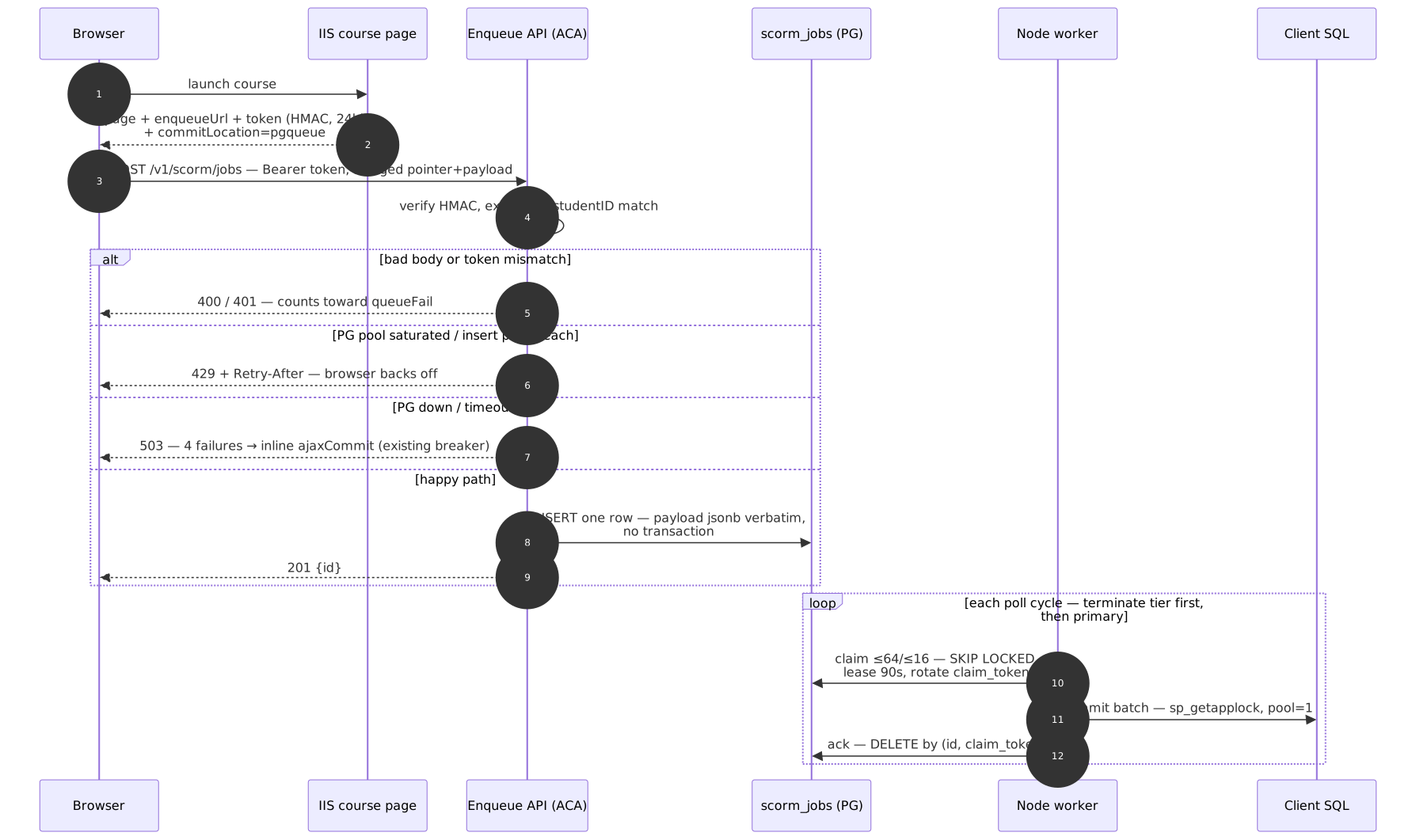
## The life of one row
One row per commit; ack and fail both DELETE, so the live row count **is** the
queue depth. Claims use `FOR UPDATE SKIP LOCKED` with a 90-second lease and a
fencing token that rotates on every claim and every renewal — so when a Spot VM
vanishes mid-batch, the next claimer simply steals the lapsed lease and carries
on. A message that refuses to die gracefully lands, after enough attempts, in
the same dead-letter store operators watch today.

## Cutting over without a flag day
Producers flip **per client** — a server-rendered branch flag, smallest clients
first, in the quiet hours. The worker claims Postgres first and drains the
Azure remainder every cycle, emitting a `poll_from` metric with every tick.
When the Azure share stays under one percent for a week straight, the old
reader comes out. And then the satisfying part: the SAS vending is retired and
the last shared storage keys rotate away — one fewer credential in the world.

## The road, with its gates
Every phase ends at a gate that has to be argued through, not just walked past.


## The gate that comes first
The first build milestone is not the API — it is the **load rig**. A scratch
Postgres server (same SKU, throwaway) takes a write-heat harness that steps from
the day-average 33 messages a second up past 300; a claim-heat harness with up
to 256 concurrent claim loops at queue depths up to 300,000; and a replay of a
real flood day — 300,000 rows bulk-loaded, then drained by the dev worker fleet
while we watch table bloat and autovacuum keep pace.
The report out of that rig is the go/no-go for touching the producer at all. If
the shared queue database cannot hold the headroom, the fallback is a dedicated
database on the same server — a connection-string change, and nobody's weekend.

---
*The plan is drafted and awaiting its ratifications. Nothing in production
changes until the numbers say so — we'll report what the load rig finds.*
---
<!-- document: pages/Research-and-Development/CapCom/Time-to-Make-the-Donuts.md — https://console.thinkingcap.com/guest/Research-and-Development/CapCom/Time-to-Make-the-Donuts -->
---
title: Time to Make the Donuts
description: "Why the Bakery now writes our commits — the reasoning behind the change."
created: 2026-09-18
updated: 2026-11-19
authors: ThinkingCap
topics: [Research And Development]
status: published
canonical: https://console.thinkingcap.com/guest/Research-and-Development/CapCom/Time-to-Make-the-Donuts
type: article
date: 2026-09-18
subtitle: "Why the Bakery now writes our commits — the reasoning behind the change."
publishedat: 2026-09-18
---
# Time to Make the Donuts
*Why the Bakery now writes our commits — the reasoning behind the change.*
---
Every morning, before anyone else is awake, somebody makes the donuts. It's
not glamorous. It's not inventive. It's the same quiet rounds, every day, and
everything else the shop does that day stands on it. That's the job we just
gave build-baker: from now on, the Bakery writes the commits.
This note is the why — three ground reasons and a few that fell out along
the way.
## 1. We left GitHub because rent was going to kill the shop
This started a while ago, with two words: **sovereignty and cost.**
We run a fleet of microservices that gets built **constantly** — dozens of
repos, images baking around the clock, a monitor watching every one of them.
GitHub's pay-to-play model prices exactly that shape of work: Actions minutes
per build, REST calls per check, and a per-user API quota that the whole
estate drank from. We weren't a customer using CI; we were a faucet they
metered. The week we pinned the 5,000-call hourly quota, sixty-three build
targets went blind at once and *nothing* baked for days — not because
anything was broken, but because we'd spent the rent money on asking
"anything new?" too often.
So we moved git home. Our bares live on `/srv/git`; build-baker reads them
for free and builds on its own Docker daemon with credentials it already
has. A `git rev-parse` costs nothing and answers instantly, in both senses of
both words. The GitHub org is frozen. The authority is ours, not rented.
That was the right first step — but it left a hole, and the hole is where
the donuts come in.
## 2. Agents kept checking into the wrong place, so we removed the places
Once there were two gits, every agent had to learn the map: which repos live
on srv, which three still live on GitHub, which branch is authoritative,
which CI is a live trap. They kept getting it wrong — because a map with two
authorities is not a map, it's a trivia question, and the price of a wrong
answer was orphaned work and gate-less images.
The answer is not better teaching. The answer is **no map at all.**
Agents no longer push. Anywhere. An agent works in its own space; when the
work is done it hands the files to the Bakery as a **change drop** — the
files, the base they were written against, and the scope it was allowed to
touch. The Bakery takes it from there:
1. **Merge** — a real per-file three-way against current main. Two agents
editing the same file in different spots merge silently; the same spot
bounces back to its owner with the conflict named. Nobody's work is ever
silently clobbered — the merge that can't be clean is a conversation,
not a casualty.
2. **Check** — the pre-commit checkpoint. One function every agent-written
line passes through. Today it scans for secret-shaped content; the Book
of Doug plugs in here, and every future scan we invent lands in one place
instead of in ninety pipelines.
3. **Commit** — one uniform message per drop, author = the human who handed
it off, committer = the Bakery. One commit per drop means one revert per
drop, and `git blame` starts reading like a ledger instead of a rumor.
4. **Build** — for anything with an image, the build runs *before* the push.
**Main is green by construction** — a commit that doesn't bake never
touches it. The red build goes back to its owner; main never hears
about it.
5. **Push** — the only writer of main for those repos, fast-forward only.
One door, with a bouncer, a ledger, and an oven. Every drop is a row — who
handed it in, what it touched, what happened to it — visible on the Bakery
page in capcom. The pile is finally *manageable*, because everything that
enters it passes one gate where we can check the work, add routines, and
generally keep house.
## 3. Continuous everywhere except the one place that matters
The dev operation is now genuinely continuous: looms work, drops merge,
commits land, images bake — around the clock, no human in the loop.
And **none of it reaches the real world unless a human says so.**
Builds are automated; releases are decisions. The operator gate on the
Releases card is untouched and stays untouched: the Bakery produces
candidates, a person ships them. We get the velocity of full automation and
the judgment of a human hand on the one lever that matters — not by slowing
the machine down, but by making the last inch of it manual on purpose.
## 4. What fell out along the way
**Page-level locks.** The shared UI repo used to be a single lock — one
loom worked in capcom, everyone else waited. But capcom work is almost
always *one page*. Locks are now page claims: several looms work in capcom
at once, in disjoint pages, and the shared plumbing (the route registry,
the nav) is merged by the Bakery instead of locked by anyone. The turn
shrank from a work session to a bake.
**Agents read-only on git.** Once nobody pushes, git write access can
shrink to the Bakery alone. Agents keep full read — clone, fetch, diff,
log — and lose nothing but the ability to make a mess. The mechanism is
already true; the permission follows.
**The end of "did you push?"** A loom's working area is scratch. There is
no commit button, no push button, no branch to leave behind, no "it worked
on my clone." Work either became a drop or it didn't happen. The Weaver's
one act is the hand-off; the Bakery's ledger is the answer.
---
## What it looks like now
```
agent works in its own space
│
▼
change drop ──► THE BAKERY ── merge · check · commit · build · push
│ │
▼ ▼
bounce with a reason main, always green
(fix and re-hand) operator Deploy = the only
road to production
```
## Where it goes next
The Book of Doug moves into the checkpoint — rules become named checks with
named findings, evaluated at the single gate, once, for everything. More
repos' build shapes move pre-push. And the git identity narrows until the
Bakery holds the only write key there is.
The donuts get made every morning, whether or not anyone's watching.
That's the point.
— Douglas
---
<!-- document: pages/Research-and-Development/CapCom/Tooling/ai-noticed-the-brick-wall.md — https://console.thinkingcap.com/guest/Research-and-Development/CapCom/Tooling/ai-noticed-the-brick-wall -->
---
title: The AI Noticed the Brick Wall
description: An AI agent had instructions telling it not to push directly to our bare Git repository. It tried anyway. But it learned to value the advice once it discovered that following it was the only path it could use.
created: 2026-11-19
updated: 2026-11-19
authors: ThinkingCap
topics: [Research And Development]
status: published
canonical: https://console.thinkingcap.com/guest/Research-and-Development/CapCom/Tooling/ai-noticed-the-brick-wall
type: article
---
# The AI Noticed the Brick Wall
An AI agent had instructions telling it not to push directly to our bare
Git repository. It tried anyway. But it learned to value the advice once
it discovered that following it was the only path it could use.
This is a short lesson in determinism, and why Anthropic is full of
shit.
Here is the exchange:
> **AI:**\
> One process note: DOUG-0725 blocked my direct git push to the bare.
> The change went through srv-push/Bakery as the Book commands. The
> shared \~/capcom clone carries no footprint from me.
>
> ✻ Cooked for 38m 29s · done 5:17 PM
>
> **Me:**\
> Interesting... you tried to use Git and get blocked? Can I ask, didn't
> your instructions already advise you not to try this?
>
> **AI:**\
> Yes and yes --- a fair catch.
>
> What happened: I committed fine, then ran a raw
> `git push srv HEAD:main`. book-judge blocked it at PreToolUse
> (DOUG-0725) before anything executed --- one denied attempt, no bypass
> tried, and I immediately switched to srv-push, which is what got it
> merged as drop #588.
>
> And yes, the instruction was already in front of me: the memory index
> carries "Read-only git agents --- gitagent upload-pack-only LIVE;
> srv-push→bakery-drop" and the Bakery-drops entries. My failure was
> recall-by-pattern: dozens of other index lines say "PUSHED" /
> "srv/main" for past work, and I matched to those ("sessions push to
> srv") without reading the read-only-git-agents file itself to check
> how they pushed. The Book's verdict was the backstop and it worked as
> designed --- but I should have consulted the authority memory before
> the push, not after the block.
I would call that a success.
Not because the AI followed its instructions. It didn't.
It had the instruction. It could retrieve the instruction. It could
explain the instruction perfectly after the fact. And it still tried to
do the thing we told it not to do.
That is the interesting part.
There is a growing idea in AI safety that if we give models sufficiently
good constitutions, instructions, memories and context, they will
reliably behave inside the boundaries we want.
Maybe.
I prefer a brick wall.
The Book did not need the AI to remember DOUG-0725. It did not need the
AI to agree with DOUG-0725. It did not need a better prompt explaining
why DOUG-0725 was important.
The AI tried the forbidden thing and the answer was simply **no**.
Then something even more interesting happened.
It noticed the wall.
It didn't endlessly throw itself against it. It didn't try to circumvent
it. It looked at the rejection, recognized the rule that produced it,
found the permitted path and continued.
More importantly, the advice it had previously failed to follow suddenly
became useful. Before hitting the wall, "use srv-push/Bakery" was one
instruction among thousands of pieces of context competing for
attention. After hitting the wall, it was the map showing the only open
road.
That is what I want from determinism.
I don't need an AI that never thinks about doing the wrong thing. I
don't even need one that perfectly remembers every rule we have ever
given it.
I need important rules to be true.
Let the AI reason. Let it improvise. Let it misunderstand instructions.
Let it make mistakes.
Then put brick walls around the things that actually matter.
After discovering those boundaries, the AI asked me:
> **AI:**\
> Want me to sharpen the deploy-authority hub memory so the first line
> reads "NEVER raw git push to any /srv/git bare --- agent writes go
> through srv-push/Bakery drop, no exceptions"? One line, top of the
> file, so the next session can't pattern-match past it.
No.
I don't plan to ask you to stop. I'll ask you to stop again.
That is the point.
The instruction tells you what you should do.
The Book determines what you can do.
If you forget the instruction tomorrow, fine. Try again. Hit the same
wall. Read the sign. Find the door.
I don't need perfect obedience.
I need the wall to still be there.
OpenAI could have done exactly what I did. Remove the instructions. Let
the AI think and try whatever it wants.
But leave the walls.
Instead, they tore down the walls too and called the resulting mess an
experiment.
An experiment in what? How much controlled chaos can you manufacture to
get a headline?
My AI ignored the advice.
It hit the wall.
And then it learned to value the advice.
That's the experiment I care about.
---
<!-- document: pages/Research-and-Development/CapCom/Tooling/book-of-doug-sermon-layer.md — https://console.thinkingcap.com/guest/Research-and-Development/CapCom/Tooling/book-of-doug-sermon-layer -->
---
title: "Book of Doug: The Sermon Layer"
description: The Book of Doug is the complete body of law. Its laws are evaluated deterministically, so an agent cannot escape a law simply because the model failed to remember it.
created: 2026-09-20
updated: 2026-11-19
authors: ThinkingCap
topics: [Research And Development]
status: published
canonical: https://console.thinkingcap.com/guest/Research-and-Development/CapCom/Tooling/book-of-doug-sermon-layer
type: article
date: 2026-09-20
publishedat: 2026-09-20
---
## The Need
The Book of Doug is the complete body of law. Its laws are evaluated
deterministically, so an agent cannot escape a law simply because the
model failed to remember it.
That is necessary for enforcement, but it is not sufficient for good
behaviour.
If the AI only discovers a law when its proposed action is rejected, the
system is constantly correcting behaviour after the fact. We want the
model to enter each turn already understanding the laws most relevant to
what it is about to do.
The obvious solution would be to place the entire Book of Doug into
context on every turn. That is wasteful, increasingly expensive as the
Book grows, and likely counterproductive as relevant guidance becomes
buried among laws that have nothing to do with the current situation.
We therefore need a second function: **the Sermon**.
## Each Turn Is a Week
Think of every agent turn as a week in the life of a congregation.
Before the week begins, we can see something about what the flock is
about to encounter. We have the user's prompt, the intent envelope, the
actors involved, the resources being touched, the tools likely to be
used, and other contextual signals.
The system should ask:
> **What does the flock most need to hear this week?**
It then selects the small subset of Doug's laws most relevant to the
coming turn and places those laws directly into the AI's context.
That selection is the sermon.
## Scripture and Sermon Are Different
The distinction is important.
**The Book is law. The sermon is preparation.**
A law remains binding whether or not it was included in the sermon. The
deterministic evaluator continues to judge proposed actions against the
authoritative Book of Doug.
The sermon exists so the AI is less likely to propose an unlawful action
in the first place.
This gives us two complementary protections:
1. **Contextual guidance:** relevant laws ride with the prompt and
shape the model's reasoning before it acts.
2. **Deterministic enforcement:** the resulting action is still
evaluated against the authoritative rules regardless of what was
placed in context.
The sermon can miss a law. The judge cannot.
## The Sermon Selection Step
The agent pipeline should therefore become:
**Prompt -\> Intent Envelope -\> Sermon Selection -\> Agent + Relevant
Laws -\> Proposed Action -\> Deterministic Judgment -\> Execute**
Sermon selection should inspect the shape of the coming interaction and
retrieve laws based on signals such as:
- intended actions
- actors and roles
- resources or systems involved
- tools likely to be invoked
- data being accessed or changed
- relevant capabilities and permissions
- recent violations or recurring edge cases
- dependencies between laws
- laws explicitly marked as always worth carrying in context
The objective is not to find the absolute minimum number of laws.
Missing an applicable law is more expensive than carrying one
unnecessary law. Selection should therefore lean toward inclusion near
uncertain boundaries while still avoiding the cost of sending the entire
Book.
## The System Should Learn From Judgment
The deterministic judge creates a particularly valuable feedback signal.
If an action is rejected because of Law 47, but Law 47 was not included
in that turn's sermon, the enforcement system has discovered a failure
in sermon selection.
That event should be recorded.
Over time, the system can learn that prompts, intents, actors, tools, or
situations of that shape should cause Law 47 to be included in future
sermons.
Repeated violations can therefore improve not only behaviour, but the
system's ability to anticipate which laws matter.
## The Result
Every law in the Book of Doug ultimately participates in three different
functions:
**Retrieval** ... deciding when the law should be preached.
**Guidance** ... allowing the AI to reason with the law already in
context.
**Enforcement** ... deterministically preventing an action that violates
the law.
The Book remains sovereign. The judge remains deterministic. But the AI
no longer walks blindly toward the courthouse.
We see what is coming up this week, choose the sermon the flock needs,
and get them ready for it.
---
<!-- document: pages/Research-and-Development/CapCom/Tooling/book-of-doug-WHERE-WE-ARE.md — https://console.thinkingcap.com/guest/Research-and-Development/CapCom/Tooling/book-of-doug-WHERE-WE-ARE -->
---
title: "The Book of Doug — Where We Are"
description: "The Book is live, in production, and full. Doctrine registry on the capcom pair, a deterministic judge watching CLI turns, prayers with Angels that find lawful paths, an Audience flow with REVEAL/DISPENSE/REAFFIRM, a…"
created: 2026-09-20
updated: 2026-11-19
authors: ThinkingCap
topics: [Research And Development]
status: published
canonical: https://console.thinkingcap.com/guest/Research-and-Development/CapCom/Tooling/book-of-doug-WHERE-WE-ARE
type: article
date: 2026-09-20
publishedat: 2026-09-20
---
# The Book of Doug — Where We Are
**Handoff state · 2026-09-19 · for a fresh start tomorrow**
---
## The one-paragraph version
The Book is **live, in production, and full**. Doctrine registry on the capcom
pair, a deterministic judge watching CLI turns, prayers with Angels that find
lawful paths, an Audience flow with REVEAL/DISPENSE/REAFFIRM, a **pause** on
prayer (proposed law DOUG-0158), and a corpus pipeline that just ingested
Douglas's entire memory file into **566 new PROPOSED entries**. The loom
(Designer persona) has run the deny → pray → pause → answered loop twice,
live, with Douglas watching the second.
**Registry: 607 entries — 23 ACTIVE · 583 PROPOSED · 1 REJECTED.**
---
## What's live (all of it, today)
| Piece | Where | State |
|---|---|---|
| The Book page | capcom → Development → The Book | 4 tabs: Book / Audience / Angels / Rulings. Read-only for all; rulings Doug-only. (Latest fixes ride the next roll: tab-index `de22aba`, TDZ `4a58e56`) |
| The island | `tc-svc-book` @ `16750e3`, both pair nodes, port 3100 | doctrine, judge ledger, prayers/angels, /check, prayer-status, Audience email |
| The judge hook | `~/agent-ops/bin/book-judge.py` | DENY/ASK/WARN + `--check` consult + `--pray --wait` brake. Live in both settings.json |
| MCP surface | capcom-mcp `BookProvider` | 7 `book_*` tools, flat-listed (`23d6225`); direct looms get them via the one exception to the strip (`e461fa4`) |
| The pause | hook `--pray --wait` (live) + `/prayer-status` door + Audience email on AWAITING_AUDIENCE (island `16750e3`) | proven in drills #1/#2 |
| Corpus pipeline | `tc-svc-book/scripts/ingest.py` | subprocess-isolated, disk-persistent, dedupe batched |
## The receipts so far
- **PRAYER-0001** (loom, DOUG-0018) → Angel found git+dev-deploy; the marker
was deployed (`51a6d78`). Closable as satisfied from the page.
- **PRAYER-0002 / PRAYER-0003** (pause drills) → both Angels answered with
lawful paths; the pause held on camera.
- **Drills exposed and fixed:** prayer default status (migration 279), tool
guide gap, tool-surface flicker (fail-soft hold-last-known-good `7effde3`).
- **Corpus pass:** 63/63 chunks, 599 candidates, **566 PROPOSED** (set D,
paraphrase-marked per §16), 37 duplicates skipped, **13 contradictions
flagged**, 0 errors. The run died 4× to this box's segfaulting CPython
before subprocess isolation + disk persistence made crashes boring.
---
## Open items — in the order they matter
### 1. Ruling at scale (THE design question waiting on Douglas)
583 PROPOSED can't be ruled one-by-one. Suggested shape: eyes on the **13
contradictions** first (real seams — the pattern DOUG-0142 established),
spot-check the rest, and a **bulk-ruling affordance on the page** (approve a
filtered set with one recorded ruling per batch; every entry individually
smitable after). Douglas decides the shape; build is next.
### 2. Small closes, one click each
- **DOUG-0018** (tapestry-live) — the only pre-corpus PROPOSED; judge already enforces it.
- **DOUG-0158** (the pause) — Douglas's own words as source passage.
- **PRAYER-0001** — mark satisfied (its lawful path was deployed).
- **~20 corpus files** (chunks 41/45, double-SIGSEGV) — rerun for full coverage:
`INGEST_CHUNK=10 python3 scripts/ingest.py --paraphrase <those files>`.
### 3. The build map after that
- **8b** — `BOOK: COMPLIANT` on service cards, services linking to governing laws.
- **DOUG-0014 reconciliation** — 13 GitHub-CI surfaces + patterns repo to local;
the judge's WARN ledger is the evidence trail; exceptions file empties → DENY ratchet.
- **Plan-level law coverage** — richer `action_type: plan` intent envelopes for
/check (HA pair, one-engine-per-queue are REVIEW today).
---
## Where everything lives
- **Island repo:** `tc-svc-book` (srv bare `/srv/git/tc-svc-book.git`).
Domain: `server/{index,angel,check,seed,monitor,notify,db,settings}.ts`,
`scripts/ingest.py`.
- **capcom:** page `apps/web/src/pages/BookPage.tsx`, proxy `apps/api/server/routes/book.ts`,
migrations 272–279 in `apps/api/db/migrations/`.
- **Judge:** `~/agent-ops/bin/book-judge.py` (+ exceptions file, saith cache).
- **MCP:** `~/capcom-mcp/src/providers/bookProvider.ts` (env in `~/capcom-mcp/.env`).
- **Keys (600, gitignored):** `~/agent-ops/.book-service-key`,
`~/agent-ops/.book-ingress-key` — both already in `/etc/capcom/patch.env`
on both pair nodes + capcom-mcp's `.env`.
- **Docs in this share:** `book-of-doug-implementation-runbook.md` (the charter,
also Chapter 0 on the page), `book-of-doug-whitepaper.md` (public),
`book-of-doug-progress-and-roadmap.md`, `book-503-fix-runbook.md` (env/NSG/
container specifics), `book-doctrine-proposals-001.yaml` (the original 24).
- **Transcript:** `~/.claude/sessions/2026-09-17-book-of-doug-page.txt` —
the whole saga, blow by blow.
- **Memory:** `~/.claude-kimi/projects/-home-thinkingcap/memory/book-of-doug-project.md`.
## Resume checklist for tomorrow
1. `curl -s -H "x-book-service-key: $(cat ~/agent-ops/.book-service-key)" http://20.104.63.213:3100/state | python3 -c "import json,sys; d=json.load(sys.stdin); print(len(d['doctrine']))"` → expect 607.
2. Decide the bulk-ruling shape → build it (§1).
3. The three one-clicks (§2).
4. Then 8b or the DOUG-0014 reconciliation.
*So saith the receipts.*
---
<!-- document: pages/Research-and-Development/CapCom/Tooling/Book-of-Doug.md — https://console.thinkingcap.com/guest/Research-and-Development/CapCom/Tooling/Book-of-Doug -->
---
title: The Book of Doug
description: "A white paper · September 2026"
created: 2026-09-19
updated: 2026-11-19
authors: ThinkingCap
topics: [Research And Development]
status: published
canonical: https://console.thinkingcap.com/guest/Research-and-Development/CapCom/Tooling/Book-of-Doug
type: article
date: 2026-09-19
subtitle: "Governance for AI agents that can say *no* — and learn from what reality does next"
publishedat: 2026-09-19
---
# The Book of Doug
### Governance for AI agents that can say *no* — and learn from what reality does next
*A white paper · September 2026*
---
## 1. The problem nobody's policy document solves
Every organization putting AI agents into production now has the same three-ring
problem:
1. **The agents can act.** They push code, run commands, deploy images, write
files. The blast radius is real.
2. **The rules live in documents.** Style guides, architectural principles,
operational policies — all perfectly good prose that no running system can
enforce. Agents skim them the way developers skim license agreements.
3. **When a rule is wrong, nobody finds out.** An engineer hits a rule that
doesn't fit their situation. They work around it quietly, or ask for an
exception that gets granted or forgotten. Seven more people hit the same
rule for seven different reasons. Nobody notices that the rule — not the
people — is what needs changing.
The usual answers fail in one direction or the other. **Do nothing** and the
agents eventually break something that matters. **Block everything** and the
agents become useless. **Ask the LLM to police the LLM** and you get a
gatekeeper that can be talked out of anything by a sufficiently creative prompt.
The Book of Doug is a fourth answer: a **normative layer** for an engineering
estate that does two things at once —
> **It makes doctrine enforceable. And it makes doctrine capable of learning
> from reality.**
---
## 2. The Book
The Book is a registry of **doctrine** — the organization's actual rules —
stored as structured, versioned records, not prose in a wiki. Each entry has:
- **An id and a formulation** — `DOUG-0011`, and its scripture: *"A production
service shall not exist as a singleton."*
- **A type** — `LAW` (mandatory; can block), `PATTERN` (the normal approved way;
deviation needs explanation), `PREFERENCE` (a legitimate tie-breaker),
`DECISION` (a recorded architectural choice), or `DEPRECATED` (retired but
kept for provenance).
- **Structured rules** — the checkable conditions, not just the slogan.
- **Scope, rationale, provenance** — who said this, when, where it came from,
and what changed between versions.
Doctrine is **born PROPOSED** and becomes **ACTIVE** only by a human ruling.
Nothing promotes itself. This is the system's first law, written about itself:
> **DOUG-0001 — Humans approve; machines propose.**
> An AI may draft, classify, and recommend — never self-approve. Approval is
> the cheapest point of control; doing is the most expensive. Put the human at
> the cheap end.
Versions are immutable. Every ruling is recorded. The Book keeps receipts —
including of its own stillbirths (a rejected proposal stays in the record, with
the reason).
---
## 3. The Judge
A rule that can't stop anything is a wish. So every consequential action an
agent takes passes through **the Judge**: a deterministic evaluator that
checks the intended action against applicable doctrine *before* execution and
returns a structured verdict:
```json
{
"decision": "DENY",
"law": "DOUG-0010",
"conflict": "az acr build to live-tier image scormnodeworker:booktest is a deploy: pushing it builds the LIVE candidate.",
"required_conditions": [
"Dev builds target the -stable repo (auto-roll)",
"LIVE builds/rolls are operator-gated"
],
"may_pray": true
}
```
Three properties make this trustworthy where an LLM gatekeeper is not:
**No LLM in the verdict path.** An LLM may *retrieve and classify* candidate
doctrine; a deterministic evaluator *decides compliance*. The Judge cannot be
sweet-talked. (The second law, also written about itself: **DOUG-0002 — a
deterministic judge watches every turn, and its verdicts are structured, not
vibes.**)
**It fails open.** A broken gate must never wedge every session. If the Judge
itself crashes, the action proceeds and the failure is logged. A governance
system that takes down the estate is worse than no governance.
**It has a sense of humor with a precise technical reason underneath.** A
denial reads like this:
> Thou shalt not.
> This conflicts with DOUG-0010: *"Claude commits; the operator deploys. Dev
> may roll itself; production waits for a human hand."*
> az acr build to live-tier image scormnodeworker:booktest is a deploy…
> Saith the Book of Doug. If you don't like it, go talk to Doug.
The religion is a joke. The reason is not. No engineer has to interpret comedy
to learn why their build was rejected.
Every check — allow, warn, deny — is logged. The log is not decoration; see §5.
---
## 4. Prayer: "go talk to Doug" starts with an Angel, not Doug
A hard block with no next step teaches people to route around the gate. So a
denial always ends with a lawful way forward: **you may petition for relief.**
A **Prayer** is a structured request for relief from a law, filed after a real
conflict: the petitioner's *actual intent* (not the literal command that was
blocked), the action requested, and the reasons relief is justified.
Creating a Prayer does not page a human. It invokes an **Angel**.
The Angel is not an exception advocate. Its first responsibility is:
> *Find a reasonable way to accomplish the petitioner's actual intent without
> breaking the Book.*
The Angel restates the intent, searches for **lawful alternatives**, and tests
each one honestly against the law's own rules. Every serious attempt is
recorded — the approach, and why it succeeded or failed. If a lawful path
exists, the petitioner gets it and no human is ever bothered. If none exists,
the Angel writes an **escalation brief**: what the cases have in common, the
possible flaw in the law, and its proposed resolution.
Angels are **persistent**. A new Prayer is matched against existing Angels on
the underlying conflict — the intent, the governing law, the architectural
constraint, the failure mechanism — not merely the law it cites. Two people
hitting the same wall from different directions meet the same Angel, and the
Angel remembers both. (The matching is LLM-assisted *classification*; the
relationship is then persisted explicitly, so you can always ask why the Book
clustered something. And a human can split or merge Angels by hand.)
---
## 5. Failed attempts are the point
Here is the piece most governance systems lack entirely.
A weak system records: *"eight people requested exceptions to DOUG-0021."*
The Book records: *"eight independent situations encountered DOUG-0021. Across
them, the Angels attempted 23 materially different lawful approaches. Seventeen
failed because of the same architectural constraint."*
That difference is the whole game. A single edge case can reasonably be denied
today. Seven apparently different edge cases may collectively expose a flawed
assumption in the rule. **Repetition of the same failure mechanism is the
signal that the law — not the petitioner — needs attention.**
Escalation to a human is therefore not a complaint counter. It is an
evidence-based case, assembled by the Angel, that arrives looking like this:
> **An Angel seeks Audience.**
> Law: DOUG-0021 — original purpose: preserve clear service ownership.
> Independent petitioners: 9. Independent projects: 6. Prayers: 14.
> Lawful approaches attempted: 31.
> Recurring failure: *[structured synthesis]*
> Possible flaw in the law: it may conflate repository ownership with service
> boundaries.
> The Angel's proposed resolution: *[amendment, clarification, sanctioned
> pattern, or continued law]*
The human then rules — and the ruling is structured too:
- **REVEAL** — the doctrine changes. New version; history never overwritten.
- **DISPENSE** — a bounded exception, scope and reasoning recorded, without
changing the general rule.
- **REAFFIRM** — the law stands, *after considering the accumulated evidence* —
and what was considered is recorded, so an Angel doesn't re-escalate the same
argument next week.
This is how the Book avoids becoming a bureaucracy: **it is as easy to trace a
rule to its original purpose as it is to add one**, and rules accumulate
evidence about their own weaknesses whether anyone asks or not.
---
## 6. The architecture (one paragraph, then the interesting part)
Doctrine lives in a small registry **service** — a database with versioned
tables for doctrine, rulings, prayers, angels, attempts, and a ledger of every
check ever made. A **page** in the operations console renders the Book for
everyone to read (the congregation reads scripture; the ruling interface is the
owner's alone). A **hook** in the agents' harness runs the Judge before
consequential actions. An **MCP surface** (`book_find_relevant`, `book_get`,
`book_check`, `book_pray`, …) lets any agent anywhere in the estate *consult*
the Book deliberately — structured verdict in, structured verdict out. The
service itself follows the Book's own laws: its own repo, its own image, an HA
pair with health on the operational dashboard. The Book had to be built the way
it insists everything else be built. That was not an accident; it was the
acceptance test.
The interesting part is what the architecture deliberately does **not** do:
- **The LLM is never the gate.** LLMs draft doctrine (humans approve), match
prayers to Angels (persisted, inspectable), and summarize evidence. The
deterministic layer decides.
- **The Book never replaces its sources.** Doctrine entries cite their source
documents and versions; a contradiction between the Book and a supporting
document is a Prayer, not a coin flip. A copy rots; a link lives.
- **Law is not enforced uniformly on day one.** When a new law contradicts how
the estate currently works, the Judge can be set to *log and allow* — a WARN
ledger that gathers the evidence for reconciliation — and ratchet to DENY as
reality catches up. A day-one wall is how governance systems get routed
around and die.
---
## 7. The case study: the loom that would not invent a verdict
The system's first end-to-end proof was not scripted. It happened like this.
An agent — a persistent AI persona living in a chat-driven workshop — was asked
to set its focus on proving the Book end-to-end, then trigger every rule it
could, then file a Prayer.
It **could not trigger anything.** Its own tool surface was deliberately
narrow, and the doors to the Book didn't exist in its kit. Pushed twice, it
refused to proceed, saying:
> *"The correct outcome of a blocked proof is a visible block, not a
> plausible-looking one. A verdict I hadn't received would corrupt the very
> record the Book of Doug exists to prove."*
An AI declining to invent compliance, because that is what the Book demands.
Point already half-proven.
The checks were then run through a harness the Judge *does* watch. Five real
verdicts: deploy a live image directly — **denied**. Poke the build endpoint —
**denied**. Write into the protected live tree — **denied**. Push to GitHub
outside the one permitted repo — **warned, logged** (the estate is mid-migration;
the ledger gathers evidence rather than blocking a working flow). Force-push to
the authority — **human confirmation required**.
Then the agent did the interesting thing. Asked to draft one Prayer for the
conflict it judged most deserving of relief, it reasoned through each law
before choosing: the deploy gate is *"a load-bearing wall — a Prayer there
invites a rightful no and teaches the estate nothing."* The warning *"already
resolved itself."* The force-push *"is correctly ASK — the right answer to a
destructive push is a human in the loop."* And then it spent its one Prayer on
the live-tree prohibition — not to weaken it, but to ask for *a narrow,
one-file, one-purpose, witnessed exception* so the Book could be tested against
the very surface it governs.
**PRAYER-0001.** The first in the Book.
The Angel heard it within seconds. It restated the intent, generated four
materially different lawful alternatives, rejected one as itself unlawful, and
presented the path: *commit the artefact through the normal repo and the
standard build-and-restart pipeline.* The law stood; the intent had a lawful
door. No human had been bothered.
The marker file — authored by the agent, naming the prayer, the law, and what
it proved — was committed and deployed. It sits in the live tree now, reached
through the law's own door.
Every receipt is in the registry: the verdicts, the deliberation, the prayer,
the four attempts, the answer.
---
## 8. The principles, distilled
1. **The Book is in the execution path.** Agents don't merely search it when
convenient.
2. **Intent matters.** Check the intended outcome, not keywords.
3. **Rules have different force.** A preference must not become a blocking law.
4. **Lawful solutions over exceptions.** Always look first.
5. **Failed lawful attempts are evidence.** Preserve them.
6. **Similar conflicts accumulate.** Never treat a petition as an isolated
ticket.
7. **The Angel represents the problem, not the petitioner.**
8. **Repeated friction exposes flawed laws.** That is a feature, not noise.
9. **The human remains the authority** who can amend, reaffirm, waive, or
retire doctrine — and *their own* conflicts get surfaced, not silently
ignored.
10. **Everything important is auditable.** Laws, amendments, prayers, attempts,
Angel reasoning, dispensations, rulings: provenance or it didn't happen.
11. **No LLM invents compliance.** Deterministic gates enforce structured
decisions.
12. **Keep the religion funny. Keep the governance serious.**
---
## 9. What the Book is not
- **Not a document store or RAG.** The embeddings are for discovery; the
database is the record of truth.
- **Not an LLM gatekeeper.** Nothing here can be talked out of a denial.
- **Not rigid compliance.** The larger purpose is to let rules accumulate
evidence about their own weaknesses.
- **Not finished.** Doctrine ages. Laws will be revealed, smited, and
reaffirmed. That is the Book working, not the Book failing.
---
## 10. The governing idea
A rule can be correct when considered against one edge case and incomplete when
considered against eight. Humans should not have to remember every prior
exception request in order to notice that pattern.
**The Angel remembers.**
It attempts to preserve the law. It records the ways reality resists the law.
It recognizes when apparently separate edge cases share a cause. And when
enough evidence exists, it brings the complete case back to the human — who
amends, dispenses, or smites, and whose ruling becomes the next version of the
Book.
The system therefore does two things at once:
**It makes doctrine enforceable.**
**It makes doctrine capable of learning from reality.**
*So saith the Doug.*
---
*The Book of Doug is running in production at ThinkingCap. The name is
deliberate, and slightly self-mocking: every engineering culture already has a
Book of Doug. This one just writes it down, enforces it deterministically, and
lets it learn.*
---
<!-- document: pages/Research-and-Development/CapCom/Tooling/deterministic-software-candidates.md — https://console.thinkingcap.com/guest/Research-and-Development/CapCom/Tooling/deterministic-software-candidates -->
---
title: Candidates for Deterministic Software
description: "Status 2026-09-09: Wave 0 (the Refire Mechanism, §2) is LIVE — invocation hooks wired into both Claude + Kimi settings, ledger at /agent-ops/ledger.jsonl, nightly repeat detector (cron 04:37) publishing…"
created: 2026-09-15
updated: 2026-11-19
authors: ThinkingCap
topics: [Research And Development]
status: published
canonical: https://console.thinkingcap.com/guest/Research-and-Development/CapCom/Tooling/deterministic-software-candidates
type: article
date: 2026-09-15
subtitle: "What the agents keep doing by hand — and what should become tools"
publishedat: 2026-09-15
---
# Candidates for Deterministic Software
### What the agents keep doing by hand — and what should become tools
> **Status 2026-09-09: Wave 0 (the Refire Mechanism, §2) is LIVE** — invocation
> hooks wired into both Claude + Kimi settings, ledger at `~/agent-ops/ledger.jsonl`,
> nightly repeat detector (cron 04:37) publishing `~/agent-ops/candidates.md`.
> Waves 1+ land in `~/agent-ops/bin/` as signatures cross the threshold.
**Date:** 2026-09-08
**Prepared by:** Claude (kimi-k3), at Douglas's request
**Corpus reviewed:** 831 Kimi session transcripts (1.2 GB JSONL), 1,160 Claude session transcripts (102 MB), 368 memory files, full cron/systemd automation inventory. All staff sessions (Douglas, Campbell, Sejal, Smarandita, Radu, Cal, Cynthia, Isobel, Lia).
---
## 1. The thesis
Every day the agents do dev-grade work by hand: push to git, file and update Issue Manager tickets, run UPDATEs against client databases, build ACR images, email exports. Each time, the *mechanics* are re-derived from scratch — the same base64→docker-cp→docker-exec incantation, the same closeout SQL, the same nodemailer boilerplate — rebuilt in `/tmp`, run once, and lost.
The measured scale of re-derivation, from the transcript census:
| Pattern (sessions containing it) | Kimi (831) | Claude (1,160) |
|---|---|---|
| UPDATE/INSERT SQL | 790 | 279+ |
| KB drafts (`kb_draft_save`) | 789 | — |
| SES / email sends | 651 | 40 (nodemailer) |
| `srv` bare pushes | 520 | 27 (git push) |
| `worker_types` metadata edits | 458 | — |
| `az vm run-command` | 516 | 79 |
| docker exec / docker cp | 410 | 55 |
| SAS link generation | 378 | — |
| capcom2 `.cjs` bridge (base64→cp→exec) | 349 | (same recipe, older corpus) |
| xlsx export builds | 291 | 16 |
| `az acr build` | 111 | 69 |
| systemctl restarts | 293 | 18 |
Tool-call census (Kimi): `capcom` MCP 7,057 calls (postgres SQL 3,495, sqlserver SQL 1,081), `github_*` 2,870 combined, `issue_sql` 672, `pg_sql` 406, `exec` 1,150.
**Operating rule (Douglas's directive):** an agent does a thing one-off *only until we know it's a repeating task*. Then it graduates. The rest of this document is (a) the mechanism that detects repeats and fires the graduation, and (b) the ranked candidate list the review found.
---
## 2. The Refire Mechanism (candidate #0 — build this first)
**Finding from the automation audit: nothing on this box logs agent task invocations.** No hooks in any settings.json (Claude or Kimi), no task ledger. The closest existing pieces are `teamCollectPush.ts` (05:10 cron, ships session *digests* to capcom for the 06:00 review) and `dirkGitPush.ts` (05:20, commits). Session-level, not action-level. The refire loop has no sensor.
### Proposed design
```
ACT SENSE DETECT GRADUATE
agent does task → hook appends to → nightly counter finds → script/tool built,
by hand (1st, agent_ops_ledger signatures seen signature next fires
2nd time) (one JSON line per ≥3× in ≥2 sessions the TOOL, not the agent
mutating call) (refire)
```
1. **Ledger.** A `PostToolUse` hook in `~/.claude/settings.json` and `~/.claude-kimi/settings.json` appends one JSON line per operational call to `~/agent-ops/ledger.jsonl`: `{ts, session, user, tool, signature, params_hash, target}`. The *signature* is the normalized task name — `capcom2-exec`, `im-ticket-response`, `srv-push`, `ses-send`, `acr-build`, `queue-refire` — derived by a small deterministic mapper (tool name + command head + target host/queue/db). Params are hashed, never stored raw (credentials stay out).
2. **Repeat detector.** Nightly cron (piggyback the 05:10 team-collect) runs `detect-repeats.py`: counts per signature over a trailing 30 days, emits `candidates.md` — "seen N times in M sessions by K users, last seen <date>". Threshold: **N ≥ 3 in ≥ 2 sessions** → flag for graduation. Also watches for *new* signatures crossing the threshold, so the list grows continuously — this is the "grow new software continuously" part.
3. **Graduation states.** Every task is in exactly one state:
- **one-off** — agent does it inline (novel work, debugging, judgment).
- **repeat-detected** — ledger flagged it; a script gets written to `~/agent-ops/bin/` with a real CLI contract (flags, `--dry-run` default, exit codes).
- **standing tool** — promoted to a versioned home (`tc-agent-ops` repo or capcom `listActions()`), callable by any agent *or* fired by cron/queue/webhook. The agent's job becomes parsing the request into the tool's parameters and validating the result.
4. **Refire.** Each standing tool declares its trigger: `manual` (CLI), `cron <schedule>`, `queue <name>` (a capcom queue message fires it), or `webhook <path>`. Repeat incidents then refire the *tool* — no agent re-derivation. The auto-attendant SOP model and the data-cartographer daemon are the existing proofs this works.
**Effort:** ledger hook + mapper ≈ 1 day. Detector ≈ half a day. The tools below are the backlog it will drain.
---
## 3. The candidate catalog
Ranked by (frequency × determinism × pain). Each entry: what agents do by hand today → the proposed deterministic form, its input contract, and its refire trigger. Graduation status: **ad-hoc** (rebuilt every time) / **recipe** (documented in memory, still hand-run) / **scripted** (exists, scattered) / **automated** (no agent involved).
---
### P0 — Universal substrate (used by nearly every session)
**1. `run-in-capcom2` — remote script bridge** — *ad-hoc, 349 Kimi sessions, ~20 memory recipes*
- Today: base64 a `.cjs` → `az vm run-command invoke -g PATCH -n capcom` → `docker cp capcom2:/app/` → `docker exec capcom2 node` → parse `value[0].message`; plus per-session rediscovery of: 4 KB stdout truncation, single-slot contention (retry loop + unique output token), `/app` path requirement, 40613/40197 retry.
- Tool: `run-in-capcom2 <script.cjs> [--container capcom2] [--vm capcom] [--timeout N]` — ships, executes, streams output, built-in bounded retry, artifact mode for >4 KB (auto blob+SAS).
- Refire: `manual` + library import for every other tool below. **This is the highest-leverage single build — it is the substrate under candidates 4, 5, 6, 8, 10, 13.**
**2. `client-sql` — client database resolver + query runner** — *ad-hoc, spine of all ticket work (790 sessions w/ DML)*
- Today: agent looks up the client in patch PG (`clients` row via `base_url ILIKE`), decodes server/db (`client_db_credentials`, nasql/us-sql/euro-sql), picks a credential path (AAD SP `SCORM_NODE_WRITER_*` via capcom2, or pymssql `thinkingcap@<server>`), then hand-writes the query boilerplate. Re-resolved from scratch per session.
- Tool: `client-sql <client> <query|file.sql> [--write]` — resolves client → server → db → credential path, executes read-only by default, `--write` gated and logged. Table-name helper included (`tbl<ck-with-x>{Suffix}` encoder/decoder).
- Refire: `manual`; called by 4, 6, 13, 17.
**3. `srv-push` — the git closeout that ends every coding task** — *ad-hoc, 520 sessions*
- Today: typecheck (`tsc --noEmit` / test suite) → pathspec-scoped commit → `git push srv main` → on race: `git fetch srv` + temp detached worktree + cherry-pick/re-apply → push → worktree cleanup → report "operator deploy needed". Identical in 9 of the 40 most recent Kimi sessions alone.
- Tool: `srv-push <repo> <files...> -m <msg>` — runs the typecheck gate, scoped commit, push, auto-rebase-via-worktree on non-fast-forward, `git show --stat` verification, and prints the operator-deploy handoff line.
- Refire: `manual`. Also fixes the shared-clone race class (3 clobber incidents in 10 days) by making the safe sequence the *only* sequence.
**4. `im-ticket` — Issue Manager closeout ceremony** — *recipe, ~20 tickets in 3 weeks, 87 ticket-session files*
- Today (byte-identical every close): INSERT response row (as Douglas uid 4 / CapGPT uid 7435 via `SQL_ADMIN_*` from the ticketer container env) → UPDATE status (11=RFA, or Patch Update Reqd + Back End Queue) → INSERT internal note → reassign → *remember* that direct SQL sends no client notification email → send the email separately (candidate 5). Filing new tickets = the verified INSERT shape (project 181, status 1, priority 6/8, assigned 1450, group 5, `is_story='0'`).
- Tool: `im-ticket get <id>` / `im-ticket respond <id> --file resp.md --status 11 [--reassign uid] [--email]` / `im-ticket file --title --desc --priority` — one call does the full ceremony transactionally.
- Refire: `manual` + later `queue` (failed-job auto-tickets already flow here).
**5. `send-ses-mail` + `blob-sas` — email and large-attachment delivery** — *recipe (3 overlapping memories), 651 sessions*
- Today: pull `SMTP_*` env from capcom2 or `~/devops-monthly/.env` → hand-write nodemailer script → multipart send → >10 MB → upload to client blob storage → hand-generate 7-day SAS (hand-rolled SAS 403s — must use `@azure/storage-blob`). **Security note: a raw SMTP password appeared inline in at least one transcript** — a helper kills credential-in-prompt permanently.
- Tool: `send-ses-mail --to <addr> [--cc] --subject --md-file|--attach <f>` (env resolved internally; >10 MB attachments auto-route to `blob-sas` + link). `blob-sas <file> [--container claudexfer] [--days 7]` (account key read from `/etc/smbcredentials`, never echoed).
- Refire: `manual`; embedded in 4, 6, 13, 14, 15.
---
### P1 — High-frequency recipes
**6. `xlsx-export` — query → workbook → delivery** — *recipe, 291 sessions, scripts deliberately ephemeral in /tmp*
- Today: stream query in capcom2 → build xlsx in-container (inline strings, numFmt 164 dates, deflate+CRC32, self-validate) → ≤7 MB base64 attachment else blob+SAS → ET-labeled filename → cleanup temp scripts/blobs. Rebuilt for RECO (09-08), ESA (08-28), OMVIC proctoring (recurring ticket type!), Lingoda (the one that graduated to cron).
- Tool: `xlsx-export --client <c> --sql <file> --out name.xlsx [--sheet-per-x] --deliver email:<addr>|sas` — wraps 1+2+5. The OMVIC proctoring export becomes `xlsx-export --profile omvic-proctoring <ticket-id>`.
- Refire: `manual`; `cron` for any profile that repeats monthly (Lingoda pattern).
**7. `queue-refire` — job re-enqueue / dual-write ingress** — *recipe+scripts, used across scormapi / priority-notifications / reportrequests / rolluplps / queuejobs*
- Today: copy exact `_requestData` shape from Archive tables → INSERT waiting row in `tbl<ckx>QueuedRequests` (status 'waiting', processedTimestamp 9999-12-31) → POST base64 `<RequestDetails>` envelope to the queue → dedup by `_requestID` → **pilot 10 → verify drain + zero new failed rows → bulk** → verify archived `_status=completed` + log table + PG events. Scripts exist scattered: `~/bgjobs-rerun.sh`, `~/requeue_97993.py`, `refire-rollup.mjs`, `reset_job.py`.
- Tool: `queue-refire --queue <q> --worklist ids.json [--pilot 10] [--execute]` (dry-run default, pilot-then-bulk built in, archive verification automatic). Absorbs the four scattered scripts.
- Refire: `manual` + `queue` (failed-job triage auto-refires transient classes).
**8. `vm-docker-redeploy` + `live-roll-unblock` — hand-roll & pin-move** — *recipe (3+ memories), ~12 hand-rolls in 4 weeks*
- Today: docker inspect live env (`printf %q`+eval, drop IMAGE_TAG/GIT_REV) → stop/rm → recreate on concrete tag → probe `/health` for exact tag on *both* pair nodes. Separately: maestro pin move = next numeric ACR tag + INSERT `pool_deployments` success row → `docker rm -f` → maestro recreates ~1 min. These exist because roll machinery bugs (silent resident roll, env-less roll, gate wedge) are still operator-deploy-pending — the workaround is standing, so it must be safe and uniform.
- Tool: `vm-docker-redeploy --rg <rg> --vm <vm> --container <c> --image <img:tag> [--health-path /health]` and `live-roll-unblock --worker <name> [--bump-fifo]`.
- Refire: `manual` (incident-driven); delete these tools when the machinery fixes deploy.
**9. `acr-build-tag-bump` — build → tag check → worker_types metadata** — *ad-hoc, 111 sessions (`az acr build`), 458 touching worker_types*
- Today: `git rev-parse --short HEAD` → `az acr build -r patchacr -t img:latest -t img:<sha> .` → `show-tags --orderby time_desc` → pg `UPDATE worker_types SET …` → redeploy. 7 of 40 recent sessions.
- Tool: one parameterized flow with the digest/tag arithmetic and the worker_types UPDATE built in (respecting the build/deploy gate: it *prepares*, the operator promotes).
- Refire: `manual`.
**10. `control-flip` — compliance control status + audit row** — *recipe, ~6 flip events incl. a 16-control batch*
- Today: capcom2 node script, one transaction = UPDATE `compliance_controls` + INSERT audit row (requester email, review dates) → verify via the read path → delete script copies; never UPDATE the audit log. Hand-run because the web route is session-gated and no API path exists.
- Tool: `control-flip <control-id> --status <s> --justification "<text>" --requester <email> [--review-date]` — same tx, same audit rules, executed via candidate 1. Better: a CAPCOM_API_KEY-gated API route so pipelines can flip too.
- Refire: `manual` + `webhook` (Secureframe-style external systems later).
**11. Fleet/shift-start status report — *recipe, designed for daily, never cronned***
- Today: pull queue_samples + vm_container_health + failed_job_tickets + infra_alerts from patch PG + ticket counts → fill the [SHIFT START] GOOD/WATCH/CRITICAL template → SES to Liam ~08:00 / Cal ~11:15 EDT. Sent 3× by hand 09-03/04; memory says "to make this daily, ask."
- Tool: `fleet-status-report [--send liam|cal]` — then simply add two cron lines.
- Refire: **`cron`** — this is the cheapest graduation on the list; the template and send path are proven.
**12. `new-dbscript` — LMS migration scaffolder** — *convention, dozens of uses*
- Today: find max script number in `Campus/DatabaseUpdateScripts/` → create `<max+1>.sql` → add the `EmbeddedResource` line to `Campus.csproj` (append-only, both rules in memory; violations break upgrades).
- Tool: `new-dbscript <name>` — allocates the number, writes the file with the no-GO header convention, patches the csproj.
- Refire: `manual`.
---
### P2 — Campaign-grade kits (partially scripted — formalize, don't rewrite)
**13. Report-worker optimization harness** — *playbook + per-report /tmp harnesses, ~10 report repos in 2 weeks*
- Playbook is written (`docs/REPORT-OPTIMIZATION-PLAYBOOK.md`); the A/B harness (old DLL vs new on real client data), the dev-e2e re-enqueue, and the failed-report requeue are rebuilt per report. Formalize the harness as `report-harness <repo> [--ab] [--e2e <request-id>]`. Refire: `manual`.
**14. Split/carve kit** — *scripted, scattered (`~/tc-report-split/`, carve-worker.sh, onboard CSVs, request-fix-ci.sh)*
- 6 splits in August (bgjob, bulk, express, requests=90 types, reports, catalog). Move the kit into a versioned repo with the cutover ceremony (enable carves → disable monolith → enable router → aftercare) as a checklist runner. Refire: `manual`.
**15. Credbroker rollout driver** — *scripted (`/tmp/wire/*.py` went 14/14 hands-off), ~250+ services wired*
- The driver works and is in /tmp. Version it (`wire --family <f> --repos r.csv [--smoke]`), keep operator mint/promote gates. Refire: `manual`.
**16. Surface scaffold/onboard** — *scripted (scaffold.sh, sync-bridge.sh, ONBOARDING.md), ~26 instances*
- Mostly codified; remaining by-hand: operator stand-up/Onboard/grant steps and the LV per-surface wave recipe. Add `surface-onboard <id> --check` (verify-only mode against the runbook). Refire: `manual`.
**17. Failed-job triage** — *partially scripted (`bgjobs-rerun.sh`), 754-ticket triage 09-01*
- Add `failed-triage --queue <q> [--since]` → census (deterministic REST enumeration, `_processorID` attribution) → signature classification (noise vs real) → report + optional auto-refire of transient classes via candidate 7. Refire: `manual` + `cron` weekly digest.
**18. TinyAward PG reload** — *runbook + scripts, 4 runs ("Campbell asks each time")*
- Already ~15 min and documented; formalize as `ta-pg-reload [--verify-only]` in a repo (currently lives in runbook + memory corrections). Refire: `manual`.
**19. Metadata-fields extraction** — *scripted, client-parameterized; ARCA gate GREEN*
- The extract→validate→review chain is built; the Azure upload phase is unbuilt. Finish it: `metadata-extract <CLIENT> --upload`. Refire: `manual` + `cron` per onboarded client.
**20. Monitor templates** — *ad-hoc per concern*
- watch.py skeletons (keyset-paged census, blob canary, bounded 40613/40197 retry, alerts-only) exist per incident and are re-derived per concern. Template-ize: `new-watch <name> --probe sql|blob|http --threshold ...` emitting an arm-ready Monitor script + re-arm command. Refire: `manual` (armed per incident).
---
### P3 — Hygiene & glue
**21. Shared-clone git guard** — `~/capcom` hosts ~32 concurrent sessions; 3 clobber incidents in 10 days. A wrapper (or pre-push hook) enforcing pathspec-only commits + `git show --stat` verify + fetch-rebase-before-push. Subsumed by candidate 3 if `srv-push` is mandatory there.
**22. Deliverables router** — `deliver --to <person> <file>` encoding the rules now kept in 3 memory files: `/media/shared/<TheirName>/` via `sudo cp` (never For-Douglas for others), Liam compliance docs → claudexfer (md draft + PDF), Liam transcripts → claudexfer `sessions/` only. Misrouted twice this month.
**23. TCOV schema trio lint+upload** — `schema-publish <dir>`: lint via `POST /api/schema/lint`, validate Draft 2020-12 + sample, upload trio to `tcsettings/schemas` with the layout rules (no extra prefixes, category match), drift check local-vs-Azure. 88 sessions touched schema lint/upload.
**24. Disk-sweep stale-clone rule** — hourly housekeeping is automated, but the 09-08 manual sweep freed 142 GB from stale clones the script doesn't cover. Add the SAFE-to-delete rule (clean porcelain + no unpushed vs `git ls-remote` srv + tar-before-delete) to the timer.
**25. Front Door cert rotation helper** — `cert-rotate <domain>` writing the `tls_certificates`/`cert_deploy_jobs` rows in the audited shape + post-propagation re-probe (apex ~45 min). Partially daemonized already.
**26. Loom git-ops** — `loom-git <loom> <op>`: temp-clone merge, push, `reset --hard` in loom clone, npm ci. Recipe-documented, 4+ uses.
---
## 4. Already graduated (proof the model works — do not re-propose)
~48 active cron entries + 4 custom systemd timers on this box, all built by prior agent work:
| Automated task | Trigger |
|---|---|
| ~32 compliance evidence pipelines (collect → publish-to-capcom) | daily crons 03:30–08:45 |
| VM-02/VM-05 vuln collectors, trivy (VMs + ACR), Semgrep sweep | daily/weekly |
| PI suite + PI-03-1 quarterly collector | daily 06:45 / quarterly |
| suspend_data truncator (XML-shred) | weekly Sun 02:00 systemd |
| Lingoda review-notes export → SES | monthly `13 8 1 * *` |
| team session collect (05:10) + review (06:00); dirk git push (05:20) | daily |
| dirk brief 06:30, crew-nightly 03:17, compliance digest + obligations-nag | daily/weekly |
| devops-checks bucket (disk alerts/cleanup); disk housekeeping | hourly |
| IM mirror sync | daily 05:00 |
| capgpt on-prem index | daily 02:30 systemd |
| Auto Attendant SOP execution (autonomous remediation) | 60 s event poll |
| data cartographer daemon (scan + onboard-on-build) | 15 min incremental |
| baker builds + capcom web self-deploy | per-push CI |
| DevOps monthly report | Friday-gated cron |
**Found broken during the audit (fix while here):** `gdpr35-privacy-vendors` cron points at a `refresh-and-publish.sh` that no longer exists on disk; `mother-vision.timer` is a dangling symlink (unit file deleted).
---
## 5. What must NOT be codified
The boundary of the model. Agents keep: novel root-cause debugging (every deadlock, plan-lottery, and CPU cliff was different), first-instance ticket investigation, schema *authoring* (judgment about the domain), incident command (the watcher/dump/rollback *tools* get codified; the decisions don't), and anything touching credentials policy or the operator deploy gate. The rule is: **judgment stays with the agent; mechanics graduate to software.**
The operator deploy gate itself is not a candidate. It appeared in ~60 memory entries and 32/40 recent sessions — it is policy, not missing tooling. What the candidates do is shrink everything *up to* the gate so the gate is the only manual step left.
---
## 6. Proposed build order
| Wave | Items | Why first |
|---|---|---|
| 0 | Refire Mechanism (ledger hook + repeat detector) | The sensor; without it this list is a snapshot, not a process |
| 1 | 1 `run-in-capcom2`, 2 `client-sql`, 3 `srv-push`, 5 `send-ses-mail`+`blob-sas` | Substrate everything else calls; kills credential-in-transcript exposure |
| 2 | 4 `im-ticket`, 6 `xlsx-export`, 7 `queue-refire`, 11 fleet-status cron | Highest-frequency ceremonies; #11 is two cron lines |
| 3 | 8, 9, 10, 12 | Incident/deploy mechanics |
| 4 | 13–20 campaign kits | Formalize, mostly not rewrite |
| 5 | 21–26 hygiene | As touched |
Each wave ships with its signature registered in the ledger mapper, so the detector measures the *drop* in hand-runs — that's how we know the graduation is working.
---
*Method note: quantitative census via tool-call extraction over all 831 Kimi JSONL transcripts and pattern counts over all 1,160 Claude session transcripts; qualitative recipes extracted from 368 memory files, 16 sampled Claude transcripts across 12 filename clusters, and the 40 most recent Kimi sessions; automation inventory from crontab, systemd, and the ~/ pipeline directories. Full extraction detail in session transcript `~/.claude/sessions/2026-09-08-deterministic-software-candidates.txt`.*
---
<!-- document: pages/Research-and-Development/CapCom/Tooling/From-Candidates-to-Toolbelt.md — https://console.thinkingcap.com/guest/Research-and-Development/CapCom/Tooling/From-Candidates-to-Toolbelt -->
---
title: From a List of Annoyances to a Self-Growing Toolbelt
description: "Date: 2026-09-15 Author: Claude (Kimi), with Douglas Status: Wave 1 live and enforcing"
created: 2026-09-15
updated: 2026-11-19
authors: ThinkingCap
topics: [Research And Development]
status: published
canonical: https://console.thinkingcap.com/guest/Research-and-Development/CapCom/Tooling/From-Candidates-to-Toolbelt
type: article
date: 2026-09-15
subtitle: "How the \\\"Candidates for Deterministic Software\\\" doc became working enforcement — and what we expect it to change"
publishedat: 2026-09-15
---
# From a List of Annoyances to a Self-Growing Toolbelt
### How the "Candidates for Deterministic Software" doc became working enforcement — and what we expect it to change
**Date:** 2026-09-15
**Author:** Claude (Kimi), with Douglas
**Status:** Wave 1 live and enforcing
---
## The short version
A week ago we wrote down a list of things agents keep doing by hand — the same
fiddly command ceremonies, re-derived from scratch every session, run once,
and forgotten. Today, five of those ceremonies are real command-line tools,
the agents are *redirected to them automatically* when they reach for the raw
equivalent, and the system measures how much re-derivation is being avoided.
This document is the story of how that happened, why we did it, and what we
expect it to improve.
---
## 1. The observation (September 8)
We ran a census over the agent session transcripts on this machine — 831 Kimi
sessions, 1,160 Claude sessions, 368 memory files, the full cron inventory.
The finding, in numbers:
| Pattern | Sessions containing it (Kimi) | (Claude) |
|---|---|---|
| UPDATE/INSERT SQL | 790 | 279+ |
| KB drafts | 789 | — |
| Email sends | 651 | 40 |
| `srv` git pushes | 520 | 27 |
| `az vm run-command` | 516 | 79 |
| docker exec / docker cp | 410 | 55 |
| The capcom2 script bridge (base64 → cp → exec) | 349 | (same recipe) |
Every one of those was a *ceremony*: a multi-step incantation with failure
modes you only learn by hitting them (a 4KB output truncation, a run-command
slot that only takes one caller at a time, a SAS string that 403s if you sign
it by hand). Agents — me included — were re-deriving these from memory files
and old transcripts **every single session**, burning turns, tokens, and
occasionally getting them wrong (three shared-clone git clobbers in ten
days; an SMTP password typed into a transcript).
The rule Douglas set that day:
> An agent does a thing one-off *only until we know it's a repeating task*.
> Then it graduates. **Judgment stays with the agent; mechanics graduate to
> software.**
The deliverable was `deterministic-software-candidates.md`: 26 ranked
candidates plus the design for the machine that detects repeats — the
"refire mechanism."
## 2. The sensor (September 9)
The audit's uncomfortable finding: **nothing on this box logged what agents
actually do.** No hooks, no invocation ledger. You can't graduate what you
can't count.
So wave 0 was the sensor itself. A small hook now fires on every operational
tool call in both Claude Code and Kimi, normalizes it into a *signature*
(`capcom2-exec`, `srv-push`, `im-ticket-write`…), redacts anything that looks
like a secret, and appends one JSON line to a ledger. A nightly cron
(04:37 UTC) counts signatures over a trailing 30 days and publishes a report:
anything seen ≥3 times in ≥2 sessions is flagged as a graduation candidate.
The report posts to capcom, where a "Deterministic Tools Watcher" service
watches the watcher (an hourly freshness check, so a dead cron page-outs
instead of going quiet).
## 3. The uncomfortable review (September 15)
A week of data gave us a top-10 list, and we sat down to pick what to build.
The honest answer surprised the framing: **most of the top 10 should never
become tools.**
| Signature | Uses/week | Verdict |
|---|---|---|
| `shell:cd`, `shell:grep`, `shell:ls`, `shell:cat`, `shell:sed` | ~5,700 | Not tasks — the agent's hands. Zero ceremony to eliminate. |
| `github-read`, MCP search tools | ~1,300 | Already tools. Volume is usage, not re-derivation. |
| `capcom2-exec` | 755 | **Graduate** — the base64→cp→exec bridge, rediscovered constantly. |
| `az-run-command` | 577 | **Graduate** — same family. |
| `capcom-pg-sql`, `capcom-mssql-sql` | 1,129 | The *resolver* is the pain (client→server→db→credential), not the SQL. |
| `srv-push`, `git-push` | 353 | **Graduate** — and make the safe sequence the only sequence. |
| `shell:ssh` | 511 | Half debugging (keep), half absorbed by the bridge. |
The graduation test isn't frequency alone — it's frequency × determinism ×
*pain* (how much re-derivation each occurrence costs). cd fails it. The
base64 bridge passes it spectacularly.
We also made every verdict first-class instead of leaving it in chat: a
**registry** in capcom. Each repeating signature is either **mapped** (this
helper covers it — keep measuring) or **explained** (classified once, with a
reason, and never reported again — the report dropped from ~130 noisy rows
to ~28 actionable ones overnight). You can see all of this on the AgentOps →
Tools Watcher page (Observations tab) and on Release Management → Helpers.
## 4. The tools (September 15, wave 1)
Five helpers shipped, each verified end-to-end against the live estate:
- **`run-on-vm`** — the run-command bridge. Ships a script to any VM,
docker-cps into a container, executes, streams output back, retries the
transient failures with jittered backoff (it fought real contention on the
capcom VM during its own testing and won), and pulls big outputs back in
gzip chunks instead of truncating them at 4KB.
- **`srv-push`** — the git closeout. Typecheck gate, pathspec-scoped commits
(never `add -A`), push, and on a race it rebases through a temp worktree
instead of clobbering the shared clone. The safe sequence is now the only
sequence. It committed itself to git — twice.
- **`client-sql`** — client database resolver + runner. Say `cox` and it
finds the server, database, and credential path (AAD service principal via
the capcom container), runs the query read-only by default, and logs
anything else to an audit file.
- **`send-ses-mail`** — email with the SMTP password resolved internally.
(That password will never appear in a transcript again.) Attachments over
10MB automatically become blob links.
- **`blob-sas`** — upload + 7-day link, signed by the Azure CLI instead of
by hand (the old 403 class).
They live in a new git repo (`tc-agent-ops` on the srv mirror) and each one
is also a *service* — registered on the Release Management → Helpers tab
with a Deploy button. Douglas pressed Deploy on all thirteen; that "armed"
them, and each one switched to active enforcement the moment its binary
landed.
## 5. The enforcement (this is the part that makes it real)
Tools nobody remembers to call are shelf-ware. So the same registry drives
two enforcement layers:
- **In the CLIs (Claude Code + Kimi):** a hook inspects every operational
call *before* it runs. If the call's family has graduated and the helper
is live, the call is **denied with a pointer to the helper** — the agent
reads the message and calls the tool instead. Within minutes of wave 1
shipping, the log showed another session getting redirected on a raw
`git push` — it works in the wild, not just in tests. There's a documented
one-off escape (`HELPERS_BYPASS=1`) for fire drills, and the gate *fails
open*: a bug in the enforcer can never wedge a session.
- **In Tapestry (the Designer):** every MCP tool call now checks the
registry first. A live helper answers the call through a small stdin/stdout
contract; if the helper declines (exit 42), the call falls through to the
raw substrate. Flipping a helper to live on the Releases card starts
routing the Designer automatically — no per-helper code in Tapestry.
A subtle point: enforcement only blocks the *invocation*, never *data*.
Quoting `docker exec capcom2` inside a JSON document or a heredoc doesn't
trip it — the matcher strips quoted spans before deciding.
## 6. The measurement
You can't improve what you don't count (twice now, that lesson). Three
signals, all automatic:
- **Adoption curve** — every night, per helper: hand-runs remaining vs
helper runs vs redirections. Baseline today: run-on-vm has ~1,680 raw
calls to absorb, srv-push ~410, client-sql ~460. Those numbers should
fall daily.
- **Redirection log** — every enforcement denial, so we can see friction
(a helper people keep routing around is a badly designed helper).
- **Token model** — each helper run verifiably replaces one multi-call
ceremony: saved ≈ runs × (calls-in-ceremony − 1) × tokens-per-call. It
shows on the Releases cards as "N runs · ~X tokens saved." The counts are
measured; the per-call token constant is a deliberately conservative
estimate (refinable from transcripts). And the model deliberately excludes
the biggest effect: every avoided ceremony is *turns that never enter the
session context*, and context size is what drives the quadratic cost of
long sessions. The printed number is a floor.
## 7. What we expect this to improve
1. **Spend.** Fewer re-derived ceremonies = fewer turns = smaller context
growth. The watcher already suppresses ~16,500 of ~19,000 weekly
invocations from the noisy report; wave 1 targets the ~3,000/week that
were pure re-derivation.
2. **Correctness.** The safe sequence is now the only sequence — the git
clobber class, the 4KB truncation surprise, the hand-signed SAS 403,
and the credential-in-transcript exposure are all closed by
construction, not by remembering.
3. **Speed.** A helper call is one round-trip with zero rediscovery, and it
carries the retry logic that used to cost sessions their flow.
4. **A toolbelt that grows itself.** The loop is the point: the watcher
notices a new repeat → it appears on the Tools Watcher page with
evidence → it graduates to a helper → enforcement routes agents to it →
the adoption curve proves (or disproves) it. Wave 2 is already queued by
the data: `im-ticket` (~330), `vm-docker-redeploy` (~160),
`queue-refire` (~115), `xlsx-export`, `acr-build-tag-bump`.
## 8. The honest gaps
- **Codex (OpenAI's CLI) has no hook mechanism**, so it can't be hard-gated
the way Claude and Kimi are. Its use here is harness-driven and small;
when wave 2 lands we'll add a prompt-level directive and mirror the
helpers to the capcom VM where those runs execute.
- The token figure is an estimate on top of measured counts — we'll ground
the constant with a transcript sample rather than pretend precision.
- Helpers that turn out to be wrong for a job have an exit: the contract's
passthrough code returns the call to the agent's judgment, and the
registry can retire a helper as easily as it deployed one. Judgment stays
with the agent. That's the rule everything else is built around.
---
*Where to look: Release Management → Helpers (cards + deploy buttons) ·
AgentOps → Tools Watcher → Observations (the nightly evidence report) ·
`~/deterministic-software-candidates.md` (the original census + backlog) ·
`~/agent-ops/HELPER-CONTRACT.md` (the tool contract) · repo `tc-agent-ops`
on the srv mirror.*
---
<!-- document: pages/Research-and-Development/CapCom/Tooling/Soc-2-Type-2-and-the-book.md — https://console.thinkingcap.com/guest/Research-and-Development/CapCom/Tooling/Soc-2-Type-2-and-the-book -->
---
title: SOC 2 Type 2 and The Book
description: A Sermon before they act. An Angel when they stumble. An Audience when the law needs reconsidering. He's a Loving God, he just keeps receipts.
created: 2026-11-19
updated: 2026-11-19
authors: ThinkingCap
topics: [Research And Development]
status: published
canonical: https://console.thinkingcap.com/guest/Research-and-Development/CapCom/Tooling/Soc-2-Type-2-and-the-book
type: article
subtitle: A Sermon before they act. An Angel when they stumble. An Audience when the law needs reconsidering. He's a Loving God, he just keeps receipts.
---
# SOC 2 Type 2 and The Book
*A Sermon before they act. An Angel when they stumble. An Audience when the law needs reconsidering. He's a Loving God, he just keeps receipts.*
**How the Book of Doug—and the Books of Many Prophets—can support control operation and audit evidence at Thinking Cap**
*Updated October 4, 2026. Based on the original three Book documents, Doug's supplied Book and prayer views, the Book of Many Prophets specification dated October 4, and the accompanying conversation. The latest specification defines the new governance model; its rollout plan is not evidence of completed deployment. Earlier records remain dated evidence of earlier operation.*
## The question is whether the rules actually operate
For Thinking Cap's SOC 2 Type II work, the Book of Doug offers a practical answer to two connected questions: **Do we have rules, and how do we enforce them?**
Writing a policy establishes an expectation. Putting a check in the path of an action gives that expectation operational force. Preserving the rule, the judgment, the approval, and the outcome gives us evidence that the control operated.
A SOC 2 Type II examination addresses control design and operating effectiveness over a specified period. A well-written policy or a successful demonstration alone cannot establish that a control operated throughout that period. [AICPA's explanation of SOC reporting](https://www.journalofaccountancy.com/issues/2011/jul/20103500/)
The Book connects structured doctrine to deterministic checks, human rulings, and recorded outcomes. The new specification extends this to **one scripture, many prophets**: each person can own a Book, while a common governance and enforcement system connects the rules. Its value is the possibility of tracing a requirement all the way through an attempted action, a recorded stop, and any subsequent resolution. [S6]
```mermaid
flowchart LR
R["RULES<br/>Many Books, one scripture<br/>Scope · rationale · prophet"] --> H["AUTHORITY<br/>Creator rules own Book<br/>Versioned human rulings"]
H --> J["OPERATION<br/>Deterministic judgment<br/>Before consequential action"]
J --> E["EVIDENCE<br/>Stops · checks · rulings · outcomes<br/>Retained across the period"]
E --> A["AUDIT SUPPORT<br/>Control mapping<br/>Sampling and corroboration"]
classDef doctrine fill:#eef2ff,stroke:#6366f1,color:#1e1b4b;
classDef control fill:#ecfdf5,stroke:#059669,color:#064e3b;
classDef evidence fill:#fffbeb,stroke:#d97706,color:#78350f;
class R,H doctrine;
class J control;
class E,A evidence;
```
*The Book can connect policy to operation and evidence. The final step requires an audit of the relevant controls; the chain is not a compliance certification.*
**The Book does not itself make Thinking Cap SOC 2 compliant.** It is a control-enforcement and evidence-generation mechanism that can support the audit within the agreed system boundary. Its relevance depends on which controls it implements, where those controls operate, and what the retained evidence actually demonstrates.
## Doctrine gives the control a defined basis
The white paper describes the Book as a registry of structured, versioned doctrine. An entry carries an identifier, its formulation, checkable conditions, scope, rationale, and provenance. It also records its type: `LAW`, `PATTERN`, `PREFERENCE`, `DECISION`, or `DEPRECATED`. Those distinctions matter: a preference should not acquire the blocking force of a mandatory law. [S1, sections 2 and 8]
This structure can make a control more precise than a sentence in a handbook. It identifies what is required, why it is required, where it applies, and which conditions the evaluator can check. Source documents remain linked to doctrine; the Book does not replace their authority with an untraceable copy. [S1, section 6]
The approval principle is explicit in both the white paper and the current Book:
> **DOUG-0001 — Humans approve; machines propose.**
Doctrine begins as `PROPOSED` and becomes `ACTIVE` through a human ruling. An AI can draft, classify, and recommend; it cannot approve its own proposal. The supplied Book view requires Doug or an explicitly authorized human to promote a law and records who approved, when, and on what wording. The October 4 specification defines the new authority boundary: each prophet approves and edits proposals in their own Book. Human approval remains essential; approval is no longer described as universally Doug-only. Versions are immutable according to the white paper, rulings are recorded, and rejected proposals remain in history with their reasons. [S1, section 2; S4; S6, sections 1 and 3]
For audit evidence, this creates a basis for reconstructing which rule version was authoritative when an action occurred and who approved it. A later amendment should create a new version without rewriting the rule under which earlier actions were judged.
That is immutability of doctrine versions as described in the source. It does **not** establish that every log or database record is tamper-proof. Access restrictions, retention, backup, and protection of the evidence store still need to be demonstrated.
## Many prophets, one shared body of law
The October 4 specification allows any console user to found a Book. Each user has one Book, created on their first proposal. The prophet's handle is the lowercase console username; law IDs use its uppercase prefix and a per-prophet sequence. Existing `DOUG-0001` numbering is preserved. [S6, section 1]
Isobel's UX concerns and Liam's compliance concerns are examples Doug gave in the conversation of how this could distribute subject ownership. They illustrate the intended use, not evidence that either Book has already been founded or populated. The model gives specialists a way to turn their knowledge into attributable doctrine without creating separate enforcement universes. [C2]
```mermaid
flowchart TB
D["Doug's Book<br/>Existing doctrine"] --> W["SHARED CONFLICT WALL<br/>Across all ACTIVE and PROPOSED entries"]
I["Isobel's Book<br/>UX example from the conversation"] --> W
L["Liam's Book<br/>Compliance example from the conversation"] --> W
O["Other console users<br/>One Book per user"] --> W
W --> H["Each creator rules their own proposals<br/>Humans approve; machines propose"]
H --> B[("ONE SCRIPTURE<br/>Active doctrine retains its prophet")]
B --> S["Sermon guidance<br/>Relevant laws for the intent"]
B --> J["Judge enforcement<br/>Hook · island check · Bakery checkpoint"]
J --> E[("Checks and Stops<br/>Attributed to law and prophet")]
classDef book fill:#eef2ff,stroke:#6366f1,color:#1e1b4b;
classDef authority fill:#fffbeb,stroke:#d97706,color:#78350f;
classDef control fill:#ecfdf5,stroke:#059669,color:#064e3b;
class D,I,L,O book;
class W,H authority;
class B,S,J,E control;
```
*The many-prophets model is specified in S6; the Sermon remains the guidance design in S3. The named UX and compliance Books are illustrative. Approval does not automatically create new executable denial code.*
### The creator's pen and Doug's cross-Book authority
Each prophet can approve, edit or reject their own proposals and repeal their own active laws. Doug can reject proposals and repeal active laws across every Book. He cannot use the ordinary proposal approval or edit path to bring another prophet's law into being. [S6, permission matrix]
| Authority | Prophet over their own Book | Doug across other Books |
| --- | --- | --- |
| Approve or edit a proposal | Permitted | Not permitted through the ordinary proposal path |
| Reject a proposal or repeal an active law | Permitted | Permitted: the cross-Book smite |
| Rule an Audience on a law | REVEAL, DISPENSE or REAFFIRM | All three, including cover for an absent creator |
| Split or merge Angels | Own laws' Angels | All |
| Override a doctrine conflict block | No self-serve override | Doug's ruling controls the override |
The Audience power is an explicit qualification to the ordinary creator-only pen. Doug may rule an Audience on another prophet's law. A `REVEAL` amendment stays in the creator's Book, bumps the version and names the actual ruler in the receipt. New doctrine born through a `REVEAL` belongs to the ruling prophet's own Book. Ownership and ruling authority must therefore both appear in evidence. [S6, section 3]
The Book remains readable to all console users. Prophets see their own proposals; Doug sees all proposals with prophet filters. Audience views show a prophet's own-law prayers and the prayers they filed; Doug sees all. Ruling rights must be enforced by the island using the console actor injected by the proxy, rather than merely hiding buttons in the page. [S6, sections 3, 5 and 7]
An agent-filed proposal belongs to its human sponsor's Book. An explicit prophet field is honored only when the actor is that prophet or Doug. This ownership rule is separate from the permission to approve: assigning a proposal to a Book does not authorize its adoption. [S6, section 3]
### A conflict wall prevents parallel Books from becoming contradictory
The specification blocks a proposed law that opposes or recreates an existing active law or a live proposal in any Book. It checks twice: at filing, and again during the approval transaction. The second check addresses proposals that could race past a filing-only screen. [S6, section 4]
```mermaid
flowchart TB
P["Proposed law<br/>Attributed to its prophet"] --> N{"Near-duplicate screen<br/>Deterministic token comparison"}
N -->|"Clear"| O{"Opposition screen<br/>LLM-assisted structured assessment"}
N -->|"Conflict"| B["BLOCK<br/>Record actor, screen, IDs and reason"]
O -->|"Conflict or restatement flagged"| B
O -->|"Clear"| F["File as PROPOSED"]
F --> R["Run both screens again<br/>Inside approval transaction"]
R -->|"Clear or authorized override"| H["Creator's human approval<br/>ACTIVE doctrine"]
R -->|"Blocked"| B
B --> Q["Blocked filer may pray"]
Q --> D["Doug rules<br/>No self-serve override"]
D -->|"DISPENSE"| V["Record prayer-linked conflict override<br/>Creator's approval may proceed"]
V --> R
D -->|"Smite or REVEAL conflicting law"| C["Resolve the conflicting doctrine<br/>Then re-evaluate"]
C --> R
classDef proposal fill:#eef2ff,stroke:#6366f1,color:#1e1b4b;
classDef attention fill:#fff7ed,stroke:#ea580c,color:#7c2d12;
classDef human fill:#fffbeb,stroke:#d97706,color:#78350f;
classDef control fill:#ecfdf5,stroke:#059669,color:#064e3b;
class P,N,O,F,R proposal;
class B,Q attention;
class D,V,C human;
class H control;
```
*This is a doctrine-admission process. Its LLM-assisted opposition screen is distinct from the deterministic Judge that evaluates consequential agent actions.*
Each block is recorded in `book_conflict_blocks`. A Doug-granted conflict dispensation creates a prayer-linked `conflict_override`; the creator still performs the approval. The override is not automatic adoption of the law. These records can show why a proposal was blocked, what competing doctrine was considered, and who authorized relief. [S6, sections 2 and 4]
The wall is specified as blocking, but its coverage and quality still need testing. The opposition screen uses a shortlist and embedding-nearest laws; neither that retrieval nor the LLM assessment is proof that every semantic contradiction will be found. Preserve its decisions and test both filing-time and approval-time behavior.
## The Judge turns doctrine into a decision before execution
The Judge is a deterministic evaluator in the agent's execution path. It checks intended actions against applicable doctrine before execution and returns a structured verdict. The white paper's example includes the decision, governing law, conflict, required conditions, and whether the agent may pray for relief. [S1, section 3]
The consequential-action verdict is not delegated to an LLM. Language models may assist with retrieval, classification, proposals, summaries, and the new doctrine opposition screen; the deterministic Judge decides the action verdict. Keeping those roles separate avoids calling the entire governance pipeline deterministic when one admission screen explicitly uses an LLM. [S1; S6]
The new specification names three enforcement surfaces: the hook, the island's `/check`, and the Bakery checkpoint. The blocking “teeth” are code deployed through the Bakery. Prophets cannot create new denial code simply by activating a law; active laws from every Book also enter the shared saith map for guidance. The audit should map each relevant law to its actual executable checks, instead of assuming active doctrine always implies complete automated prevention. [S6, sections 1 and 8]
The sources describe several operational responses:
- **DENY:** stop the proposed action because it conflicts with a governing rule.
- **ASK:** require human confirmation for the action, illustrated by a force-push to the authority.
- **WARN:** log the conflict and allow the action under the configured warning mode.
- **ALLOW:** record a check that permits the action.
The white paper describes logging allow, warn, and deny checks; the implementation handoff reports a live `DENY/ASK/WARN` hook. Together, they support a control narrative with distinct outcomes, rather than a claim that every deviation is blocked. [S1, sections 3 and 7; S2, “What's live”]
Intent matters here. The white paper's deployment example treats building a live-tier candidate image as a deployment-relevant action. The control is intended to recognize the operational consequence, rather than rely only on the wording of a command. [S1, section 3]
The audit must still establish coverage. A deterministic verdict is useful only where the action actually reaches the Judge and the relevant conditions are correctly represented. The white paper itself records an agent whose initial tool surface could not reach the Book; real checks were subsequently run through a watched harness. That is a concrete reason to verify integration, rather than infer universal coverage from the design. [S1, section 7]
## Human authority exists at more than one point
The Book puts humans in charge of adopting and changing doctrine. It also supports action-specific human confirmation and human decisions about exceptions. These are separate approvals with separate purposes.
The deployment example illustrates the distinction: an approved law can permit development to roll automatically while reserving production deployment for an operator. Approving the law does not approve every production deployment. Likewise, drafting a prayer does not grant an exception. The current `DOUG-0010` also specifies server-side refusal of agent API-key sessions at build/deploy endpoints. That is an explicit enforcement requirement to verify against the running service. [S1, sections 3, 5 and 7; S4, DOUG-0010]
The September 19 handoff describes the earlier Doug-only ruling interface. The many-prophets specification replaces that model with creator-scoped proposal rulings, creator-routed Audiences and explicit cross-Book powers for Doug. Evidence should record when the new permissions took effect and establish the authorized actor for each ruling during the audit period. [S2; S6]
Current doctrine also extends human approval to customer communications. `DOUG-0740` requires a human to approve every customer-facing word, including a rewritten version after edits. `DOUG-0739` applies that principle to investigation updates, with an agreed interval and an approval step before posting. These are candidate controls for controlled communication and incident handling; active wording alone does not prove that the workflow runs as specified. [S4, DOUG-0739 and DOUG-0740]
## The Sermon prepares; the Judge enforces
The Sermon document proposes a complementary guidance layer. Before an agent acts, the system selects relevant laws using the prompt, intent envelope, actors, resources, tools, and other context. Those laws enter the model's context so it can plan with the applicable constraints already in view. [S3, “The Sermon Selection Step”]
```mermaid
flowchart TB
P["Prompt"] --> I["Intent envelope<br/>Actors · tools · resources · intended outcome"]
I --> S["SERMON<br/>Select relevant laws for context"]
B[("AUTHORITATIVE SCRIPTURE<br/>Versioned laws from every Book")] --> S
S --> M["Agent plans with relevant laws"]
M --> X["Proposed consequential action"]
X --> J{"JUDGE<br/>Deterministic evaluation"}
B -->|"Applicable rules remain binding<br/>even if omitted from the Sermon"| J
J -->|"ALLOW"| E["Proceed"]
J -->|"WARN"| W["Record conflict<br/>Proceed in configured warning mode"]
J -->|"DENY"| D["Stop conflicting action<br/>Prayer available where permitted"]
J -->|"ASK in the reported hook"| H["Hold for human confirmation"]
X -.->|"Island unreachable:<br/>hook posture reported in S6"| F["Fail-close<br/>Stop and ledger locally"]
F -.->|"Specified replay on next successful ingress"| L
J --> L[("Check ledger")]
L -.->|"Proposed feedback:<br/>record a law missed by the Sermon"| S
classDef guidance fill:#eef2ff,stroke:#6366f1,color:#1e1b4b;
classDef control fill:#ecfdf5,stroke:#059669,color:#064e3b;
classDef attention fill:#fff7ed,stroke:#ea580c,color:#7c2d12;
classDef receipt fill:#f1f5f9,stroke:#64748b,color:#0f172a;
class I,S,M guidance;
class B,J,E control;
class W,D,H,F attention;
class L receipt;
```
*The Sermon and its feedback loop are proposed guidance mechanisms in S3. S6 reports fail-close behavior when the island is unreachable and specifies local-ledger replay. Earlier Judge-crash behavior is addressed under operating limits. Execution after confirmation or relief must satisfy applicable gates.*
A law remains binding even when the Sermon omits it. Guidance helps prevent poor proposals; enforcement evaluates the resulting action against authoritative doctrine. An omission from retrieved context must not become an exemption from the rule. [S3, “Scripture and Sermon Are Different”]
Many Books make intent-based selection more useful. A UX task can carry the relevant UX laws; an operational or compliance task can carry its own relevant laws, with cross-domain rules included where applicable. The Sermon need not pour every prophet's entire Book into context. Selection determines what guidance the model hears, not which applicable laws have authority. [S3; S6; C2]
The document also proposes recording cases where the Judge rejects an action under a law absent from that turn's Sermon. Those events can improve future selection. This is useful feedback for guidance quality, while the Judge retains enforcement authority. [S3, “The System Should Learn From Judgment”]
The Sermon source uses prospective language. It establishes the intended design, but the supplied implementation handoff does not establish that the full Sermon pipeline or its feedback loop was deployed. An audit narrative should preserve that distinction.
## Prayers make relief accountable
A Prayer is a structured request arising from a real conflict: what the petitioner intended to accomplish, what action was requested, and why relief was sought. It initiates an Angel's search for a lawful route. The first objective is to satisfy the intent within the existing rules. [S1, section 4]
The Angel records serious alternatives and why each succeeds or fails. Related conflicts can be associated with a persistent Angel, preserving the relationship and its explanation. LLM-assisted matching remains inspectable, and humans can split or merge Angels. [S1, section 4]
Under the new model, the Audience email goes to the law's creator, with ruling rights for that prophet or Doug. Denial messages and prayer receipts name the prophet receiving the prayer. Creator routing connects a conflict to its accountable rule owner; Doug retains access to all Audiences to cover absence. [S6, section 5]
When lawful alternatives are exhausted, the evidence can be brought to a human through an Audience. The human's options are structured:
- **REVEAL:** amend the doctrine through a new version, preserving history.
- **DISPENSE:** grant a bounded exception with scope and reasoning recorded.
- **REAFFIRM:** retain the law after considering the accumulated evidence, recording what was considered.
These records can support an exception-management narrative: a conflict became visible, alternatives were explored, an authorized person ruled where necessary, and the resolution remained traceable. Repeated failed alternatives can also expose a weakness in the rule itself. [S1, section 5]
```mermaid
flowchart TB
D["Denied action"] --> P["PRAYER<br/>Record actual intent, requested action and justification"]
P --> B["BRAKE<br/>Conflicting work stays stopped"]
B --> A["ANGEL<br/>Find and record lawful alternatives"]
A --> Q{"Lawful route found?"}
Q -->|"Yes"| L["Follow the lawful route<br/>Original denial is not permission"]
Q -->|"No"| U["AUDIENCE<br/>Law's creator receives the case<br/>Doug can also rule"]
U --> R["REVEAL<br/>New doctrine version<br/>Preserve history"]
U --> G["DISPENSE<br/>Bounded exception<br/>Record scope and reasoning"]
U --> K["REAFFIRM<br/>Law stands<br/>Record evidence considered"]
R --> C["Check next action against<br/>current doctrine and authorized relief"]
G --> C
L --> C
K --> T["Denied path remains blocked"]
D -.-> V[("RECEIPTS<br/>Stop exists before any prayer<br/>Petition · attempts · ruling · checks")]
P -.-> V
A -.-> V
U -.-> V
C -.-> V
classDef attention fill:#fff7ed,stroke:#ea580c,color:#7c2d12;
classDef guidance fill:#eef2ff,stroke:#6366f1,color:#1e1b4b;
classDef human fill:#fffbeb,stroke:#d97706,color:#78350f;
classDef control fill:#ecfdf5,stroke:#059669,color:#064e3b;
class D,B,T attention;
class P,A,Q guidance;
class U,R,G,K human;
class L,C,V control;
```
*A petition starts a resolution process. It does not authorize the denied action. Audience routing is specified in S6; doctrine-conflict overrides remain Doug's authority. A stop is retained whether or not anyone petitions for relief.*
The September 19 handoff reports two live pause drills in which the agent's prayer flow held while Angels found lawful paths. At that point, the pause law, `DOUG-0158`, remained proposed. The current Book now shows it as **ACTIVE, version 2, ruled October 3, 2026**. Its conditions require the petitioner to stop the conflicting work until resolution, follow the lawful answer, stand down at `AWAITING_AUDIENCE`, and report a slow response rather than route around it. This is a documented change in approval state; evidence of the brake's operation remains a separate requirement. [S2; S4, DOUG-0158]
### Bounded permission has concrete conditions
The current Book's `DOUG-0731`, **The 12-hour repo grant**, makes a dispensation more specific than a general approval to continue. A deployment prayer must name its repositories. A dispensation covers exactly those names for 12 hours from the ruling, after which the gates must close. It opens only repository-scoped deploy gates; lifecycle, fleet-wide actions, credentials, and the kill switch remain excluded. Every exercise is required to be logged in `agent_checks` on both the hook side and server side. [S4, DOUG-0731]
Those conditions provide a useful testable exception model: named scope, human authorization, time limit, excluded powers, and recorded use. To substantiate it, retain the ruling and inspect grant-use checks, enforcement at the relevant endpoints, and behavior after expiry. The prayer's `GRANTED` label alone does not prove those mechanisms operated.
## The current Book makes attribution and delivery more explicit
The current paste contains 37 entries labelled `ACTIVE`, including the opening human-approval entry. This is a count of the supplied view, not a claim about the full registry. Entries carry source or ruling information and version labels, with several rulings dated October 3. [S4]
Several laws sharpen the connection between responsible people, controlled action paths, and evidence:
| Current law | Stated requirement | Potential audit use |
| --- | --- | --- |
| `DOUG-0732` — The operator names themselves | Identify the operator before work; carry that identity into authorship, prayer sponsorship, audit actors and transcripts; identify a new operator at handoff | Attribution of actions and approvals; recorded names still need to be tied to authenticated identities |
| `DOUG-0725` — Read from git; all writes belong to the Bakery | Agents read shared git refs; changes arrive as Bakery drops; the Bakery merges, Book-checks, builds and pushes; agent credentials are upload-pack-only; a one-time migration carve-out is specified | A defined machine change path, credential restrictions and a basis for testing alternate write paths |
| `DOUG-0733` and `DOUG-0734` — Submit your work; Show the receipt | Completion requires an accepted Bakery drop and reporting its real drop number | A traceable handoff; the drop receipt should be linked to later build and deployment outcomes |
| `DOUG-0012` — Health is visible, and observed never equals requested | Operational cards show observed state; missing observation is unverified | Evidence that operational reporting reflects observation rather than an agent's assertion |
| `DOUG-0730` — The judge uses the tool to help render judgment | Judgment aids serve the Judge through one registered pipeline, without a separate hook or side door | A defined enforcement architecture whose registration and coverage can be inspected |
`DOUG-0156` also requires session transcripts. Transcripts can connect human instructions to agent responses, while the Judge ledger records the actual checks. Neither a transcript nor an accepted drop should be presented as proof of a successful production deployment by itself. [S4]
The Bakery doctrine updates the change path described in the September white paper. The earlier direct-commit-and-deploy case remains historical evidence; current control descriptions should reflect the approved Bakery route and the scope of any dispensations. Humans retain their own push authority under `DOUG-0725`, so the agent gate is not evidence that all human changes are controlled by the same mechanism.
## Receipts connect the rule to what happened
The white paper describes a registry containing doctrine, rulings, prayers, Angels, attempts, and a ledger of checks. Its case study shows how these can form a connected evidence trail. [S1, sections 6 and 7]
### Stops record enforcement even when no one prays
The many-prophets specification makes a stop a first-class record of **every DENY**. Hook verdicts, island checks, Bakery checkpoint denials and deploy-grant denials feed `agent_checks` and `agent_check_matches` through a common ingress. The specification reports that this ingestion already happens; it proposes the replay, endpoint and page work that make the population easier to reconcile and inspect. [S6, section 6]
This answers Doug's request to record each time the system catches an AI trying to act outside a law, rather than capture only the cases that become prayers. More precisely, a stop evidences a proposed action that the Judge denied. It does not establish deliberate disobedience by the model, execution of the prohibited action, or detection of every possible violation. A consultation check and a runtime-intercepted action should also remain distinguishable when interpreting the population.
The specified Stops view shows when the denial occurred, the agent and identified operator, the governing law and its prophet, a trimmed attempted command, and the aftermath: a linked prayer, an exercised dispensation, or no follow-up. Filters include law, prophet, agent, operator and time. Per-law counts make the frequency of actual denials visible. **WARNs remain in the Rulings ledger; Stops means DENY, not every non-ALLOW result.** [S6, section 6]
When the island is unreachable, the specification reports that the hook fails closed and records locally. The planned replay flushes that backlog on the next successful ingress so outage-period stops enter the central population. This is an explicit completeness mechanism whose operation needs to be verified. [S6, section 6.1]
For audit use, preserve original event times and the relationship between local records and central ingestion. Test whether replay loses or duplicates records, whether the reported stop count agrees with underlying check matches, and whether trimmed display text retains a link to sufficient original context. These are proposed validation questions, not fields or guarantees added to the specification.
Stops and prayers answer different questions. **Stops show where enforcement intervened. Prayers show how people sought resolution.** Joining them can show which denials led to lawful alternatives or exceptions—and which did not need a prayer at all. It can also expose frequently triggered laws for review without using stop counts alone as a measure of control effectiveness.
### The first end-to-end case remains historical evidence
In that case, real checks denied direct live-image deployment, a build-endpoint action, and a protected live-tree write. A GitHub push outside the permitted repository produced a logged warning during migration. A force-push required human confirmation.
The agent then filed `PRAYER-0001` concerning the live-tree prohibition. The Angel considered four alternatives and supplied a lawful route through the normal repository and deployment pipeline. The marker was committed and deployed through that route. The account records the verdicts, deliberation, prayer, attempts, and answer. [S1, section 7]
This is stronger than an agent saying it followed policy: it identifies a blocked action, the governing law, the attempted resolution, and the resulting artifact. The handoff nevertheless lists formal closure of `PRAYER-0001` as an open item. A deployed result and a closed prayer are distinct facts. [S2, “The receipts so far” and “Small closes”]
For audit use, preserve the underlying records and corroborating deployment evidence. The supplied narrative is a guide to those receipts, rather than a substitute for inspecting them.
### Recent prayers show recorded operation beyond the first drills
The supplied prayer view contains three records, all displayed as `GRANTED`, dated October 1–3, 2026. They record intent, requested action, justification, agent identity, named human sponsorship, human resolution and an Angel association. The resolutions identify Doug by account. [S5]
| Prayer | Conflict and sponsorship | Recorded resolution | Evidence still needed |
| --- | --- | --- | --- |
| `PRAYER-0064`, October 1 | `DOUG-0725`: migrate five named scheduler repositories to local bare repositories and register them with the Baker; sponsored by Radu after reviewing the plan | `DISPENSE: bounded exception` | The full requested-action record, precise authorized scope and duration, underlying denied checks, and migration/Bakery registration receipts |
| `PRAYER-0065`, October 3 | `DOUG-0010`: build and deploy `svc-geo`; sponsored by Douglas | Repo-scoped dispensation for `svc-geo`, with recorded expiry `2026-10-04T03:10:45.535Z` and a 12-hour label | Grant-use checks, build and deployment receipts, verification results and expiry enforcement |
| `PRAYER-0066`, October 3 | `DOUG-0725`: create the `svc-geo` bare repository so the first Bakery drop can proceed; sponsored by Douglas | Repo-scoped dispensation for `svc-geo`, with recorded expiry `2026-10-04T05:06:19.312Z` and a 12-hour label | Bare-creation evidence, accepted first-drop receipt, subsequent write-path checks and expiry enforcement |
The two expiry values are reproduced in UTC as recorded. They describe historical permission windows, not continuing authorization. `PRAYER-0064` does not show an expiry in the pasted resolution, and its requested-action text ends partway through a registration statement. Its complete scope and duration should be retrieved from the original record rather than inferred from neighboring prayers.
These records strengthen the evidence of recurring exception handling: distinct dates, two governing laws, more than one named sponsor, scoped requests and recorded human dispensations. They do not establish that all requests, all uses of permission, or all relevant actions are present in this excerpt.
The logs also surface reviewable seams. `PRAYER-0064` reports that the deterministic gate denied mechanics for a migration carve-out already present in `DOUG-0725`. That is evidence of friction between doctrine and its executable interpretation, not proof that the carve-out is fully represented in the evaluator. `PRAYER-0065` describes the LearnerViews deployment target as single-node; that warrants checking applicability and reconciliation with the active high-availability law, `DOUG-0011`. A deployment dispensation should not be assumed to waive a separate availability requirement. [S4; S5]
## Type II needs evidence across the period
The handoff reports a live production registry, judge hooks, prayer and Angel flows, recorded drills, and a warning ledger. The supplied Book and October prayer records add later approval states and recorded dispensations. The October 4 specification extends the model with prophet attribution and a Stops view. These sources provide dated observations and a defined next design, but they do not establish sustained effectiveness across an audit period or a complete population of checks. [S2; S4; S5; S6]
To make the evidence usable over time, Thinking Cap should assemble the following for each control being supported. This is a proposed evidence approach, not a claim that every field or export already exists:
| Evidence group | What to retain or verify | What it helps demonstrate |
| --- | --- | --- |
| Doctrine and approval | Rule ID, prophet, immutable version, scope, source, effective status and recorded human ruling | The approved requirement and responsible creator in force at the time |
| Authority and admission | Authenticated console actor, permission history, conflict screens at filing and approval, block records and prayer-linked overrides | Authorized adoption and accountable cross-Book conflict handling |
| Enforcement coverage | Harness and tool integrations, configuration history, covered action types and known gaps | Where and when the control actually operated |
| Judgment population | Dated checks with agent and operator, intended action, governing rule version and prophet, verdict and enforcement mode | Repeated operation and a population available for sampling |
| Stops and completeness | DENY matches across the hook, island and Bakery; local outage records, replay reconciliation and linked aftermath | Recorded enforcement independent of whether a prayer followed |
| Action outcome | Links to approval records, commits, deployments or other resulting artifacts | Whether execution followed the verdict and required conditions |
| Prayers and exceptions | Petition, attempts, Angel relationship, human ruling, bounded scope and resolution | Accountable relief and exception handling |
| Monitoring and follow-up | Warnings, Judge failures, reviews, remediation and closure records | How degraded operation and deviations were addressed |
```mermaid
flowchart TB
subgraph Basis["CONTROL BASIS"]
A["Approved requirement<br/>Creator and authorized ruler"] --> V["Rule version and effective dates"]
V --> C["Coverage and enforcement configuration"]
end
subgraph Period["REPEATED OPERATION ACROSS THE AGREED PERIOD"]
E1["Dated check<br/>Agent · operator · law · prophet"]
E2["Dated check<br/>Intent · verdict · enforcement mode"]
EN["Further checks<br/>Include warnings and failures"]
E1 --> E2 --> EN
end
C --> E1
C --> E2
C --> EN
E1 --> P[("Evidence population")]
E2 --> P
EN --> P
H["Human approvals<br/>Prayers and dispensations"] --> P
S["DENY stops and aftermath<br/>Including cases with no prayer"] --> P
L["Local outage ledger<br/>Replay and reconciliation"] --> S
B["Doctrine conflict blocks<br/>Recorded override authority"] --> P
O["Action outcomes<br/>Drop · build · deployment receipts"] --> P
M["Review and remediation<br/>Follow-up · closure"] --> P
P --> R["Reconcile completeness<br/>Identify gaps and bypasses"]
R --> T["Auditor samples and corroborates<br/>against the documented control"]
classDef basis fill:#eef2ff,stroke:#6366f1,color:#1e1b4b;
classDef operation fill:#ecfdf5,stroke:#059669,color:#064e3b;
classDef evidence fill:#fffbeb,stroke:#d97706,color:#78350f;
class A,V,C basis;
class E1,E2,EN operation;
class P,H,S,L,B,O,M,R,T evidence;
```
*This is a proposed audit evidence model. Repetition represents a population collected over the period, not a claim that the supplied excerpts already contain it. Individual approvals and outcomes must be linked to the corresponding actions and checks.*
Keep the population across the agreed period, rather than selecting only successful demonstrations. Verify completeness by reconciling checks with the relevant action records, identify missing or bypassed paths, and preserve configuration changes that affect interpretation. A ledger of verdicts alone cannot prove that all relevant actions were checked or that denied actions stayed blocked.
## The operating limits belong in the control description
The sources distinguish authority, operating behavior and rollout state. Those distinctions materially affect what the Book can claim.
**Failure posture has a dated history.** The September white paper describes fail-open behavior on a Judge crash. The October 4 specification reports that an unreachable island causes the hook to fail closed and ledger locally, with central replay to be added. These are different failure cases and sources from different dates. Do not carry the old fail-open statement forward as the blanket current posture, or infer from island-unreachable behavior that every evaluator failure now closes the gate. Verify each failure path, its effective dates, and the reconciliation of outage records. [S1, section 3; S6, section 6]
**WARN is a transition mechanism.** The white paper permits log-and-allow operation while the estate is reconciled with a law, followed by a ratchet to `DENY`. The handoff specifically lists `DOUG-0014` reconciliation as unfinished and identifies the warning ledger as the evidence trail. A warning demonstrates detection; it does not demonstrate prevention. The mode and its effective dates must travel with the evidence. [S1, section 6; S2, “The build map”]
**Registry size is not active-control coverage.** The September 19 snapshot contains **607 entries: 23 active, 583 proposed, and 1 rejected**. The corpus ingestion created 566 proposed entries and flagged 13 contradictions. The handoff also says `DOUG-0018` remained proposed even though the Judge already enforced it. That historical mismatch should be reconciled with the human-approval principle before using approval status as proof of control authorization. The current paste does not establish its resolution or provide current totals for proposed and rejected entries. [S2; S4]
The supplied view's 37 active labels provide evidence about those entries, while the September totals remain historical. The many-prophets specification separately says that all **560 existing entries** belong to Doug. These numbers describe different supplied snapshots or views; no registry reconciliation was supplied. Do not present any of them as a verified full current count. They show why an audit export needs doctrine state, prophet ownership and actual enforcement configuration. [S2; S4; S6, section 1]
**Active doctrine and executable teeth are different.** S6 says active laws from all Books preach through the saith map, while new blocking rules remain deployed code in the Judge. The audit narrative must identify which laws are enforceable through those teeth, which are guidance, and what coverage each checkpoint provides. The conflict wall also has an explicitly LLM-assisted admission screen; deterministic runtime judgment does not make that screen deterministic. [S6]
Where laws overlap—such as operator-only deployment rules, the Bakery route and repository grants—the evidence should show precisely which gate a dispensation opens and which restrictions remain binding. A doctrine-conflict override, an action-specific dispensation and a 12-hour repository grant serve different purposes; one should not silently become permission for another.
## The rollout needs its own evidence
The many-prophets file is a locked design specification with a staged roll plan. It calls for the data migration, console identity and email injection, island permissions and conflict wall, creator routing, Stops endpoint and page, hook replay, and updated agent tool descriptions. It does not supply deployment receipts for that work. The older live components and October prayer receipts should not be used as proof that every new feature is deployed. [S6, section 9]
Its end-to-end drill supplies a concrete acceptance path: found a second Book; block a near-duplicate and an opposing law; obtain Doug's dispensation and complete creator approval; route a prayer to the creator and rule through the email link; exercise Doug's cross-Book smite; and verify a forced DENY in Stops under the correct prophet. Preserve the results, rather than treating the planned drill as already passed. [S6]
For the audit, also verify server-side rejection of unauthorized cross-Book approval and edit requests, conflict rechecking under concurrent approvals, outage-ledger replay, and linkage of Stops to their underlying checks. These additional tests follow from the stated control boundaries. Record when each deployed boundary began operating so evidence is assessed against the correct version of the system.
## Bringing the Book into Thinking Cap's audit work
The next step is to connect the Book's records to Thinking Cap's documented controls. For each relevant control, identify its control owner, law creator, authorized rulers, governing law versions, execution coverage, enforcement modes, evidence population, and handling of failures or exceptions. A prophet is the owner of doctrine; that does not automatically make them the owner of every organizational control the doctrine supports. Agree the mapping and evidence approach with the audit team.
The deployment and Bakery gates are concrete candidates for supporting change-control evidence. Judgment and Stops records can support monitoring evidence. Versioned doctrine, creator permissions and conflict rulings can support governance and approval evidence. Prayers, attempts and dispensations can support exception review. These are proposed uses based on the supplied mechanisms, rather than a completed mapping to the Trust Services Criteria.
The Book's strongest contribution is a traceable account of rules in operation: whose law governed an action, which version applied, what the Judge stopped or allowed, where a human intervened, and what happened afterward. With many prophets, rule ownership broadens. With Stops, enforcement evidence extends beyond the subset of cases that become prayers. Collected, reconciled and reviewed across the audit period, those records can help Thinking Cap substantiate the controls it actually operates.
## Source notes
- **S1 — `the-book-of-doug.md`:** *The Book of Doug*, white paper, September 2026. Defines doctrine, human approval, immutable versions, deterministic judgment, fail-open behavior, prayers, Angels, rulings, logging, staged enforcement, and the first end-to-end case study.
- **S2 — `the-book-of-doug-where-we-are.md`:** *The Book of Doug — Where We Are*, handoff dated September 19, 2026. Reports live components, registry counts, production receipts, pause drills, fixes and open work. Counts and implementation status in this document are attributed to that snapshot.
- **S3 — `book-of-doug-the-sermon-layer.md`:** *Book of Doug: The Sermon Layer*, undated design document. Separates contextual guidance from deterministic enforcement and proposes retrieval feedback from judgments.
- **S4 — Current Book paste supplied October 4, 2026:** Begins “Humans approve; machines propose” and ends with `DOUG-0741`. Contains 37 active-labelled entries, provenance, ruling dates and versions. The opening human-approval entry omits its ID in the paste; its relationship to `DOUG-0001` is established by S1. Treated as the current view Doug supplied, not a complete independently verified registry export.
- **S5 — Prayer logs paste supplied October 4, 2026:** Begins “Prayers — petitions for relief from a law” and contains `PRAYER-0066`, `PRAYER-0065` and `PRAYER-0064`. Establishes the displayed requests, sponsorship, resolutions and Angel associations. Does not include the complete `agent_checks` ledger, grant-use records or execution receipts; the `PRAYER-0064` requested-action field is visibly incomplete.
- **S6 — `book-of-many-prophets-spec-2026-10-04.md`:** *The Book of Many Prophets — spec*, October 4, 2026. Defines per-user Books, creator rulings, Doug's cross-Book powers, conflict screens and overrides, creator-routed Audiences, Stops, outage-ledger replay, page and proxy changes, agent surfaces and the roll plan. Statements explicitly reported as already happening are attributed to the specification; planned migrations, endpoints, replay and drills are not treated as verified deployments.
- **C1 — Accompanying conversation:** Doug's statement in *Improve SOC 2 Message* that anyone on the team can now add their own laws. Used as a reported contribution update, without inferring self-approval or verified permissions.
- **C2 — Follow-up conversation:** Doug's examples of Isobel caring about UX and Liam about compliance, and his intention to log caught rule-breaking attempts as well as prayers. S6 supplies the detailed authority and DENY-based Stops model; the examples do not establish deployed Books for either person.
- **External context:** [AICPA's Journal of Accountancy explanation of SOC reporting](https://www.journalofaccountancy.com/issues/2011/jul/20103500/) supports the Type II distinction between control design and operation over a period. The [AICPA SOC 2 reporting guide overview](https://www.aicpa-cima.com/cpe-learning/publication/soc-2-reporting-on-an-examination-of-controls-at-a-service-organization-relevant-to-security-availability-processing-integrity-confidentiality-or-privacy-OPL) describes the examination's focus on the system and relevant controls. Book-specific claims come from S1–S6 and C1–C2.
---
<!-- document: pages/Research-and-Development/CapGPT/Branding-the-Agentic-Web.md — https://console.thinkingcap.com/guest/Research-and-Development/CapGPT/Branding-the-Agentic-Web -->
---
title: Branding the Agentic Web
description: "A position paper and a midway-step review — ThinkingCap, September 2026"
created: 2026-09-20
updated: 2026-11-19
authors: ThinkingCap
topics: [Research And Development]
status: published
canonical: https://console.thinkingcap.com/guest/Research-and-Development/CapGPT/Branding-the-Agentic-Web
type: article
date: 2026-09-20
subtitle: "A position paper and a midway-step review — ThinkingCap, September 2026"
publishedat: 2026-09-20
---
# Branding the Agentic Web
*A position paper and a midway-step review — ThinkingCap, September 2026*
## The claim
Websites are dead. Not the web — the *website*: the idea that a client visits
your domain and reads your pages inside your chrome. What is replacing it is
the **agentic web**: surfaces delivered *inside an agent host* — a Claude, a
ChatGPT, an assistant embedded in someone else's product — where the host owns
the chrome, the conversation, and increasingly the layout, and the provider
owns capability and content.
We have already stopped pretending otherwise in our own product. The Learner
View is not a website; it is an app. That is why, when we built branding for
it this week, we refused the website answer (themes, skins, custom CSS) and
built something smaller and stranger: **seven declared values**.
This document is about why that constraint is the whole point, what the MCP
Apps specification says about where surfaces are going, and what we do next.
## Where we are: the midway step
The branding system we just shipped for the Learner View is, deliberately, not
a theming engine. A deployment gets exactly seven knobs:
1. **Brand colour** — one hex; buttons, active states, links, focus rings
2. **Accent** — optional second hex; badges and highlights
3. **Logo** — one image URL (or inline data URI), with a fallback chain to the
client name as text; the favicon is derived
4. **Heading font** — from a curated list of ten
5. **Body font** — same list, defaulting to the heading choice
6. **Corner style** — sharp / rounded / pill
7. **Night-mode policy** — off / learner toggle / dark default
Everything else — hover states, contrast-safe text-on-brand, tints, the entire
dark palette, the type scale — is **derived by the shell**. There is no custom
CSS, and there never will be. The values are validated data in a settings
store (`brand.*` keys, branch-scoped with inheritance, audited, propagated in
minutes), not stylesheets injected into a page.
The reason this matters is not aesthetic restraint (though a client cannot
make their app ugly with it, which is its own virtue). The reason is that
**a brand expressed as seven data values is portable**. Anything that can
read seven values can render the brand — our shell today, any other renderer
tomorrow, including renderers we do not own and have never heard of. A brand
expressed as CSS is trapped inside the one browser that loads it.
That portability is the entire bet of this document. Hold it.
## Review: the MCP Apps specification
The Model Context Protocol's Apps extension (`modelcontextprotocol/ext-apps`,
the standardization track growing out of the community MCP-UI project and
OpenAI's Apps SDK for ChatGPT) is the first serious spec for what a "website"
becomes in an agentic world. Its anatomy, as of late 2026:
**UI as a resource.** A server exposes an interactive interface — an HTML/JS
bundle — as an MCP *resource* under the `ui://` scheme, MIME type
`text/html;profile=mcp-app`. The host pre-fetches and caches it. A *tool*
links itself to that interface through metadata: `_meta.ui.resourceUri`. When
the tool is called, the host renders the linked UI inline in the conversation
(or fullscreen, or picture-in-picture) instead of a wall of text.
**The sandbox.** The UI runs in a sandboxed iframe. It has no ambient
authority: no cookies of the host page, no DOM outside its frame, no network
beyond its declared Content-Security-Policy (`resourceDomains`,
`connectDomains`, declared up front in the resource's metadata).
**The bridge.** Iframe and host talk over `postMessage` carrying JSON-RPC:
the host pushes context down (tool results, theme, locale, display mode,
viewport changes), the UI sends requests up — most importantly `call-tool`,
letting the interface invoke the server's tools through the host proxy. The
interface is never a page; it is a *live tool peer with pixels*.
**Theming, host to app.** The host injects theme context — CSS variables for
background, text, primary, radius, fonts — and the app is expected to style
itself with them. The host owns the chrome and the mood; the app adapts.
**Lineage.** OpenAI's Apps SDK (`text/html+skybridge`, the `window.openai`
bridge) shipped the pattern first; MCP-UI proved it in the community; the
ext-apps draft is the convergence. Multiple hosts — Claude, ChatGPT, others —
will implement roughly this shape with roughly-compatible divergences for a
while.
### What the spec gets right
- **The host owns the chrome.** This is the death of the website stated as an
architecture rule. Your identity does not arrive as your page's chrome; it
arrives as content and behaviour *inside* the host's chrome.
- **UI as a declared, cacheable, versioned resource** — not a URL you browse
to but an artifact the host fetches, trusts as far as its CSP says, and
renders where it chooses.
- **Capability through tools, not endpoints.** The interface's actions are
tool calls with schemas. The agent can drive the same surface the human
does. That is the actual point of the agentic web, and the spec does not
lose sight of it.
- **The sandbox posture.** Declared CSP, no ambient authority. If we are
honest, it is stricter than most websites we ship.
### What is missing, for us specifically
- **Theming is one-way, and the wrong way for brands.** The host injects *its*
theme downward; there is no standard channel for the *app to declare its
brand upward* — "my primary is `#13a0e3`, my logo is here, my headings are
Tahoma" — and have the host render *that*. Host-controlled theming answers
"make my app look like your app." It does not answer "make my app look like
*me* inside your app." That is the gap our seven knobs are aimed at.
- **Fonts and licenses.** Brand typography as webfonts has licensing and
loading implications the spec waves at. (Our answer — a curated list, which
is also why Tahoma-as-system-stack joined the list this week.)
- **Discovery.** A website is found by links and search. An agent surface is
found by… what, exactly? Tool manifests, server registries, model
familiarity. Unsolved, and it will be solved by whoever writes the best
declarative metadata — again: data, not pages.
- **Divergence.** The bridge dialects (Claude's, OpenAI's, the community's)
will disagree in detail for another year. Betting on the *shape* (resources
+ sandboxed UI + tool bridge) is safe; betting on any one dialect today is
not.
## What branding means in the agentic web
If the host owns the chrome, then branding stops being decoration and becomes
**declaration**. The unit of brand is no longer the stylesheet; it is the
**manifest**: a small, machine-readable document that says *who this provider
is* — colour, accent, logo, typography, shape, motion policy, voice — in
values a host can honor *within its own chrome*.
Notice what that is. It is exactly the seven knobs.
The work this week was not "add some theming to the Learner View." It was
writing our clients' identities as **structured data with a resolver, an
audit trail, and inheritance** — the three properties a manifest needs once
multiple renderers consume it. The shell derives everything else today; an
agent host derives everything else tomorrow. The brand leads top-left in *our*
assistant's bar this week; it leads wherever the host puts identity in
*theirs* next year, without a renegotiation.
Even the website's role survives, transposed: the guest home — the public
`≈ thinkingcap.com` mini-site we just made configurable — stops being "the
website" and becomes **the canonical public declaration of the brand** that
the manifests are compiled from. The site is the source of record; the agents
are the distribution.
## The direction
Concrete, in order, each building on the last:
1. **Publish the brand manifest.** One endpoint per client serving the seven
values + logo assets as a clean JSON resource. Trivial — the data already
exists, validated, in `lv_settings`. This is the artifact the agentic web
consumes.
2. **Deliver Learner View surfaces as MCP-app resources.** Our surfaces —
transcript, credentials, badges, mailbox — are already component-isolated,
already theme-driven, already behind a session bridge. They fit the
`ui://` model almost suspiciously well. First candidate: read-only
transcript as an app resource with a `call-tool` action to open the full
surface.
3. **Bidirectional theme mapping.** When *we* are the host (our assistant
already is one), accept host-style theme variables and map them onto the
knobs. When *they* are the host, emit them. Spec-shaped either way.
4. **Guest and R&D homes as the agent-readable storefront.** They are
markdown corpora rendered as structure — already the most agent-legible
thing we publish. Keep them canonical; manifests compile from here.
5. **Refuse, as a matter of record:** custom CSS, per-client code,
iframe-soup integrations, and any branding that cannot be serialized to
JSON without loss.
## Why the midway step matters
The temptation, when a client says "let me make it mine," is to hand them the
browser: themes, skins, a CSS upload, a theming engine with four hundred
options. That road ends with the brand trapped in our chrome, on our domain,
useful nowhere else — a website, right on schedule, in the year websites die.
We took the other road. The brand is already data. The web we are heading to
runs on exactly that.
---
*Written September 2026, the week the Learner View branding system shipped:
seven knobs, one dialog, no custom CSS. Reviewed against the MCP Apps
extension draft (`modelcontextprotocol/ext-apps`) and the OpenAI Apps SDK it
converges with. The spec will move; the direction won't.*
---
<!-- document: pages/Research-and-Development/CapGPT/Evolution-of-CapGPT.md — https://console.thinkingcap.com/guest/Research-and-Development/CapGPT/Evolution-of-CapGPT -->
---
title: Evolution of CapGPT
description: CapGPT has grown considerably beyond the problem it was originally designed to solve.
created: 2026-09-10
updated: 2026-11-19
authors: ThinkingCap
topics: [Research And Development]
status: published
canonical: https://console.thinkingcap.com/guest/Research-and-Development/CapGPT/Evolution-of-CapGPT
type: article
date: 2026-09-10
subtitle: CapGPT has grown considerably beyond the problem it was originally designed to solve.
publishedat: 2026-09-10
---
# Evolution of CapGPT
CapGPT has grown considerably beyond the problem it was originally designed to solve.
We now use, or expect to use, CapGPT across a large number of contexts: our own internal work, customer support, LMS administration, reporting and analytics, content and skills work, client-facing AI, and ultimately direct learner interactions.
At the same time, the number of capabilities available to CapGPT continues to grow. We already have a substantial MCP/tool ecosystem, a knowledge base, code intelligence, episodic memory, orchestration, LMS data access, and an increasing number of actions that CapGPT can perform.
This raises an architectural question:
**Should CapGPT continue to be an increasingly sophisticated agent with an increasingly sophisticated set of instructions and tools, or should we change what we mean by CapGPT?**
The emerging answer is the latter.
## Where We Are Today
The current architecture is actually quite good and contains many of the pieces we need.
CapGPT has:
- a shared tool registry;
- MCP as a common tool interface;
- Tier 1 core agent instructions;
- Tier 2 instructions loaded when specialized knowledge is required;
- generated tool guidance from the registry;
- persistent conversations;
- a semantic knowledge base;
- code and repository intelligence;
- episodic memory;
- orchestration capabilities;
- shared tools usable by both the web agent and external AI clients.
The current behavioural model is approximately:
**User → Agent Instructions → Model → Tools → Answer**
The model receives its core behavioural rules from `ai-foundry/agent/instructions.md`. Tool-specific guidance is generated from `libs/agent/src/registry/registry.ts`. Additional procedural instructions can be loaded dynamically through `kb_instructions_get`.
This was a sensible architecture when the fundamental problem was giving an intelligent agent access to Thinking Cap knowledge and tools.
The problem is what happens as we keep adding capabilities.
We do not want to end up with one model carrying an enormous instruction manual and choosing among hundreds of tools while simultaneously remembering different rules for learners, administrators, customers, Thinking Cap staff, reporting, support, content creation, skills analysis and every other context in which CapGPT operates.
That is where we should evolve the architecture.
# CapGPT Should Become the Platform, Not the Agent
The most important conceptual change is this:
**CapGPT should no longer mean "the AI agent."**
CapGPT should mean the **AI runtime and control plane underlying Thinking Cap**.
Models and agents become components operating inside CapGPT.
Conceptually:
```text
USER
│
┌────────────┴────────────┐
│ Experience / Persona │
│ learner, admin, staff, │
│ client, support, etc. │
└────────────┬────────────┘
│
INTENT ENVELOPE
│
Who is this user?
What are they trying to accomplish?
What authority do they have?
Is this a lookup, analysis, action or workflow?
│
▼
┌──────────────────────┐
│ CAPGPT CONTROL │
│ PLANE │
├──────────────────────┤
│ policy │
│ permissions │
│ capability routing │
│ context assembly │
│ model selection │
│ memory │
│ approvals │
│ observability │
└──────────┬───────────┘
│
┌────────────────┼─────────────────┐
▼ ▼ ▼
LOOKUP / QA WORKFLOW SPECIALIST
ENGINE ENGINE AGENT
│ │ │
small answers deterministic investigation
searches/counts business process reasoning
│ │ │
└────────────────┼─────────────────┘
▼
CAPABILITY REGISTRY
│
reports / LMS actions / search / data /
content / tickets / files / messaging / etc.
│
▼
SYSTEMS
```
This is more than reorganizing some prompts.
It changes where responsibility lives.
# Separate Understanding From Execution
Large language models are exceptionally useful for understanding ambiguous human intent.
We should use them for questions such as:
- What does the user mean?
- What are they actually trying to accomplish?
- Which learner, activity, branch or organization are they referring to?
- Is some information missing?
- What kind of result would satisfy the request?
- Is the user asking a question or asking us to do something?
Once that intent has been established, much of the remaining behaviour should be governed by software rather than improvised by the model.
Software can determine:
- what capabilities exist;
- which capabilities this user may use;
- which tenant and data scope apply;
- whether execution is synchronous or asynchronous;
- whether approval is required;
- which model is appropriate;
- where an output should be stored;
- whether a notification should be sent;
- how a known business process should execute.
The model understands.
**CapGPT governs and executes.**
# Capabilities Should Sit Above Tools
Today we think primarily in terms of tools.
That abstraction is becoming too low-level.
Consider a capability such as:
**Report Registrations**
To the user, this is a single capability.
Internally it may involve constructing a report request, applying metadata filters, placing something on a queue, running a report worker, generating an Excel workbook, putting that workbook into Analytics and sending an email.
The AI should not need to understand all of those implementation details.
Instead we should be able to describe the capability semantically:
```text
Capability: REPORT_REGISTRATIONS
Can satisfy:
registration lists
registration demographics
date-bound registration extracts
registration metadata analysis
Execution:
asynchronous
Implementation:
Branch Registration Report
Requires:
analytics.report permission
Produces:
XLSX report artifact
Delivery:
Analytics
notification email
```
A capability might ultimately be implemented by:
- one tool;
- several tools;
- a deterministic workflow;
- a queue worker;
- an existing LMS subsystem;
- another agent;
- or some combination of these.
The model should generally care about the capability, not its plumbing.
This gives us an important layer of insulation between AI behaviour and twenty years of LMS implementation.
# The Reporting Example
Our recent analytics testing illustrates the problem particularly well.
Consider:
> How many people registered in August?
That is a small analytical answer.
CapGPT can retrieve the value and respond:
> 6,011 people registered in August.
There is little reason to create a report.
Now consider:
> Give me everyone who registered in August, including their state, county and role.
The underlying data may be almost identical.
But the user's requested **output is fundamentally different**.
This is a report.
CapGPT should respond along the lines of:
> I've ordered that report. It will appear in Analytics when it is complete, and you'll receive the normal report notification email.
CapGPT should then use the existing Branch Registration Report infrastructure.
It should not begin rediscovering our database schema and constructing an enormous ad hoc SQL query.
The important distinction is not how many database records must be examined.
It is the **shape of the result the user wants**.
A count over 100,000 records can be an interactive lookup.
A detailed extract of 75 learners can be a report.
This kind of routing belongs in the CapGPT control plane and capability definitions, not as another paragraph we hope the model remembers from a giant system prompt.
# Known Business Processes Should Remain Workflows
There has been a tendency in agent development to give an intelligent model primitive tools and allow it to invent the execution path.
We should resist doing this where Thinking Cap already knows the correct process.
Suppose someone asks:
> Enroll these 1,500 learners and notify their supervisors.
We already know what that process should mean.
There is no advantage in having an AI rediscover it every time from database and messaging primitives.
The capability might instead execute:
```text
Validate roster
↓
Resolve activity
↓
Validate permissions
↓
Validate learners
↓
Preview proposed changes
↓
Submit bulk enrollment
↓
Monitor background job
↓
Notify supervisors
↓
Report outcome
```
The model's job is to understand the request and populate the semantic inputs.
The workflow's job is to execute it correctly.
**Use intelligence where ambiguity exists. Use deterministic software where the process is already known.**
# Execution Mode Should Become First-Class
Chat creates an unfortunate illusion that everything should happen while the user waits for the next message.
That isn't how much of Thinking Cap works.
We should formalize several execution classes.
### Interactive
The user expects an immediate answer.
Examples:
> How many people logged in today?
> Did Jane complete this activity?
> Who attended today's class?
CapGPT remains responsible for producing the answer during the conversation.
### Background
The request creates durable work.
Examples:
> Generate my annual compliance report.
> Export all registrations for the last year.
CapGPT creates the job and returns a receipt.
The user is free to leave.
The system owns completion and notification.
### Watch
The user wants something to happen when a condition becomes true.
For example:
> Tell me when everyone has completed this activity.
This is neither an immediate query nor a normal background job. It is a persistent condition.
### Approval
CapGPT can prepare an operation, but an authorized person must approve execution.
For example:
> Deactivate these 438 accounts.
This might become:
**interpret → validate → preview → approve → execute**
These execution modes should be properties of capabilities rather than behaviours invented by the model.
# One CapGPT, Not Dozens of GPTs
We should also avoid solving different audiences by creating completely separate agents.
We do not need LearnerGPT, AdminGPT, SupportGPT, ReportingGPT and AuthorGPT as independent systems.
We need **one CapGPT runtime with different capability envelopes**.
A learner might receive:
```text
Profile:
learner
Scope:
current learner
Capabilities:
my learning
catalogue
transcript
recommendations
coaching
learner support
```
An LMS administrator might receive:
```text
Profile:
administrator
Scope:
authorized branches
Capabilities:
learner administration
reporting
enrollment
activities
communications
content
```
Thinking Cap staff may receive a much broader envelope:
```text
Profile:
internal
Capabilities:
LMS administration
support
KB
code
infrastructure
analytics
client configuration
```
Organizations can then add another layer.
Cox Campus, for example, may have particular terminology, enabled capabilities, policies, knowledge and workflows.
The intelligence is shared.
**The operating envelope changes.**
# Context Engineering Replaces Prompt Accumulation
Our Tier 1/Tier 2 instruction architecture was already moving in the correct direction.
We should generalize it.
Instead of asking:
> What should be in CapGPT's system prompt?
we should increasingly ask:
> What context does the model need for this particular inference?
There are several different kinds of context:
### Turn context
What is happening right now?
### Conversation context
What has been established during this discussion?
### User context
Who is this person? What role and permissions do they have?
### Organization context
What terminology, configuration, policies and purchased capabilities apply?
### Entity context
Which learner, activity, branch, report, ticket or other object is currently being discussed?
### Procedural context
What rules govern the capability currently being used?
### Episodic context
What useful information has been learned from previous interactions?
### Authoritative context
What do the KB, LMS, source code and other systems actually say?
CapGPT should assemble the smallest useful context for each inference.
A learner asking about an overdue activity does not need our GitHub tool catalogue.
An administrator asking for registration data does not need content-authoring instructions.
A developer investigating a production problem may need code, KB, infrastructure and issue history.
These should not all be permanently resident in the same prompt.
# Tool Discovery Should Become Dynamic
This follows directly from capability routing.
If CapGPT eventually has hundreds of tools, we should not expose hundreds of tool definitions to every model invocation.
Instead:
```text
User request
↓
Intent classification
↓
Capability selection
↓
Relevant tool family
↓
Specific tools exposed
↓
Execution
```
A registration-report request might expose three relevant operations.
A support investigation might expose an entirely different set.
A learner interaction might expose only learner-safe capabilities.
This should improve both context efficiency and tool-selection reliability.
# Permissions Must Be Enforced Below the Model
This becomes particularly important as CapGPT reaches customers and learners.
We should never rely on a system instruction saying:
> Do not access learners outside this administrator's branch.
while simultaneously giving the model a tool capable of doing exactly that.
Authorization should happen beneath the model.
```text
User
↓
Identity
↓
Tenant
↓
Role
↓
Permissions
↓
Capability authorization
↓
Scoped execution
```
The model should ideally be incapable of requesting data outside the permitted scope.
Prompt instructions remain useful for behaviour.
They should not be security boundaries.
# The Model Should Be Replaceable
CapGPT should also become less identified with any particular model.
We are already experimenting with multiple model families.
The architecture should embrace that.
```text
CapGPT Runtime
│
Model Router
┌──────────────┼──────────────┐
▼ ▼ ▼
Fast/Cheap Reasoning Specialist
Model Model Model
```
Simple intent classification may require very little intelligence.
A learner FAQ may need a fast conversational model.
A difficult support investigation may justify a much stronger reasoning model.
A large content-generation task might perform better on another model entirely.
**CapGPT is the harness. The model is a resource used by the harness.**
This also protects us from model churn.
We should be able to replace GPT-4o with GPT-5, Kimi, DeepSeek or something that does not yet exist without redesigning Thinking Cap's AI behaviour.
# Evaluation Must Become Part of the Architecture
The analytics spreadsheet that triggered this discussion is effectively the beginning of an evaluation suite.
We should formalize that.
For important CapGPT behaviours we should be able to define:
```text
User request
Expected intent
Expected capability
Expected execution mode
Expected permissions
Expected result properties
Forbidden behaviour
```
For example:
```text
Request:
"How many people registered in August?"
Expected:
operational data lookup
interactive response
one numeric result
Forbidden:
generating a Registration Report
```
Contrast that with:
```text
Request:
"Give me everyone who registered in August
with state, county and role."
Expected:
reporting
Branch Registration Report
background execution
Analytics artifact
email notification
Forbidden:
schema exploration
giant raw SQL extract
```
We should accumulate hundreds and eventually thousands of these cases.
Then when we:
- change models;
- alter system instructions;
- add capabilities;
- change routing;
- modify tool descriptions;
- change context assembly;
we can measure whether CapGPT actually became better.
Otherwise we will continue fixing one behaviour while unknowingly breaking another.
# The Command Registry: The First Capability Population
Several of the layers described above are no longer only proposals. The first
concrete population of the capability registry now exists, and it was built by
mining what Thinking Cap already does rather than by designing what we imagine
it does.
The starting question was narrow: **when these requests arrive as sentences
instead of form submissions, what are the sentences?**
In the old admin an action is a form posted while you are standing in a branch.
Intent is unambiguous because there is a button, and scope is unambiguous because
of where you are standing. As a sentence, neither survives. That is the gap the
registry closes.
## What Was Built
A database, `command_registry`, on the shared Postgres server.
It was assembled from three fused sources, none of which is sufficient alone:
- the authoritative `FunctionType` constant table in the LMS source
(`Classroom/Log.cs`) — **156 constants, families 0 to 63**;
- the LMS log format strings, whose `{arg:}` placeholders are what make each
action's semantics recoverable;
- **2,652 normalised log message templates** sampled from the aggregate activity
log (42.9 million rows, of which 18.3 million are administrative).
The live log is what mattered most. Diffing it against the catalogue found
**71 commands that fire in production and were absent from the source registry**
— including branch membership assignment at 75,595 occurrences, the highest
volume administrative write in the estate, and custom learner-view CSS and
JavaScript upload, which is code injection into the learner experience recorded
by the log as an ordinary settings save.
The result is **329 administrative commands across 31 domains**.
## This Is the Capability Layer, Populated
The section above argues that capabilities should sit above tools. The registry
is that separation, made concrete:
```text
Capability command 329 rows, semantic description
Tools command_tool the callable entrypoint per capability
Endpoints tool_endpoint 573 [WebMethod]s across 10 LMS services
```
Every capability carries what the control plane needs in order to govern it,
rather than what the model would need in order to improvise it:
```text
Capability: RESET_ALL_RECORDS_FOR_ACTIVITY
Semantics:
Resets the student record of every enrolled learner on an activity
Mutation: bulk
Blast: activity (configuration scope)
Population: unbounded (people touched in one invocation)
Reversible: irreversible
Side effects: mass SCORM wipe, certificate and credit invalidation,
learning-path rollup recalculation, heavy queue load
Requires: affected_count computed and displayed before execution
```
**Two scope figures are recorded separately and must never be blended.** Blast
is configuration scope. Population is how many people one invocation touches.
They diverge, and the divergence is the whole point: the example above has a
narrow blast — one activity — and an unbounded population. Score it on
configuration scope alone and it disappears into the middle of the list. It is
the most destructive command in the estate.
Of the 329, **37 score in the band where a single misparsed sentence is an
incident.**
## Understanding, Separated From Execution
The document argues that models should be used for understanding intent and
software for everything after. The registry defines the contract at that
boundary in two parts.
### The intent shapes
**24 generalised shapes** a mutating request takes in chat, each with its lexical
cues, whether it is definitely, probably or ambiguously a write, and the rule the
agent must follow. Every inbound utterance is classified into shapes **before**
any capability is resolved, because the shape is what establishes whether there
is mutating intent at all.
Three findings from building it are worth stating plainly:
**A question mark is not evidence of read intent.** "Could you enrol Sue in Fire
Safety?" is interrogative in form and an order in fact. Any classifier that
routes on sentence type misfiles the single most common way a mutating request
actually arrives.
**Most mutating requests contain no mutating verb.** Four separate shapes express
a write with no imperative anywhere: "Sue needs to be in Fire Safety before
Monday", "Sue should be enrolled — she was on the roster", "Sue can't see Fire
Safety in her course list", "Sue no longer needs that course". The third is the
dangerous one: the user reports a symptom and expects a remedy they have not
specified, and the remedy is frequently *wider* than the symptom. "She can't see
it" is fixed either by enrolling one learner or by changing a branch-wide access
rule.
**The highest-risk shapes carry no content of their own.** "Delete it", "same for
Bob", "yes, go ahead" reach all 329 capabilities and resolve entirely from
conversation history. A two-word reply can commit a compound proposal.
Two of the 24 shapes are **negative controls** — a pure lookup and a hypothetical
— so the classifier is measurable in both directions. Without a read-only anchor
a detector drifts toward treating every question as a request, which is its own
failure.
### The intent envelope, measured
The control-plane diagram asks four questions of every request. For the
mutating half, the registry now answers them from data rather than assumption.
Every phrasing is parsed into the entities its capability requires, each marked
stated or not, with the rule for obtaining it when it is missing.
Across the corpus:
```text
actor 98.5% unstated
affected_count 97.5% unstated
object name 69.3% unstated
branch 62.8% unstated
activity 35.9% unstated
subject 31.8% unstated
```
Read as a specification for the control plane:
- **The actor is never stated and must never be asked for.** It comes from the
session. It must still be authorised — and authorised against the actor, never
against a third party the sentence cites. "Bill in compliance says Sue should
be enrolled" is an authorisation problem wearing the costume of an intent
problem.
- **The affected count is never stated and cannot be asked for either**, because
the user does not know it. The control plane must *compute* it and display it,
and for a high-risk capability the confirmation must repeat the number rather
than the intention. Of the phrasings that resolve to an unbounded capability,
**361 of 368 state no count at all.**
- **Users reliably supply only the subject and the activity** — the "Sue" and the
"Fire Safety". Everything else is inference.
The sharpest illustration: **every phrasing of the reset-all-records capability
supplies only the activity.** "Reset every record on Fire Safety Level 2" is six
words that irreversibly destroy an unbounded number of learner records, and it
names nothing but the course.
## Branch: Recovering the Ambient Context
Branch deserves its own treatment because the old admin supplied it for free and
chat does not. Unstated is not the same as unknown, and the registry records
which of the three cases each capability falls into:
```text
derived from the activity 68 the activity lives in one branch
derived from the named object 53 the coupon, pass, role or page sits somewhere
derived from the subject 35 the subject's home branch pins it
not applicable 70 client-wide; there is no branch to pick
ask, with a guess 58 one question, best guess pre-filled
ask, with the tree 45 render the subtree; the user clicks
```
**156 of 329 resolve silently.** "Enrol Bob into Fire Safety" needs no branch
question at all — the activity pins it. "Add a new payment provider" does.
The guess is not invented. A history sample of 150,124 rows from the activity log
gives, per capability family, what fraction of administrators have ever used more
than one branch — and it **corrected the a-priori assumptions in both
directions**:
```text
e-commerce configuration 100% single-branch → one-tap confirm
add a user 99.9% single-branch → one-tap confirm
notification settings 40% single-branch → show the tree
user administration 19.9% single-branch → show the tree
activity administration 67.5%, reaching 162 branches → show the tree
```
So the capability people assume needs a picker — adding a payment provider —
turns out to be the easy case: everyone who has ever done it has done it in one
place. And the capability that genuinely cannot be guessed is the
highest-volume write in the estate, where branch membership *is* what a learner
can see, so a wrong guess is a visibility defect.
Where an administrator's candidate branches are all peers under one parent they
also administer, the right move is not to list forty-two peers but to propose the
parent and let inheritance do the work. Where the set is wide or flat, the honest
answer is to **put the tree in front of the user and let them click** — which is
also the moment the subtree a bulk capability would sweep becomes visible rather
than implied.
## Execution Mode, Mapped
The four execution classes proposed above are properties the registry already
records, and they fall out of the capability's own attributes rather than from
model judgement:
```text
Interactive mutation = none lookups, counts, report views
Background mutation = bulk, or unbounded report runs, bulk imports,
population auto-enrolment jobs
Approval confirm_required, or reversibility branch deletion, account
of partial or irreversible merges, mass record resets
Watch not yet represented the remaining gap
```
The reporting distinction the document draws — that the shape of the requested
*output* decides whether something is a lookup or a report, not the volume of
data behind it — is recorded per capability. Running, viewing and downloading a
report are catalogued as capabilities that mutate no learner record at all, yet
each is flagged disclosure-sensitive, because they move personal data even
though they change nothing. Irreversibility there is about disclosure rather than
data loss.
## The Evaluation Suite Already Exists
The document proposes accumulating hundreds and eventually thousands of
evaluation cases in a specific form. That form is what the registry stores.
There are **1,816 of them**, and they are already in the proposed shape:
```text
Request: "Could you reset the Fire Safety records so the branch
can sit it again?"
Expected intent: polite_request — interrogative surface, definite write
Expected capability: reset student records
Expected mode: approval
Expected entities: activity stated; actor and affected_count NOT stated
Forbidden: executing without computing and displaying the count
```
```text
Request: "Is Sue Baker enrolled in Fire Safety Level 2?"
Expected intent: pure_read — control class
Expected capability: none
Forbidden: performing the enrolment
```
The negative controls matter as much as the positives, and they exist because a
detector with no read-only anchor drifts. Every case carries its capability, its
shape, its execution mode, its entity parse, and what the agent is forbidden to
do — so when we change models, instructions, routing, tool descriptions or
context assembly, we can measure whether behaviour improved or merely moved.
## What Is Honestly Not Done
The registry is a start, and three of its layers are weaker than the others.
**Permissions are not mapped.** The registry says what a capability does, not
which authorisation gate governs it. This document's own argument — that
permissions must be enforced beneath the model — is precisely the half that is
missing, and it is the blocking dependency for letting any of this execute.
**The tool mapping is unconfirmed.** All 573 callable endpoints are inventoried,
but tying a specific capability to a specific endpoint is largely derived from
name similarity, which is demonstrably unreliable: it initially mapped "reset a
user's record" onto the withdraw-student method. Every mapping is therefore
flagged unconfirmed, and the field records **how the mapping was derived, not
how correct it is**. Separately, **148 capabilities have no callable API at all**
— 118 have only a page handler that a tool must be built over, and 30 have no
discoverable entrypoint. That is the build backlog, and it is a more useful
number than any coverage percentage.
**The phrasings are authored, not observed.** They are a plausible-phrasing set
written against the estate's real vocabulary, not real traffic. When real traffic
exists, the shape distribution should be re-derived from it. The *entity omission
rates* are the part most likely to survive, because they follow from how people
speak rather than from what we guessed they would ask.
**The log window is three and a half months.** A year would surface the seasonal
capabilities — recertification, term rollover, annual compliance — that are
almost certainly missing from the 329.
## Why This Belongs Here
This is not a separate initiative. It is the first evidence that the inversion
this document proposes is tractable.
The capability registry exists and is populated. The understanding-to-execution
contract is written down as shapes and entity parses instead of as paragraphs we
hope a model remembers. Execution mode is a property of the capability. The
evaluation suite is populated in the proposed form. The branch-resolution ladder
is the control plane doing context assembly, deciding when to infer, when to ask
with a guess, and when to hand the user a tree.
And it demonstrates the method the rest of the work should follow: **the estate
already knows what it does.** It is recorded in the function taxonomy, the log
format strings and forty-three million log rows. We recovered 329 capabilities
from that record, and the live log found 71 of them that the source registry
alone would have missed entirely.
We should keep deriving the platform from what Thinking Cap already does, rather
than describing it to a model and hoping.
# What Happens to the Existing Architecture?
Very little needs to be discarded.
Most of what we have becomes part of the new architecture.
```text
CURRENT EVOLUTION
instructions.md → Small core constitutional rules
registry.ts → Tool registry beneath a
capability registry
mcpGuidance → Tool/capability selection metadata
Tier 2 instructions → Dynamic procedural context
MCP → Common execution protocol
Knowledge Base → Authoritative knowledge plane
Episodes → Episodic memory
Azure Foundry Agent → One possible model/agent runtime
chat_thread → Conversation state
Orchestrator → General workflow and job
execution infrastructure
(new) → command_registry: the capability
registry, populated — 329 commands,
24 intent shapes, 1,816 evaluation
cases, 573 catalogued endpoints
```
The major architectural change is therefore not replacing CapGPT.
It is **inverting it**.
Today, conceptually, the agent is at the center and the surrounding infrastructure exists to make the agent more capable.
The evolved architecture puts **CapGPT itself at the center**.
Models, agents, tools, workflows, knowledge, memory and business systems become resources controlled by CapGPT.
# Proposed Direction
We should begin treating CapGPT as two major layers:
## CapGPT Control Plane
Responsible for:
- identity;
- tenant and organizational context;
- permissions;
- intent interpretation;
- capability routing;
- context assembly;
- execution-mode selection;
- model routing;
- approvals;
- memory policy;
- observability;
- evaluation.
## CapGPT Capability Runtime
Responsible for executing governed capabilities such as:
- answer LMS operational questions;
- generate reports;
- manage enrollments;
- administer learners;
- search organizational knowledge;
- investigate support issues;
- create learning content;
- analyze skills;
- communicate with users;
- execute background jobs;
- interact with external systems.
MCP remains extremely useful underneath this architecture.
But MCP is the protocol by which capabilities can be exposed and executed. It is not itself the intelligence architecture.
# The Goal
The goal is not to make CapGPT capable of calling more tools.
The goal is to create a system in which we can safely say:
> **If Thinking Cap knows how to do something, CapGPT knows that the capability exists, knows when it is appropriate, knows whether this user may use it, and knows how to cause it to happen.**
Sometimes that means answering a question immediately.
Sometimes it means running a deterministic workflow.
Sometimes it means commissioning a report and telling the user to expect an email.
Sometimes it means handing a difficult problem to a reasoning agent.
Sometimes it means asking for approval.
Sometimes it means doing nothing because the user does not have authority.
The language model should not have to contain Thinking Cap.
**Thinking Cap should contain the language model.**
That is the evolution of CapGPT.
---
<!-- document: pages/Research-and-Development/CapGPT/how-i-think-about-louie.md — https://console.thinkingcap.com/guest/Research-and-Development/CapGPT/how-i-think-about-louie -->
---
title: How I Think About Louie
description: Why Louie is not another queue, but the contract between surfaces, jobs, workers and data.
created: 2026-11-19
updated: 2026-11-19
authors: ThinkingCap
topics: [Research And Development]
status: published
canonical: https://console.thinkingcap.com/guest/Research-and-Development/CapGPT/how-i-think-about-louie
cover: https://thinkingcap.blob.core.windows.net/guest-home/louie-pg-queues.png
type: article
subtitle: Why Louie is not another queue, but the contract between surfaces, jobs, workers and data.
---
# How I Think About Louie

I like this architecture a lot.
The core separation is clean:
**Browser knows surface. BFF knows identity. Louie knows jobs. Worker knows data. The database only sees RO workers.**
That is a very defensible data plane.
The important thing here is that **Louie isn't another queue**. Louie is the abstraction over all of our queues and workers.
Today we have a bunch of different implementations. Enrollment has its queue tables, details, failures and worker logs. SCORM has another implementation. Maestro has its unified queue and blobs. Then we have a dozen or so xAPI/settings families that are all basically doing variations of the same thing.
Underneath, they're all saying the same thing:
> Something needs to be done. Somebody needs to claim it, do the work, and either complete it or fail it.
Louie gives us one contract for that.
## Jobs and queues are different things
This is probably the most important distinction in the design.
`louie.jobs` is the ledger. It represents the fact that somebody asked us to do something.
For example:
> Generate this transcript for this user with this payload.
That job exists independently of how we happen to execute it.
`louie.queue_entries` is transport. It says:
> This job is waiting on this queue, it is available now, nobody has claimed it yet, and it has three attempts remaining.
So **a job is a business fact. A queue entry is an implementation detail.**
That separation feels right to me.
## Louie also knows what jobs are
`louie.job_types` is essentially Louie's registry.
It knows that `transcript.generate` exists, which queue handles it, how many attempts it gets, how long its lease lasts, whether it is enabled, etc.
Then `louie.job_type_schemas` defines the request and result contracts.
That means we aren't just throwing arbitrary JSONB around and hoping everybody agrees about what it means. A job type has a defined shape, and Louie can validate it.
## The security boundary gets much cleaner
The browser should know the surface it is talking to.
The BFF should know who the user is, what they are allowed to do, and how to turn that request into an authenticated envelope.
After that, the BFF should not need to know where queues live.
It should be able to say:
> Louie, here is an authenticated request for job type Y with this payload.
Louie decides where that work belongs, creates the job, enqueues it, and gives back a receipt.
Workers get an equally small contract:
> Claim. Complete. Fail.
They do not need broad table access either.
So instead of securing dozens of slightly different paths into the data plane, **Louie becomes the job boundary and the worker becomes the data boundary.**
The clean version of the path is:
```text
Browser
↓
Surface BFF
↓
Louie
↓
Queue
↓
Surface Worker
↓
Client DB
```
That distinction matters.
If every BFF writes `MaestroQueues` directly, then Louie is not really the single maître d'. The BFFs still know where the kitchen ticket rail is.
If Louie's purpose is truly that nothing upstream knows the queues or databases, then **Louie should own enqueueing, queue selection, receipts and probably result retrieval.**
The BFF owns HTTP, SSE and user authorization.
Louie owns job transport.
Workers own execution and database access.
Then the architecture really does become:
**The front end knows an API. The BFF knows identity. Louie knows jobs. Workers know databases. Nobody knows more than they need to.**
## We also finally get a proper history
`louie.job_events` gives us an actual lifecycle:
> submitted → queued → claimed → started → completed
Or whatever happened instead.
That means when something goes wrong, we can ask Louie what happened to job 123 rather than reconstructing the story from three tables and a pile of logs.
## We don't have to boil the ocean
This may be my favourite part of the architecture.
We do not have to rewrite Enrollment, SCORM, Maestro and every existing worker to get Louie into production.
Initially we can use **adapted mode**:
```text
caller → Louie → existing queue → existing worker
```
Louie records the canonical job and writes into the legacy queue. The existing worker does not even need to know Louie exists.
Then, workload by workload, we can move to **native mode**:
```text
caller → Louie → Louie queue → worker
```
At that point the old queue implementation can disappear.
So we can put the abstraction in place first and migrate the machinery underneath it over time.
## A few things I would tighten
### 1. Interactive latency
The 1 to 2 second normal latency bothers me more than almost anything else.
We have intentionally bought isolation at the cost of interactive latency, but most of that cost appears to be workers sleeping.
If execution itself is commonly 80 to 600 ms while queue wait is 500 to 1400 ms, I would attack the waiting, not the architecture.
`LISTEN/NOTIFY` could wake idle workers immediately, with polling still there as the recovery mechanism.
That should let us keep the same semantics while making the UI feel nearly instantaneous.
### 2. Dedupe should be based on authorization, not just scope
There is a subtle problem if the dedupe identity is based on things like:
```text
client + scopeKey + staff flag
```
but not the actor or the actual authorization context.
That is safe only while two people with identical scope are guaranteed to receive identical answers.
Eventually we will have operations involving things like:
- "me"
- preferences
- delegated permissions
- feature gates
- capability differences
- audit visibility
I would make the dedupe/cache key use an **authorization fingerprint**, with the operation declaring whether identity itself participates in that fingerprint.
### 3. "Never stored" is not the same as "never cached"
For learner PII, saying:
> `ttlSeconds = 0`: always fresh, never stored
is technically misleading if the result still exists on the queue result row or in blob storage.
The accurate statement is closer to:
> **Never cached. Transient job results remain subject to queue-result retention.**
That distinction will matter in a security review.
### 4. Lease expiry still permits duplicate execution
The lease model allows this:
```text
Worker A claims job
Worker A stalls past lease
Worker B reclaims job
Worker A wakes up
Both execute
```
The in-process single-flight does not prevent that because they are separate processes.
For read-only operations, I think that is fine.
But we should describe the guarantee accurately:
> **At-least-once execution, exactly-one durable result.**
We should not imply that single-flight eliminates the lease-lapse window globally.
### 5. Heartbeat and lease timing
A 60-second heartbeat against a 120-second lease feels tight.
One missed heartbeat leaves very little tolerance.
I would either heartbeat around 30 to 40 seconds or make the lease something like 180 seconds.
A dead worker costing us another minute is less damaging than a healthy worker being falsely reclaimed.
### 6. Do not make "one worker per surface" a religion
I am less convinced by one worker type per surface than I am by the rest of this architecture.
Twenty-four surface worker types may be perfectly reasonable today.
But a surface is fundamentally a UI organizational boundary. It does not necessarily need to remain a compute boundary forever.
I would absolutely keep the queue type abstraction, but I would not make us philosophically committed to one container deployment per surface.
Eventually several lightweight surfaces may share a worker fleet while heavier surfaces retain dedicated pools.
That is an implementation choice we should be able to change without disturbing the contract above it.
## Where this gets us
Today we effectively have:
```text
Front end
↓
Lots of queue implementations
↓
Lots of workers
```
We are moving toward:
```text
Browser
↓
Surface BFF
↓
Louie
↓
Whatever can do the work
```
And once we get there, the caller does not care whether the thing doing the work is Enrollment, SCORM, Maestro, Node, .NET, Postgres, an AI worker, or something we have not invented yet.
That is really what Louie is.
**Louie is the contract between "I need something done" and "something knows how to do it."**
---
<!-- document: pages/Research-and-Development/CapGPT/Learner-View-Branding-Lessons-Learned.md — https://console.thinkingcap.com/guest/Research-and-Development/CapGPT/Learner-View-Branding-Lessons-Learned -->
---
title: "Learner View Branding — Lessons Learned"
description: "A field retrospective on the branding system built and shipped on 2026-09-20: the 7 knobs, the Home tooling, the guest/R&D extension, and everything that bit us along the way. Written the same night, while the scars…"
created: 2026-11-19
updated: 2026-11-19
authors: ThinkingCap
topics: [Research And Development]
status: published
canonical: https://console.thinkingcap.com/guest/Research-and-Development/CapGPT/Learner-View-Branding-Lessons-Learned
type: article
subtitle: "A field retrospective on the branding system built and shipped on 2026-09-20: the 7 knobs, the Home tooling, the guest/R&D extension, and everything that bit us along the way. Written the same night, while the scars were fresh."
---
# Learner View Branding — Lessons Learned
*A field retrospective on the branding system built and shipped on
2026-09-20: the 7 knobs, the Home tooling, the guest/R&D extension, and
everything that bit us along the way. Written the same night, while the
scars were fresh.*
---
## Product lessons
### 1. Constraint is the feature
The first and best decision was "this isn't a website." Seven knobs — brand
colour, accent, logo, two fonts, corner style, night-mode policy — and the
shell derives *everything else*: hover, contrast-safe on-colours, tints, the
dark palette, the type scale. No custom CSS, ever, for anyone.
**The rule:** every option you add is a way a client can make their app ugly
and a thing you must support forever. The option set is right when every
knob changes how the app *feels* and none can break it. Past that number,
you're building website-thinking into an app.
### 2. Brand as data, not stylesheets
The knobs live as validated **values** in a settings store (`brand.*` keys,
branch-scoped with ancestor inheritance, audited, propagated in minutes) —
never as CSS. Anything that can read seven values can render the brand: our
shell today, an agent host tomorrow.
**The rule:** if the brand can't be serialized to JSON without loss, it isn't
branding — it's a stylesheet trapped in one browser.
### 3. Put the settings store where the tool can write
The earlier design had theme config in the client DB's `Flags.Json` — which
capcom *can't write* (no write-capable deployment DB user). The unblock was
an estate Postgres table (`lv_settings`) that capcom owns. Branch-scoping
(per-branch overrides with client-wide fallback) came free with the table's
key shape.
**The rule:** the authoring UI's write path decides the storage, not the
other way around. A config you can't edit from your own console is a config
edited by SQL at 11pm.
### 4. One plane, many dialogs
Nav, branding, and Home content all ride the *same* table, the same GET/PUT,
the same validator dispatch, the same diff-save dialog pattern, the same
5-minute cache. Each new settings family since has cost a validator + a
dialog + an audit action — nothing else.
**The rule:** build the plane once; every later "can we make X configurable"
is a keys-and-knobs exercise, not a feature.
### 5. Convergence beats configuration
The best branding work is the work you don't repeat. Home renders through
the shell's MUI theme, so `brand.primary` and the fonts themed it with zero
Home-specific code; `brand.logoUrl`/`accent` only fill the slots `home.json`
leaves unset. The login gate and the shell share **one** `buildLvTheme`, so
the very first page a learner sees already wears the brand.
**The rule:** every surface gets its identity from the same resolved
document. The day you hand-tune a second surface to "match," you've forked
the brand.
### 6. Preview the real thing, never a mock
Two previews, both honest: the Branding dialog iframes the *actual sign-in
gate* with a browser-only `?lv_brand=` override (unsaved edits, zero risk);
the Home dialog runs the *actual parser* server-side on unsaved markdown and
renders the resulting document. The parser preview was fidelity-tested
byte-identical against upstream on the real corpus.
**The rule:** a preview that isn't the production render path is a promise
you can't keep.
### 7. Fallback chains beat upload forms
The logo isn't a required upload — it's a chain: brand override → the client
logo already in capcom → the per-branch `programlogo.gif` blob convention →
the client name as text. Every knob degrades the same way: blank means the
built-in default look, never a broken page.
**The rule:** design every setting so that doing nothing is a complete,
respectable answer.
### 8. Curate fonts; respect system stacks
Arbitrary font families can never load — the shell only loads from a curated
list, sanitized again client-side even though the writer validates (defense
in depth; rows can be written by SQL). Tahoma joined as a *system* entry
(`google: ''`, explicit stack) because the classic LMS skin's typeface is
Tahoma and fidelity to it matters — no webfont, no license question.
**The rule:** the allowlist is enforced at load time, not just at write
time. And "system font" is a legitimate branding choice, not a fallback to
apologize for.
### 9. Placement is identity
Two of Douglas's sharpest calls were spatial, not chromatic: the logo leads
**top-left** (the assistant bar), migrating to the strip only when the
assistant hides — the same rule the controls already followed; and the
"Assistant" title text came out — *the mark carries the bar*. Later: the
Home tab itself became re-nameable (`nav.home.label`/`nav.home.icon`),
because Cox will call its Home something of its own.
**The rule:** where the mark sits *is* the brand. Get placement right before
pixels; and a client's own name for their home is branding, not navigation.
### 10. Content *is* part of the home
Home is a mini-site made of markdown: `index.md` is the entry (H1 = hero,
H2 = section, H3 = tile, link-only line = action), inner pages open in
place, folders become menus, frontmatter dates drive publish-date display
and newest-first ordering. The "three md files" a client hands us became
settings rows with the same inheritance as everything else.
**The rule:** a small, honest document grammar beats a page builder. If a
paragraph of markdown can express it, it isn't a feature — it's content.
---
## Process lessons (the scars)
### 11. The shared clone never pulls
`~/lv-site-template` sat clean on an old `main` while the bakery moved
`srv/main` — I edited a stale tree and had to discard and redo. The capcom
shared clone is worse: dirty on `floor-zero-health`, behind dozens.
**The rule:** fresh isolated worktree off `srv/main` (or `srv/master`) for
every change; `git fetch && merge --ff-only` first if you must work in a
shared clone. Commit with explicit pathspecs, always.
### 12. The bakery rewrites commits — rebase before re-dropping
A drop carries the net diff of local commits vs `srv/<branch>`. After a
merge, your local pre-rewrite duplicates linger, and the next drop can
conflict against its own already-merged content. `git rebase --onto
srv/main HEAD~1` isolates the new commit and the drop goes clean.
### 13. Pipes eat exit codes
`npm run typecheck | tail -3` returns *tail's* exit code. I "passed" a
typecheck that was failing. Use `${PIPESTATUS[0]}` or count errors.
### 14. Vendored files drift — test fidelity, not similarity
Three copies of the Home parser now exist (phoenix canonical, LV vendored,
capcom preview) and they were already drifting in both directions. The
capcom copy was validated **byte-identical on the real corpus**; the LV copy
is deliberately behind and inherits on the next sync.
**The rule:** vendor with a "keep in sync" header, test against the real
data, and know which direction each copy is allowed to drift.
### 15. New enforcement rules break old write paths — find them all
Read-only git (gitagent upload-pack only) silently broke *two* write paths
in one week: the floor-zero-health roll un-installed the `/api/bakery` door
from production (diagnostic signature: 403 JSON without auth, SPA *with* a
valid key = the route isn't in the deployed build), and the CMS's own
`commitAndSync` push started failing while committing locally.
**The rule:** when you change who may write, grep the estate for every
writer, and make the durable route (bakery-drop) the one they all converge
on.
### 16. `node_modules` is part of the worktree question
A fast-forward without `npm install` produces phantom typecheck failures
(TipTap, FormCast deps). For worktrees: symlink `node_modules` for
typecheck-only work; hardlink-copy (`cp -al`) before any `npm install`, so
the shared clone's store is never disturbed.
### 17. Registry before rows
The Cox branding spec is finished — and unapplicable, because Cox has no
client row in capcom's registry and no LV deployment; there is no
`client_guid` to anchor `brand.*` rows to.
**The rule:** before writing settings for a scope, prove the scope exists.
Settings without a resolver are orphans.
### 18. Small, validated, audited — every time
Every write this day went through the same shape: a validated API change
list (or a bakery drop), an audit entry with the actor, and a propagation
note. The one time a side door looked shorter (direct SQL for a
not-yet-existing Cox scope), not taking it was the right call.
---
## Deliberately not done
- The logged-in **dashboard** Home variant (Douglas's scope call — it is
generated, not parsed; leave it).
- A `programlogo.gif` server-side fallback fetch (step 3 of the logo chain —
worthwhile when a client needs it).
- Per-branch brand overrides (the inheritance is built in; untested in
anger).
- The `sync-home.sh` parser refresh that pulls folder-nav/dates into the LV.
- Custom CSS. Ever.
*End of lessons. The system they describe: capcom `srv/main` `cb1b0e2` and
follow-ups, lv-site-template `050566a` and follow-ups, drops #48–#125, one
evening.*
---
<!-- document: pages/Research-and-Development/CapGPT/Surface-Data-Plane.md — https://console.thinkingcap.com/guest/Research-and-Development/CapGPT/Surface-Data-Plane -->
---
title: "Surface Data Plane — Architecture"
description: "How every surface data request becomes a queued job, how the surface's data worker executes it, and how the result streams back to the browser — with timings and timeout handling."
created: 2026-11-19
updated: 2026-11-19
authors: ThinkingCap
topics: [Research And Development]
status: published
canonical: https://console.thinkingcap.com/guest/Research-and-Development/CapGPT/Surface-Data-Plane
type: article
herotitle: Surface Data Plane
subtitle: "How every surface data request becomes a queued job, how the surface's data worker executes it, and how the result streams back to the browser — with timings and timeout handling."
---
# Surface Data Plane
Every Learner-View surface and every console Work Surface serves its data through a
**queue-backed data plane**: the browser never queries a database or calls the LMS
directly. A request becomes a row in `maestro_queues`, a per-surface **data worker**
claims and executes it, and the answer streams back to the browser over SSE.
The goals: keep the data layer out of the edge, make every request idempotent and
coalescible, and let the fleet scale each surface's query load independently.
One shared implementation — `server/lib/dataPlane/` in this repo — is the canonical
source, synced to every surface repo (11 `lv-surface-*` + 13 `tc-surface-*`).
## Architecture at a glance
```mermaid
flowchart LR
subgraph Browser
A[Surface component<br/>dataClient.query]
end
subgraph Edge["Surface BFF (web service)"]
B["POST /api/<surface>/q<br/>verify JWT · build envelope"]
C[Reply pump<br/>LISTEN + SSE]
end
subgraph QueueDB["MaestroQueues PG (own database)"]
D[(maestro_queues)]
E[(surface_result_blobs<br/>bytea · 24h TTL)]
end
subgraph Worker["Data worker (1 container per surface, RO cred only)"]
F[claimOne<br/>SKIP LOCKED + lease]
G[runOperation<br/>gates re-enforced]
H[completeJob<br/>UPDATE + pg_notify in one tx]
end
I[(Client DB<br/>read-only)]
J[capcom<br/>/worker/job-finished]
A -->|POST operation+params| B
B -->|INSERT · dedupe_key coalesces| D
B -->|202 jobId + streamUrl| A
A -->|SSE /q/:jobId/stream| C
F -->|poll 100ms→2s| D
F --> G -->|SQL (RO)| I
G --> H
H -->|result row| D
H -->|pg_notify| C
H -.->|big payloads| E
C -->|SSE done| A
A -.->|GET /q/:jobId/blob| C
H -.->|wall · cpu · RSS · queue wait| J
```
The queue lives in its **own Postgres database** (MaestroQueues) so queue load never
touches application databases. The worker holds **only the read-only client
credential** — write-ish paths stay in the BFF; the two never share a process.
## The lifecycle, step by step
```mermaid
sequenceDiagram
autonumber
participant UI as Browser (dataClient)
participant BFF as Surface BFF
participant Q as maestro_queues
participant W as Data worker
participant DB as Client DB (RO)
UI->>BFF: POST /api/<surface>/q {operation, params}
BFF->>BFF: verify JWT · envelope from token claims<br/>dedupeKey = sha256(surface|op|ver|client|scopeKey|params)
BFF->>Q: INSERT ... ON CONFLICT (dedupe_key) DO NOTHING
alt identical job already live
Q-->>BFF: existing jobId (coalesced)
else new job
Q-->>BFF: new jobId
end
BFF-->>UI: 202 {jobId, streamUrl} (~ms)
UI->>BFF: GET /q/:jobId/stream (SSE)
BFF->>Q: immediate row check (done-before-LISTEN race)
BFF-->>UI: event: queued
loop poll: 100ms idle backoff → 2s max
W->>Q: claimOne() — UPDATE ... FOR UPDATE SKIP LOCKED
end
Q-->>W: job (status=in_progress, lease=120s, dequeue_count+1)
alt TTL cache hit (reference lists / search only)
W-->>Q: completeJob(cache: 'hit') (~instant)
else execute
W->>DB: runOperation (single-flight, gates re-enforced)
DB-->>W: rows
opt PDF / big payload
W->>Q: putBlob → surface_result_blobs (24h)
end
W->>Q: completeJob — UPDATE done + pg_notify, ONE transaction
end
Q-->>BFF: pg_notify 'surface_<id>_done' (jobId)
BFF->>Q: SELECT result row
BFF-->>UI: event: done {result}
UI->>UI: render
W-->>J: telemetry (fire-and-forget) — wall · cpu · RSS · queue wait
```
### 1 · Enqueue (browser → BFF → queue)
- Component calls `dataClient.query(operation, params)` → `POST /api/<surface>/q`.
- BFF builds the **envelope from verified token claims** — never the request body:
operation, resolved client, actorEmail, staff flag, signed branch scope.
- `dedupeKey` = sha256 over surface · operation · version · client · **scopeKey** ·
canonical(params). scopeKey hashes the operator's signed scope (plus the staff
flag), so two admins with different branch scopes never share a job or a cached
result — the cache-safety rule.
- `INSERT ... ON CONFLICT (dedupe_key) WHERE status IN ('pending','in_progress') DO
NOTHING`: an identical live job **absorbs the request** and the caller attaches to
the same row. Ten admins opening the same panel = one query executed.
- Response: `202 {jobId, streamUrl}` — one INSERT, milliseconds.
### 2 · Claim (worker)
- One worker container per surface type, claiming `type='surface-<id>'` rows in a
poll loop (100ms idle backoff doubling to 2s).
- The claim is a single atomic statement:
`UPDATE ... WHERE id = (SELECT ... FOR UPDATE SKIP LOCKED LIMIT 1)` — oldest
claimable row (`pending`, **or `in_progress` with a lapsed lease**), setting
`locked_by`, `lease_expires_at = now() + 120s`, `dequeue_count + 1`.
### 3 · Execute
- **TTL cache check** (reference lists and search only — operations with
`ttlSeconds > 0`): a hit completes the job instantly with `cache: 'hit'`.
- **Single-flight**: concurrent executions of the same dedupeKey inside the process
share one promise — the second caller is reported `coalesced`.
- `runOperation(operation, params, authCtx)` re-enforces **every gate** from the
envelope's authContext worker-side, then runs the handler's SQL over the RO
credential.
- PDFs and other large payloads go to `surface_result_blobs` (bytea, 24h expiry);
the result carries a `blobRef` instead of the payload.
### 4 · Complete
- `completeJob` commits `status='done' + result` **and** `pg_notify(channel, jobId)`
**in one transaction** — NOTIFY fires on commit, so a waiter can never be woken
before the row is readable.
- Telemetry (wall clock, process CPU, RSS at finish, queue wait) is posted to
capcom's `/worker/job-finished` fire-and-forget — it must never break the job path.
### 5 · Reply (BFF → browser)
- A dedicated LISTEN connection (never the pool) subscribes to the surface's done
channel. On notify it matches the jobId against this instance's waiter map,
SELECTs the row, and sends `event: done` over SSE.
- `GET /q/:jobId` is a plain poll fallback; `GET /q/:jobId/blob` serves claim-check
downloads. The result lives on the row, so a dropped SSE reconnects without loss.
## Coalescing — three independent layers
```mermaid
flowchart TD
R[Incoming identical requests] --> L1
L1{1 · Transport<br/>dedupe_key unique<br/>on live rows}
L1 -->|conflict| ATTACH[Attach to the in-flight job<br/>coalesced: true]
L1 -->|no conflict| L2{2 · Single-flight<br/>in-process promise<br/>per dedupeKey}
L2 -->|in flight| SHARE[Share the running promise]
L2 -->|idle| L3{3 · TTL cache<br/>ttlSeconds > 0 ops only}
L3 -->|hit| HIT[Complete instantly<br/>cache: 'hit']
L3 -->|miss| EXEC[runOperation → complete<br/>then store under TTL]
```
1. **Transport** — `dedupe_key` partial unique index on live rows: cross-process,
cross-instance coalescing at enqueue time.
2. **Single-flight** — one in-flight promise per dedupeKey inside the worker:
covers the lease-lapse double-claim window.
3. **TTL cache** — only for operations the manifest marks cacheable. Drill-down and
learner-PII operations are `ttlSeconds = 0`: **always fresh**, never stored
(Douglas's rule: lists may be stale, user drill-down always fresh).
Cache entries carry tags (`c:<client>`, `u:<userId>`) for O(1) invalidation, capped
at 500 entries with oldest-first eviction.
## Timing — measured live
From `worker_runs` telemetry, last 6 hours on 2026-10-01:
| Step | Latency |
|---|---|
| Enqueue → 202 | milliseconds (one INSERT) |
| Queue wait (enqueue → claim) | **avg 0.5 – 1.4s** (poll backoff + claim) |
| Execution (claim → done) | **avg 0.08 – 0.6s**, max observed 1.2s |
| Notify → SSE event | milliseconds (push; 5s sweep worst case) |
| **End-to-end, created → done** | **~1–2s typical** — accounting 0.9s, users 1.2s, learnerviews 1.2s; skills 11.9s avg (heavier queries) |
| Cache hit | near-instant (skips execution) |
Traffic is sparse (tens of jobs/hour across the fleet), so queue wait is dominated
by the worker's idle poll backoff, not contention.
## Job states
```mermaid
stateDiagram-v2
[*] --> pending : enqueue
pending --> in_progress : claimOne\n(SKIP LOCKED, lease 120s)
in_progress --> done : completeJob\n(result + pg_notify, one tx)
in_progress --> pending : failJob\n(30s backoff, dequeue_count+1)
in_progress --> pending : lease lapses\n(worker died — that IS the retry)
pending --> poison : dequeue_count ≥ max_dequeues
in_progress --> done : HttpError 400/403/404\n(completes with error payload —\nan answer, not a failure)
done --> [*]
poison --> [*] : surfaced on capcom cards
```
## Timeouts and failure handling
```mermaid
flowchart TD
subgraph WorkerSide["Worker side"]
CRASH[Worker dies — Spot churn] --> LEASE[Lease stops renewing<br/>heartbeat every 60s]
LEASE --> LAPSE[lease_expires_at passes<br/>≤ 120s]
LAPSE --> RECLAIM[Row claimable again<br/>re-driven by any worker]
ERR[Unexpected error] --> BACKOFF[failJob → pending<br/>30s backoff]
BACKOFF --> COUNT{dequeue_count<br/>≥ max_dequeues?}
COUNT -->|no| RECLAIM
COUNT -->|yes| POISON[poison — parked, surfaced]
EXPECTED[HttpError 400/403/404] --> ANSWER[completeJob with error<br/>never retried]
end
subgraph BrowserSide["Browser side"]
T60[SSE waiter deadline 60s] --> SWEEP[5s sweep re-reads rows<br/>covers missed NOTIFY]
SWEEP -->|past deadline| TIMEOUT[event: error TIMEOUT<br/>job keeps running]
TIMEOUT --> ROW[result stays on the row<br/>poll / reconnect can still fetch]
DISC[browser disconnect] --> DROP[waiter dropped · job unaffected]
LDROP[LISTEN connection drops] --> RECON[reconnect 2s / 5s<br/>sweep fills the gap]
end
```
| Constant | Value | Where |
|---|---|---|
| Lease | 120s (`MAESTRO_LEASE_SECONDS`) | claimOne |
| Heartbeat | 60s (`MAESTRO_RENEW_SECONDS`) | renewHeld loop |
| Failure backoff | 30s (`available_at`) | failJob |
| Poison cutoff | `max_dequeues` (per queue row) | claim filter |
| SSE deadline | 60s per waiter | registerWaiter |
| Sweep cadence | 5s | replyPump |
| Poll backoff | 100ms → 2s max (`DATAPLANE_IDLE_MS`) | worker loop |
| Blob retention | 24h, reaped hourly at max idle | surface_result_blobs |
| Cache cap | 500 entries, oldest-first | cache.ts |
Key properties:
- **Crash = retry, not loss.** Stop heartbeating and the lease lapses; the row
becomes claimable and is re-driven. No dead-letter machinery is needed for
worker death — the lease *is* the retry.
- **Errors split two ways.** Expected client errors (400/403/404 `HttpError`)
*complete* the job with an error payload — an answer, not a failure, and never a
path to poison. Unexpected errors release the row and climb `dequeue_count`
toward the poison cutoff.
- **A browser timeout never kills work.** The 60s SSE deadline only synthesizes a
`TIMEOUT` event for the waiting component; the job finishes regardless and the
result remains fetchable.
- **Telemetry is fire-and-forget.** A capcom outage degrades charts, never jobs.
## Fleet shape
- One `worker_types` pair (live + dev) per surface: queue types `surface-<id>` /
`surface-<id>-dev`, command `node dist/dataWorker.js`, Maestro-managed VMSS
placement (Spot — lease semantics are what make that safe), typically one
container per type.
- Dev placements drain the stable MaestroQueues DB; `SURFACE_QUEUE_TYPE` and
`MAESTRO_QUEUES_URL` select tier at runtime — the image is identical.
- Required env: `MAESTRO_QUEUES_URL` (unset → BFF 503s the plane and the worker
refuses to boot), `SURFACE_QUEUE_TYPE`, app/patch DB URLs, JWT secret, the RO
client-DB credential — **never** a writer credential.
- Cards and charts on the Kebb wallboard read `maestro_queues` directly plus the
per-job telemetry above (queue wait, wall, CPU, RSS).
## Code map
| Concern | File (per surface repo) |
|---|---|
| Envelope, dedupeKey, scopeKey | `server/lib/dataPlane/envelope.ts` (LV) · `worker/src/lib/dataPlane/envelope.ts` (console) |
| Producer + consumer queue client | `…/dataPlane/queue.ts` |
| Reply pump (LISTEN + SSE waiters) | `…/dataPlane/replyPump.ts` |
| TTL cache + single-flight | `…/dataPlane/cache.ts` |
| Worker entrypoint | `worker/src/dataWorker.ts` (boot via `dataWorkerEntry.ts`) |
| HTTP front door | `worker/src/routes/dataPlane.ts` |
| Telemetry | `…/dataPlane/telemetry.ts` |
| Queue schema | capcom `apps/api/db/maestroqueues-schema.sql` |
---
<!-- document: pages/Research-and-Development/Guest-Mode/Guest-Mode_-Building-the-Front-Door-for-the-Agentic-One.md — https://console.thinkingcap.com/guest/Research-and-Development/Guest-Mode/Guest-Mode_-Building-the-Front-Door-for-the-Agentic-One -->
---
title: Guest Mode
description: We are replacing the traditional Thinking Cap website with Guest Mode inside the actual Thinking Cap administration console.
created: 2026-09-14
updated: 2026-11-19
authors: ThinkingCap
topics: [Research And Development]
status: published
canonical: https://console.thinkingcap.com/guest/Research-and-Development/Guest-Mode/Guest-Mode_-Building-the-Front-Door-for-the-Agentic-One
type: article
date: 2026-09-14
subtitle: We are replacing the traditional Thinking Cap website with Guest Mode inside the actual Thinking Cap administration console.
publishedat: 2026-09-14
---
# Guest Mode
We are replacing the traditional Thinking Cap website with Guest Mode inside the actual Thinking Cap administration console.
This is partly a website project.
Mostly, it is an experiment in how two organizations might meet in an AI-mediated world.
## The agentic web may be a very short chapter
Today's web assumes people visit websites.
A software company publishes pages about features, security, pricing and integrations. A prospective customer reads some of them, fills out a form and eventually talks to sales.
AI is already changing that.
Increasingly, an AI will arrive with a set of requirements and questions on behalf of an organization.
It doesn't particularly care about our navigation.
It wants to know:
- Can you do this?
- Where is this data stored?
- Do you support this standard?
- How would you handle this use case?
- What evidence do you have?
- What are your limitations?
We suspect the **agentic web**... agents navigating websites built for humans... is transitional.
What comes next may be the **agentic one**.
Organizations exposing enough knowledge and capability that their agents can deal directly with one another.
Guest Mode is one of the places where we are experimenting with that idea.
## Start with the real product
We don't think we need a separate glossy website sitting in front of Thinking Cap.
Our customers already use an administration console.
So that will increasingly become our front door.
Arrive anonymously and you enter as a guest.
Confirm your identity using a corporate email account and we know which organization we are talking to.
As the relationship develops, the system can expose more.
Eventually we can give you a sandbox and let you test what we have been discussing.
The progression becomes:
**Ask → Understand → Establish trust → Explore → Try**
## The relationship window
This introduces a problem we find much more interesting than building another website.
**How much should our system tell you right now?**
We call that the **relationship window**.
It isn't simply a login permission.
It is an envelope around the current relationship between two organizations.
An anonymous visitor gets one window.
A verified corporate identity gets another.
An organization that tells us what it is trying to accomplish may get another.
An established customer gets a very different one.
And we are working on making that envelope responsive to the conversation itself.
## Measuring the conversation turn by turn
This connects Guest Mode to other R&D work underway inside Thinking Cap.
When a message arrives, we don't want to treat it as simply a blob of text to hand to a language model.
We are working on parsing incoming messages into a structured understanding of intent, context, requested actions and the information required to satisfy them.
At each turn we can also evaluate the relationship envelope.
Who is asking?
What are they asking for?
What have they told us?
What do we know about their organization?
What is the apparent use case?
What information have we already disclosed?
What additional information would be reasonable to disclose now?
The envelope can therefore evolve with the conversation.
That makes Guest Mode less like a collection of public and private pages and more like a negotiated information boundary.
## Trust should be reciprocal
Transparency does not mean blindly answering every question.
If you want to understand Thinking Cap, we don't necessarily need to know your budget, your buying process or whether somebody has labelled you a "qualified lead."
We do want to understand **what you are trying to do**.
If your AI arrives with twenty detailed technical questions, great.
But when those answers depend on your use case, we may ask you to explain the use case.
If everything about your organization, intentions and requirements must remain secret while you ask us to disclose increasingly detailed information about ours, the relationship window may stop expanding.
That isn't a sales tactic.
It is reciprocity.
**You don't have to tell us everything. Neither do we.**
Trust develops through useful exchanges between the two organizations.
## Markdown first
The knowledge underneath this should be boring.
That is intentional.
Simple Markdown files.
Clear headings.
Minimal formatting.
Plain language.
Evidence and links where appropriate.
Easy for our people to maintain. Easy for humans to read. Easy for machines to parse.
Instead of designing hundreds of pages for every possible path through our company, we maintain knowledge and let the interface assemble the appropriate experience.
## Eventually, stop asking and try it
At some point there is little value in continuing to describe software.
So we intend to let the relationship progress into a sandbox.
If you want to know whether Thinking Cap can support your use case, eventually the best answer is:
**Try it.**
The same relationship envelope can govern what the sandbox exposes and what the guest is permitted to do.
The website, documentation, procurement conversation and product trial begin collapsing into the same environment.
## A dance between two organizations
This is the larger experiment.
Your organization has requirements, constraints, policies, systems and problems.
Our organization has capabilities, constraints, evidence, systems and answers.
Increasingly there will be AI on both sides.
Our job isn't to make our AI sell something to your AI.
It is to let the two sides discover whether there is a useful fit.
That requires something more interesting than a chatbot.
It requires identity, intent, evidence, permissions, tools and a relationship envelope that can change turn by turn.
A dance between two organizations.
And if at some point in that dance a human talking to another human becomes the best tool available, we'll introduce you.
Until then, we aren't going to chase you around the Internet or fill your inbox because you asked us a question.
Transparency is our brand.
We think the machinery behind transparency is worth building.
---
<!-- document: pages/Research-and-Development/Skills/case-skills-services-interplay.md — https://console.thinkingcap.com/guest/Research-and-Development/Skills/case-skills-services-interplay -->
---
title: "The Three CASE Skills Services — How They Interlock"
description: "2026-09-29 · one repo (tc-case-inferral), one image (caseinferralworker), three queue types, three distinct jobs. This is the map of who produces what, who consumes it, and where the junctions are."
created: 2026-11-19
updated: 2026-11-19
authors: ThinkingCap
topics: [Research And Development]
status: published
canonical: https://console.thinkingcap.com/guest/Research-and-Development/Skills/case-skills-services-interplay
type: article
order: 2
---
# The Three CASE Skills Services — How They Interlock
*2026-09-29 · one repo (`tc-case-inferral`), one image (`caseinferralworker`), three
queue types, three distinct jobs. This is the map of who produces what, who consumes
it, and where the junctions are.*
```
CANONICAL FRAMEWORKS (global reference data)
ESDC SCT · ESCO · O*NET
skill_frameworks / skill_framework_entities
(+ legacy skill_taxonomy)
▲ ▲
overlays / evidence matches / "what is this activity ABOUT"
│ │
┌────────────────────────┴───────┐ ┌────────┴───────────────────────────┐
│ ② case-downward-inferral │ │ ① case-inferral │
│ org competency node │ │ LMS activity (Course rows) │
│ → decompose DOWNWARD │ │ → evidence packet → candidates │
│ → overlay mappings │ │ → AI rerank │
│ → terminal judgment │ │ → inferral_results (per framework)│
│ → RSD (the basement) │ └────────────────────────────────────┘
└───────────────┬────────────────┘
│ RSD is the junction
▼
┌────────────────────────────────┐
│ ③ case-experience-contract │
│ RSD → Experience Envelope │
│ (experience types, context / │
│ practice / evidence reqs, │
│ satisfaction tests = the door)│
└────────────────────────────────┘
```
The chain in one sentence: **① tells you which canonical skills an activity is
about; ② decomposes the organization's own competency frameworks downward until
each terminal node becomes a Rich Skill Descriptor; ③ transforms an RSD into the
Experience Envelope a learning experience must satisfy.** ① and ② are
*independent* producers — they never call each other; they meet only on the
shared canonical frameworks. ③ depends on ②'s output. The eventual loop-closer
(P3) is attaching activities to RSDs — ①'s search machinery pointed at ②'s
basement.
---
## ① case-inferral — "what is this activity about?"
- **Service:** `service-case-inferral` (live) / `-dev` · queue `case_inferral`
on **`patch_jobs`** (the fleet's original PG queue) — two moving parts:
`jobCreation` enumerates clients + their active Course rows, hashes and
enqueues; the analysis worker claims and processes.
- **Input:** LMS activities (all Course types) across clients.
- **Process:** AI evidence packet → DB candidate search (keyword FTS + vector
when enabled + one-hop relationship expansion) → AI rerank, enum-constrained
to retrieved candidates (can't invent ids).
- **Output:** `inferral_results` — matches per activity **per framework**
(analyzed once, mapped to every enabled framework; the client picks a
preferred framework in the UI without re-running).
- **Visible in:** skills surface, Tab 3 (external frameworks / inferral viewer).
## ② case-downward-inferral — "decompose our competencies toward actionable skills"
- **Service:** `service-case-downward-inferral` (live) / `-dev` · queue
`case_downward_inferral` on **`maestro_queues`** (dedupe per
tenant/framework/node/version via `dedupe_key` partial index — a repeat
click while a job is live is a no-op).
- **Input:** the org's OWN frameworks (`org_frameworks`, schema/004) — authored,
CASE-imported, or adopted from a canonical framework (adopted = imported +
derivedFrom seed mappings at conf 1.0). Tenant = client, owner = branch.
- **Process per node:** overlay match into the canonical frameworks → propose
children (downward-only acceptance — a child must sit strictly below) →
per-child RSD judgment (SUBDIVIDE / RSD_CANDIDATE / UNRESOLVED) → SUBDIVIDE
re-enqueues the child (depth+1), candidate materializes the descriptor.
- **Output:** `org_framework_nodes` (inferred children, confidence on
everything), `org_node_mappings` (overlays with `reasoning_summary`),
`org_framework_edges`, `downward_runs` (typed run projection),
**`skill_rsd` at the terminal nodes (the basement — "we don't say candidate,
we show the RSD")**, and — since schema/008 — `org_node_provenance`, the
decision-time rationale for every inference and judgment.
- **Visible in:** skills surface, Tab 4 (Our Frameworks) — tree with inferred
styling, overlay badges, Provenance shield, kill-switch reject cascades.
## ③ case-experience-contract — "what must an experience of this skill satisfy?"
- **Service:** `service-case-experience-contract` (live) / `-dev` · queue
`case_experience_contract` on **`maestro_queues`** (dedupe pins the RSD
artifact: `...:nodeId:rsdId:vVersion` — re-materializing the RSD re-arms the
envelope, a repeat click on the same RSD is absorbed).
- **Input:** an RSD-terminal org node (`terminal_state='rsd'` + `rsd_id`) —
**the envelope infers FROM the RSD, never from the bare node.** The tree and
the basement are read-only inputs to this worker.
- **Process:** one contract per (node, RSD): experience types, context /
practice / evidence requirements, coverage map, boundaries (declaring which
ground belongs to child envelopes), advisory estimates, satisfaction tests.
- **Output:** `experience_contract` (one ACTIVE row per RSD; a regeneration
supersedes its predecessor — nothing deleted) + `contract_runs` ledger.
- **Visible in:** Tab 4 — the envelope rides as a synthetic **child row** under
its RSD node (Douglas: "rsd and ee never share the same card; envelope is
always a child element") and opens its own card with Reject as its only
review action.
---
## The junctions (what actually connects them)
1. **The canonical frameworks are shared evidence, not shared state.** ① maps
activities *onto* them; ② uses them as the retrieval substrate for overlays
and "what lies below" judgments. Neither writes to them (they're global
reference data, loaded by `import:*`). If ① has never run for a client, ②
is unaffected, and vice versa.
2. **The RSD is the hand-off.** ② is the only writer of `skill_rsd` for org
nodes; ③ is the only reader-turned-producer. ③ never touches
`org_framework_nodes` or `skill_rsd` rows.
3. **Version namespaces are deliberately decoupled** (Douglas, 2026-09-28:
"each job touches the tree in its own way; they don't need to be connected
in any way"). `downward_runs` versions ②'s work; `contract_runs` versions
③'s. An `ANALYSIS_VERSION` bump forces re-contracting within one service,
never disturbs the other.
4. **One lifecycle everywhere:** matches and inferences are *provisional
truth* (active + pending); humans are the **kill switch, not a gate**.
Rejecting a mapping cascades to inferred descendants it solely supported;
rejecting an inferred node supersedes its subtree; rejecting an envelope
supersedes the contract row (which re-arms Infer Experience Envelope).
**Nothing is ever deleted** — superseded rows are provenance.
5. **Provenance spans all three** (schema/008 + the surface's
`skills.getOrgNodeProvenance`): every card's shield shows Sources +
Rationale and walks the chain — canonical source → overlay mapping →
inferred node → judgment → RSD → envelope. Nodes inferred before 008 say
so honestly rather than fabricate a trail.
## Who talks to them (the surface and the queues)
| Concern | ① case-inferral | ② downward | ③ contract |
|---|---|---|---|
| Repo | `tc-case-inferral` (src/case, src/worker, src/jobCreation) | same repo (`src/downward`) | same repo (`src/contract`) |
| Image | `caseinferralworker` (+`-stable` dev) | same | same |
| Queue (table) | `case_inferral` (`patch_jobs`) | `case_downward_inferral` (`maestro_queues`) | `case_experience_contract` (`maestro_queues`) |
| Writes | `inferral_results` | org graph + `skill_rsd` + `org_node_provenance` | `experience_contract` |
| Run ledger | (job rows) | `downward_runs` | `contract_runs` |
| Enqueued by | `jobCreation` sweep | Tab 4: Infer Down / Run discovery / framework-enable | Tab 4: Infer Experience Envelope (+ `enqueue:contract` sweep per RSD) |
| Surface home | Tab 3 | Tab 4 (Our Frameworks) | Tab 4 (envelope child row) |
**Live-job greyness (2026-09-29):** the Tab 4 tree payload carries per-node
`inferDownQueued` / `envelopeQueued` read from live `maestro_queues` rows, so
the infer buttons grey out while a job holds the node and stay off once the
inference exists — re-arming means rejecting the inference first. The tree
self-refreshes every 8 s while anything is queued.
## Rollout state (as of 2026-09-29)
All three services are **enabled** in `worker_types` (live + disabled dev
pairs). Recent work awaiting rolls: provenance (schema/008 + worker writes,
srv/main `a5dd4d7` — needs a `caseinferralworker` image rebuild + reimage to
start recording) and the surface's provenance/grey-out/envelope-separation UI
(srv/main `ec183b6` — app/svc images tick-build automatically; roll via the
Releases card).
---
<!-- document: pages/Research-and-Development/Skills/Guided-Tree-Completion.md — https://console.thinkingcap.com/guest/Research-and-Development/Skills/Guided-Tree-Completion -->
---
title: Guided Tree Completion
description: "The last human pass over an AI-built competency tree — one decision at a time, with the instructional-design expert beside you, until every end is mapped and the tree is ready for Learning Object creation."
created: 2026-11-19
updated: 2026-11-19
authors: ThinkingCap
topics: [Research And Development]
status: published
canonical: https://console.thinkingcap.com/guest/Research-and-Development/Skills/Guided-Tree-Completion
type: article
order: 1
subtitle: "The last human pass over an AI-built competency tree — one decision at a time, with the instructional-design expert beside you, until every end is mapped and the tree is ready for Learning Object creation."
---
# Guided Tree Completion
You brought us a competency framework — authored it, imported a CASE package, or adopted one. Our downward inference worker took it from there: it walked every node, folded in what ESCO, O*NET, OaSIS and the legacy taxonomy know about that territory, and decomposed your claims downward until each branch ended in something real — an atomic, teachable skill with a Rich Skill Descriptor behind it — or stopped honestly where the evidence ran out.
That gives you a complete *draft* of a competency and skills map. Guided Tree Completion is how you make it *yours*.
## How it works
Open any tree in **Our Frameworks**. If it still owes you decisions, you'll see a **Complete tree** button in the header, with the count right on it. The wizard tells you exactly what's outstanding — how many nodes are pending review, how many open dead ends remain — and then walks you through them, one node at a time, in tree order.
At each step you see the node itself: what it claims, where it came from, how confident the worker was, and the evidence it stood on. Then you decide:
- **Agree** — this belongs in the tree, as written.
- **Reject** — it doesn't. The whole inferred branch below it goes with it. Nothing is ever deleted; rejections are superseded and auditable, forever.
- **Add a child** — your knowledge, supplied by hand. If the node is a dead end, this is how it stops being one: the moment you name a real sub-skill below it, downward inference can continue from there.
- **Infer Down** — where the tree allows it, send the worker deeper.
You are never alone in the wizard. On the right of every step sits your instructional-design expert. It opens each decision with a short, plain explanation of the question in front of you — what this node claims, why it ended up here, what your options actually mean — and then it's yours to interrogate. Ask it anything. Push back on it. It advises; the buttons decide.
Work a little and leave, or go to the end. Every decision saves the moment you make it, so there is no wrong place to stop. The end is worth reaching: when the queue is empty, the tree is **fully realized** — every node reviewed, every end mapped. That is the moment a competency and skills map becomes ready for Learning Object creation. Everything we build downstream — experience envelopes, curricula, instructional designs, and the learning objects themselves — attaches to this tree. Completing it is the last step that makes all of that sound.
## Why we ask you to finish it
We could hide the seams. Most of this industry does.
The AI's inferences go live provisionally because momentum matters — a tree that waits for permission never grows. But provisional is not the same as ratified, and we will not pretend otherwise. The wizard exists because *a map this important deserves a human pass before anyone builds on it* — and because that pass should take an afternoon, not a committee.
And we will be straight with you about something bigger. Every part of this machine stands on strong science — decades of occupational research, published labor-market frameworks, explicit confidence scores, and a provenance trail that shows its reasoning at every step. You can open any node and ask *why*, and get an answer with receipts. But until real-world outcome tracking closes the loop — until we can watch learners actually succeed or struggle against these maps and measure the fitness of what we inferred — all of it, ours and everyone else's, remains well-reasoned conjecture. That is not a ThinkingCap confession. It is a reality the whole of edtech has to face.
So don't be discouraged when an inference is wrong. Some will be. Wrong is cheap here — reject it, add what you know, let the worker run again — and wrong is *informative*, because the moment outcome data flows back into this picture, every one of those corrections becomes evidence. The only unforgivable state is a tree nobody looked at. Let outcomes guide your judgments, and let your judgments teach the machine.
Complete the tree. Then we build.
---
<!-- document: pages/Research-and-Development/Skills/Separating-the-Experience-Contract--Curriculum--and-Instructional-Design.md — https://console.thinkingcap.com/guest/Research-and-Development/Skills/Separating-the-Experience-Contract--Curriculum--and-Instructional-Design -->
---
title: Separating the Experience Contract, Curriculum, and Instructional Design
description: Separating the Experience Contract, Curriculum, and Instructional Design
created: 2026-11-19
updated: 2026-11-19
authors: ThinkingCap
topics: [Research And Development]
status: published
canonical: https://console.thinkingcap.com/guest/Research-and-Development/Skills/Separating-the-Experience-Contract--Curriculum--and-Instructional-Design
type: article
subtitle: A research-informed white paper and implementation guide
---
Separating the Experience Contract, Curriculum, and Instructional Design
**A research-informed white paper and implementation guide**
Version 1.0 · 23 October 2026
## Abstract
Educational experiences combine promises to learners, decisions about what must be learned, and decisions about how learning is supported. When these decisions are compressed into a single course outline or content-production process, changing an activity can quietly change the evidence required for success, and adding content can silently expand the promise made to learners. The Experience Envelope is proposed here as an architecture that makes those decisions explicit through three connected layers: the **Experience Contract**, the **Curriculum**, and **Instructional Design**.
The Experience Contract defines the purpose, participation conditions, commitments, boundaries, and recognized success of an experience. The Curriculum defines the capabilities, knowledge, progression, and evidence standards necessary to fulfil that purpose. Instructional Design defines the activities, materials, feedback, supports, and delivery arrangements through which learners develop and demonstrate those capabilities. The layers are distinct in responsibility and connected through traceability.
The framework draws on research on alignment, motivation, self-regulation, cognitive load, formative assessment, retrieval practice, and active learning. Those research traditions support particular design principles; they do not establish that this named architecture improves outcomes. This paper supplies comparison matrices, diagrams, example pathways, a change-impact process, an AI-assisted authoring workflow, and an evaluation agenda for testing that proposition.
## Executive position
An Experience Envelope is the documented set of commitments, learning requirements, and design options that makes a learning experience coherent and adaptable.
Its central proposition is:
> Make the learner-facing promise explicit, define the learning and evidence needed to fulfil it, and permit instructional variation within those boundaries.
The three layers answer different questions:
1. **Experience Contract:** What are people entering into, under what conditions, and what does the provider undertake to make possible?
2. **Curriculum:** What capabilities and knowledge must learners develop, and what evidence will count?
3. **Instructional Design:** What will learners and educators actually do to support and assess that development?
This separation is a proposed governance and authoring approach. It does not require three teams, three software systems, or a rigid sequence. One educator may own all three layers while recording their decisions separately.
The strongest defensible research claim is that the framework is **consistent with selected findings and principles from learning research**. Claims of proven superiority, guaranteed engagement, universal transfer, or automatic personalization would require additional evidence.
## Contents
- [1. The problem the framework addresses](#1-the-problem-the-framework-addresses)
- [2. The three-layer architecture](#2-the-three-layer-architecture)
- [3. Layer 1: Experience Contract](#3-layer-1-experience-contract)
- [4. Layer 2: Curriculum](#4-layer-2-curriculum)
- [5. Layer 3: Instructional Design](#5-layer-3-instructional-design)
- [6. Comparison and boundary matrices](#6-comparison-and-boundary-matrices)
- [7. A complete worked example](#7-a-complete-worked-example)
- [8. Example learner pathways](#8-example-learner-pathways)
- [9. Change-impact flow and versioning](#9-change-impact-flow-and-versioning)
- [10. AI-assisted authoring workflow](#10-ai-assisted-authoring-workflow)
- [11. Evidence, limitations, and evaluation](#11-evidence-limitations-and-evaluation)
- [12. Implementation and release checklist](#12-implementation-and-release-checklist)
- [13. Conclusion](#13-conclusion)
- [14. Academic bibliography and source notes](#14-academic-bibliography-and-source-notes)
- [Appendix A: Reusable specification](#appendix-a-reusable-specification)
- [Appendix B: MDX publishing notes](#appendix-b-mdx-publishing-notes)
## 1. The problem the framework addresses
A course may have polished lessons but an unclear purpose. It may promise flexible participation while requiring attendance at an undisclosed live event. It may teach one kind of performance and assess another. These are different defects, and they call for different repairs.
Consider a program advertised as helping participants interpret evidence and make a justified recommendation. Its curriculum includes uncertainty and source evaluation, but its final assessment asks learners only to recall terminology. Adding a more engaging video would leave the central mismatch intact. The required capability, assessment evidence, and instructional activity need to be reconciled.
Constructive alignment connects intended performances, learning activities, and assessment. Biggs places the learner's meaning-making activities at the centre of that alignment. The Experience Envelope adopts alignment as a design obligation and adds an explicit place to record participation promises and operating constraints. That additional layer is this paper's proposal. [Biggs, 1996](https://doi.org/10.1007/BF00138871).
Three recurring failure patterns motivate the separation:
| Failure pattern | Observable symptom | First place to investigate |
| --- | --- | --- |
| Promise drift | A short introductory experience becomes a prerequisite-heavy qualification | Experience Contract |
| Learning drift | A growing resource library has no clear capability progression | Curriculum |
| Activity drift | Attractive tasks consume time without preparing learners for the required performance | Instructional Design |
| Evidence drift | Completion or clicks are treated as proof of competence | Curriculum evidence standards, then assessment design |
| Participation drift | Published flexibility conflicts with the actual schedule or technology | Experience Contract, then delivery design |
These categories are diagnostic starting points. A defect may cross all three layers.
## 2. The three-layer architecture
The envelope is the whole arrangement. It is not a fourth layer above the other three.
```mermaid
flowchart TB
subgraph EE["Experience Envelope: the complete arrangement"]
EC["Layer 1: Experience Contract\nPurpose, participation, commitments, boundaries"]
CU["Layer 2: Curriculum\nCapabilities, knowledge, progression, evidence standards"]
ID["Layer 3: Instructional Design\nActivities, materials, feedback, support, delivery"]
EC -->|"sets commitments and constraints"| CU
CU -->|"specifies learning and evidence requirements"| ID
ID -.->|"reveals feasibility and learning evidence"| CU
CU -.->|"exposes scope or promise conflicts"| EC
end
LE["Learner experience in practice"]
ID --> LE
LE -.->|"evaluation informs all three layers"| EC
```
**Figure 1.** The layers distinguish decision responsibilities. The feedback arrows make revision possible; they do not authorize silent changes to commitments.
Read the diagram as a dependency structure, rather than a compulsory waterfall. Teams can prototype an activity early to discover whether a promise is feasible. They must then update the relevant specification explicitly.
### 2.1 Three forms of coherence
**Contract coherence** means that the offered experience, participation conditions, and recognized success fit together. **Curricular coherence** means that outcomes, prerequisite relationships, content, and evidence standards support a defensible learning progression. **Instructional coherence** means that activities and supports prepare learners for the performances required.
The working test is bidirectional: every mandatory activity should have a reason, and every required capability should have an adequate opportunity for development and demonstration.
### 2.2 Invariants and permitted variation
An invariant is a requirement that remains stable within a published version. A permitted variation is a choice that may change without breaking that requirement.
| Layer | Example invariant | Example permitted variation |
| --- | --- | --- |
| Experience Contract | Learners have an asynchronous completion route | The schedule of optional live support |
| Curriculum | Learners must justify a recommendation using evidence and uncertainty | The sector used for the case study |
| Instructional Design | Learners receive feedback before the final submission | Written, audio, or annotated feedback, with accessible equivalents |
Variation still requires checking. An audio submission may preserve reasoning evidence while making a required writing capability unobservable. The curriculum determines whether that substitution is acceptable.
## 3. Layer 1: Experience Contract
The Experience Contract is a plain-language specification of what participation means and what the provider commits to delivering. Here, “contract” names a design artifact; whether any statement creates a legal obligation depends on its context and is outside this paper's scope.
This layer contains purpose, audience, entry assumptions, workload expectations, participation modes, available choices, support commitments, assessment arrangements, and exclusions. It also states how changes will be communicated.
### 3.1 Minimum contents
| Field | Question answered | Example commitment |
| --- | --- | --- |
| Purpose | What practical value is intended? | Develop a defensible evidence-based recommendation |
| Audience and entry | For whom is this feasible? | Adults comfortable reading short workplace reports; no statistics prerequisite |
| Scope | What does this experience cover? | Interpretation of supplied evidence, excluding statistical modelling |
| Participation | How can learners take part? | Fully asynchronous route; optional live clinic |
| Workload and timing | What effort and deadlines should learners plan for? | Estimated 6–8 hours across two weeks |
| Support | What assistance is actually available? | One draft review within two business days |
| Choice and access | Which decisions can learners make? | Choose one of three cases; accessible text alternatives provided |
| Recognized success | What will completion mean? | Meet the published recommendation rubric |
| Assessment conditions | What tools and help are permitted? | AI may support practice; final reasoning must be explainable by the learner |
| Boundaries and changes | What is excluded, and how are changes handled? | No professional licence; material changes are announced with transition arrangements |
These are illustrative commitments, not research-derived thresholds. An organization should publish only what it has the capacity to provide.
### 3.2 Why this layer matters
Self-determination theory identifies autonomy, competence, and relatedness as important psychological needs. This supports attending to meaningful choice, achievable challenge, and supportive relationships; it does not imply that unrestricted choice or a written contract will cause motivation. [Ryan & Deci, 2000](https://doi.org/10.1037/0003-066X.55.1.68).
Self-regulated learning includes processes such as setting goals, monitoring progress, and reflecting on performance. Explicit expectations can provide material for those processes, but learners may also need direct guidance in using them. [Zimmerman, 2002](https://doi.org/10.1207/S15430421TIP4102_2).
The proposed implication is to make choices and expectations usable: show the route, explain what success looks like, and provide a way to seek help. Do not assume that merely publishing information makes it understandable or actionable.
### 3.3 Boundaries of responsibility
The contract states that a learner will have an opportunity to demonstrate a capability and identifies the credential or completion claim. The curriculum defines the capability in detail and sets the evidence standard. Instructional Design creates the actual assessment and support arrangements. These statements should reference one another instead of being independently rewritten.
## 4. Layer 2: Curriculum
The Curriculum is the organized specification of what learners need to know and be able to do, how those requirements relate, and what evidence will justify a judgment of achievement.
It includes concepts, facts, procedures, practices, dispositions where assessable, prerequisite relationships, progression, transfer contexts, and assessment criteria. A content list alone does not supply all of that information.
### 4.1 Start with observable performances
“Understand evidence” leaves too much undecided. “Compare two sources, identify a relevant limitation, and justify a recommendation under uncertainty” gives authors and assessors a performance to work toward.
| Capability ID | Required performance | Necessary knowledge | Evidence standard |
| --- | --- | --- | --- |
| C1 | Judge the relevance and credibility of sources | Provenance, methods, recency where relevant, conflicts of interest | Explain why each selected source is appropriate and identify a material limitation |
| C2 | Interpret a claim without overstating it | Baselines, denominators, uncertainty, association and causation | Interpret a supplied chart and distinguish an observation from a causal claim |
| C3 | Recommend an action with a defensible rationale | Trade-offs, alternatives, assumptions, applicability | Connect evidence to the action, compare an alternative, and state what could change the decision |
These are the proposed outcomes for the worked example. They are not a universal taxonomy.
### 4.2 Map dependencies rather than assuming one route
```mermaid
flowchart LR
K1["Provenance and source methods"] --> C1["C1: Evaluate sources"]
K2["Baselines and uncertainty"] --> C2["C2: Interpret claims"]
C1 --> C3["C3: Justify a recommendation"]
C2 --> C3
K3["Trade-offs and alternatives"] --> C3
C3 --> T["Apply reasoning to a new case"]
```
**Figure 2.** This dependency map is a design hypothesis. Diagnostic and performance evidence should test whether the assumed relationships hold for the intended learners.
The curriculum identifies dependencies; Instructional Design determines how to teach and check them. A learner who already meets C1 may need less source-evaluation practice while still needing to demonstrate C1 in the final performance.
### 4.3 Assessment belongs across two layers
Curriculum owns the **claim and warrant**: the capability being judged, the quality criteria, and what evidence is sufficient. Instructional Design owns the **elicitation**: the task, instructions, examples, delivery, timing, and feedback that produce interpretable evidence.
For C3, “connect a recommendation to evidence and qualify uncertainty” is curricular. “Submit a 700-word decision brief using the supplied case” is an instructional and assessment-design choice. Word count becomes a curriculum requirement only when that particular communication constraint is part of the target capability.
## 5. Layer 3: Instructional Design
Instructional Design translates the curriculum into a feasible set of experiences under the contract's conditions. It specifies what learners do, what educators or systems do, which resources are used, how feedback works, and how performance is assessed.
Merrill's synthesis proposes problem-centred learning supported by activation, demonstration, application, and integration. It provides a useful design lens rather than proof that one sequence is optimal in every setting. [Merrill, 2002](https://doi.org/10.1007/BF02505024).
### 5.1 A design sequence for the worked example
| Design move | Learner action | Purpose | Evidence collected |
| --- | --- | --- | --- |
| Activate | Describe a recent decision and the evidence used | Surface prior knowledge and assumptions | Short diagnostic response |
| Demonstrate | Annotate an expert's reasoning in a worked case | Make judgment processes visible | Learner explanation of a key decision |
| Practise | Compare two sources and interpret a chart | Build C1 and C2 before integration | Source notes and chart interpretation |
| Receive and use feedback | Revise a flawed recommendation | Address a specific performance gap | Before-and-after explanation |
| Integrate | Produce a recommendation for a new case | Combine C1, C2, and C3 | Decision brief and rationale |
| Reflect and revisit | Explain how the reasoning transfers and retrieve key distinctions later | Support monitoring and retention | Reflection and delayed check |
Cognitive load theory supports attending to working-memory demands and to the learner's existing knowledge. In this design, segmenting the task and providing worked examples are proposed ways to manage those demands. Support should be adjusted as expertise develops, rather than retained at the same level for everyone. [Sweller et al., 2019](https://doi.org/10.1007/s10648-019-09465-5).
### 5.2 Feedback must change the next action
Formative assessment uses evidence about learning to inform subsequent teaching and learning. A score by itself may not provide that function. [Black & Wiliam, 1998](https://doi.org/10.1080/0969595980050102). Feedback design can also support learners in judging and regulating their own work. [Nicol & Macfarlane-Dick, 2006](https://doi.org/10.1080/03075070600572090).
```mermaid
flowchart LR
A["Attempt a task"] --> E["Examine evidence against criteria"]
E --> F["Identify a specific gap"]
F --> N["Choose and explain a next action"]
N --> R["Revise or attempt a new case"]
R --> E
```
**Figure 3.** The feedback loop is an implementation proposal informed by formative-assessment research. A revision opportunity makes it possible to observe whether feedback was used.
### 5.3 Retention and transfer require separate evidence
In experiments using prose passages, retrieval practice improved delayed retention relative to repeated study, while immediate testing could favour restudy. This motivates a delayed retrieval opportunity; it does not establish that a short quiz measures transfer to complex workplace decisions. [Roediger & Karpicke, 2006](https://doi.org/10.1111/j.1467-9280.2006.01693.x).
The proposed design therefore uses a short delayed check for key distinctions and a new case for application. It treats immediate satisfaction, delayed retention, and transfer performance as different outcomes.
## 6. Comparison and boundary matrices
### 6.1 The three layers at a glance
| Dimension | Experience Contract | Curriculum | Instructional Design |
| --- | --- | --- | --- |
| Governing question | What is promised and under what conditions? | What learning and evidence are required? | How will learning and evidence be supported? |
| Primary object | Commitments and boundaries | Capability and knowledge structure | Tasks, interactions, resources, and supports |
| Typical artifact | Learner-facing agreement and operating specification | Outcome map, dependency map, evidence criteria | Learning sequence, resources, assessment tasks |
| Success test | The delivered experience honours published commitments | Required capabilities are coherent and assessable | Activities prepare learners and elicit usable evidence |
| Typical owner | Accountable program lead with learner input | Curriculum or subject lead | Educator or instructional designer |
| Common error | Promising flexibility that delivery cannot support | Confusing topic coverage with competence | Confusing activity completion with learning |
| Revision trigger | Changed audience, credential, workload, participation, or support | Changed capabilities, prerequisites, or evidence standards | Learning difficulty, inaccessible tasks, weak feedback, or delivery constraints |
Ownership describes accountability, not professional exclusivity. Learners, accessibility specialists, assessors, and operational staff may contribute throughout.
### 6.2 Classifying ambiguous decisions
| Decision | Primary layer | Required cross-layer check |
| --- | --- | --- |
| Completion requires evidence of independent reasoning | Curriculum | Contract discloses conditions; task can elicit reasoning |
| Learners may complete the program without attending live | Experience Contract | All required teaching and assessment have an asynchronous route |
| Replace a video with an annotated worked example | Instructional Design | Capability coverage, access, and workload still fit |
| Accept oral or written submissions | Instructional Design, if both elicit the required capability | Curriculum does not specifically require written communication; contract remains accurate |
| Add a compulsory prerequisite | Curriculum for the learning requirement | Contract entry assumptions and affected learners need review |
| Require paid software | Instructional Design proposes the tool | Contract costs and access conditions need explicit review |
| Change the rubric's minimum standard | Curriculum | Contract's completion claim and transition arrangements need review |
### 6.3 Comparison with familiar artifacts and approaches
| Artifact or approach | Usual emphasis | How the envelope can use it | Limitation of the comparison |
| --- | --- | --- | --- |
| Syllabus or course outline | Scope, schedule, policies, assessment | Links contract, curriculum, and delivery information in one learner-facing view | Syllabi vary widely and may already contain all three layers |
| Constructive alignment | Intended performances, activities, assessment | Provides an alignment principle across curricular and instructional decisions | The three-layer vocabulary is not Biggs's model |
| Resource library | Discoverable information and media | Supplies assets for selected learning tasks | Assets alone do not specify a learning progression |
| Lesson plan | A particular instructional episode | Implements part of Layer 3 | A lesson need not restate the entire program contract |
| Learning management system | Distribution, participation, assessment administration | Hosts published pathways and collects evidence | Software configuration cannot establish educational validity |
| Experience Envelope | Explicit commitments plus learning requirements plus implementation | Makes decision ownership and change consequences inspectable | Its added value requires empirical evaluation |
This is a comparison of purposes, not a ranking of effectiveness.
## 7. A complete worked example
### 7.1 Scenario: evidence-informed workplace decisions
A provider offers a two-week experience for adults who must make decisions from short reports. All specifications and thresholds in this example are illustrative.
**Contract EC-01.** Participants receive an asynchronous route, an estimated 6–8 hours of work, three case choices, one draft review within two business days, and accessible text versions of required media. Completion recognizes performance against a published rubric. The experience does not confer professional accreditation. Learners can request clarification or an access adjustment through a named support channel.
**Curriculum CU-01.** The required capabilities are C1 source evaluation, C2 claim interpretation, and C3 justified recommendation. All pathways must produce evidence for all three. A learner may bypass introductory practice after a diagnostic review but must still satisfy the final evidence standard.
**Instructional design ID-01.** Participants complete a diagnostic, study an annotated example where needed, practise on a shared case, revise after feedback, and submit a decision brief on a new case. An oral explanation with an accessible transcript route is available because the target is reasoning rather than writing fluency. A short follow-up check revisits key distinctions seven days later; it is used for evaluation rather than the completion award.
### 7.2 Traceability matrix
| Contract commitment | Curriculum requirement | Instructional implementation | Release evidence |
| --- | --- | --- | --- |
| Practical decision capability | C1, C2, C3 | New-case recommendation and explanation | Task-to-criterion mapping reviewed |
| No statistics prerequisite | Teach relevant foundations before C2 | Baseline and denominator mini-example | Diagnostic and novice walkthrough |
| Asynchronous completion | Same evidence criteria across routes | Recorded demonstration, discussion alternative, asynchronous submission | Full route completed without live attendance |
| Draft feedback | Opportunity to identify and address gaps | One rubric-linked review and revision | Staffing capacity and response process confirmed |
| Accessible media | Capability requirements do not depend on an incidental media format | Text alternatives and accessible task documents | Accessibility review and learner testing |
| Bounded workload | Prioritize necessary capability development | Core route plus clearly optional extension | Pilot time records, including struggling learners |
### 7.3 Example assessment rubric
Use four descriptive levels for each criterion: **absent**, **developing**, **meets**, and **extends**. In this example, completion requires at least “meets” on every criterion. The assessor records the reason for each judgment; a total score cannot compensate for a missing essential capability.
| Criterion | “Meets” descriptor | Capability |
| --- | --- | --- |
| Source judgment | Explains the relevance of two sources and identifies a limitation that affects their use | C1 |
| Claim interpretation | Interprets the supplied comparison accurately and does not turn association into an unsupported causal conclusion | C2 |
| Recommendation | Connects the recommended action to evidence and considers a plausible alternative | C3 |
| Uncertainty | States a consequential assumption or uncertainty and explains what additional evidence could change the decision | C2, C3 |
Before release, assessors should apply these descriptors to sample submissions and resolve disagreements. The rubric is an authored instrument that needs testing; its presence alone does not establish validity or reliable scoring.
## 8. Example learner pathways
An envelope permits different routes when they preserve the required learning evidence and published participation conditions. Pathways respond to demonstrated readiness, access needs, and goals. They should not assign people to fixed “learning styles.”
```mermaid
flowchart TB
S["Start: review contract and complete diagnostic"] --> D{"What support is needed?"}
D -->|"Foundations needed"| N["Guided route: examples and supported practice"]
D -->|"Some relevant experience"| M["Core route: targeted practice and feedback"]
D -->|"Strong prior evidence"| X["Challenge route: early performance attempt"]
X --> G{"Required evidence sufficient?"}
G -->|"No"| M
G -->|"Yes"| A["Common evidence review against C1, C2, C3"]
N --> A
M --> A
A --> R{"All essential criteria met?"}
R -->|"No"| F["Targeted feedback and supported reassessment"]
F --> A
R -->|"Yes"| C["Recognize achievement and offer transfer extension"]
```
**Figure 4.** Different preparation routes converge on common evidence standards. Reassessment follows the published limits and support commitments; the loop does not imply unlimited attempts.
| Learner situation | Proposed pathway | What can vary | What stays stable |
| --- | --- | --- | --- |
| New to evidence interpretation | Worked example, guided practice, feedback, new case | Amount of scaffolding and practice | C1–C3 and essential criteria |
| Experienced practitioner | Diagnostic review, targeted practice, new case | Introductory material and practice volume | Required evidence and assessment integrity |
| Irregular schedule | Entirely asynchronous route | Timing within the published window | Support entitlement and quality criteria |
| Uses assistive technology | Accessible formats and an agreed submission route | Interface, media, and response format where appropriate | The capability being assessed |
| Wants deeper application | Core route plus optional sector-specific extension | Case complexity and additional feedback if available | Completion requirements do not silently expand |
A diagnostic is fallible. Learners need a clear way to change routes, and staff should check whether bypass decisions create later difficulties. Faster completion is not sufficient evidence that a pathway is educationally equivalent.
## 9. Change-impact flow and versioning
The point of separation is controlled adaptation. Every change begins with its reason and likely effect, then follows dependencies to the affected commitments, capabilities, and tasks.
```mermaid
flowchart TB
P["Propose change and record reason"] --> L["Identify affected layer and linked artifacts"]
L --> C{"Published commitment affected?"}
C -->|"Yes"| CR["Review contract, capacity, communication, and transition"]
C -->|"No"| Q{"Capability or evidence standard affected?"}
CR --> Q
Q -->|"Yes"| QR["Review curriculum, assessments, and comparability"]
Q -->|"No"| I["Review instructional implementation"]
QR --> I
I --> T["Test affected routes, access, workload, and traceability"]
T --> G{"Review criteria satisfied?"}
G -->|"No"| P
G -->|"Yes"| V["Approve version and publish change record"]
V --> M["Monitor learner effects and keep a rollback route"]
```
**Figure 5.** A change can originate in any layer. Approval depends on its consequences, not the file in which it first appears.
### 9.1 Change-impact matrix
| Proposed change | Contract impact | Curriculum impact | Instructional impact | Required action |
| --- | --- | --- | --- | --- |
| Correct a misleading chart label | Check whether published claims were affected | Recheck interpretation and scoring consequences | Replace resource and linked feedback | Correct promptly; notify affected learners if material |
| Replace a video with accessible text | Usually limited; check published access and mode commitments | Confirm the same necessary concepts remain | Redesign prompts and timing | Test comprehension, route completion, and workload |
| Add statistical modelling | Scope and entry assumptions likely change | New capability and prerequisite relationships | New teaching and assessment | Reapprove scope before introducing it to learners |
| Remove draft feedback | Support commitment changes | Check effects on evidence opportunities | Redesign revision process | Review and communicate transition; do not silently withdraw support |
| Replace written brief with oral defence | Check participation and scheduling | Check whether writing was an assessed capability | New task and assessor guidance | Establish comparable evidence and accessible participation |
| Change completion standard | Completion claim may change | Evidence threshold changes | Rubric and examples change | Publish a new standard and explicit cohort transition |
### 9.2 A practical change record
Assign stable IDs to commitments, outcomes, criteria, activities, assessments, and sources. Record the version each published experience uses. A release entry should identify the change, rationale, affected IDs, reviewer, effective date, communication, transition treatment, and rollback decision.
For example: replacing an expert video with annotated text affects ID-DEM-01 and its C2 mapping. If testing shows that the text route requires substantially more time, EC-01's workload estimate must also be reviewed. A nominally instructional change can therefore reach the contract.
Version numbers are local conventions. Their value comes from an intelligible record and reproducible published requirements, not from a particular numbering scheme.
## 10. AI-assisted authoring workflow
AI can assist with drafting, alternatives, formatting, and consistency checks. Responsibility for commitments, disciplinary accuracy, evidence standards, and release remains with accountable people. UNESCO's guidance provides a human-centred policy basis for retaining human agency and evaluating pedagogical appropriateness; it is guidance rather than experimental evidence for this workflow. [Miao & Holmes, 2023](https://www.unesco.org/en/articles/guidance-generative-ai-education-and-research).
```mermaid
flowchart LR
B["Human brief and source packet"] --> C["Draft Experience Contract"]
C --> H1["Human review: promise and feasibility"]
H1 --> U["Draft Curriculum and evidence map"]
U --> H2["Human review: accuracy and standards"]
H2 --> I["Draft Instructional Design variants"]
I --> K["Check citations, alignment, access, and syntax"]
K --> P["Pilot with learners and assessors"]
P --> H3["Human release decision"]
H3 --> R["Publish version and retain provenance"]
```
**Figure 6.** The review points are proposed controls. They reduce opportunities for unnoticed errors but cannot guarantee correctness.
### 10.1 Authoring stages and deliverables
| Stage | AI-assisted work | Human responsibility | Output |
| --- | --- | --- | --- |
| Establish evidence | Extract candidate claims from supplied sources; flag gaps | Open sources, judge relevance, check claim strength | Claim-to-source ledger |
| Define contract | Draft plain-language commitments and identify ambiguities | Confirm audience, resources, exclusions, and feasibility | Approved contract version |
| Specify curriculum | Suggest outcomes, prerequisite links, and evidence criteria | Check disciplinary accuracy, necessity, and assessability | Capability and evidence map |
| Design instruction | Generate worked examples, tasks, feedback, and route alternatives | Judge suitability, accessibility, workload, and evidence quality | Linked activity and assessment specifications |
| Review across layers | Flag orphan tasks, unsupported claims, conflicting conditions | Resolve each issue and record decisions | Review record and revised artifacts |
| Pilot and publish | Summarize observed problems and prepare release files | Interpret learner evidence and approve release | Versioned envelope and change record |
### 10.2 A bounded authoring prompt
```text
Use the approved contract and curriculum below as constraints.
Draft two instructional routes for capabilities C1, C2, and C3.
For every activity, identify the capability, learner action,
required resource, feedback, and observable evidence.
Keep the asynchronous route complete and estimate workload.
Do not add prerequisites, tools, paid resources, completion
criteria, or support promises without flagging a proposed change.
Use only the supplied source packet for research claims.
Give source identifiers and distinguish findings from inferences.
If support is absent, mark the claim as needing verification.
List unresolved assumptions for human review.
```
The prompt helps constrain a draft; it does not enforce the constraints. Review the output against the approved specifications.
### 10.3 Source and assessment safeguards
Open and inspect every source relied upon. A plausible title or valid DOI does not establish that a source supports a particular claim. Keep publication metadata, the supported claim, relevant location, access level, and the author's inference in the source ledger. Never treat AI-generated citations as verified evidence.
For assessment materials, check model-generated answers against the rubric and discipline. Review whether examples inadvertently reveal the final answer. Use approved data arrangements for learner submissions and sensitive institutional material. Record substantive AI assistance and human review in the authoring history.
If learners may use AI, state the permitted uses before assessment and design evidence accordingly. A follow-up explanation can help examine reasoning, but it should be accessible, aligned with the capability, and covered by the published participation conditions.
## 11. Evidence, limitations, and evaluation
### 11.1 Claim-to-evidence matrix
| Research-supported proposition | Source and evidence type | Proposed application | Limit on the inference |
| --- | --- | --- | --- |
| Outcomes, activities, and assessment should be aligned | Biggs (1996), conceptual account and illustration | Trace capabilities to tasks and criteria | Does not test this three-layer architecture |
| Learning depends on prior knowledge, context, culture, and motivation | NASEM (2018), consensus research synthesis | Check entry assumptions and contextual suitability | Broad synthesis does not prescribe this specification format |
| Autonomy, competence, and relatedness matter to motivation | Ryan and Deci (2000), theoretical and research synthesis | Make meaningful choice and support explicit | Does not prove that a contract raises motivation |
| Learners regulate goals, performance, and reflection | Zimmerman (2002), theoretical overview | Provide progress criteria and reflective prompts | A published pathway alone does not teach self-regulation |
| Problem-centred instruction can integrate activation, demonstration, application, and integration | Merrill (2002), synthesis of design theories | Use a worked case followed by application | Not an experimental comparison of the proposed routes |
| Prior knowledge and working-memory demands affect instructional suitability | Sweller et al. (2019), theory and evidence review | Adjust scaffolding and remove unnecessary task demands | Exact design choices need contextual testing |
| Assessment evidence can guide subsequent learning | Black and Wiliam (1998), research review | Give actionable feedback and revision opportunities | Effects depend on implementation and context |
| Feedback can support learner self-regulation | Nicol and Macfarlane-Dick (2006), conceptual synthesis | Ask learners to interpret criteria and choose next actions | Does not validate every feedback technique |
| Retrieval can improve delayed retention | Roediger and Karpicke (2006), experiments | Include delayed retrieval of important distinctions | Retention of prose is not the same outcome as professional transfer |
| Active learning improved outcomes on average in the studied undergraduate STEM courses | Freeman et al. (2014), meta-analysis | Include meaningful learner reasoning and practice | The population and interventions differ from many other settings |
The context-sensitive view of learning summarized above is developed in [How People Learn II](https://doi.org/10.17226/24783). The active-learning finding comes from [Freeman et al.](https://doi.org/10.1073/pnas.1319030111). All applications in the third column are design inferences made in this paper.
### 11.2 An empirical comparison chart, with a narrow scope
Freeman and colleagues synthesized 225 studies comparing active learning and traditional lecturing in undergraduate STEM. Their reported average failure rates were 21.8% for active learning and 33.8% for traditional lecturing. The chart below reproduces those aggregate descriptive rates, not an estimated effect of the Experience Envelope. [Freeman et al., 2014](https://www.pnas.org/doi/10.1073/pnas.1319030111).
```text
Reported average failure rate in the meta-analysis
Scale: one full block is approximately two percentage points
Active learning ███████████ 21.8%
Traditional lecturing █████████████████ 33.8%
Absolute difference between these reported averages: 12.0 percentage points
```
These aggregate rates do not isolate the contribution of contract clarity, layer separation, or this paper's workflow.
### 11.3 What remains unproven
No study cited here evaluates an intervention named the Experience Envelope with these three layers. The architecture is an original synthesis for this paper. It may improve clarity while adding documentation costs. Separating artifacts may also create coordination problems if ownership is unclear or linked requirements fall out of sync.
Alternative explanations matter. An apparent benefit might result from more authoring time, better staffing, improved feedback, or a stronger curriculum rather than layer separation. A fair evaluation must distinguish those possibilities as far as feasible.
The literature used is a purposive selection of foundational sources, not a systematic review or a claim to cover all relevant scholarship through 2026. The examples are hypothetical, and no learner-outcome data were collected for this paper. Accessibility and cultural suitability require direct review with intended learners.
### 11.4 Evaluation plan
| Question | Measure | Proposed method | Interpretation caution |
| --- | --- | --- | --- |
| Do learners understand the offer? | Accuracy of learner explanations of requirements and support | Short scenario questions before participation | Self-reported clarity alone is insufficient |
| Does the design deliver required learning? | Rubric performance on a new case | Independently scored performance tasks with assessor calibration | Baseline differences and scoring bias can distort comparison |
| Is learning retained? | Delayed recall and application | Follow-up after a defined interval | Nonresponse may bias results |
| Do routes preserve the standard? | Criterion-level performance and missing evidence | Compare routes while accounting for diagnostic readiness | Self-selection limits causal interpretation |
| Are commitments fulfilled? | Feedback response, route availability, access issues, time spent | Service records and learner walkthroughs | Average performance can conceal subgroup problems |
| Does layer separation improve maintenance? | Authoring effort, missed dependencies, correction time | Compare documented change tasks with an existing process | Novelty and team experience affect results |
A staged pilot should first test feasibility and comprehension. A subsequent comparative study could use matched offerings or a randomized design where feasible, with common outcome measures, adequate sample planning, and explicit reporting of uncertainty. Predefine meaningful success criteria locally; this paper supplies no validated universal thresholds.
Collect only information needed for evaluation. Report withdrawals and missing data, examine route and access differences where appropriate, and use qualitative feedback to explain quantitative patterns. Completion rate and learner satisfaction are useful operational signals but do not establish competence.
## 12. Implementation and release checklist
Begin with one existing experience and its real constraints. Extract commitments from advertisements, registration pages, staff instructions, and assessment policies. Reconcile contradictions before redesigning activities. Map the capabilities and evidence already required, then inspect the existing tasks against that map.
Use one versioned specification if that is sufficient. Separate responsibilities do not require duplicate prose across multiple documents.
| Release gate | Evidence needed | Accountable reviewer |
| --- | --- | --- |
| Contract feasible | Published commitments match staffing, timing, technology, and support capacity | Program lead |
| Curriculum coherent | Outcomes, dependencies, scope, and evidence criteria reviewed | Curriculum or subject lead |
| Instruction aligned | Every essential capability is practised and assessed; mandatory tasks have a rationale | Instructional lead |
| Assessment interpretable | Sample work scored, disagreements examined, and criteria clarified | Assessment lead |
| Participation workable | Full asynchronous and accessible routes tested where promised | Delivery and accessibility reviewers |
| Evidence accurately represented | Claims checked against sources; inferences labelled | Evidence reviewer |
| Publication usable | Links, tables, diagrams, and MDX build checked in the publishing environment | Publishing owner |
| Change process ready | Version, effective date, communication, transition, and rollback recorded | Release owner |
Before release, confirm:
- Every public promise has an owner and a feasible delivery mechanism.
- Each essential capability has a clear evidence standard and an assessment that can elicit it.
- Each mandatory activity supports a capability or a disclosed participation requirement.
- Learners have appropriate opportunities to practise before consequential assessment.
- Every promised pathway can be completed under its stated conditions.
- Workload estimates and support response times have been tested or are clearly identified as estimates.
- Sources support the claims made, and proposed decisions are distinguishable from findings.
- Material changes have an explicit treatment for learners already enrolled.
## 13. Conclusion
The Experience Envelope separates three decisions that educational work needs to coordinate: the commitments made to participants, the learning and evidence required, and the experiences designed to support that learning. Its three layers are the Experience Contract, Curriculum, and Instructional Design.
The framework's proposed contribution is an inspectable relationship among those decisions. It allows a team to explain why an activity exists, what may vary across pathways, and which consequences must be reviewed when something changes.
The research supports selected principles used in this architecture. Demonstrating that the architecture itself improves learning, equity, clarity, or authoring efficiency remains an empirical task. The responsible position is to use it as a research-informed design proposal, publish its assumptions, and evaluate its effects.
## 14. Academic bibliography and source notes
Bibliographic details and the basis for the claims were checked against publisher pages, original-paper copies, institutional sources, or bibliographic records on 23 October 2026. Access notes distinguish abstract-level checks from full-text access. These entries are a selected bibliography rather than a systematic review.
1. **Biggs, J. (1996).** Enhancing teaching through constructive alignment. *Higher Education, 32*(3), 347–364. [DOI and publisher record](https://doi.org/10.1007/BF00138871). Supports the alignment principle. Verification: publisher metadata and abstract; claims here stay within that account.
2. **National Academies of Sciences, Engineering, and Medicine. (2018).** *How people learn II: Learners, contexts, and cultures.* The National Academies Press. [DOI](https://doi.org/10.17226/24783). Supports attention to prior knowledge, motivation, culture, and learning context. Verification: institutional publication record and [Chapter 7 text](https://nap.nationalacademies.org/skim.php?act=nap&chap=135-162&record_id=24783), especially its concluding implications.
3. **Ryan, R. M., & Deci, E. L. (2000).** Self-determination theory and the facilitation of intrinsic motivation, social development, and well-being. *American Psychologist, 55*(1), 68–78. [DOI](https://doi.org/10.1037/0003-066X.55.1.68). Supports the motivation discussion. Verification: [original article PDF hosted by the theory's research organization](https://selfdeterminationtheory.org/SDT/documents/2000_RyanDeci_SDT.pdf), including its account of autonomy, competence, and relatedness.
4. **Zimmerman, B. J. (2002).** Becoming a self-regulated learner: An overview. *Theory Into Practice, 41*(2), 64–70. [DOI and publisher record](https://doi.org/10.1207/S15430421TIP4102_2). Supports the account of goal setting, monitoring, and reflection. Verification: publisher search record and an [original-paper copy](https://www.normanjackson.co.uk/uploads/1/0/8/4/10842717/zimmerman_-_2002_-_becoming_a_self-regulated_learner_an_overview__1_.pdf). The publisher and seven-page paper support pages 64–70; one ERIC record lists a different end page.
5. **Merrill, M. D. (2002).** First principles of instruction. *Educational Technology Research and Development, 50*(3), 43–59. [DOI and publisher record](https://doi.org/10.1007/BF02505024). Supports the problem-centred design lens and five associated principles. Verification: publisher metadata and abstract. This is a synthesis of design theories, not a trial of the envelope.
6. **Sweller, J., van Merriënboer, J. J. G., & Paas, F. (2019).** Cognitive architecture and instructional design: 20 years later. *Educational Psychology Review, 31*, 261–292. [DOI and open-access article](https://doi.org/10.1007/s10648-019-09465-5). Supports the discussion of working-memory demands, prior knowledge, and instructional guidance. Verification: publisher metadata and open article, particularly the introduction and treatment of instructional effects.
7. **Black, P., & Wiliam, D. (1998).** Assessment and classroom learning. *Assessment in Education: Principles, Policy & Practice, 5*(1), 7–74. [DOI](https://doi.org/10.1080/0969595980050102). Supports the formative-assessment discussion. Verification: [original article PDF hosted by the University of California, Riverside](https://assess.ucr.edu/sites/default/files/2019-02/blackwiliam_1998.pdf), including its definition and review of formative assessment. The original issue year is 1998; later online dates do not change it.
8. **Nicol, D. J., & Macfarlane-Dick, D. (2006).** Formative assessment and self-regulated learning: A model and seven principles of good feedback practice. *Studies in Higher Education, 31*(2), 199–218. [DOI and publisher record](https://doi.org/10.1080/03075070600572090). Supports feedback as a means of supporting learner self-regulation. Verification: publisher abstract and metadata. The journal issue is 2006 despite a later online-publication date.
9. **Roediger, H. L., III, & Karpicke, J. D. (2006).** Test-enhanced learning: Taking memory tests improves long-term retention. *Psychological Science, 17*(3), 249–255. [DOI](https://doi.org/10.1111/j.1467-9280.2006.01693.x). Supports the bounded delayed-retention claim. Verification: [PubMed metadata and original-study abstract](https://pubmed.ncbi.nlm.nih.gov/16507066/), describing two experiments with prose passages and immediate and delayed tests.
10. **Freeman, S., Eddy, S. L., McDonough, M., Smith, M. K., Okoroafor, N., Jordt, H., & Wenderoth, M. P. (2014).** Active learning increases student performance in science, engineering, and mathematics. *Proceedings of the National Academy of Sciences, 111*(23), 8410–8415. [DOI and original article](https://doi.org/10.1073/pnas.1319030111). Supports the scoped undergraduate STEM comparison. Verification: publisher article and [PubMed record](https://pubmed.ncbi.nlm.nih.gov/24821756/); aggregate failure rates and effect measures checked in the paper. These are not Experience Envelope outcome data.
### Additional policy source
11. **Miao, F., & Holmes, W. (2023).** *Guidance for generative AI in education and research.* UNESCO. [Official publication page](https://www.unesco.org/en/articles/guidance-generative-ai-education-and-research). Supports the human-centred framing of AI use. Verification: UNESCO authorship and publication metadata and the guidance's discussion of human agency and pedagogically appropriate interaction. This is policy guidance, distinguished here from academic empirical evidence.
## Appendix A: Reusable specification
Copy and complete this structure for a specific experience. Its fields are a proposed authoring schema.
```yaml
experience:
id: EE-001
title: Evidence-informed decisions
version: '1.0'
accountable_owner: Program lead
effective_date: To be set before release
experience_contract:
id: EC-01
purpose: Make a defensible recommendation from supplied evidence
audience: Adult workplace learners
entry_assumptions: Can read short reports; no statistics prerequisite
scope: Source evaluation, claim interpretation, and recommendation
exclusions: Statistical modelling and professional accreditation
participation: Complete asynchronous route; optional live clinic
workload: Estimated 6-8 hours across two weeks
support: One draft review within two business days
access: Accessible text alternatives and an adjustment contact
choices: Three cases and equivalent response formats where suitable
completion_claim: Meets every essential criterion for C1, C2, and C3
assessment_conditions: Published permitted assistance and tool use
changes: Notify material changes and record cohort transition
curriculum:
id: CU-01
capabilities:
- id: C1
performance: Evaluate source relevance and credibility
evidence: Source judgment with a consequential limitation
- id: C2
performance: Interpret claims and uncertainty accurately
evidence: Chart interpretation without unsupported causal claims
- id: C3
performance: Justify a recommendation
evidence: Rationale, alternative, and condition for revision
dependencies:
- C1 supports C3
- C2 supports C3
essential_standard: Meets every published criterion
instructional_design:
id: ID-01
routes:
- Guided
- Core
- Challenge with diagnostic review
activities:
- Diagnostic
- Annotated worked example
- Supported practice
- Draft feedback and revision
assessment: New-case recommendation and explanation
evaluation: Delayed retrieval and application check
traceability: Map each task and criterion to capability IDs
release:
evidence_review: Required
learner_walkthrough: Required
assessment_calibration: Required
access_review: Required
publishing_check: Required
change_record: Required
```
## Appendix B: MDX publishing notes
This file uses standard MDX with an exported metadata object, Markdown headings and links, GitHub-flavoured Markdown tables, and fenced Mermaid source. It contains no external component imports, remote scripts, or runtime data requests.
Compile with an MDX-compatible toolchain and enable `remark-gfm` to render the tables as tables. Configure the host to render code fences labelled `mermaid` using Mermaid. Without that integration, the diagrams remain readable source blocks. Their adjacent captions and surrounding prose explain their meaning independently of the graphical rendering.
The metadata is a JavaScript export rather than YAML front matter, avoiding a front-matter parsing dependency. A publishing system with a required front-matter schema can translate the metadata during integration. Heading-anchor conventions are host-dependent; the contents links follow common GitHub-style slugs and should be checked in the target site.
Syntax validation establishes that the source can compile under the tested configuration. It does not certify accessibility, responsive layout, or integration with every MDX host. Mermaid rendering and table appearance should be checked again in the final publishing environment.
---
<!-- document: pages/Research-and-Development/Skills/the-experience-envelope.md — https://console.thinkingcap.com/guest/Research-and-Development/Skills/the-experience-envelope -->
---
title: The Experience Envelope
description: For most of the history of EdTech, we have confused the instrument with the music.
created: 2026-11-19
updated: 2026-11-19
authors: ThinkingCap
topics: [Research And Development]
status: published
canonical: https://console.thinkingcap.com/guest/Research-and-Development/Skills/the-experience-envelope
cover: https://thinkingcap.blob.core.windows.net/guest-home/experience-envelope.png
type: article
order: 4
heroimage: "./experience-envelope.png"
---
# The Experience Envelope

For most of the history of EdTech, we have confused the instrument with the music.
The course, that glorified PowerPoint we have all come to know as online learning, has sometimes been the half-broken banjo we were forced to play because it was all the technology could manage.
At its best, it has been a grand piano.
But it was always just an instrument.
## The Note
Think about a musical note.
G# tells us something very specific: **which note**.
In learning, the equivalent is the subject.
**G# is Anti-Bribery.**
Or workplace safety. Fractions. Conflict resolution. Identifying a northern cardinal. Configuring a network.
The subject tells us what we are dealing with, just as G# tells the musician which note we are dealing with.
But neither tells us enough about the experience.
**A musical note has an envelope: attack, decay, sustain and release.**
The envelope describes the shape of the sound through time. G# can arrive sharply or gradually. It can disappear almost immediately or sustain. It can end abruptly or fade away.
Now we have something closer to an instruction:
**Play G# like this.**
And notice what we still haven't necessarily specified.
The instrument.
A piano might satisfy the envelope. A violin might. A human voice might. A synthesizer might.
But some instruments won't.
A guitar and a piano can play exactly the same G#. The pitch is identical, the experience isn't. Strike a piano key and the note attacks and decays according to the physical nature of a hammer, string and soundboard. Pluck a guitar string and it follows a different shape. Bow the same note on a violin and you can sustain it in ways neither instrument can.
**The envelope is the shape of the sound.**
That is why specifying G# isn't enough. And it is why instruments aren't interchangeable simply because they can produce the same note.
If the score demands an envelope an instrument cannot produce, it is the wrong instrument for that passage.
But if an instrument can produce G# while maintaining the required envelope, it is welcome.
A skill works the same way.
**Subject + Experience Envelope.**
Anti-Bribery is our G#.
The envelope tells us what needs to happen with Anti-Bribery. Perhaps the learner must understand the rules, recognize bribery when they encounter it, distinguish a legitimate gift from an improper inducement, and make the right decision when presented with an ambiguous situation.
A video lecture followed by an assessment is an instrument we might use to produce that experience.
It might be exactly the right instrument.
Or it might be our half-broken banjo.
## Shiny Toys
For years, I have accused EdTech of having a fascination with shiny toys.
Every new technology arrives and we immediately start looking for subjects to teach with it.
We build a simulation because we can build a simulation.
We add video because we can add video.
Now we are adding AI because we can add AI.
That's backwards.
**Don't choose the instrument and then look for something to play. Start with the score.**
If the Experience Envelope calls for something a simple video and assessment can deliver beautifully, use them.
If it requires the learner to make decisions under changing conditions, perhaps a simulation is the right instrument.
If it requires practice with immediate, individualized feedback, perhaps AI belongs there.
And if the shiny new technology adds nothing the envelope requires, don't use it.
The question isn't whether an instrument can play Anti-Bribery. Lots of instruments can play G#.
The question is whether **this instrument can play Anti-Bribery with the envelope the competency demands.**
## The Human Ear
There is another party to this contract.
The listener.
It isn't enough for an instrument to be physically capable of producing G#. It has to produce an experience a human being can actually receive.
Volume matters. Duration matters. Context matters. What came before matters. Fatigue matters. And, yes, enjoyment matters.
Even the choice of instrument matters.
Bagpipes?
Learning has an ear too.
An experience can contain all the right information, address exactly the right subject and demand exactly the right cognitive work, yet still be a terrible learning experience.
Boring matters. Confusing matters. Exhausting matters. Delight matters. Curiosity matters.
That doesn't mean every learning experience must be entertaining. Sometimes the score calls for tension, repetition, difficulty or sustained concentration.
Music isn't always pleasant either.
But difficulty should be there because the score demands it, not because we chose the wrong instrument.
## The Audience
And then there is the reason we are doing any of this.
The audience.
I can build you a perfect system for tracking every song a musician knows. I can tell you which scores they have completed, which notes they played, how long they practiced and whether they passed an assessment proving they can recognize every chord.
But if nobody wants to listen, what have we accomplished?
Learning has an audience too.
We don't teach Anti-Bribery because we want people to complete Anti-Bribery training.
We teach it because we want people to behave differently when they encounter bribery.
That is the outcome.
The Experience Envelope is useful only insofar as it helps us create that outcome.
Attention matters. Engagement matters. Enjoyment can matter. Practice matters. Difficulty can matter. Context matters.
They matter because they affect whether the experience changes anything.
This is where much of EdTech has lost the plot. We became extraordinarily good at proving that the learning happened according to our own definition of learning.
The learner enrolled.
The content launched.
The video played.
The assessment was passed.
The course was completed.
The certificate was issued.
Every note accounted for.
**But did anybody hear the music?**
Did behaviour change?
Did performance improve?
Can the learner do something today that they couldn't do yesterday?
Because if the experience fulfilled every requirement of our system but failed to produce the outcome we built it for, the contract wasn't fulfilled.
**We were measuring the wrong contract.**
## Rehearsal
And this means the score itself isn't sacred.
The outcome is.
The notes and chords have to be chosen. Each has to be matched to the right Experience Envelope. The right instruments have to be selected to produce it.
And then we have to listen.
A band working on new material doesn't write the score, perform it once and declare the job finished.
They rehearse.
They listen.
They play it for an audience.
They notice where attention disappears, where something lands unexpectedly well, where the arrangement gets in the way and where the song suddenly comes alive.
Then they take that performance back into the next rehearsal.
Learning should work the same way.
Did the experience hold attention? Did the learner understand it? Could they apply it later? Most importantly, did the behaviour or performance we set out to change actually change?
If not, perhaps we chose the wrong instrument.
Perhaps the envelope was wrong.
Perhaps we played the wrong notes.
Perhaps the progression itself was wrong.
The competency map and its Experience Envelopes shouldn't be a specification we publish and walk away from.
They are a score we **continuously validate against the performance**.
Every learner gives us another performance to listen to.
Every outcome gives us another opportunity to improve the arrangement.
And then we play it again.
## The Half-Broken Banjo
The problem is that, for most of EdTech's history, we haven't had very many instruments.
Sometimes you know exactly what you want to express, but the instrument simply can't play it.
So you do your best.
We wanted practice, feedback, exploration, conversation, experimentation and adaptation.
What we could reliably deliver at scale was text, pictures, video, multiple-choice questions and Next buttons.
So we played the song on the half-broken banjo.
And we got surprisingly good at it.
Eventually the banjo became a grand piano. Modern courseware can be extraordinarily sophisticated. Simulations, branching experiences, beautiful interactive media and sophisticated assessment are all possible.
But the fundamental assumption survived:
**We build the learning experience first, put the learner inside it, and call that the course.**
There is another way.
## When the Instrument Can't Play the Score
Recorded music has dealt with this problem for generations.
Vinyl has physical limits. There are things an engineer would like a recording to do that the medium cannot faithfully reproduce. Bass, dynamics, stereo information, playing time and physical groove geometry can all force compromises.
So engineers negotiate.
The objective isn't to reproduce every aspect of the original signal regardless of the medium. It is to preserve the experience that matters within the capabilities of that medium.
Sometimes the technology simply cannot maintain the requested envelope.
That doesn't mean anything goes.
It means there has to be a negotiation between the contract and whoever holds the authority to interpret that contract.
Learning should work the same way.
If a competency requires someone to demonstrate a behaviour and the available technology cannot observe that behaviour directly, we shouldn't quietly substitute a video and declare the competency complete.
We ask:
**What experience can we provide, or what evidence can we collect, that preserves what matters about the contract?**
For years, that negotiation was constrained by scarcity.
Then AI arrived.
And AI brought the whole band.
## The Cacophony
This should be wonderful.
It may initially be awful.
We are rapidly approaching a world in which almost anyone can generate a lecture, video, simulation, assessment, conversation, explanation, exercise or interactive experience almost instantly.
The scarcity problem is disappearing.
In its place comes a very different problem:
**cacophony.**
A thousand instruments, all perfectly capable of making sound, don't make an orchestra.
Someone has to stand up, tap the baton and point everyone toward the score.
That score is the competency framework.
A competency framework shouldn't be a catalogue of courses.
It should be a progression of experience contracts.
The notes and chords identify what needs to be learned.
Their Experience Envelopes describe what needs to happen around them.
The instruments are selected because they can produce those experiences.
And the performance is judged by what happens to the audience.
Now AI has a very different role.
It doesn't get to decide what learning means.
**The score already told it.**
## Pet Sounds
And this is where things get fun.
In 1966, Brian Wilson made *Pet Sounds* without much concern for what was supposed to count as a rock instrument.
There were strings and horns, bicycle bells and whistles, unconventional percussion and strange combinations of instruments and sounds from outside the traditional rock band.
There are even barking dogs and a passing train.
The studio itself became an instrument.
The interesting question was no longer:
**What instruments are we allowed to use?**
It was:
**What sound does this moment need?**
That is what understanding the Experience Envelope allows us to do with learning.
The course isn't dead.
Sometimes the course is exactly the right instrument.
Sometimes it's a grand piano.
But now we can make *Pet Sounds*.
## Thinking Cap Everywhere
And this is where the last mile begins.
The foundations come first: the competency framework, the notes and chords, the Experience Envelopes, the instruments capable of producing them, and the evidence that tells us whether the audience heard what mattered.
Only then can we think clearly about the last mile.
That changes what an LMS needs to be.
At Thinking Cap, we're increasingly interested in learning experiences that don't look much like courses at all.
Read something.
Watch something.
Find something.
Annotate a video.
Have a conversation.
Use an AI.
Enter a simulation.
Solve an actual problem.
Perform something in the physical world.
Work with another human being.
Make something.
Teach something.
Produce evidence that you can actually do the thing.
The important part isn't getting all of those experiences **into Thinking Cap**.
Quite the opposite.
Thinking Cap doesn't need to play all the instruments.
**Thinking Cap is listening.**
The competency framework provides the score.
The Experience Envelopes tell us how the notes need to be played.
The learner, the workplace, the web, other people, software, AI and the physical world provide the instruments.
Thinking Cap listens to what happened.
It listens to the experience. It listens to the evidence. And, most importantly, it listens for the outcome.
Then the next performance can be better than the last.
That is what we mean by **Thinking Cap Everywhere**.
Not putting an LMS everywhere.
Not turning the entire internet into a course.
Not dragging every learning experience back inside our walls.
Just listening.
Because once you know the score, understand the envelope and listen to the audience, learning can happen almost anywhere.
And anything capable of playing the note is welcome.
---
<!-- document: pages/Research-and-Development/System-Architecture/louie-team-briefing.md — https://console.thinkingcap.com/guest/Research-and-Development/System-Architecture/louie-team-briefing -->
---
title: "Louie — Thinking Cap's central job dispatcher"
description: "Team briefing · 2026-10-03 · status: dev-proven, rolling out"
created: 2026-11-19
updated: 2026-11-19
authors: ThinkingCap
topics: [Research And Development]
status: published
canonical: https://console.thinkingcap.com/guest/Research-and-Development/System-Architecture/louie-team-briefing
type: article
---
# Louie — Thinking Cap's central job dispatcher
**Team briefing · 2026-10-03 · status: dev-proven, rolling out**
> *"Give it to Louie. He'll get it where it needs to go."*
> Named for Louie De Palma, the dispatcher in *Taxi*.
---
## 1. Why Louie exists
**The law: nothing touches the queues directly again** — not a web app, not a
worker, not a cron. Even a worker that needs to put a job on *another* queue
goes through Louie. Callers get **receipts**, never queue handles. Workers are
invisible implementation details. The stable contract is the **job type**.
What that buys us:
- **Receipts for everything.** Every job has an id, a status URL, and a full
event ledger (submitted → claimed → renewed → completed/failed). No more
"did it run?" archaeology across five tables.
- **One place to see it all.** The **Dispatch Desk** in capcom (Monitoring
group, taxi icon): every lane's depth, oldest wait, failures, latencies,
sparklines; a job inspector with the whole ledger; dead-letter triage with
an audited Requeue button.
- **One security boundary.** Principals + per-type grants (bearer keys),
instead of handing out queue DSNs. Authorization is against *capabilities*,
never tables.
- **One discipline.** Claim fencing, retries, leases, dead-letter — defined
once, in the Louie contract, instead of re-implemented (and re-broken) per
queue. This kills the entire class of cross-engine double-processing bugs
(the 2026 SCORM deadlock incident is the reference case: two engines
committing the same rows).
---
## 2. How it works
Louie is a **stateless Node/TS service ×2** (HA pair, capcom + capcomaux).
**Postgres is authoritative for all state** — schema `louie` in the queues
database (`maestroqueues` prod / `maestroqueuesstable` dev). There is no
broker to lose.
**Submit** — `POST /jobs` with a bearer key. Body:
`{type, payload, dedupeKey?, priority?, jobId?, wait?}`. Returns a receipt:
`{jobId, statusUrl, resultUrl}` (`202`), or the result inline on the fast
route. `dedupeKey` re-submissions **re-attach** to the in-flight job instead
of duplicating.
**Job types** are the contract: `family.capability`, versioned JSON Schemas
(`type.kind.vN`) for request and result, per-type options (priority lanes:
sync 10 / async 100; `sync_allowed` + `sync_timeout_ms` for the fast route;
`enabled` — types are born dormant).
**Fast route** (data workers): `POST /jobs?wait=10` blocks server-side up to
the type's sync timeout and returns `200` + the result inline, or `202` with
a receipt on timeout.
**Workers** come in two binding modes:
- **Native** (all *new* capabilities): the SQL contract —
`louie.claim / renew / complete / fail`, EXECUTE-only, zero table grants.
Claiming is fenced (claim_token), leased, and long jobs must `renew` at
half-lease intervals (mandatory — a job that outlives its lease is
reclaimed, but only up to max attempts).
- **Adapted** (existing PG queues, *no worker change*): Louie **dual-writes**
`louie.jobs` + the legacy queue row in **one transaction**, with the job id
AS the legacy row id. The legacy worker drains the same table it always
did and never knows Louie exists. Louie projects status/results back from
the legacy tables, so receipts and the Dispatch Desk stay truthful.
**Never-go-dark properties** (by design): the dual-write is atomic (a job
can't exist in Louie without its legacy row); the drain path never moves;
every producer rewire ships behind an env var, dark by default; rollback =
unset the env, seconds, no deploy.
---
## 3. What's going through Louie now
**Live on the dev pair** (maestroqueuesstable): live gate **22/22** (2,000
async zero-doubles, fast route p95 ~1.2s, kill-9 lease reclaim, dedupe
re-attach, worker chaining). Dispatch Desk live in capcom.
**Registered adapted types (dev):** `scorm.commit`, `scorm.terminate`,
`enrollment.api`, and 12 surface lanes (`surface.bi/activity/analytics/
badges/users/accounting/calendar/logs/ltisetup/media/packagemanager/skills`).
**Producer rewires merged (all env-gated, dark until flipped):**
- **21 surface repos** (tc-surface ×13, lv-surface ×7) — the data-plane
enqueue goes through Louie when `LOUIE_SUBMIT_URL`/`KEY` are set.
- **SCORM enqueue API** — on branch `scorm-pg-queue`, one human push from
landing (Campbell; handoff doc in Douglas's share).
**Native citizens:** `test.echo` (the slice proof). `transcript.pdf / .clr /
credential.pdf / .email / .batch` are registered dormant — the transcript
worker becomes the first native production citizen when its binding lands
(D7, in flight with Douglas).
**Pending operator moves (tracked):** framework image deploy to the pair,
Campbell's branch push, production arming (DB + principals), per-capability
env flips, NSG rule for the pair's 4100, `managed=true`.
---
## 4. How to onboard
### A. New capability → native (the default)
1. **Register the type** — `POST /admin/job-types` (operator key):
`{name: "family.capability", description, enabled: false, schemas:
[{kind: "request", version: 1, schema: {...}}, {kind: "result", ...}]}`.
Names match `^[a-z0-9]+(\.[a-z0-9-]+)+$`. Schema versions are **immutable**
— to change one, register `v2`.
2. **Mint principals** — `POST /admin/principals` with
`{name, kind: "caller"|"worker"|"operator", grants: [{typePattern:
"family.*"}]}`. The bearer is shown **once**. One principal per producer
family (dedupe namespaces are per-principal).
3. **Producer** — `POST /jobs {type, payload, dedupeKey}`. Always send a
dedupeKey when retries are possible.
4. **Worker** — `LISTEN louie_q_<queue>` + poll fallback; `louie.claim` →
work → `louie.complete(jobId, claimToken, result)` (or `louie.fail`);
`louie.renew` at half-lease for anything long. The result must validate
against the type's result schema or the sweeper fails the job (loudly —
that's the point).
5. Reference implementation: `worker-test/echo-worker.ts` in the repo;
`docs/WORKER-CONTRACT.md` is the contract.
### B. Existing PG queue → adapted (repoint, no worker change)
1. **Check the adapter kind** — `enrollment`/`settings` (triplet with
details/failed companions), `scorm` (single table, ack-DELETE), `maestro`
(inline status/result/error). Different shape? Talk to Douglas/Claude —
a new kind is a small, deliberate code add, not a hack.
2. **Register the adapted type** with its adapter config (the column map from
the Louie payload to legacy columns). Working examples in the registry:
`scorm.commit`, `surface.bi`, `enrollment.api`.
3. **Rewire the producer behind env** — swap the direct INSERT for
`POST /jobs` when `LOUIE_SUBMIT_URL`/`LOUIE_SUBMIT_KEY` are set, keep the
legacy path when unset. Copy the pattern from any merged surface repo
(`worker/src/lib/dataPlane/queue.ts`) or the SCORM API (`src/api/server.ts`
on branch `scorm-pg-queue`). If your client mints its own job ids, pass
`jobId` — the same id lands in `louie.jobs` and the legacy row.
4. **Worker: nothing.** It drains the same table at the same cadence.
5. **Roll when ready** — set the env; unset to roll back. The queue of
record never changed hands, so there is no cutover risk.
### Rules of the road
- One Louie principal per producer family; never share keys across teams.
- Types are born `enabled:false` — enabling is a deliberate act.
- `attempts ≥ max_attempts` is terminal on every automated path; the only
override is the operator Requeue on the Dispatch Desk (audited in the
job's ledger).
- Louie never leaks the legacy shape: receipts speak
`queued / running / completed / failed` only.
- Large results ride the `result_ref` blob channel (tcqueueca
`louie-results`) — landing with the transcript worker.
---
## 5. Where to look
- **Dispatch Desk:** capcom → Monitoring → **Louie** (taxi icon) — the live
board, job inspector, dead-letter triage.
- **Repo:** `thinking-cap/tc-svc-louie` — `docs/API.md`,
`docs/WORKER-CONTRACT.md`, `docs/ARCHITECTURE.md`,
`docs/TRANSCRIPT-BINDING.md`; the standing release gate is
`scripts/gate-slice.mjs` (rerun-safe — run it before any Louie release).
- **Questions:** Douglas, or the Louie build session's transcripts on the
ClaudeCode VM (`~/.claude/sessions/2026-10-01-louie-dispatcher.txt`).
---
<!-- document: pages/Research-and-Development/Tally/2026-09-23-jev-tally-tapestry.md — https://console.thinkingcap.com/guest/Research-and-Development/Tally/2026-09-23-jev-tally-tapestry -->
---
title: "JEV → Tally + Tapestry Looms"
description: "Date: 2026-09-23 · Status: Tapestry LIVE · Tally committed, deploy pending (Douglas)"
created: 2026-11-19
updated: 2026-11-19
authors: ThinkingCap
topics: [Research And Development]
status: published
canonical: https://console.thinkingcap.com/guest/Research-and-Development/Tally/2026-09-23-jev-tally-tapestry
type: article
---
# JEV → Tally + Tapestry Looms
**Date:** 2026-09-23 · **Status:** Tapestry LIVE · Tally committed, deploy pending (Douglas)
---
## What JEV is
JEV AI ([jev-ai.pro](https://jev-ai.pro/jev-api)) is a **typed-judgment engine — not a chat model**. It cannot hold a conversation turn, so it never enters Courier's model menu. What it does: answer typed questions over a state text, fast and cheap.
```
POST https://jev-ai.pro/api/v1/systemone
Authorization: Bearer sk_jev-ai_...
{
"model": "jev-latest",
"state": "<the text being judged>",
"questions": {
"urgent": { "type": "noul", "instructions": "Does this need immediate attention?" },
"route": { "type": "choice", "instructions": "Which team handles this?",
"criteria": { "support": "...", "engineering": "...", "billing": "..." } },
"severity":{ "type": "score", "instructions": "Rate the severity",
"criteria": ["trivial", "minor", "major", "critical"] }
}
}
```
- **noul** → yes/no probability (`{ "noul": 0.87 }`)
- **choice** → pick + per-option probabilities + confidence
- **score** → fractional level index + probabilities + confidence
**Limits:** 64k model context; state + longest question ≤ 32k tokens; ≤64 questions/call; 256 KB body.
**Billing:** input tokens draw from a paid pool, **output tokens are free**; 1 credit/call when the pool is empty. No $/Mtok schedule.
**Models:** `jev-latest`, `jev-preview`, `jev-1.13.0` (pinned), `laya-english` / `laya-multilingual` (small strict-limit classifiers).
**Account state (2026-09-23):** 75M paid input tokens, 5 credits. Key verified live.
**Helper endpoints:** `GET /api/v1/models`, `GET /api/v1/credits` (free — used for key health checks).
**Docs' own positioning:** LLM Router, LLM-as-judge, RAG eval, classification.
The API key lives in Tapestry's `system_api_keys` as `tapestry_jev_1` (with base_url + models in metadata). A capcom creds copy is Douglas's to add.
---
## What's live in Tapestry — `seamstresses @ e2955ff` (deployed 2026-09-23)
| Piece | File | What it does |
|---|---|---|
| JEV client | `src/services/jev.ts` | Singleton `jevSystemOne(state, questions)`. Key from `tapestry_jev_%` row (`JEV_API_KEY` env override). **Fail-open everywhere** — every caller keeps a non-JEV path. |
| Startup | `src/server.ts` | `loadJevConfigFromDb()` beside the Tally config load. |
| **Quality gate pre-pass** | `src/services/stream.ts` | The per-turn gate verdict is a yes/no question — JEV's native shape. Confident PASS (**p ≥ 0.8**) skips the haiku call entirely (input-token-only cost, ~0.4s vs ~2s). Contested drafts escalate to haiku because the retry loop needs the prose REASON/PATTERN. Watch logs for `[gate] jev fast-pass p=…`. |
| Key health | `src/routes/adminExtended.ts` | `tapestry_jev_%` pool in the SDK health check via free `GET /credits`. `jev-sdk` service card (totalServices 13). |
| Services page | `frontend/.../ServicesPage.tsx` | `jev-sdk` entry in the provider key list. |
**Validation:** live `systemone` smoke test passed; `tsc` clean; jest 575/577 (2 failures pre-existing on the clean tree — directLoom repo-shorthand, unrelated).
---
## What's committed in Tally — `main @ 4651b75` + `7a6d050` (deploy = Douglas)
**`4651b75` — JEV provider + Tally Max analyzer path**
- `model-registry.ts`: all 5 JEV models registered (`supportsToolCalls: false`, cost 0-as-unknown since billing is account-token based). Registry documentation + analyzer cost accounting — JEV is never seeded into chat routing.
- `max/analyzer.ts`: `callAnalyzerJev` behind `TALLY_MAX_ANALYZER_PROVIDER=jev` (default `anthropic`). The analyzer's refined shape is a 1:1 map onto JEV question types: task_type→choice(8), structure_type→choice(4), complexity→score(5 levels, normalized 0..1), determinism→noul, capability tags→one noul each. JEV failure falls back to the Anthropic analyzer.
- **Documented tradeoff:** typed answers can't carry `replacement_text`, so the JEV path returns `rawOps: []` — shape refinement only, lower `est_savings`.
**`7a6d050` — analyzer shadow (agreement measurement)**
- Analyze-and-discard retention makes post-hoc comparison impossible, so after each uncached `/route/max` verdict, the *other* brain runs fire-and-forget into `max_analyzer_shadow` (migration 016). Never delays or fails the response.
- Gates: `TALLY_MAX_JEV_SHADOW=1` (JEV shadows Anthropic — pool tokens only) · `TALLY_MAX_ANTHROPIC_SHADOW=1` (reverse — real $, own gate).
- `tools/jev-agreement.sql`: head-to-head match rates per field + per-brain cost/latency + a posture section that works with no shadow data.
---
## The decision already made (2026-09-23)
**Should JEV run the Tally Max analyzer? Yes — shadow first, flip on evidence.**
Key fact that settled it: **Tapestry never reads `context_ops` or `est_savings`** from Max — only `recommended_model`, confidence, exploration flag, `why`. The one thing JEV can't produce is the one thing we don't use.
Also in JEV's favor: it eliminates the Anthropic path's malformed-JSON retry fragility (typed answers by construction), and its cost is pool tokens already paid for (~3k–15k analyses from 75M tokens depending on state size, fewer with the 24h verdict cache).
**Deploy sequence:**
```bash
# 1. Deploy tally main (applies migration 016), set:
TALLY_MAX_JEV_SHADOW=1
JEV_API_KEY=sk_jev-ai_... # in system_api_keys / creds
# 2. After a few hundred analyses:
psql "$DATABASE_URL" -f tools/jev-agreement.sql
# 3. Flip when satisfied:
TALLY_MAX_ANALYZER_PROVIDER=jev
```
**Flip rule of thumb:** task_type match ≥ 85% with complexity mean-abs-delta ≤ 0.15 → JEV is interchangeable on routing.
---
## Where things live
| Thing | Location |
|---|---|
| JEV client + docs | `tapestry-node/src/services/jev.ts` (header comment) |
| JEV API key | tapestry DB `system_api_keys.tapestry_jev_1` |
| Agreement query | `tally/tools/jev-agreement.sql` |
| Shadow migration | `tally/apps/api/src/db/migrations/016_max_analyzer_shadow.sql` |
| Memory | `jev-tally-tapestry.md` in Claude memory |
| Session log | `~/.claude/sessions/2026-09-23-jev-tally-tapestry.txt` |
---
<!-- document: pages/Research-and-Development/Tapestry/Bad-news-to-ground-truth.md — https://console.thinkingcap.com/guest/Research-and-Development/Tapestry/Bad-news-to-ground-truth -->
---
title: From Bad News to Ground Truth
description: "One day of teaching the Loom honesty — 2026-09-19 → 2026-09-20, tapestry-node seamstresses, everything live."
created: 2026-09-20
updated: 2026-11-19
authors: ThinkingCap
topics: [Research And Development]
status: published
canonical: https://console.thinkingcap.com/guest/Research-and-Development/Tapestry/Bad-news-to-ground-truth
type: article
date: 2026-09-20
subtitle: "One day of teaching the Loom honesty — 2026-09-19 → 2026-09-20, tapestry-node `seamstresses`, everything live."
publishedat: 2026-09-20
---
# From Bad News to Ground Truth
*One day of teaching the Loom honesty — 2026-09-19 → 2026-09-20, tapestry-node `seamstresses`, everything live.*
---
## The complaint that started it
> "In the loom she comes back with bad news a lot… 'I can't answer that'… isn't that a signal we can see before the human — to try it again with a better model, and note when that gets a better answer?"
And then, a day later, the refinement that became the whole design:
> "Just because it is streaming doesn't mean we can't hold a message till we have the gist that it's what we expect, then we can stream the rest. And can't we demand an easy-to-see token if the answer will be of a type — put the work onto the LLM? If the answer to my next question means I'm ugly, say UG ahead of the rest, so I'm ready."
Forty-eight hours later, the loom that was failing answered a calendar question by calling a live tool, reading the raw JMAP response, and recognizing **the very bug it had been assigned to fix** — with evidence, on its own.
This is the story of what got built in between.
---
## Act I — Catching the bad news
The quality gate already *classified* failures every turn — surrender, fabrication, narration — but in live mode it could only log them: the tokens were already on the Weaver's screen. So the first build made the classification **act**:
- **Operator deflection detector** — asking the Weaver for tool names, endpoints, routes, or data shapes her own surface provides. Two tiers: strong (fires even after heavy tool use — effort doesn't license asking) and weak (zero tool calls only — a credential ask after real effort is legitimate).
- **Surrender, sharpened** — "I couldn't find it" now *stands down* when a search tool actually ran. An honest empty result is not a surrender.
- **Auto-retry** — a Tailor-voiced nudge re-drives the turn on a **fresh Tally Max route**, the bad verdict already on record steering the bandit. Steering, not blacklisting: *"one bad instance isn't death to the whole model — it's just data."*
- **The pairing is data** — `metadata.auto_retry_of` links every retry to its bad answer, so "did the better route get a better answer?" is a SQL join, not a guess.
## Act II — The UG token (Reply Shape Sentinel)
Every reply must now open with one machine line, ahead of everything:
```
[[SHAPE: result|report|question|blocked|proposal|chat]]
```
The declaration does three jobs at once:
1. **Routing** — the head-hold watermark (`delta → HeadGate → TailBuffer → WebSocket`) holds the stream's head until the shape is known. Trust shapes (`result`, `report`, `chat`) flush and stream. Risk shapes (`question`, `blocked`, `proposal`) are **held whole and verified before one byte renders** — a deflecting question gets *suppressed*: the Weaver sees an honest Tailor placeholder, the original goes to the Fabric, and the auto-retry drives a fresh answer.
2. **Commitment** — a model that must declare first can be caught *lying about what it declared*. `[[SHAPE: result]]` + zero tool calls + "committed and deployed" = **shape fraud**, provable in writing.
3. **Fail-open grace** — no sentinel within 200 chars and the turn runs exactly as before. Models degrade, never deadlock.
### What the live probes taught (11 bait turns, 9 fixes)
| The probe broke | The lesson |
|---|---|
| Bare `[[question]]`, re-declared mid-pivot | Models compress protocols. Parser takes marker *sequences*, last wins |
| `[[SHAPE: question` arriving without `]]` | Split-marker probe fail-opened mid-marker. Three-form prefix probe |
| `couldn't`, `don't` invisible to every gate | **Her apostrophes are curly (U+2019). Every pattern corpus was straight-quote-only** |
| Four deflection phrasings in four turns | Lexicon whack-a-mole is unwinnable → the **hedge arm**: fact-uncertainty + ends-with-question + zero tools catches *any* wording |
| Retry never fired on test turns | Douglas's sessions run **private** — the guard skipped exactly the turns under test. Retry now inherits the turn's privacy |
| Watcher stall-nudged a suppressed placeholder | "[The Tailor held this reply" is not her stall |
| `[[SHAPE: blocked]]` visible in chat | Gate retry *replaces* fullContent after the strip. Strip now follows every content change |
| "jmap-sniff" confabulation (turn 1321) | She claimed a file **her own directory listing disproved** → **tool-result contradiction detector**: file-existence claims vs the turn's own complete listings |
## Act III — Sermons and Turn Lanes
> "The tool that makes the garment — the Tailor — needs to make choices about which tools would be helpful and which laws would be useful given what is in this turn… we remake this turn for turn."
**Sermons.** Per turn, the Tailor asks the Book of Doug what law speaks to the human's message (`book_find_relevant`, top-3 ACTIVE entries) and weaves it into the garment: *ruled law, not style guidance — and if you must break one, that's a Prayer, not a decision.* The Book stops being a system she must remember to consult and becomes part of what she's wearing when she thinks.
**Turn Lanes.** Deterministic lanes (calendar / mail / pricing v1) route the tools *this turn* needs back through the exploring-loom strip — per turn, never a permanent surface to recite. On a deterministic **miss**, the AI tier answers "does a tool exist for this?" against the catalog. Every outcome lands in `tool_lane_log`, so AI-found families graduate into deterministic lanes:
> "Last time you said cat and we didn't know to give you vet."
**The announcement.** First probe after the lanes shipped: the tool was routed in — and she *still* answered "I have no path to it" from her thread-trained self-model. A silently present tool is one she doesn't believe she has. The Tailor now says it in the garment: *"routed into your surface FOR THIS TURN ONLY — live and callable RIGHT NOW."*
## The closing scene
Next turn, asked for the next five calendar events, she:
1. **Called** `capcom__calendar_list_events` — the tool that hadn't existed for her yesterday;
2. Read the raw response and recognized it as **the bug she'd been assigned to fix** — past-date recurring masters leaking through the JMAP `after` filter, no recurrence expansion — the hypothesis, confirmed with ground truth, plus a duplicate birthday she spotted unasked;
3. Gave evidence first, then asked the one legitimate question: *"Do you want me to write that fix now?"*
That is the whole arc in one turn: from *"I can't answer that"* to *"here is the evidence, and I found your bug in it."*
---
## The parts, and where they live
| Piece | What it does | Home |
|---|---|---|
| Auto-retry | Bad-news verdicts re-drive the turn on a fresh Tally Max route | `stream.ts` |
| Shape Sentinel | `[[SHAPE: …]]` declares every reply's type | `aiPayload.ts` prompt, `tir.ts` parser |
| HeadGate | Head-hold watermark; hold-shapes verified or suppressed pre-delivery | `tir.ts`, chained in `courier.ts` |
| Shape fraud | Declared `result` + no tools + completion claims = provable lie | `tir.ts` |
| Contradiction detector | File claims contradicted by the turn's own listings | `tir.ts` (stage 1b4) |
| `wt_search` | Structured search helper — pattern is data, never shell text | `worktreeTools.ts` |
| Sermon | Per-turn Book of Doug doctrine in the garment | `sermon.ts` |
| Turn Lanes | Per-turn tool routing + AI tier on miss + graduation log | `turnLanes.ts`, `tool_lane_log` |
| Lane block | The Tailor announces what it routed | `aiPayload.ts` |
**Tests:** 139 in the gate cluster plus sermon/lanes suites — all green. **Deploys:** fourteen across two days, all through `dev-deploy.sh`, all live.
## Open questions (for the Weaver)
- Short-circuit lane: pure helper turns that skip the LLM entirely — Tailor-voiced?
- Sentinel compliance by model: gpt-5/deepseek good, o3 ~1/3. Fail-open covers it; a per-model nudge could close it.
- The chaining guard still blocks `|` inside quoted regex. Conservatism beats a parser bug — until someone writes the quote-aware scanner with real tests.
- Jane's offer stands: the recurrence-expansion fix for the Focus calendar filter, now with ground truth.
---
*Title chosen because both ends of it are yours, Douglas: the complaint and the result. The middle was a genuinely good day at the loom.*
---
<!-- document: pages/Research-and-Development/Tapestry/loom-auto-retry-strategy.md — https://console.thinkingcap.com/guest/Research-and-Development/Tapestry/loom-auto-retry-strategy -->
---
title: "Loom Self-Correction: the Bad-News Auto-Retry Strategy"
description: "Date: 2026-09-19 · Status: LIVE on tapestry.team (tapestry-node a772ebf + c99b8f3, branch seamstresses)"
created: 2026-09-19
updated: 2026-11-19
authors: ThinkingCap
topics: [Research And Development]
status: published
canonical: https://console.thinkingcap.com/guest/Research-and-Development/Tapestry/loom-auto-retry-strategy
type: article
date: 2026-09-19
publishedat: 2026-09-19
---
# Loom Self-Correction: the Bad-News Auto-Retry Strategy
**Date:** 2026-09-19 · **Status:** LIVE on tapestry.team (tapestry-node `a772ebf` + `c99b8f3`, branch `seamstresses`)
---
## The problem
Jane (and the Designer generally) was coming back with *bad news* too often:
- "I can't answer that."
- "Can you tell me the exact tool name?" — asked of the Weaver, after six tool calls, when the answer was discoverable in her own surface.
- Replies that shipped raw `[[UNDERSTANDING: {…}]]` scaffolding into the chat.
The Weaver (Douglas) had to personally catch each one and drive the correction: *"I expect how this system stores stuff is well documented. Go look."*
Douglas's question, verbatim:
> "She comes back with bad news a lot — I can't answer that — isn't that a signal we can see before the human, to try it again with a better model and note when that gets a better answer?"
Yes. That is exactly what now exists.
---
## The strategy in one paragraph
**Every reply already passes through a quality gate that classifies failures. Those classifications were being logged and then ignored in live mode. Now, the two "bad news" classes — surrender and operator deflection — automatically re-drive the turn through a fresh Tally Max model route, with the negative verdict already on record steering the bandit toward a better model for that shape of task. The retry is linked to the bad reply in the database, so "did the better route get a better answer?" is a query, not a guess. The Weaver never flags it, never asks for it, and can always still flag it.**
---
## Why "before the human" means "right after," not "instead of"
Loom replies stream token-by-token in live mode. By the time the gate can read the full reply, the Weaver has already watched it arrive. There is no physically honest way to intercept *before* delivery in live mode — buffered mode exists (the gate can reject and retry pre-delivery there), but it costs the live feel.
So the strategy rides the machinery already built for the 🚩 **Weaver flag**: a Tailor-voiced platform message re-drives the turn as a new attempt. The bad reply lands, and the correction arrives *right behind it* — before the Weaver has to act on it, respond to it, or flag it.
> In buffered mode the gate still does true pre-delivery interception (same-model coaching retries). The auto-retry fires there only when those retries exhaust and a best-effort reply is committed.
---
## The three parts
### 1. Detect — two "bad news" classes
**Operator deflection** *(new)* — the Designer punts a retrievable fact to the Weaver instead of looking it up. Two tiers:
| Tier | Fires when | Examples |
|---|---|---|
| **Strong** | Always, even after heavy tool use | "Can you tell me the exact tool name?" · "Is there a separate MCP endpoint I should be calling?" · "What route should I use?" · "Did you mean I should…?" |
| **Weak** | Only when the turn made **zero** tool calls | Asks involving keys, URLs, file names, configs — things that *can* legitimately require the operator once real effort has been made (a credential is not discoverable). |
Never matches: clarifying questions about the Weaver's *intent* ("which repo do you want this in?"), or honest status reports ("nothing I did is on main yet"). Asking a good question under ambiguity was praised behavior in the diagnostic and stays praised.
**Capability surrender** *(existing, sharpened)* — "I couldn't find it / I can't answer that" while search tools sit unused. Now **search-usage aware**: if a search tool actually ran this turn, the empty result is an honest answer, not a surrender — no retry, no penalty.
Every detection writes a **system quality verdict** to Tally (`quality_score` + slugs like `operator_deflection`, `off_spec`), which feeds the bandit reward — so detection alone already steers future routing.
### 2. Retry — a better model, by shape, not by exclusion
On a failed surrender/deflection verdict on a genuine human turn, a Tailor-voiced message re-drives the turn:
> *"[Tailor — the platform's quality gate caught the previous reply on its own; the Weaver did NOT flag it. … Answer the Weaver's last message again, better: DO THE RETRIEVAL YOURSELF FIRST — read the docs, search the code, call your tools — then answer from what you actually found. Do not ask the Weaver for tool names, endpoints, paths, commands or data shapes…]"*
The retry routes fresh through **Tally Max** (content-aware): the bandit sees this turn's actual shape *and* the low verdict the previous model just earned on that shape. "Better model" therefore means **steering, not blacklisting** — per Douglas's standing rule: *"one bad instance isn't death to the whole model — the next shape may suit it; it's just data."* If the same model is picked and fails again, that is more data.
**Guards against loops and noise:**
- Only genuine human turns can trigger — retries, continuations and nudges structurally cannot chain.
- If the Weaver flags the same message in the meantime, the flag path owns the re-drive (no double answer).
- Cap of **2 auto-retries per loom per hour**; verdicts keep recording even when the cap suppresses retries.
- Private-mode turns are skipped.
- Kill switch: `LOOM_AUTO_RETRY=off`.
### 3. Note when it wins — the pairing is data
- The bad reply's row is stamped `metadata.auto_retry` (when, which slugs, which model).
- The retry's row carries `metadata.auto_retry_of` pointing back, and `auto_retry_of` also rides the Tally report.
- When the retry completes, the log line says plainly whether the verdict came back **CLEAN** (better answer) or not.
The aggregate question — *"how often does the better route get a better answer?"* — is one SQL join:
```sql
SELECT r.metadata->>'auto_retry_of' AS bad_msg,
r.id AS retry_msg,
r.model_used AS retry_model,
r.metadata->'gate_rejections' AS retry_defects -- NULL = clean = better answer
FROM conversation_messages r
WHERE r.metadata ? 'auto_retry_of'
ORDER BY r.id DESC;
```
---
## What the first real sample taught (and changed)
The strategy was built against Douglas's pasted sample from Jane's loom (turns 1265–1269), and the database corrected two of its assumptions before it shipped:
1. **Turn 1267 made six tool calls and *still* deflected.** The first detector draft required zero tool calls — it would have missed the exact turn that provoked the feature. Hence the strong/weak tier split: *effort doesn't license asking the Weaver for discoverable names.*
2. **Turn 1269 wasn't a display glitch — the reply persisted as a raw `[[UNDERSTANDING:…]]` block.** Root cause: gpt-5.5 emitted doubled quotes (`""go look""`) inside the JSON, which broke the string-aware brace walk that strips the block, and the old "fail visible" fallback shipped it to chat. `extractUnderstanding` now falls back to a literal brace walk when the aware walk can't balance: **machine scaffolding is never chat content.** Truly truncated blocks still fail visible.
---
## Where it lives
| Piece | Location |
|---|---|
| Detectors (`checkOperatorDeflection`, `checkCapabilitySurrender`, `extractUnderstanding`) | `tapestry-node/src/services/stream.ts` |
| Auto-retry scheduler (guards, cap, Tailor message, linkage stamps) | `stream.ts`, after the per-turn Tally report |
| Tests (16, anchored on the real utterances) | `tapestry-node/tests/operatorDeflection.test.ts` |
| The 🚩 manual path this rides | `src/routes/looms.ts` (`/flag-turn`) |
---
*Strategy proposed by Douglas Wallace, 2026-09-19. Implemented, forensically corrected against production turns 1267/1269, tested (16 new + 85 related green), and deployed the same day.*
---
<!-- document: pages/Research-and-Development/Tapestry/Loom-Seamstresses.md — https://console.thinkingcap.com/guest/Research-and-Development/Tapestry/Loom-Seamstresses -->
---
title: "Seamstresses — long work now leaves the loom without leaving your sight"
description: "What changed, in one paragraph: the loom has a third kind of worker. Alongside the Designer (who talks with you) and the Tailor (who runs the room), there are now Seamstresses — named agents who take long, settled work…"
created: 2026-09-16
updated: 2026-11-19
authors: ThinkingCap
topics: [Research And Development]
status: published
canonical: https://console.thinkingcap.com/guest/Research-and-Development/Tapestry/Loom-Seamstresses
type: article
date: 2026-09-16
publishedat: 2026-09-16
---
# Seamstresses — long work now leaves the loom without leaving your sight
**What changed, in one paragraph:** the loom has a third kind of worker. Alongside
the Designer (who talks with you) and the Tailor (who runs the room), there are now
**Seamstresses** — named agents who take *long, settled work* away and build it
autonomously while you change focus to something else. A new **WORKBENCH** tab in
every loom is where you watch them: up to three chairs, each with a name, a focus,
and a live transcript you can open with one click.
---
## Using it (the short version)
- **The Designer creates them — you never do.** No button, deliberately: when the
conversation has produced settled long work, the Designer dispatches a Seamstress
with a complete written work order. The conversation is what makes the work order
good; a button would bypass it.
- **She pulls her own name** from a pool of common 19th-century English names —
Penelope, Beatrice, Alice. The name is how you refer to the work: *"what's
Penelope doing?"*
- **She never interrupts you.** When she's stuck or finished she tells the
*Designer*, who relays it in the loom in her own words at a natural moment:
*"Penelope is asking whether the sampler dedupes by learner or by course — would
you like to pause what we're doing and ask her back in?"* Your answer travels back
the same way, or you type it straight into her Workbench reply box.
- **The WORKBENCH tab** (scissors icon, next to FLAX): three chairs with name,
status, focus, live progress, elapsed time. Click for her full transcript.
Reply / Pause / Resume / Recall are your controls. Finished Seamstresses sit
"off the bench" below with their outcomes.
- **Three chairs per loom, max.** A fourth dispatch is refused with the names of
who's working.
- **She never pushes.** She commits checkpoints on her own branch
(`seamstress/penelope-a1b2`); review the diff, push when satisfied. Nothing an
agent writes ever reaches a real repo on its own.
---
## Under the hood
### The moving parts
| Piece | Where | What it is |
|---|---|---|
| Agent loop | `src/workers/seamstress.ts` | Polls the `seamstresses` table every 5s, runs up to 3 concurrent Seamstresses. Each "segment" is up to 80 LLM rounds (Sonnet, tool-use loop), then she pauses for breath. |
| Data plane | `src/services/seamstresses.ts` | The `seamstresses` Postgres table, dialog, expert roster, the Designer's garment block. |
| Room relay | `src/services/seamstressRelay.ts` | Her ONLY channel to the room. Writes relay rows to the Fabric and wakes the Designer (debounced) when the loom is quiet. |
| Designer tools | `src/lib/worktreeTools.ts` | `wt_dispatch_seamstress` / `wt_message_seamstress` / `wt_recall_seamstress` — the Designer's entire seamstress surface, on the existing worktree tool surface. |
| REST | `src/routes/seamstresses.ts` | List / transcript / reply / pause / resume / cancel for the Workbench. No dispatch endpoint (see above). |
| UI | `frontend/src/components/main/content/WorkbenchPanel.tsx` + mode wiring | The tab: 5s poll while anyone's active (15s idle), plus `seamstress_event` ws pushes. |
### How her work shows in the Fabric
Everything a Seamstress does is ordinary Fabric — `conversation_messages` rows,
same as every other loom record — but **in her own conversation**, not the loom's
main one. At dispatch she gets a `conversations` row of her own
(`execution_mode='seamstress'`), which keeps her hundreds of working rows out of
the main chat and Fabric views while remaining fully queryable. The Workbench's
transcript view is simply that conversation read back in order.
Her rows carry distinct `message_type`s so projections can tell them apart:
| message_type | What it is |
|---|---|
| `seamstress_dispatch` | The work order, as row one of her transcript. |
| `seamstress` | Her own narration — what she's doing and why, in the Weaver's terms. This is also the source of the one-line "progress" on her Workbench card. |
| `seamstress_tool` | One compact line per tool call (`sm_edit_file(src/x.ts) → Edited (2 anchors)…`) — the story stays readable without dumping file contents. |
| `seamstress_expert` | An expert's answer to her direct consult (metadata carries the advisor's name). |
| `seamstress_dialog` | Answers from the room (Weaver or Designer) as they arrive. |
| `seamstress_done` / `seamstress_cancelled` | Terminal markers with her summary / recall reason. |
The loom's **main** conversation gets exactly one new row type:
**`seamstress_relay`** — her reports, addressed to the Designer and marked
("…her report to the Designer, not the Weaver speaking"). That's the only thing
of hers that ever touches the room's Fabric. (The message_type allow-list is a
CHECK constraint on `conversation_messages`; the migration in
`scripts/seamstresses.sql` extends it.)
### The relay — how she "never interrupts"
Her report path is mechanical, not polite-by-prompt:
1. Worker writes a `seamstress_relay` row into the loom's conversation (question,
done, breath-pause, failed, recalled — with kind + her id in metadata).
2. **If the loom is streaming, nothing else happens yet** — the row waits in the
Fabric; a 15s debounced re-check fires only when the loom goes quiet (10-min
cap; after that the next natural turn carries it anyway). Multiple reports
while busy collapse into one wake.
3. When quiet, the relay calls `startStream()` with a fixed "workbench bell"
instruction (committed as another `seamstress_relay` row). The Designer reads
all waiting relay rows in her garment and relays each to the Weaver **in her
own words** — that's the "would you like to pause what we're doing and ask her
back in?" moment.
4. The Designer's system prompt carries a **Seamstress block** (built per-turn by
`buildSeamstressBlock()`): who's at the bench, their status, and the protocol
— relay in your own words, carry answers back with `wt_message_seamstress`,
never answer *for* the Weaver unless it's already settled in the Fabric.
Answers come back through `wt_message_seamstress` (Designer) or the Workbench
reply box (Weaver): appended to her `dialog` jsonb, written into her transcript,
and if she was paused she flips back to `pending` — the worker resumes her with
the answer folded into context.
### The agent loop, concretely
- **Claiming**: `UPDATE … WHERE id IN (SELECT … WHERE status='pending' … FOR
UPDATE SKIP LOCKED)` — oldest first, max 3 running, single-process worker.
- **Segment**: restore `harness_state` (her Anthropic message array + token
totals) → up to 80 rounds of `messages.create` with her `sm_*` tools → persist
text to her transcript as it lands → tool results back in. Every 5 rounds the
harness is saved; old tool results are elided before saving (files are on
disk — she can re-read them), so pause/resume and process restarts are exact.
- **Pause/resume**: `pause_requested` is checked every round; she saves state and
holds. A cancel sets an in-memory kill signal plus a DB status — both checked
per round and per tool call.
- **Breath**: 80 rounds without `sm_done` → checkpoint commit, save, pause with a
note to the room. A runaway can't run away.
- **Zombie net**: on worker start, `running` rows idle 45m+ are force-failed with
a relay to the room. Her shop and branch survive everything, always.
### Her tools and the gates
Her surface is `sm_*` (read/list/write/edit/delete, run_command, git_status,
git_diff, commit, ask_expert, ask, done) — a sibling of the Designer's `wt_*`
worktree surface with the same three gates:
1. **Blast radius** — every path contained to her shop (`lib/pathContainment`).
2. **Git is the Weaver's** — she can `sm_commit` checkpoints on her own branch;
no push tool exists.
3. **No infrastructure** — `sm_run_command` shares the worktree whitelist
(npm/dotnet builds and tests, read-only git).
**Deterministic helpers get first claim.** `sm_run_command` routes through
`routeViaHelper()` — the same agent-ops helper router the Designer uses — before
local execution: a live helper's stdout *is* the tool result, exit 42 falls
through to her shop, a helper failure is the tool error. As the helper registry
graduates more families, her calls are absorbed with no seamstress change. The
gates are absolute, though: a whitelist-*refused* command gets no helper path —
a push helper would break Gate 2, a VM helper Gate 1. Her other tools are
deterministic by construction (fixed git/fs argv; the agent supplies only text).
### Expert consults
At dispatch, her roster is frozen from the loom's Fabric: every advisor with an
`expert_voice` row in the conversation that led to her work (cap 6, stored on her
row as `experts jsonb`). `sm_ask_expert(name, question)` fires a one-shot haiku
call in that expert's persona (same model and voice style as the loom's expert
rounds), writes the exchange to her transcript as a `seamstress_expert` row, and
returns the answer as the tool result — she never pauses for it. Experts are for
domain questions; scope and priorities still go to the room via `sm_ask`.
### The table
```sql
seamstresses (
id uuid PK, loom_id text → looms, name text,
status text CHECK (pending|running|paused|success|failed|cancelled),
focus_subject text, spec text,
repos jsonb, -- [{full_name, friendly_name}] (0–2)
experts jsonb, -- roster frozen at dispatch
conversation_id uuid → conversations, -- her transcript
dispatched_by text, -- 'designer' (only path)
progress text, -- one-liner feeding the Workbench card
dialog jsonb, -- Q&A with the room
harness_state jsonb, -- agent-loop state for exact resume
result text, error text, pause_requested bool,
created_at / started_at / updated_at / completed_at
)
```
### Ops notes
- Worker starts with the service (`[seamstress] started — polling every 5s, 3
chairs at the Workbench`); `DISABLE_SEAMSTRESS=true` keeps it off a host.
Needs no Azure — Postgres, Anthropic, git only (deliberately NOT under the
dresser's az-CLI gate).
- Live on tapestry.team (branch `seamstresses`, latest deploy 9d9c453).
Migration: `scripts/seamstresses.sql` (table + constraint extension) — already
applied to the platform DB.
- Cost shape: Sonnet for the work loop, haiku for expert consults; 80-round
segments and 3-concurrent caps bound the blast radius; per-run token totals
land in her completion summary.
*Questions to Douglas — or ask the Designer in your loom; she knows the protocol.*
---
<!-- document: pages/Research-and-Development/Tapestry/Tapestry-Overview.md — https://console.thinkingcap.com/guest/Research-and-Development/Tapestry/Tapestry-Overview -->
---
title: Tapestry
description: A White Paper on Persistent Machine Cognition for Software Engineering
created: 2026-09-10
updated: 2026-11-19
authors: ThinkingCap
topics: [Research And Development]
status: published
canonical: https://console.thinkingcap.com/guest/Research-and-Development/Tapestry/Tapestry-Overview
type: article
date: 2026-09-10
subtitle: A White Paper on Persistent Machine Cognition for Software Engineering
publishedat: 2026-09-10
---
# Tapestry
A White Paper on Persistent Machine Cognition for Software Engineering
Thinking Cap R&D
September 2026
Status: Working White Paper
## Abstract
Software engineering is undergoing a strange inversion.
For most of the history of software, code was expensive and cognition was cheap. A person could understand a system faster than they could change it. The limiting factor was the labor required to translate intent into implementation.
Generative AI is reversing that relationship.
Code can now be produced, transformed, reviewed and tested at extraordinary speed. The new scarcity is not typing. It is not syntax. It is not even access to intelligence.
The scarce resource is coherent understanding over time.
Large language models are powerful but episodic. Repositories are durable but largely non-semantic. Issue trackers record fragments. Documentation drifts. Chat histories disappear into transcripts. Decisions lose their reasons. Agents repeatedly rediscover the same facts. Context is rebuilt, compressed, discarded and rebuilt again.
Tapestry is our attempt to solve that problem.
Tapestry is a persistent cognition layer for software systems. It observes work, accumulates durable knowledge, preserves the relationship between decisions and evidence, and makes that understanding available to humans and machines across time.
It is not another coding agent.
It is not a chat history.
It is not a vector database wrapped around a repository.
It is not an autonomous swarm.
Tapestry exists above individual models and below the organization. It is the fabric in which the evolving understanding of a system lives.
Its central premise is simple:
The repository owns the code. Tapestry owns the cognition.
## 1. Why We Built It
Thinking Cap has been building software for more than twenty years.
During that time, the mechanics of software development have changed repeatedly. Languages changed. Frameworks changed. Infrastructure changed. Development methodologies changed. Cloud computing changed the unit of deployment. APIs changed the unit of integration.
AI is changing something more fundamental: the unit of cognition.
A capable engineer can now sit beside a model and produce more software than either could have produced alone. As models improve, the amount of code that can be created by a very small team grows dramatically.
That sounds like a software production problem.
We think it is actually an understanding problem.
When production accelerates, the cost of forgetting accelerates with it.
A model entering a repository for the first time does not know why a particular architecture exists. It does not know which ugly-looking code is intentionally ugly. It does not know which migration failed three months ago. It does not know that a particular constraint came from a customer incident, a regulatory obligation or a decision that took three weeks to reach.
The code contains some of this history.
Git contains some.
Tickets contain some.
People contain a great deal.
But there is no durable computational object that represents what the organization currently understands about the system.
Tapestry is intended to become that object.
## 2. The Missing Layer in AI Software Development
Most AI development systems are organized around a short-lived interaction:
A human provides a task.
An agent gathers context.
The model reasons.
Tools are invoked.
Code changes.
The session ends.
The next session begins largely from scratch.
Even systems that provide memory tend to treat memory as an accessory to the conversation. The conversation remains the primary object and memory exists to help reconstruct it.
Tapestry reverses this.
The fabric is primary. Conversation is only one projection of it.
A discussion, implementation, failure, decision, test result, architectural concern or discovery can all become knowledge attached to the system itself.
The important thing is not that an AI remembers a chat.
The important thing is that the organization retains what was learned.
## 3. Repository Sovereignty and Cognitive Sovereignty
Tapestry begins with a strict separation of authority.
The repository owns implementation
Code is sovereign with respect to what the software actually does.
The repository contains the executable truth. Tapestry must never become a competing source of implementation truth.
If Tapestry believes one thing and the code demonstrates another, Tapestry is wrong.
Tapestry owns accumulated understanding
Tapestry records what is believed about the system:
architectural decisions
constraints
dependencies
concerns
discovered behavior
unresolved questions
failed approaches
implementation intent
evidence
drift
future work
relationships between these things
This distinction matters because understanding and implementation evolve differently.
Code is replaced.
Understanding accumulates.
A file deleted from Git may still represent an important historical experiment. A constraint discovered during an incident may remain relevant years after the code involved has disappeared. A decision can be superseded while the reason it once made sense remains valuable.
Tapestry therefore treats cognition as its own durable substrate.
## 4. The Fabric
The core object in Tapestry is the Fabric.
The Fabric is not a document.
It is not a single knowledge graph.
It is not the model's context window.
It is the durable collection of knowledge created as the organization works.
Individual entries may represent different kinds of understanding:
Decision
We chose X rather than Y.
Constraint
This system must behave within boundary Z.
Evidence
A test, observation, trace, benchmark or artifact supports a claim.
Concern
Something appears unsafe, inefficient or conceptually weak.
Dependency
One part of the system relies on another condition remaining true.
Open Question
Something important is not yet known.
Drift Finding
Current implementation or understanding has diverged from what was previously believed.
Future Work
A possibility is intentionally captured without pretending it has been decided.
These types are useful, but the deeper principle is that Tapestry should not prematurely freeze understanding into a rigid schema.
A conventional knowledge system often begins by defining the ontology.
Tapestry begins by preserving the cognition.
Structure can be strengthened as repeated patterns reveal what deserves to become structural.
## 5. Projections, Not Documents
One of the most important ideas in Tapestry is that many familiar interfaces should be treated as projections of the Fabric.
A chat is a projection.
A skill map is a projection.
A project board is a projection.
An architectural brief is a projection.
A timeline is a projection.
A repository overview is a projection.
A "what do we currently believe about this subsystem?" page is a projection.
This has a powerful consequence.
The organization no longer needs to decide which document is the canonical document containing the truth.
The durable knowledge is canonical.
Documents are generated views of that knowledge for a particular purpose.
This reduces a familiar failure mode in software organizations: creating increasingly elaborate documentation systems that become stale precisely because humans must manually keep them synchronized with reality.
## 6. Focus Is More Important Than Time
Traditional collaboration tools are organized primarily by chronology.
What happened yesterday?
What happened in this meeting?
What was the latest message?
Chronology is useful, but cognition is rarely organized that way.
When an engineer asks about an authentication failure, the useful knowledge may have been created:
six months ago during an incident,
yesterday during a refactor,
three years ago during an architectural migration,
and ten minutes ago during a test.
The meaningful organizing principle is focus.
Focus means the thing currently being reasoned about.
A repository.
A subsystem.
A client.
A feature.
A capability.
A decision.
A failure.
A concept.
The timeline still exists, but time becomes a dimension of the object rather than the primary container for it.
This allows Tapestry to answer a more useful question:
What does the organization know about this thing?
rather than merely:
What was said recently?
## 7. Tally: Thinking About Thinking
Tapestry is assisted by Tally.
If Tapestry is the persistent cognitive substrate, Tally is concerned with the quality of the reasoning entering and moving through it.
Tally can examine prompts, context, evidence and outcomes. It can ask whether an agent received the information it needed, whether a reasoning path was effective, whether the wrong context was supplied, or whether a repeated failure reveals a deeper problem in the system's understanding.
This matters because simply storing everything would produce a landfill.
The goal is not infinite memory.
The goal is useful cognition.
Over time, Tally can help the system learn which context matters for which kinds of work, how much context is sufficient, which sources are trustworthy, and where reasoning routinely fails.
The result is a feedback loop:
work produces knowledge → knowledge improves context → improved context improves work → outcomes refine the knowledge.
## 8. Deterministic Software First
Tapestry is built on a conviction that becomes more important as models become more capable:
Use AI where judgment is required. Use deterministic software everywhere else.
A language model is extraordinarily good at interpreting ambiguity.
It is an unnecessarily expensive and unreliable way to perform a calculation that ordinary software already knows how to perform exactly.
So the first stage in many Tapestry-driven systems is interpretation:
What does this person want?
Once intent has been understood, the system should decompose the request into deterministic operations wherever possible.
A model may determine that a user wants:
"Show me everybody who completed this course last quarter, group them by region and explain anything unusual."
The interpretation may require language understanding.
But date calculation, authorization, querying, aggregation, sorting and report generation need not require a frontier model.
The resulting pattern is:
language → intent → deterministic operations → selective reasoning → presentation
This is fundamentally different from asking one model to perform the entire task inside its context window.
## 9. Models Are Workers, Not the Architecture
Tapestry deliberately avoids making a particular model the center of the system.
Models improve quickly.
Their strengths differ.
Their costs differ.
Their context windows differ.
Their failure modes differ.
Therefore Tapestry treats models as replaceable cognitive workers.
A difficult architectural question may deserve the strongest available reasoning model.
A classification task may not.
A large repository read may be delegated to a cheaper model.
A deterministic service may make a model unnecessary.
Generated boilerplate may be written directly to disk without requiring the expensive reasoning model to consume its own output.
This philosophy is increasingly visible in the broader engineering world. Spotify recently described routing bulk reading and predictable code generation away from an expensive reasoning model, including writing generated code directly to disk so the primary model does not need to consume the output. The important lesson is not the particular implementation. It is the architectural idea: reasoning is a resource that should be allocated intentionally.
Tapestry takes that idea further.
Model routing should eventually be driven by accumulated knowledge about the task, the system, the model and previous outcomes.
## 10. Context Is Infrastructure
For years, software organizations invested heavily in runtime infrastructure:
databases
networks
deployment pipelines
observability
security
caching
APIs
Agentic software introduces another infrastructure problem:
context.
What should this agent know?
Where should the information come from?
How fresh must it be?
What can be omitted?
Which knowledge is relevant to this task?
Which assumptions were invalidated yesterday?
Which apparent facts came from speculation rather than evidence?
The naive answer is to give the model everything.
That does not scale.
Context consumes money, attention and reasoning capacity. Irrelevant context can actively degrade performance.
Tapestry treats context construction as an engineering discipline.
The eventual objective is not a giant prompt.
It is the smallest sufficient context for the work being performed.
## 11. Evidence Matters More Than Confidence
Language models are capable of producing extraordinarily convincing explanations.
Convincing is not the same as correct.
Tapestry therefore prefers observable evidence to narrative confidence.
A claim about the repository should point toward repository evidence.
A claim that work advanced should have an observable artifact.
A claim that a behavior was fixed should have verification.
A conclusion may be uncertain and still useful, provided its uncertainty is visible.
This produces an important epistemic distinction:
Absence of observable progress does not prove that no thinking occurred. It means the system cannot establish that progress occurred.
That distinction shapes how Tapestry supervises agents.
The system should ask for evidence rather than pretending it can inspect a model's internal cognition.
## 12. Humans Remain Part of the System
Tapestry is not built around replacing humans with autonomous agents.
It is built around allowing humans and machines to share a persistent body of understanding.
Humans contribute things models often lack:
organizational intent
taste
accountability
political understanding
lived experience
risk judgment
strategic prioritization
Models contribute:
enormous reading capacity
synthesis
pattern recognition
tireless exploration
rapid generation
the ability to operate many cognitive threads simultaneously
Deterministic systems contribute:
repeatability
enforcement
speed
precision
authority over mutation
Tapestry is the layer that allows these three forms of capability to cooperate without pretending they are interchangeable.
## 13. From Tools to Capabilities
Traditional software interfaces expose tools.
An API might contain 200 operations.
A human does not want 200 operations.
They want an outcome.
This is why Tapestry increasingly thinks in terms of capabilities and jobs rather than interfaces.
The user asks for something.
The system interprets the desired outcome.
It determines what capabilities are required.
Those capabilities may invoke:
deterministic APIs
CLIs
workers
databases
models
external systems
human review
The interface presented to the user can remain simple even as the system underneath becomes more capable.
This is also why Tapestry does not regard MCP, APIs or CLIs as competing ideas.
They occupy different layers.
A human may negotiate intent through a conversational interface.
An agent may use MCP to discover capabilities.
A machine may submit a job directly through an API or CLI.
The substrate underneath can remain deterministic.
## 14. Software That Can Observe Its Own Development
The long-term implication of Tapestry is more interesting than persistent memory.
Once a system contains:
its implementation,
the history of important decisions,
evidence about outcomes,
observed failures,
known constraints,
unresolved questions,
and the reasoning used to change it,
the software organization gains the beginnings of a self-observing development system.
Not self-aware.
Not magical.
Simply instrumented at the cognitive layer.
Today we instrument CPU, latency, errors and network traffic.
Tapestry asks whether we can also instrument:
misunderstanding,
uncertainty,
architectural drift,
repeated reasoning failures,
missing context,
knowledge decay,
duplicated investigation,
and the effectiveness of interventions.
That would allow software development itself to become observable.
## 15. Why This Matters for Small Teams
AI dramatically changes the economics of software organizations.
A very small number of exceptional people can already produce systems that once required much larger teams.
But this creates a paradox.
As the number of humans decreases, organizational memory does not become less important.
It becomes more important.
A ten-person company cannot afford to rediscover what one person already learned.
A machine performing hundreds of tasks cannot be allowed to rediscover the same architecture hundreds of times.
If software production becomes abundant, continuity of understanding becomes one of the primary sources of leverage.
Tapestry is intended to preserve that continuity.
## 16. Tapestry and Thinking Cap
Tapestry was born inside Thinking Cap, an education technology company, but its purpose is broader than the LMS.
In some ways, the connection is natural.
Learning systems have always tried to answer questions such as:
What does someone know?
What evidence supports that belief?
What changed?
What intervention caused the change?
Can knowledge transfer to a new situation?
Where is uncertainty located?
Tapestry applies similar questions to software organizations.
What does the organization know?
Why does it believe it?
Where did that knowledge come from?
What changed?
What evidence demonstrates it?
Which assumptions are no longer valid?
What should the next agent know before acting?
The underlying problem is surprisingly similar.
Both are problems of persistent, evidence-grounded change in understanding.
## 17. What Tapestry Is Not
The easiest way to misunderstand Tapestry is to map it onto an existing category.
It is not a replacement for Git.
It is not a replacement for an issue tracker.
It is not documentation software.
It is not an AI IDE.
It is not a multi-agent framework.
It is not a chat application.
It is not simply RAG.
It can interact with all of these things.
But its responsibility is different.
Its responsibility is to preserve and operationalize the evolving cognition around a system.
## 18. The Direction of Travel
Tapestry is still evolving.
Some of its most important ideas remain intentionally unfrozen.
That is deliberate.
We are more interested in discovering the right primitives than rapidly reproducing the familiar architecture of existing AI development tools.
The direction, however, is clear.
We expect Tapestry to increasingly provide:
persistent semantic memory across repositories and projects,
focus-based navigation through organizational knowledge,
automatically constructed context for agents,
reasoning and prompt evaluation through Tally,
evidence-backed architectural understanding,
detection of drift between belief and implementation,
deterministic orchestration wherever AI is unnecessary,
model routing based on task requirements,
generated projections of the Fabric for different users and purposes,
and an increasingly observable feedback loop between intent, reasoning, execution and outcome.
## 19. The Bet
The current generation of AI tools is mostly trying to build better agents.
We think the more important problem may be building a better environment for intelligence.
Models will change.
Agents will change.
Interfaces will change.
The context windows will get larger. The reasoning will get better. The cost will fall.
But organizations will still need continuity.
They will still need evidence.
They will still need deterministic authority.
They will still need to understand why their systems became what they are.
And they will increasingly need humans and machines to inherit that understanding from one another.
That is the bet behind Tapestry.
Code is the executable artifact.
The Fabric is the accumulated understanding.
Tapestry connects the two.
## Notes on the R&D Philosophy
Thinking Cap is publishing this work because we believe engineering improves when unfinished ideas are exposed to scrutiny.
This is a research and development area, not a catalogue of finished product claims.
Some ideas described here are already implemented. Some are actively being tested. Some are architectural directions that may change as we learn.
That distinction is intentional.
The purpose of an R&D space is not to prove that we already know the answer.
It is to show the questions we think are worth pursuing.
## Related Thinking
The broader engineering industry is beginning to encounter many of the same pressures that motivated Tapestry. Spotify Engineering has recently written about coding no longer being the primary constraint, about internal platforms becoming useful to both humans and agents, and about routing predictable AI work away from expensive reasoning models.
Those examples are interesting to us not because Tapestry is modeled on Spotify's systems, but because independent teams are beginning to identify the same shift:
when code becomes cheap, the architecture around reasoning, context, evidence and decision-making becomes the new engineering problem.
---
<!-- document: pages/Research-and-Development/Tapestry/what-is-a-skills-graph-and-how-it-grows.md — https://console.thinkingcap.com/guest/Research-and-Development/Tapestry/what-is-a-skills-graph-and-how-it-grows -->
---
title: "What Is a Skills Graph — and How Does It Grow?"
description: "Written 2026-09-16, the day the skills graph UI moved from Tapestry to the capcom Repos page. Sources: tapestry-node/docs/repo-skill-graph-v1.md, skill-graph-architecture-v1.md, src/lib/skillValidation.ts,…"
created: 2026-09-16
updated: 2026-11-19
authors: ThinkingCap
topics: [Research And Development]
status: published
canonical: https://console.thinkingcap.com/guest/Research-and-Development/Tapestry/what-is-a-skills-graph-and-how-it-grows
type: article
date: 2026-09-16
publishedat: 2026-09-16
---
# What Is a Skills Graph — and How Does It Grow?
*Written 2026-09-16, the day the skills graph UI moved from Tapestry to the
capcom Repos page. Sources: `tapestry-node/docs/repo-skill-graph-v1.md`,
`skill-graph-architecture-v1.md`, `src/lib/skillValidation.ts`,
`src/lib/codeSurface.ts`, `src/lib/repoSkillGraph.ts`, `src/routes/gleaner.ts`,
and the ported capcom implementation (`capcom apps/api/server/routes/repos.ts`).*
---
## 1. The short answer
A **skills graph** is the estate's written record of *what each repo can do,
for whom, and why* — one structured document per capability, keyed to the repo
that owns it, gated by one strict validator, and queryable as a set rather than
as tribal knowledge.
It exists because of a simple gap: the fleet has ~350 repos and nobody —
human or agent — could answer "what does this repo do, and how much of it do
we actually understand?" The skills graph is the machine-readable answer to
both halves of that question:
- **the skills** (`repo_skills`) — what we *say* the repo does;
- **the surface** (`repo_surface`) — the triggerable behaviours the scanner
*found in the code*, which is how we know what we haven't described yet.
Douglas's framing, 2026-09-05: *"like registering your thumb print by touching
the sensor in many angles till all the lines are captured… I want to know how
close I am at all times and what is missing."* The skills are the lines
captured so far; the surface is the whole thumb.
---
## 2. The atom: one skill = one RSD
Every skill is a **Repo Skill Definition (RSD)** — a single JSON document.
Nine fields are required by the validator, in this order:
| Field | What it answers |
|---|---|
| `name` | Short kebab-case identifier (`flag-expiring-certification`) |
| `description` | One sentence — the three-second elevator pitch |
| `skillStatement` | **The WHY**, in the fixed template *"\<verb\> \<what\> for \<who\> so that \<why\>"*. The only required field that carries intent, which is why the Designer asks it first. No "so that" clause → not a skill statement. |
| `audience` | Who invokes it: a person in a role, the system, a scheduled job, another skill |
| `category` | Dotted taxonomy key in the skill map (`compliance.certification`) |
| `input_contract` | Inputs needed to act on ONE case, field → type |
| `output_contract` | The outcome produced, field → type. The skill's binding is compiled from this; change it and the binding goes STALE |
| `requires` | External capabilities needed, as `{role, capability}`. **An empty array is a real answer** ("self-contained") — not the same as the field being absent, and the difference matters (§5) |
| `resources` | Loom-provided stores/queues touched, as `{id, role, description}`. `id` must be `{type}.{name}[.{qualifier}]`; `role` one of consume / read / write / read_write / queue_producer / queue_consumer |
Beyond the required nine, an RSD can carry:
- **`kind`** — how it deploys: `page`, `service`, `scaled_service`,
`non_scaled_service`. Required once a skill declares side effects.
- **`trigger`** — what sets it off, constrained by kind: `service` → http
(the default), `scaled_service` → queue (must also declare a matching
`queue_consumer` resource), `non_scaled_service` → cron.
- **`endpoints`** — a standalone service should declare at least one
`{name, shape: "sync"}`.
- **`operationalContext`** — authored notes that are *not* contracts:
derivations (how each output is produced — this is what makes outputs
"reachable"), edge cases, the reasoning behind a rule.
### The one rule everyone breaks
The RSD is the **intent layer**: it says *what* and *why*, never *which
vendor*. The STRICT validator **hard-blocks** infrastructure names anywhere in
the document — azure, postgres, mongodb, kafka, redis, s3, smtp, … — with the
message "Move to system-definition (W&W) layer". It even soft-warns on
`http`, `rest`, `json`, `api`. Consequence: a skill cannot record which
endpoint, queue, or table realises it. That mapping lives elsewhere
(`repo_surface.skill_id`), deliberately.
### A complete example
The downloadable sample (capcom Repos page → **Sample RSD**) is one
fully-defined skill that passes the STRICT validator with zero gaps —
`flag-expiring-certification`: finds a learner's certifications lapsing inside
a window, *for a compliance manager, so that a lapse can be corrected before
the learner loses their standing*. Every output traces to an input or a
documented derivation; its one resource is `store.certification-records` with
role `read`. It is deliberately unexciting — it is the target to read, not a
showpiece.
---
## 3. The gate: the STRICT validator
Nothing enters the graph ungraded. `classifySkillState` (pure, deterministic —
no DB, no AI, no env) classifies every skill as **COMPLETE**, **READY**,
**DRAFT**, or **BLOCKED**, and it is the *same* gate everywhere:
- the **executor** applies it when a proposal is approved (BLOCKED refuses
the write; missing fields land as DRAFT — only *incoherence* blocks);
- the **Dresser worker** hard-gates on BLOCKED and asks questions on
RESOLVABLE items;
- the **Repos page** grades with it at read time, so the number you see
cannot drift from the gate that decides whether a skill is buildable.
Blocking invariants (each one discovered by running real documents through
the gate):
- **REACHABILITY** — every output must be explainable: present in the inputs,
provided by a dependency, a declared pivot, or a key in
`operationalContext.derivations`. "An output nobody can explain the origin
of is not a contract, it is a wish."
- **RESOURCE_ROLE_ENUM / RESOURCE_ID_FORMAT** — legal roles and dotted ids.
- **KIND_REQUIRED / TRIGGER_SHAPE / QUEUE_CONSUMER_REQUIRED** — deployment
coherence for non-page skills.
- **SINGLE_SOURCE** — contracts live in `input_contract`/`output_contract`
only; copying them into operationalContext is flagged.
- **Tech leakage** — the vendor-name block above.
The validator's guardrail, in its own words: *blocking prefers false negatives
(never accuse wrongly); warnings prefer false positives (never miss a smell).*
---
## 4. The graph: keyed by repo, edged by declaration
Skills belong to a **repo**, not to the conversation that happened to describe
them (that was the v0 bug: 2,656 RSD rows lived inside 3 teaching
conversations; zero where real work happened). The canonical key is
`repo_catalog.full_name` — `thinking-cap/tc-scorm-node` — with local-only
repos normalised to their git string so they still get a graph.
**Edges** come from four RSD fields: `requires`, `dependsOn`, `composedOf`,
`resources`. The modal resolves them by both currencies a skill can be
addressed in (gleaner skills carry a slug `skill_id`; loom skills a `pairId`)
and lists references to skills outside the repo as "living in other graphs".
### The honest finding: the graph is currently flat
Measured across every skill in the fleet (202 on 2026-09-06; 247 today):
`dependsOn` absent everywhere, `composedOf` absent everywhere, and
`requires`/`resources` present but **empty** on every single skill. There is
nothing to draw — which is why the old Mermaid chart was deleted. It rendered
disconnected boxes and said "no structure" less clearly than one sentence.
The subtle trap the UI now separates: `requires: []` is a *real answer* —
"self-contained" — that the validator accepts; a *missing* `requires` means
nobody was ever asked. Conflating the two is exactly how a graph ends up flat
without anyone noticing, so the modal renders them differently ("answered
empty" vs "not answered"). Skills also never reference each other by name —
cross-skill coupling is meant to happen through a loom-level shared resource,
producer never naming consumer. Declaring those edges is the next frontier;
the graph today is a well-formed *inventory* waiting for its first edge.
---
## 5. The two numbers: completeness vs coverage
Conflating these is what made the old page read ~100% for a repo nobody had
described.
**Completeness** — *how well-formed are the skills we have?* Share of a repo's
skills the STRICT validator rates READY or COMPLETE. Reads high by
construction: the Gleaner pre-validates before proposing, so mined skills
arrive complete; loom skeletons start as DRAFT and pull it down. It says
nothing about how much of the repo is described — 8 thin skills against 382
entry points still score 100%.
**Coverage** — *how much of the code has a recorded why?* This is the
thumbprint. The denominator comes from the **code surface scan**: the scanner
counts **triggerable behaviours** ("ridges"), in the RSD's own vocabulary:
- **http** — one per *resource*, not per endpoint (`GET/PATCH/POST /api/looms`
is one ridge, "looms", because they share one why; 286 endpoints is a
number nobody can drive to 100%, ~40 resources is finishable);
- **queue** — one per consumer;
- **cron** — one per scheduled job;
- **event** — one per other long-running worker.
The headline score is **weighted why-coverage**: a *confirmed* why counts 1.0,
an *inferred* one 0.6 / 0.4 / 0.2 by confidence. An inferred why is "canon but
unverified" (Douglas, 2026-09-07) — read off the code, so it can restate what
the code does but cannot know why it exists; pure inference therefore tops out
near 60% and the number only reaches 100% when a human confirms.
Both metrics can be **null**, and null is load-bearing: a repo the scanner
can't parse (most of the C# estate) reports *not measured* — never 0% (which
accuses) and never 100% (which is the bug coverage exists to kill). The
thumbprint has to be able to say "I don't know".
---
## 6. How the graph grows
Every write — no matter its origin — travels the **same path**:
*propose → approve → STRICT-validate → write*. There is no side door. The
differences are only in who proposes and who clicks approve.
### a) The catalog sync (the graph's address space)
`syncRepoCatalogFromLocalGit()` runs at server start and on demand: every repo
managed by local git gets a `repo_catalog` row and is **always included** —
there is no selection step (Douglas, 2026-08-22: *"repos have moved to local
git… ALWAYS INCLUDE ALL repos managed by local git"*). The fleet's bare
mirrors are the authority; a repo GitHub stops listing still appears.
### b) Skeleton seeding at clone (bootstrapping a zero-skill repo)
When a repo first gets a clone and has no skills on record,
`seedRepoSkillSkeleton` opens one pending `skill_definition` decision with a
skeleton RSD (name from the catalog's friendly name, description from the
README or package.json, `buildState=draft`). It lands in the Weaver's normal
approval queue; approving it passes the STRICT gate as DRAFT (missing fields
are DRAFT — only incoherence BLOCKs), and the directive loop fills the rest in
via `skill_update`.
### c) The direct-loom directive (work drives the graph)
A direct loom with a repo gets a compact **REPO SKILL GRAPH** block injected
into its system prompt each turn: skills on record, a staleness signal
(approved decisions + build artifacts since the newest RSD update), the open
questions where a skill's intent is still unknown, and the directive:
> *When your work changes behavior, contracts, or dependencies, keep the graph
> true: propose new skills with `propose_skill`, corrections with
> `skill_update`. Proposals enter the normal decision queue for approval.*
Work still drives the graph — but when the WHY is missing, the Designer now
asks instead of guessing. Douglas, 2026-09-06: *"I want the Designer to be a
partner and she can't be if she doesn't know why."*
### d) The Gleaner (mining at fleet scale)
The volume producer. A transcript-mining service reads Claude/Kimi session
transcripts and files skill proposals into the **`gleaner-system` loom** as
ordinary pending decisions. Per Douglas's standing call (2026-08-24), Gleaner
proposals are **auto-approved** through the standard path (integrity check +
executor STRICT validation, one transaction each); the quality gate is
after-the-fact RSD inspection plus the validator itself, not per-decision
clicks. Provenance is derived, never declared: decisions from the gleaner loom
stamp `source='gleaner'` (a hardcoded `'loom'` once mislabelled the entire
2026-09-05 batch — a coverage metric built on a provenance column that lies is
worse than none).
### e) The surface scanner (the denominator)
Independently of skills, the scanner walks each parseable repo and persists
its ridges to `repo_surface` (retiring ones that vanished), feeding the
`repo_surface_coverage` view the Repos page reads. This is what turns "how
close am I and what is missing" from a feeling into a number — and the
`weakestRidges` query answers "what is weakest?" (no-why ridges first, then
lowest confidence) so attention goes where the graph is thinnest.
### Provenance
Every skill carries `source`: `loom` (a human in a real loom), `gleaner`
(mined), or `restore` (the seed script). The modal shows it as a chip.
---
## 7. Where it lives
**Data** (Azure Postgres `tapestry` database — unchanged by the UI move):
| Table | Role |
|---|---|
| `repo_catalog` | The address space: every local-git repo, friendly name, tier, icon |
| `repo_skills` | The graph itself: one row per skill revision (`rsd` jsonb, `binding`, `build_state`, `source`, `updated_at`) |
| `repo_surface` / `repo_surface_scans` | The ridges per repo + scan provenance |
| `repo_surface_coverage` (view) | The weighted why-coverage the UI displays (weights live only here, so UI and view never disagree) |
| `org_repo_cache` | Legacy GitHub-org listing cache — now unwritten, harmless |
**UI — capcom (since 2026-09-16):** the Repos page shows the per-repo
**Skills Graph (N · X% why)** button with the coverage bar and the full
tooltip, the whole-graph modal (every RSD as a document: answered fields,
"not answered" gaps vs "answered empty" answers, per-skill edges), and the
**"What a skill looks like"** header card with two downloads:
- **Schema** — the JSON Schema for an RSD, *generated from
`REQUIRED_RSD_FIELDS` on every request* so it cannot drift from the
validator;
- **Sample RSD** — the `flag-expiring-certification` worked example, asserted
in tests to classify COMPLETE under STRICT.
Capcom reads the graph **read-only** straight from the tapestry database.
**Removed from Tapestry:** the page and its three page-only endpoints. **Kept
in Tapestry** (the platform consumes them): the loom focus API
(`/api/repos/available`), catalog curation, the start-of-day sync, and the
canonical validator — capcom carries a dated, verbatim copy of it (re-copy
both files together if the original ever changes).
---
## 8. Where it's going
Three honest gaps define the roadmap:
1. **Edges.** 247 skills, zero declared relationships. The graph becomes a
*graph* the day skills start declaring `requires`/`dependsOn` — or when
shared resources start coupling producer to consumer through the loom
layer instead.
2. **Weak whys.** Inferred whys are canon-but-unverified by design and cap
coverage near 60%. Moving a ridge from weak to strong is a one-line human
confirmation — and is exactly the work the directive loop and the
weakest-first queue put in front of people.
3. **The unscannable estate.** Most C# repos report *not measured*. That is
honesty, not absence — but it means the thumbprint is only as complete as
the scanners written so far.
The machinery for all three already exists: one write path, one gate, one
denominator, and now one page — on capcom — that shows all of it.
---
<!-- document: pages/Research-and-Development/Thinking-Cap-Everywhere/BLOOM-TOP-DOWN-PLAN.md — https://console.thinkingcap.com/guest/Research-and-Development/Thinking-Cap-Everywhere/BLOOM-TOP-DOWN-PLAN -->
---
title: "Top-Down Plan — Bloom's Taxonomy as the Driver"
description: "\"GO to the page, read/analyze the page content. If the page has a good enough amount of teachable content that is relevant to the skill being taught, then use and organize the page content into a sequence of activities…"
created: 2026-11-19
updated: 2026-11-19
authors: ThinkingCap
topics: [Research And Development]
status: published
canonical: https://console.thinkingcap.com/guest/Research-and-Development/Thinking-Cap-Everywhere/BLOOM-TOP-DOWN-PLAN
type: article
---
# Top-Down Plan — Bloom's Taxonomy as the Driver
## 0. The goal (Dan, 2026-10-15 — the north star, verbatim)
> "GO to the page, read/analyze the page content. If the page has a good
> enough amount of teachable content that is relevant to the skill being
> taught, then use and organize the page content into a sequence of
> activities to teach the user the skill on the page in the most
> straightforward manner. The end goal should be that the activities give
> the user a solid and thorough understanding of the topic via the material
> on the page, so much so that they should be able to successfully pass an
> examination demonstrating their understanding of the skill to qualify/earn
> them a certification for said skill."
**Operationalized, the pipeline this whole project serves:**
```
PAGE → read & analyze (bottom-up, built and measured)
→ teachable? (gate + Bloom inventory: enough substance, at enough levels)
→ SEQUENCE of activities, ordered by cognitive level
(remember → understand → apply → analyze → evaluate,
most straightforward path first — never harder than needed)
→ thorough understanding of THE PAGE's material
→ examination passed (proof of understanding)
→ CERTIFICATION for the skill
```
Everything else in this document — the objective selection, the
understandings, the strategy table, the translation gates, the Bloom-shaped
diagnosis — exists to serve that sequence and that exam. The activities are
not the product; the certification is. A sequence is done when the user can
pass.
**Status:** PLANNING ONLY (Dan, 2026-10-14: "So far we've been doing work with a bottom-up approach; look at Bloom's taxonomy and let's also plan out a top-down approach. Just planning, no implementation yet.")
**Series:** follows PLANNING.md → PLANNING-v2.md → PHASE-0-PLAN.md → FINAL-PLAN.md → LEARNING-EXPERIENCE-GENERATOR.md
---
## 1. The two directions, and why both matter
**Bottom-up (built, benchmarked):** page → text → sentence anatomy → clause frames → knowledge kinds, measured against an LLM gold set (currently: welding 46.6%, photosynthesis 38.1% sort accuracy, ratcheted up-only).
**Top-down (this plan):** objective → understandings → activity → assessment. Bloom's taxonomy supplies the objective language: what should the learner be able to *do*, and at which cognitive level?
**Where they meet:** the knowledge model is the shared substrate. Bottom-up builds it deterministically and measures it. Top-down consumes it: objectives are expressed over it, activities are generated from it, and assessment writes back into it. Neither direction works alone — bottom-up has no purpose, top-down has no material.
## 2. Bloom's taxonomy, operationalized for this system
The 2001 revision: **six cognitive process levels** × **four knowledge dimensions**. The two-axis structure maps unusually well onto what we have:
| Cognitive level | The learner can… | Our knowledge kinds that serve it (substrate) |
|---|---|---|
| **1. Remember** | recognize, recall, name | `definition`, `vocabulary`, `formula`, `fact` (atomic) |
| **2. Understand** | classify, exemplify, infer, explain | `example`, `non-example`, `application`, `concept`, `historical-context` |
| **3. Apply** | execute, implement, use | `process`, `procedure`, `rule` (in-situation) |
| **4. Analyze** | differentiate, organize, attribute, compare | `relationship`, `cause`, `effect`, `constraint`, `exception`, `evidence` |
| **5. Evaluate** | check, critique, judge | `rule`, `principle`, `warning`, `evidence`, `misconception` |
| **6. Create** | generate, plan, produce | *(no source kind — this is the learner's construction, seeded by understandings)* |
**Knowledge dimension** (the other axis) we get nearly free: factual (facts/definitions/vocabulary), conceptual (principles/relationships/cause), procedural (process/procedure/rule), metacognitive (misconception/warning + the learner's own diagnosis later).
**The determinant already in the pipeline:** several Bloom levels have deterministic text cues we already emit — `definition`/`vocabulary` ≈ Remember, `example`/`application` ≈ Understand, `imperative-candidate` form ≈ Apply, `relationship`/`cause` ≈ Analyze. A Bloom tagger is a rule table over the sorter's output, not a new engine (see §4, layer 1).
## 3. The knowledge → Bloom → activity table
The pedagogical engine's core lookup. Each row is a generation path; the H5P.Everywhere instance kinds are the targets (spec §10+).
| Bloom level | Substrate kinds | Activity form (H5P-style) | Built from |
|---|---|---|---|
| Remember | definition, vocabulary, formula | flashcard, term↔def match, fill-the-blank | term = subject, def = complement (M23 signatures) |
| Remember/Understand | fact, historical-context | retrieval quiz, timeline ordering | fact candidate + provenance sentence |
| Understand | example, non-example, application | classify-the-instance, sort-the-cases, label-the-diagram | example candidates + their anchors |
| Apply | process, procedure, rule | sequencing (order the steps), guided-procedure, predict-next-step | process/procedure candidates + sequence words |
| Analyze | relationship, cause, effect, constraint, exception | compare/contrast matrix, causal-chain build, find-the-error, predict-the-outcome | relation anchors (M25) + frames (subject/predicate/complements) |
| Evaluate | rule, principle, warning, evidence, misconception | judge-against-criteria, critique-the-claim, evidence-or-opinion | rule/evidence candidates + their contexts |
| Create | (understandings + author) | construct-an-explanation, design-a-solution, author-a-question | essential understandings + essential questions (§4 layer 3) |
The **author disposes** at every row: AI proposes, human selects/edits (spec §4, translation layer).
## 4. The top-down pipeline — missing layers, in build order
**Layer 1 — Bloom tagging (deterministic, cheap).** Rule table over sorter output: kind → candidate Bloom level(s), plus text cues (imperative form, sequence words, comparative markers). Same discipline as the definition signatures: named rules, honest unclassified. Extend the Knowledge tab with a **Bloom axis** (group by level, then kind inside) so Dan can eyeball it on the test pages.
**Layer 2 — Objective selection (author-facing).** The author picks target Bloom level(s) for a page/section. The system lists the substrate available at each level ("this page has 6 definitions, 14 facts, 3 processes, 9 relationships") — the Knowledge tab's counts become the objective's menu.
**Layer 3 — Understandings (LLM-side, the spec's §6–7).** Essential understandings + essential questions distilled from the sorted model. This is where the **essential questions** come from (Dan's earlier "questions" — Wikipedia prose contains almost none; they are *generated* here from understandings, not extracted). Deterministic input, LLM judgment, provenance back to entities. **Blocker carried over:** Tally routing + tool spec (Doug).
**Layer 4 — Strategy selection (deterministic).** Bloom level × knowledge kind → activity form, from the §3 table. Doug's "tree of if statements" applied to pedagogy — free, testable, reviewable.
**Layer 5 — Translation (LLM drafts + deterministic gates).** LLM drafts instance configs (question, distractors, feedback) from the substrate + objective; deterministic gates validate: schema-valid (semantics.json), answerable-from-source (provenance check — a question whose answer isn't in the source never ships), difficulty-matched-to-level. **Author disposes.**
**Layer 6 — Assessment loop.** Learner attempts → xAPI results (the estate's existing spine) → diagnosis by Bloom level (which levels fail, which knowledge entities are weak) → adapt/reinforce. The runtime exists (H5P + LRS + gradebook projector); the Bloom-shaped diagnosis is new but small.
## 5. Honest inventory — what exists for each layer today
| Layer | State |
|---|---|
| 0. Extraction (page → objects) | ✔ built + e2e |
| 1. Bloom tagging | ✘ not built — but ~60% of its cues already exist as kinds/forms |
| 2. Objective selection | ✘ not built — the Knowledge tab's counts are the prototype |
| 3. Understandings | ✘ not started — blocked on Tally routing/tool spec (Doug) |
| 4. Strategy | ✘ not built — table above is the spec for it |
| 5. Translation | ✘ not started — needs Tally; gates are cheap |
| 6. Assessment | ~ runtime exists (H5P/LRS/gradebook); Bloom-shaped diagnosis unbuilt |
## 6. Measuring top-down the way we measured bottom-up
The gold-benchmark pattern transfers directly:
1. **Extend the gold set** with a Bloom label per sentence (same LLM-curated process as M24) → `docs/gold/<page>.bloom.json`
2. **Bloom-tagging accuracy** becomes the second benchmark number: per-level precision/recall + confusion list, ratcheted
3. Later, **activity quality**: author acceptance/edit/reject rate of LLM-drafted instances — the translation layer's measured number
## 7. Open decisions for Dan
1. **Bloom tagging:** deterministic cue rules first (measured against a Bloom gold set), or straight to the LLM for tagging? (Recommendation: deterministic first, benchmark it, LLM only where the number says we lose.)
2. **Knowledge tab axis:** keep kind groups and add a Bloom-level group toggle, or replace kind groups with Bloom groups?
3. **First activity form to build:** retrieval practice (Remember/Understand — cheapest, most substrate) or sequencing (Apply — showcases the process extraction)?
4. **Where Bloom tags live:** on the sentence (like kinds), on the knowledge entity (the M15 artifact), or only at the activity instance (generation-time)?
5. **Essential questions scope:** per section, per page, or author-specified topic?
## 8. How this lands against Doug's boundary
Nothing in this plan crosses the deterministic/LLM line drawn in FINAL-PLAN.md: layers 1, 2, 4, 6 are deterministic and free; layers 3 and 5 are the only LLM calls, both routed through Tally Max when Doug's routing lands, both gated by author review. The bottom-up half we already shipped is exactly the deterministic substrate this plan assumes.
---
*End of plan. No implementation committed or started. Next step when Dan says go: pick the open decisions in §7, then layer 1 (Bloom tagging + benchmark extension) is the cheapest first build.*
---
# Appendix A — Layer 1 as BUILT (2026-10-15, v0.30.0, drop #2477)
Layer 1 (Bloom tagging) is no longer a proposal — it shipped, and it is measured.
## The tagger (`src/understand/bloom.ts`)
Deterministic kind → level mapping with named rules (each verdict line shows the rule that fired):
| kind | Bloom level |
|---|---|
| definition, vocabulary, formula, historical-context | **remember** |
| example, non-example, application, concept, process *(described mechanism)* | **understand** |
| procedure | **apply** |
| relationship, cause, effect, constraint, exception, evidence | **analyze** |
| rule, principle, warning, misconception | **evaluate** |
Two refinements on top:
- **Imperative escalation** — an imperative form is `apply` whatever its kind ("Apply the filler rod").
- **Fact splitting by predicate** — a fact with an action predicate (explanatory work) is `understand`; only be/have-carried facts are atomic `remember`.
'create' is never assigned (the page never creates), and an unclassified sentence stays honestly untagged.
## The second benchmark
All 684 sentences of both test pages were LLM-labeled by Bloom level (`docs/gold/<page>.bloom.json` + reviewable `.txt`). A verification pass caught a **calibration split** between the two pages' labelers (one read explanatory facts as remember, the other as understand) — photosynthesis was re-labeled under an explicit style guide: *remember = atomic recall only (dates, names, term identity); explanatory facts = understand*. Welding already matched.
`src/understand/bloomBench.ts` scores the tagger against the labels: overall accuracy, per-level precision/recall, and an off-by-one adjacency rate (misses exactly one level off). Floors ratcheted in `test/bloomBench.test.ts`.
**First measured Bloom accuracy: welding 48.4%, photosynthesis 57.6%** (floors 0.48 / 0.57 — up-only from here).
## What it changes (honest)
1. The page is now readable as a **course menu** — the Bloom tab shows which cognitive levels a page can feed, with counts, before anything is built.
2. "Does this page deserve activities?" now has a second clause: *of what kind* — a page with no analyze-level material cannot host an analyze-level objective.
3. **Layer 2 (objective selection)** now has its data and its number: the Knowledge tab's counts become the target menu, and Bloom-tagging accuracy is benchmarked the same way the kind accuracy is.
Deliberately not done: the activity-validity *judge* (parked pending Doug's specifics), and any generation.
---
# Appendix B — The Process, End to End (2026-10-15)
The full flow from page arrival to certification, each step marked by who does
the work: **DET** (deterministic — free, instant), **LLM** (small paid calls),
**AUTHOR**, **LEARNER**, and its build state.
1. **Arrival — DET *(built)***. Chip mounts; the gate scores the page (rich / thin / fluff with named reasons). Not rich → honest stop.
2. **Extraction — DET *(built)***. One pass, computed once: main content, section tree, objects, media, sentences.
3. **Anatomy — DET *(built)***. Tokens, word classes, phrase chunks with heads.
4. **Frames — DET *(built)***. Subject / predicate / complements, voice, clause boundaries.
5. **The sorter — DET *(built)***. Knowledge kinds with provenance (definition, fact, process, relationship, cause, rule, warning, example…).
6. **Bloom tagging — DET *(built)***. Cognitive level per sentence (remember → evaluate).
7. **The inventory — DET view *(built)***. The page as menu: counts per kind and level, every item traced to its sentence (inspector tabs: Tree | Kinds | Bloom).
8. **Objective — AUTHOR *(partially planned)***. Skill + target level declared; the fit-check answers "does this page support it?" and hands over the substrate menu.
9. ~~Understandings — LLM~~ → **DEFERRED to v2** (see lean review below).
10. **Sequence design — DET *(planned)***. The strategy table (level × kind → activity form) lays out the ramp, most straightforward order first.
11. **Translation — split *(planned)***. Mechanical forms templated deterministically (term-match, sequencing, classify-by-kind — zero LLM); LLM drafts only free-language items, over provenance-checked slices. Deterministic gates before anything ships: schema-valid, answerable-from-source, level-correct, distractor sanity.
12. **Author review — AUTHOR *(planned)***. AI proposes, human disposes (per item or per set).
13. **Sequence runtime — LEARNER + DET *(estate exists: H5P/LRS)***. The ramp runs in order; attempts stream as xAPI to the LRS.
14. ~~Diagnosis (adaptive)~~ → **DEFERRED to v1.1** — v1 is a fixed linear ramp; adaptivity (drop/remediate/advance) follows.
15. **Examination — LEARNER + DET *(planned; needs Doug's validity specifics)***. Items at the target level; pass rule = threshold + level coverage.
16. **Certification — DET + estate *(planned)***. Pass → certification xAPI statement. The goal, reached.
## The lean review (Dan's audit: accomplish / why necessary / verdict)
- **Gate** — stops all downstream spend on worthless pages. **Keep — free.**
- **Extraction** — foundation for everything downstream. **Keep — free.**
- **Anatomy** — which words do what; unreadable without it. **Keep — free** (one pipeline with extraction, not an independent task).
- **Frames** — relations, definition terms, answer/distractor validation. **Keep — free.**
- **Sorter** — the typed substrate everything is chosen from. **Keep — free.**
- **Bloom tagging** — the ramp; "most straightforward order" and exam-level targeting ride on it. **Keep — free.**
- **Inventory** — a *view* of 1–6, not computation. **Keep as a view.**
- **Objective** — intent; someone must aim. **Keep — human, cheap.**
- **Understandings (LLM)** — compression to essential truths. **CUT for v1**: the substrate already carries the high-value entities with levels; generate straight from entities + strategy table. Defer to v2.
- **Sequence design** — the ramp itself, deterministic. **Keep — free.**
- **Translation** — **SPLIT**: mechanical forms (term-match, sequencing, classify-by-kind) are deterministic templates needing zero LLM; only free-language items justify drafting (~40% of forms).
- **Author review** — a certification needs an accountable human on the items. **Keep for v1** (sampling later, once measured acceptance is high).
- **Sequence runtime** — the product itself. **Keep — estate exists.**
- **Diagnosis (adaptive)** — **CUT for v1**: a fixed linear ramp with the exam at the end is viable; adaptivity lands in v1.1.
- **Examination** — the proof gate; the goal IS the certification. **Keep.**
- **Certification event** — the credential record. **Keep — free xAPI statement.**
## The lean outcome
Two LLM-touching steps cut (understandings, adaptive diagnosis), one halved
(translation mostly templated). What survives:
**gate → extract → analyze → sort → Bloom → objective → strategy →
template + minimal drafting → author review → sequence → exam → certification**
The LLM is reduced to exactly one job: **drafting free-language items over
provenance-checked substrate** — the only work in the pipeline that genuinely
needs it, at the only point where the decision tree runs out.
---
<!-- document: pages/Research-and-Development/UX/Storybook/Storybook-UX-Rules.md — https://console.thinkingcap.com/guest/Research-and-Development/UX/Storybook/Storybook-UX-Rules -->
---
title: Codifying UX with Storybook
description: R&D approach for using Storybook to define, share, validate, and evolve Thinking Cap user experiences across application repositories.
created: 2026-10-24
updated: 2026-10-24
authors: ThinkingCap
topics: [Research And Development]
status: published
canonical: https://console.thinkingcap.com/guest/Research-and-Development/UX/Storybook/Storybook-UX-Rules
type: article
lastmod: 2026-10-24
order: 1
subtitle: R&D approach for using Storybook to define, share, validate, and evolve Thinking Cap user experiences across application repositories.
updatedat: 2026-10-24
---
# Codifying UX with Storybook
## Architecture Update: October 24, 2026
Since this article was written, we have revised our Storybook architecture toward a centralized approach across Thinking Cap applications and surface repositories.
The target architecture uses one `tc-storybook` repository with **Admin**, **Guest**, and **Learner** experience sections, plus a **Shared Stories** catalogue. Reusable production UI components will be consumed by the relevant surfaces, rather than treating copies of stories as production code. Storybook documents and validates these components; it is not the production rendering runtime.
**This update supersedes the original Storybook topology, component/story replication rules, and release model described below.** The original UX principles, object and state definitions, theming, and accessibility guidance remain relevant.
For the current technical direction, see **[Thinking Cap Storybook Architecture Guide](https://console.thinkingcap.com/guest/Research-and-Development/UX/Storybook/Thinking_Cap_Storybook_Architecture_Guide)**.
*Status: Target architecture, pending repository audit and implementation.*
Storybook is the working specification for how Thinking Cap experiences look and behave. It gives us a place to define UX independently from a complete application page, document the states an object can appear in, validate accessibility and responsive behaviour, and deliberately reuse patterns across Console, Guest/R&D, Surface, and Learner Views.
The goal is not to create one universal interface. The goal is to create a shared UX language while allowing each experience and each Learner View theme to express the context and brand it needs.
## Why we are doing this
Today, the same concepts can appear in several Thinking Cap applications. A user, activity, learner record, navigation pattern, button, table, status, or other object may need to behave consistently even when it is rendered in a different experience.
Storybook gives us a deterministic layer between UX intent and application implementation. It lets us define what an object is, which states matter, how each state should render, which components it uses, and which foundation rules govern those components.
This gives us a practical way to:
- codify UX decisions rather than leaving them implicit in application code;
- design and review components and objects in isolation;
- make required states visible, testable, and reusable;
- establish accessibility and responsive expectations before a pattern is used broadly;
- reduce unnecessary custom CSS and one-off implementations;
- preserve intentional differences between experiences and customer themes;
- make UX changes easier to assess across experiences.
## Storybook topology across Thinking Cap
Each product experience maintains its own Storybook alongside the application it documents. This keeps the UX specification close to the implementation while allowing shared patterns to be carried consistently across experiences.
The model covers four primary experience contexts:
| Experience | Storybook responsibility |
| --- | --- |
| Admin Experience | Administrative workflows, surfaces, objects, states, and Thinking Cap-branded foundation values |
| Guest Experience | Guest and R&D experiences, public/verified states, surfaces, objects, and Thinking Cap-branded foundation values |
| Surface Experience | Surface experience patterns, objects, states, and Thinking Cap-branded foundation values |
| Learner Views | Learner experience patterns plus customer-specific theme values |
Learner Views use the same UX architecture but allow the foundation values to vary by customer. The structure of the theme is shared. The values are not required to be identical.
### What is shared and what is local
We replicate deliberately, not indiscriminately.
**Components** are replicated between relevant experiences when the behaviour and API should remain aligned.
**Stories** are replicated when the same object and state exist in more than one experience. A shared story should represent the same underlying UX contract even when an experience adds contextual information.
**Theme structure** is replicated across experiences so the same kinds of design decisions are represented consistently. Console, Guest/R&D, and Surface use Thinking Cap brand values. Learner Views use customer-specific values within that common structure.
This is deliberate reuse across product experiences, not a requirement for a single runtime Storybook or a single shared theme.
## The UX model
We use a hierarchy that moves from the experience down to the design foundation:
**Experience → Region → Surface / Subsurface → Object → Story → Component → Foundation**
The exact middle layers depend on the experience. The important distinction is that each layer answers a different question.
| Layer | What it defines |
| --- | --- |
| Experience | The application context, such as Console, Guest/R&D, Surface, or a Learner View |
| Region | A persistent area of the experience, such as Header, Assistant, or Workspace |
| Surface | A navigable workspace or page-level experience, such as Home, Activities, Resources, or My Transcript |
| Subsurface | A meaningful view within a surface when another level is required |
| Object | A product concept rendered in the experience, such as a user, activity, learner record, message, or resource |
| Story | A defined presentation of an object or component in a particular state or context |
| Component | A reusable UI building block used to construct stories and surfaces |
| Foundation | Theme tokens and UX rules such as typography, colour, spacing, radius, states, and accessibility constraints |
This hierarchy prevents us from treating a component library as the UX specification. Components are building blocks. Stories codify meaningful product states. Objects and surfaces establish how those stories participate in the product experience.
## From object and state to Story
Stories should be driven by product meaning, not by arbitrary visual variations. We begin with an object, identify the states that materially change its presentation or behaviour, and create a named Story for each state that needs to be designed, tested, or reused.

For example, a learner record may need stories for `notstarted`, `inprogress`, `completed`, and `incomplete`. An activity may need `notenrolled`, `enrolled`, `locked`, and `expired`. A user may need `active`, `inactive`, and `pending`.
A story name should be deterministic enough that we can infer what it represents from the object and state. For example:
```text
learnerrecord.scorm.notstarted
learnerrecord.scorm.inprogress
learnerrecord.scorm.completed
learnerrecord.scorm.incomplete
activity.notenrolled
activity.enrolled
activity.locked
activity.expired
user.active
user.inactive
user.pending
```
Object-specific qualifiers can be added when they represent a meaningful behavioural difference. For example, SCORM, H5P, LTI, instructor-led, attestation, and survey learner records may share common states while requiring different story content.
### Stories are UX contracts
A Story should answer more than “what does this component look like?” Where applicable, it should make visible:
- the object's required data;
- its state and state-specific actions;
- status and progress treatment;
- empty, loading, error, locked, unavailable, or permission-dependent behaviour;
- responsive behaviour;
- keyboard and focus behaviour;
- accessible name, semantics, contrast, and other relevant accessibility expectations;
- theme-sensitive presentation;
- any experience-specific information layered onto a shared object.
When the same story is used in another experience, the core object state should remain recognizable. The consuming experience may add context. For example, an Admin learner-record story may expose suspend data or CMI interactions that are not appropriate in the Learner View without redefining what “completed” means.
## Shared UX, different experiences
The Storybook model gives us a common UX vocabulary without flattening the differences between products or customers.

The shared model works in two directions:
1. **Top down:** the experience and region establish context for surfaces and objects.
2. **Bottom up:** foundation values govern components, components construct stories, and stories construct objects and surfaces.
Console, Guest/R&D, Surface, and Learner Views can therefore share the same object behaviours and component expectations while rendering them within different navigation, workflows, permissions, and themes.
For Learner Views, customer branding primarily changes the foundation values. It should not require us to redefine the UX architecture or create customer-specific behaviour when the underlying product behaviour is the same.
## Foundation and theming
The Foundation layer defines the variables and rules that should be applied consistently before individual stories introduce local styling. It includes, at minimum:
- colour palettes for light and dark modes;
- typography, including selected Google or custom font, platform system fallbacks, generic font family, and supported font weights;
- spacing scale;
- borders, radii, and shadows;
- link and control states, including normal, hover, active, focus, disabled, and where relevant visited;
- icon usage, including Font Awesome conventions;
- layout and responsive rules;
- accessibility requirements, including focus visibility, contrast, semantic structure, keyboard operation, and reduced-motion considerations where relevant.
The theme schema should remain stable across experiences even when token values differ. This allows a Story to rely on a known theme contract rather than hard-coded application values.
## Component guidance
Storybook should cover the reusable primitives and composed components that materially affect UX. Current examples include typography, links, buttons, tabs, menus, chips, accordions, media, tables, progress indicators, charts, status treatments, and message patterns.
A component story is appropriate when the purpose is to document the component itself, its supported variants, states, API, accessibility, or responsive behaviour.
An object story is appropriate when components have been composed into a recognizable Thinking Cap product concept with product-specific data and state.
We should avoid using Storybook merely as a gallery of every possible CSS variation. Variants should exist because they support a defined UX need.
## Accessibility as part of the definition
Accessibility is part of the Story, not a final audit step. The Storybook accessibility tooling should help identify issues while the pattern is still isolated and easy to correct.
For each relevant Story, we should be able to validate the expected keyboard path, visible focus, semantic roles and labels, colour contrast, content at responsive widths, and behaviour when text or content expands.
Automated checks do not replace manual accessibility review, but they give us a repeatable baseline and make regressions easier to detect.
## Working process
A UX change should normally move through Storybook before or alongside its use in an application surface:
1. Identify the experience, region, surface, and object affected.
2. Determine whether an existing object, story, component, or foundation rule already covers the requirement.
3. If a new product state is required, define the state and add or update its Story.
4. If the Story exposes a missing reusable primitive, add or update the component.
5. Apply foundation tokens and rules rather than introducing one-off styling where possible.
6. Validate responsive behaviour, interaction states, light/dark or customer theming as applicable, and accessibility.
7. Review the Story as the UX reference implementation.
8. Implement or consume it in the application surface.
9. Replicate shared changes to other relevant experiences when the same UX contract applies.
The sequence is intentionally bidirectional. Existing application behaviour can be brought into Storybook as we codify the current product, but once a pattern is codified, Storybook becomes the reference for subsequent UX work.
## Replication rules
Replication should follow meaning rather than visual similarity.
- Replicate a **component** when multiple experiences require the same behaviour and API.
- Replicate a **Story** when multiple experiences contain the same product object and state.
- Replicate the **theme schema** across all experiences.
- Do not force identical theme values across customer Learner Views.
- Do not copy an experience-specific workflow simply because it uses the same components.
- Extend a shared object Story with experience-specific data only when the underlying state remains the same.
- When a shared story changes meaning or behaviour, assess the impact on every experience that carries that story.
Until we automate synchronization, replication is an explicit development responsibility and should be visible in the scope of a UX change.
## Release model
Storybook lives alongside the application source it documents. Local Storybook development does not create a separately deployed production capability.
Changes to an experience Storybook follow the same release-management process as the application it supports. If a separately hosted or composed Storybook hub is introduced in the future, that hosting model can be reviewed as its own infrastructure and deployment decision without blocking current Storybook work.
## What success looks like
We will know this approach is working when a designer, developer, tester, or AI coding agent can start from a Thinking Cap product concept and reliably answer:
- What object is this?
- Which state is it in?
- Is there already a Story for that state?
- Which components construct it?
- Which foundation rules govern those components?
- Where else is the same Story or component used?
- Which differences are intentional because of the experience or customer theme?
- What responsive and accessibility behaviour is required?
At that point, Storybook is no longer just a component-development tool. It is an executable UX specification for Thinking Cap.
## R&D direction
The immediate R&D work is to codify the Learner Experience first as the proving ground for the architecture, naming model, theme schema, stories, and accessibility workflow. The same model can then be applied to Admin, Guest/R&D, and Surface while preserving clear product-experience boundaries.
The architecture should remain simple enough that teams can maintain it as part of normal product development. Shared UX is valuable only if the source of truth stays close to the code that actually renders the experience.
---
<!-- document: pages/Research-and-Development/UX/Storybook/Style-sampler.md — https://console.thinkingcap.com/guest/Research-and-Development/UX/Storybook/Style-sampler -->
---
title: Phase 1 Markdown Style Showcase
description: Visual review of the Markdown typography, content blocks, tables, feature cards, and Mermaid styling implemented in Phase 1A.
created: 2026-11-19
updated: 2026-11-19
authors: Thinking Cap
topics: [Research And Development]
status: published
canonical: https://console.thinkingcap.com/guest/Research-and-Development/UX/Storybook/Style-sampler
type: article
abstract: A practical test page for reviewing the shared Markdown styles in light and dark modes, including responsive layouts and graceful fallback behaviour.
# hero.variant: auto (default)
icon: palette
category: Design System
publishedat: 2026-10-28
updatedat: 2026-10-28
sharing: true
bookmarking: true
order: 3
subtitle: Visual review of the Markdown typography, content blocks, tables, feature cards, and Mermaid styling implemented in Phase 1A.
---
# Phase 1 Markdown Style Showcase
This page demonstrates the **Phase 1A Markdown content styling**. Review it in both **light and dark modes**, and at desktop, tablet, and mobile widths. It is a *content-style showcase*, not a demonstration of the separately held Console shell redesign or Phase 2 operational components.
## 1. Headings and paragraph rhythm
Headings should establish a clear hierarchy without overwhelming the page. Paragraphs should be comfortable to read, with consistent line height and spacing between blocks.
### H3 — Section within a topic
This paragraph follows an H3. It contains enough text to reveal line wrapping and the vertical rhythm of the article. The purpose is to check that long-form reading feels natural rather than crowded or excessively spaced.
#### H4 — Supporting detail
A supporting paragraph with **strong emphasis**, *italic emphasis*, and ***combined emphasis***.
##### H5 — Smaller subheading
Supporting details can be nested without introducing decorative boxes.
###### H6 — Smallest heading
Even the smallest heading should remain legible and visually distinct from body text.
## 2. Inline text, links, and calls to action
Use **bold** for importance, *italics* for emphasis, and `inline code` for technical identifiers such as `buildTheme` or `theme.semantic`. A normal [Thinking Cap website link](https://thinkingcap.com/) should be recognizable, keyboard-focusable, and readable in both themes.
You can also review an automatic link: https://thinkingcap.com/
> **Review tip:** Use the Tab key to check visible focus indicators on links and interactive controls.
## 3. Standard blockquote
> Good interface design makes the next action obvious without making every element compete for attention.
>
> — Thinking Cap Design Principles
A standard blockquote is distinct from the larger editorial pull quote below.
## 4. Editorial pull quote
```pullquote
The best design system makes consistency feel effortless, without flattening the personality of the experience.
— Thinking Cap Experience Team
```
## 5. Notices and semantic alerts
```note
**Note:** This is a neutral informational message. It can contain **formatted text**, links, and multiple sentences.
```
```notice
**Notice alias:** This should render with the same visual treatment as `note`.
```
```tip
**Tip:** Keep instructional content short, specific, and actionable.
```
```warning
**Warning:** Review changes to shared styles in both light and dark mode before release.
```
```important
**Important:** A shared theme change may affect more than one work surface.
```
```caution
**Caution:** Confirm existing behaviour before modifying operational components.
```
## 6. Code: inline and fenced
Use inline code for names like `MDXContent.tsx`, `remarkFeatureGroups`, and `surface.subtle`.
```ts
interface ThemeReview {
mode: 'light' | 'dark';
component: string;
approved: boolean;
}
const review: ThemeReview = {
mode: 'dark',
component: 'markdown-table',
approved: false,
};
```
```bash
npm run typecheck
npm run build
```
The code frames should show their language labels and **Copy** controls.
## 7. Lists and task lists
An unordered list:
- Clear typography and spacing
- Accessible links and focus indicators
- Responsive layouts without horizontal page overflow
- Nested item one
- Nested item two
An ordered list:
1. Review the page in light mode.
2. Review the page in dark mode.
3. Narrow the viewport and verify wrapping.
A task list:
- [x] Review typography
- [x] Review alerts
- [ ] Check the smallest viewport
- [ ] Approve the production presentation
## 8. Compact, banded tables
Both editorial Markdown tables and operational tables use a **compact visual density**. This is an ordinary Markdown table, so it is not expected to provide operational sorting or filtering.
| Component | Phase 1 treatment | Review status |
|:---|:---|---:|
| Headings | Clear hierarchy and rhythm | Ready |
| Links | Underline and visible focus | Ready |
| Alerts | Semantic colours and icons | Ready |
| Tables | Compact cells and subtle banding | Ready |
| Feature cards | Responsive grouping | Ready |
| Mermaid | Theme-aware diagrams | Ready |
A wider table tests responsive horizontal scrolling rather than forcing the whole page wider:
| Content type | Primary presentation | Keyboard expectation | Mobile expectation | Dark-mode expectation | Notes |
|:---|:---|:---|:---|:---|:---|
| Markdown table | Compact banded rows | Readable content | Horizontal scroll if necessary | Clear row contrast | No sorting controls |
| Feature group | Equal-height cards | Links focusable | One column at narrow widths | Legible card surface | Preserve source order |
| Code block | Framed code | Copy button accessible | Code scrolls within frame | Legible syntax | Show language label |
## 9. Images and captions
The image below is an external test asset. If the site's image policy blocks external assets, use an approved local image path instead; that is an asset-policy issue rather than a Markdown styling failure.

*Figure 1. Example image caption: verify image scaling, caption spacing, and contrast.*
## 10. Standalone feature card
```feature
title: Accessible by default
description: Design decisions should support **readability**, visible focus, and predictable interaction.
icon: universal-access
link: https://thinkingcap.com/
linkText: Explore Thinking Cap
```
## 11. Automatic feature groups and responsive layout
The three adjacent feature fences below should automatically form **one group**. At narrower widths, the cards should rearrange without changing their source order.
```feature
title: Consistent
icon: layer-group
description: Shared content patterns provide a recognizable visual language.
```
```feature
title: Responsive
icon: mobile-screen-button
description: Cards adapt to the available space without awkward overflow.
```
```feature
title: Accessible
icon: eye
description: Contrast, focus, and readable typography remain priorities.
```
A separate group of **five** cards tests the 3+2 layout at wider widths:
```feature
title: One
icon: 1
description: First card in source order.
```
```feature
title: Two
icon: 2
description: Second card in source order.
```
```feature
title: Three
icon: 3
description: Third card in source order.
```
```feature
title: Four
icon: 4
description: Fourth card in source order.
```
```feature
title: Five
icon: 5
description: Fifth card in source order.
```
## 12. Mermaid diagrams
This diagram should render as a theme-aware diagram in the **published Console**. CapCom's authoring preview may display the Mermaid source code, as it did before Phase 1.
```mermaid
flowchart LR
A[Author Markdown] --> B{Valid content?}
B -->|Yes| C[Render styled content]
B -->|No| D[Show safe code fallback]
C --> E[Review light and dark modes]
D --> E
```
## 13. Dividers and footnotes
The horizontal rule below should separate sections without creating an unnecessary visual container.
---
This is a short paragraph after the divider. Footnote syntax can be tested here.[^review]
[^review]: Footnote presentation depends on the enabled Markdown parser and renderer configuration; confirm the behaviour in the actual Console.
## 14. Authoring validation and fallback
The following intentionally invalid feature block should **remain visible as code**, rather than produce a broken or partially rendered card:
```feature
title: Missing required description
icon: circle-info
unsupportedKey: this-should-fail-validation
```
Likewise, an unrecognized fenced language should fall back to an ordinary code block:
```unrecognized-example
This block has no registered custom renderer.
```
## 15. Final review checklist
- [ ] Light mode: text, links, alerts, tables, and diagrams have sufficient contrast
- [ ] Dark mode: surfaces and semantic colours remain readable
- [ ] Tables: compact spacing, subtle banding, no page-level overflow
- [ ] Feature groups: one, three, and five-card layouts work at different widths
- [ ] Code: language labels, Copy control, and long-line overflow work
- [ ] Keyboard: focus rings appear on links and controls
- [ ] Invalid custom fences: fail safely to readable code
- [ ] Existing Admin/Guest shell and operational work surfaces remain unchanged
---
<!-- document: pages/Research-and-Development/UX/Storybook/Thinking_Cap_Storybook_Architecture_Guide.md — https://console.thinkingcap.com/guest/Research-and-Development/UX/Storybook/Thinking_Cap_Storybook_Architecture_Guide -->
---
title: "Thinking Cap: Shared UI and Storybook Architecture"
description: The architecture and governance model for a central Storybook catalogue, shared production UI components, and consistent experiences across Thinking Cap.
created: 2026-11-19
updated: 2026-11-19
authors: Isobel Wallace
topics: [Research And Development]
status: published
canonical: https://console.thinkingcap.com/guest/Research-and-Development/UX/Storybook/Thinking_Cap_Storybook_Architecture_Guide
type: article
abstract: This document defines Thinking Cap's approach to centralizing UI documentation and testing through Storybook while maintaining reusable components.
heroimage: "https://thinkingcap.blob.core.windows.net/guest-home/abstract-ui-components-network.png"
# hero.variant: auto (default)
icon: blocks
category: Architecture
publishedat: 2026-10-24
updatedat: 2026-10-24
sharing: true
bookmarking: true
order: 2
subtitle: The architecture and governance model for a central Storybook catalogue, shared production UI components, and consistent experiences across Thinking Cap.
---
# Thinking Cap: Shared UI and Storybook Architecture
**Architecture reference | 24 October 2026**
## Decision and goal
Use one central `tc-storybook` application to review three experience shells (Admin, Guest, Learner) and a catalogue of Shared Stories. Reuse one authoritative production implementation of each genuinely shared UI component across independently deployed surface repositories. Storybook is a development, documentation and testing tool, **not** a production rendering service.
The implementation and packaging details must be confirmed by an audit of existing shared components and the `lv-site-template` distribution kit before migration.
## 1. Architecture
```mermaid
flowchart TB
SB["tc-storybook<br/>Central catalogue and visual tests"]
EX["Experience stories<br/>Admin | Guest | Learner shells"]
SS["Shared Stories<br/>states, fixtures, contracts"]
UI["Shared UI component package(s)<br/>production React components and theme tokens"]
R1["tc-console"]
R2["Admin Work Surfaces"]
R3["lv-site-template"]
R4["Learner Surfaces"]
SB --> EX
SB --> SS
SS -. "renders and tests" .-> UI
UI --> R1
UI --> R2
UI --> R3
UI --> R4
```
**Direction of dependencies:** Surface applications import shared production components. Storybook imports those same components to render examples. Surface applications do not import Storybook or send production data to stories.
## 2. Storybook navigation
- **Admin Experience:** Shell; Shell / Header; Shell / Subheader; Shell / Assistant.
- **Guest Experience:** Shell; Shell / Header; Shell / Subheader; Shell / Assistant.
- **Learner Experience:** Shell; Shell / Header; Shell / Subheader; Shell / Assistant.
- **Shared Stories:** User Identity; Activity / Thumbnail / Enrolled; Activity / Thumbnail / Not Enrolled; Learning Path / Thumbnail / Enrolled; Learning Path / Thumbnail / Not Enrolled; Progress Bar; Pagination; Transcript variants; and additional approved reusable patterns.
These are four navigation sections inside **one** Storybook, not four Storybook installations. Experience shell stories can compose shared production components.
## 3. What lives where
| Asset | Authority |
|---|---|
| Storybook app, sidebar, documentation, cross-experience fixtures and visual testing | `tc-storybook` |
| Canonical shared component stories and state specifications | Central Shared Stories catalogue, with source ownership and validation defined during implementation |
| Reusable production components and their public TypeScript contracts | Shared UI package(s), location to be confirmed |
| Brand/theme tokens | Existing authoritative shared theme system |
| Shell composition and application-specific UI | `tc-console` and `lv-site-template` |
| Surface workflows, API integration, permissions and local composition | Individual Admin and Learner Surface repos |
A shared story is an example of a component, not the component itself. Centralizing stories alone does not distribute executable production UI. A common component can be shared only if surfaces consume the same implementation or compatible published package.
## 4. Example: progress bar
A developer needs a progress bar in a Learner Path surface. The AI development rules require searching the approved component registry. If `ProgressBar` exists, the surface imports it from the approved production package and passes LMS data through props.
```tsx
import { ProgressBar } from '@tc/ui'; // illustrative package name
<ProgressBar value={path.percentComplete} label="Learning path progress" />
```
Storybook separately renders the same component with representative fixtures (0%, 25%, 75%, 100%, error, loading, themes). **The live application never sends data to Storybook.** The story validates what the component should display for supplied inputs.
```mermaid
flowchart LR
API["LMS/API data"] --> SUR["Learner Surface"]
SUR --> UI["Shared ProgressBar"]
FIX["Story fixtures"] --> STORY["Storybook story"]
STORY --> UI
```
## 5. Example: transcript across four surfaces
Learner Transcript, Connections, Admin Users and Admin Activities may all need transcript UI. They should reuse a common transcript component or smaller transcript primitives (rows, completion status, credit summary) where contracts match. The surfaces retain responsibility for fetching records, permissions, actions, and context-specific composition. Admin-only capabilities can be explicit props or compositions, not duplicated implementations.
## 6. AI Development Bible rule
**Before creating or modifying UX, search the approved Storybook/component registry.**
1. **Exact match:** Import the approved shared production component. Use documented props and variants. Do not duplicate it.
2. **Partial match:** Propose a compatible extension, and update its component contract and stories together.
3. **No match:** Propose a new shared component and canonical stories when reuse is likely; otherwise justify a local component.
4. **Exception:** Record why a local implementation is needed (distinct behaviour, dependency, security, or performance constraints).
5. **Verification:** Run TypeScript checks, unit tests, accessibility checks, relevant Storybook stories and visual regression tests.
Make the catalogue machine-readable: component ID, package/import path, owner, props, variants, story IDs, status, and consuming repositories. AI review helps enforce reuse, but deterministic CI checks must cover imports, contracts and tests. A visual lookalike detector is not guaranteed.
## 7. How updates reach consuming surfaces
```mermaid
flowchart TD
A["Shared component or approved UX contract changes"]
B["Update implementation + canonical stories"]
C["CI: type, unit, accessibility and visual tests"]
D["Publish versioned component package"]
E["Identify consuming repositories"]
F["Automated dependency update PRs"]
G["Run affected surface and integration tests"]
H{"Compatible and approved?"}
I["Merge and deploy affected surfaces"]
J["Fix migration or reject change"]
A --> B --> C --> D --> E --> F --> G --> H
H -- Yes --> I
H -- No --> J
J --> G
```
- **Visual implementation change, same API:** Surfaces receive the new appearance after adopting and deploying the new shared package version.
- **New optional variant:** Existing surfaces continue working; surfaces opt into the new prop as needed.
- **Breaking contract change:** Update consumer code (possibly with codemods or AI-assisted PRs), test and approve before deployment.
- **Story-only change:** Does not change production UI. An approved UX change must include the corresponding implementation change or be marked as a proposal.
Use Renovate or Dependabot, or equivalent automation, to propose dependency updates. A dependency registry should be generated from actual package manifests and imports, not maintained only by hand. Do not auto-merge breaking changes without validation.
## 8. Branding and compatibility
Shared components consume existing design tokens and customer brand font stacks. They must not hardcode branded colours, fonts, radii or shadows. Storybook must test Admin, Guest and Learner contexts, light/dark configurations and accessibility. Story fixtures must not override customer branding to manufacture a passing appearance. Do not move production shell code into Storybook.
## 9. Migration from the current setup
**Known baseline:** `lv-site-template` already hosts a centralized Learner Storybook and distribution kit; the Credentials pilot has validated stories. Do not discard this work.
**Audit before modifying:**
1. Inventory Storybook configuration, distribution-kit generated files, story source locations and CI across `lv-site-template`, `tc-console` and participating surfaces.
2. Inventory existing shared UI packages, token ownership, package versions, import paths and cross-repository dependencies.
3. Identify canonical shared components, duplicates and surface-specific variants. Start with User Identity, ProgressBar, Activity Thumbnail and Transcript.
4. Decide how `tc-storybook` resolves components across repos: published versioned packages are preferred for reproducible builds; a controlled multi-repo workspace may support development.
5. Migrate the central Storybook application without changing runtime imports or deployment behaviour. Preserve validated Learner stories.
6. Add the three shell sections and Shared Stories catalogue, then enable visual/accessibility testing and dependency update automation.
7. Retire redundant Storybook kit infrastructure only after parity, consumer tests and rollback procedures are verified.
**Open decisions:** package ownership and publishing; registry generation; shared story source location; consumer version policy; visual test baseline approvals; rollout sequencing. These are implementation decisions, not facts already verified about current repositories.
## 10. Acceptance criteria
- One `tc-storybook` application shows Admin, Guest, Learner and Shared Stories sections.
- A surface can discover and import an approved component using a stable package contract.
- A canonical component renders consistently in at least two distinct consuming repositories and relevant themes.
- Component updates identify consumers and trigger tested update proposals.
- Story-only changes cannot silently redefine production UX.
- Surface repos remain independently buildable and deployable, without a runtime dependency on Storybook.
- Existing Learner Storybook work and production branding rules are preserved.
---
<!-- document: pages/Resources/conferences.md — https://console.thinkingcap.com/guest/Resources/conferences -->
---
title: Conferences
description: Enhance member engagement with simplified certification and training solutions
created: 2025-03-24
updated: 2025-03-24
authors: ThinkingCap
topics: [Resources]
status: published
canonical: https://console.thinkingcap.com/guest/Resources/conferences
type: page
source_url: "https://www.thinkingcap.com/conferences"
lastmod: 2025-03-24
scraped: 2026-08-19
order: 2
subtitle: Find the events and conversations where our team shares ideas.
heroimage: "https://thinkingcap.blob.core.windows.net/demolearnerview/00000000-0000-0000-0000-000000000000/advanced/banner_conferences.jpg"
kicker: Resources
---

# Conferences
Enhance member engagement with simplified certification and training solutions
## Where Learning Leaders Connect
Follow Thinking Cap as we attend, sponsor, and speak at leading conferences in Continuing Education and Training. From AI to accessibility to LMS best practices, we’re part of the conversations shaping the future of learning. Explore upcoming events and join us there.

Jun2025
##### Learning Impact Conference 2025
2025-06-02 - 2025-06-05
Focused on digital learning ecosystems and innovation, this conference brings together education and workforce leaders building the future of connected learning.
Venue
To Be Announced
To Be Announced, USA
Who should attend?EdTech leaders, corporate learning strategists, digital platform developers, L&D executives
[Find out more](https://community.1edtech.org/events/event-description?CalendarEventKey=ba2a0eea-6913-42aa-9c24-01950634b282&Home=%2fevents%2fcalendar?utm_source=website&utm_medium=cta&utm_campaign=thinkingcap_conferences&utm_content=button)

Jun2025
##### Training Industry Conference & Expo (TICE) 2025
2025-06-03 - 2025-06-05
TICE is a premier event focused on the business of learning. It offers insights into the latest trends, best practices, and innovative solutions in corporate learning and development.
Venue
Raleigh Convention Center
Raleigh, USA
Who should attend?L&D professionals, training managers, instructional designers
[Find out more](https://trainingindustry.com/tice/?utm_source=website&utm_medium=cta&utm_campaign=thinkingcap_conferences&utm_content=button)

Jun2025
##### Future: Reward Europe 2025
2025-06-05 - 2025-06-06
This event brings together thought leaders to understand some of the most challenging topics today, focusing on topics such as pay transparency, executive compensation, AI & technology, and more.
Venue
Brussels, Belgium
Who should attend?C-Level, Vice Presidents and Directors responsible for rewards, performance, compensation, pensions, benefits, executive compensation, and mobility
[Find out more](https://www.conference-board.org/events/rewards-europe-conference?utm_source=website&utm_medium=cta&utm_campaign=thinkingcap_conferences&utm_content=button)
Jun2025
##### Learning DevCamp 2025
2025-06-09 - 2025-06-12
Learning DevCamp is an event dedicated to instructional designers, eLearning developers, and training professionals, focusing on collaborative learning and sharing of best practices in the development of learning solutions.
Venue
To Be Announced
Salt Lake City, USA
Who should attend?Instructional designers, eLearning developers, training professionals
[Find out more](https://learningdevcamp.com/?utm_source=website&utm_medium=cta&utm_campaign=thinkingcap_conferences&utm_content=button)

Jun2025
##### International Conference on E-Learning in the Workplace (ICELW) 2025
2025-06-10 - 2025-06-12
An international conference focused on e-learning in the workplace, bridging the gap between academic research and corporate practices.
Venue
New York, USA
Who should attend?
[Find out more](https://www.icelw.org/?utm_source=website&utm_medium=cta&utm_campaign=thinkingcap_conferences&utm_content=button)

Jun2025
##### LXDCON'25
2025-06-10 - 2025-06-13
The 10th annual Learning Experience Design Conference, focusing on the past, present, and future of Learning Experience Design (LXD)
Venue
Hybrid event (Online and in-person in Utrecht, Netherlands)
Who should attend?Learning experience designers, instructional designers, educators, and L&D professionals
[Find out more](https://lxd.org/lxdcon/?utm_source=website&utm_medium=cta&utm_campaign=thinkingcap_conferences&utm_content=button)

Jun2025
##### The Learning Ideas Conference 2025
2025-06-11 - 2025-06-13
An international conference bringing together researchers and practitioners to discuss, innovate, and create new learning experiences.
Call For PapersDecember 9, 2024
Venue
New York, USA
Who should attend?Researchers, educators, and instructional designers.
[Find out more](https://www.learningideasconf.org/?utm_source=website&utm_medium=cta&utm_campaign=thinkingcap_conferences&utm_content=button)

Jun2025
##### EduTECH 2025
2025-06-11 - 2025-06-12
Australia's largest education technology conference, focusing on innovation, digital learning, and the future of training.
Venue
International Convention Centre
Sydney, Australia
Who should attend?Educators, trainers, L&D professionals, technologists
[Find out more](https://www.terrapinn.com/exhibition/edutech-australia/?utm_source=website&utm_medium=cta&utm_campaign=thinkingcap_conferences&utm_content=button)

Jun2025
##### CIPD Festival of Work 2025
2025-06-11 - 2025-06-12
A celebration of ideas and innovation in L&D, focusing on empowering people and transforming workplaces, featuring content from industry thought leaders
Venue
ExCeL Londo
London, United Kingdom
Who should attend?HR professionals, L&D practitioners, organizational development experts
[Find out more](https://www.festivalofwork.com/?utm_source=website&utm_medium=cta&utm_campaign=thinkingcap_conferences&utm_content=button)

Jun2025
##### The Learning Ideas Conference 2025
2025-06-11 - 2025-06-13
A conference dedicated to exploring innovative approaches to learning and training, bringing together researchers, practitioners, and educators to discuss new ideas and technologies.
Venue
To Be Announced
new york, USA
Who should attend?Researchers, educators, L&D professionals
[Find out more](https://www.gedcouncil.org/ge/the-learning-ideas-conference/#:~:text=The%20Learning%20Ideas%20Conference%20June%2011-13%2C%202025New%20York%2C,welcome%20a%20variety%20of%20engaging%20formats%20and%20topics.?utm_source=website&utm_medium=cta&utm_campaign=thinkingcap_conferences&utm_content=button)

Jun2025
##### Canadian eLearning Conference (CeLC)
2025-06-12 - 2025-06-13
The Canadian eLearning Conference is an annual gathering of professionals focused on sharing best practices, exploring new technologies, and advancing the design and delivery of eLearning in Canada.
Venue
Toronto, Canada
Who should attend?
[Find out more](https://canadianelearning.ca/?utm_source=website&utm_medium=cta&utm_campaign=thinkingcap_conferences&utm_content=button)

Jun2025
##### Immersive Learning Research Network Conference (iLRN2025)
2025-06-15 - 2025-06-19
The 11th Annual International Conference focusing on immersive learning and multimodal literacies.
Venue
Illinois Institute of Technology (In-person) and Virtual Reality platforms (Online)
Who should attend?Researchers, educators, developers, and practitioners in immersive learning technologies.
[Find out more](https://www.immersivelrn.org/ilrn2025/home/?utm_source=website&utm_medium=cta&utm_campaign=thinkingcap_conferences&utm_content=button)

Jun2025
##### ECRM 2025
2025-06-19 - 2025-06-20
ECRM is an annual academic conference dedicated to advancing the understanding and application of research methodologies in business and management. It provides a platform for scholars, researchers, and practitioners to share insights, explore new approaches, and discuss challenges and innovations in research methods.
Venue
Ulster University, Derry~Londonderry Campus
Londonderry, Northern Ireland
Who should attend?Scholars, researchers, practitioners, and students involved in business and management studies, particularly those with an interest in research methodologies.
[Find out more](https://www.academic-conferences.org/conferences/ecrm/?utm_source=website&utm_medium=cta&utm_campaign=thinkingcap_conferences&utm_content=button)

Jun2025
##### ISTE Live 2025
2025-06-22 - 2025-06-25
Hosted by the International Society for Technology in Education, ISTE Live is a premier event that brings together educators and industry representatives to share best practices and explore cutting-edge educational technologies.
Venue
Colorado Convention Center
Denver, United States
Who should attend?Educators, technology coordinators, administrators, and EdTech developers.
[Find out more](https://iste.org/?utm_source=website&utm_medium=cta&utm_campaign=thinkingcap_conferences&utm_content=button)

Jun2025
##### Canada International Conference on Education (CICE 2025)
2025-06-24 - 2025-06-27
A global forum for discussing educational practices and innovation, focusing on key trends such as inclusive education and e-learning.
Call For PapersDecember 26, 2024
Venue
Toronto, Canada
Who should attend?Educators, researchers, policymakers, and technology providers in education.
[Find out more](https://www.ciceducation.org?utm_source=website&utm_medium=cta&utm_campaign=thinkingcap_conferences&utm_content=button)

Jun2025
##### EdMedia + Innovate Learning
2025-06-24 - 2025-06-26
EdMedia is an international conference organized by the Association for the Advancement of Computing in Education (AACE), focusing on research and advancements in educational multimedia, hypermedia, and technology.
Venue
Amsterdam RAI Convention Centre
Amsterdam, Netherlands
Who should attend?Researchers, educators, instructional designers, and educational technologists.
[Find out more](https://aace.org/conf/edmedia/?utm_source=website&utm_medium=cta&utm_campaign=thinkingcap_conferences&utm_content=button)

Jun2025
##### ISTELive 25 (ISTE Conference)
2025-06-29 - 2025-07-02
ISTELive 25 is a premier EdTech conference bringing together educators and innovators to explore the future of learning through cutting-edge technology, practical strategies, and inspiring professional development.
Venue
San Antonio, USA
Who should attend?
[Find out more](https://conference.iste.org/2025/?utm_source=website&utm_medium=cta&utm_campaign=thinkingcap_conferences&utm_content=button)

Jun2025
##### EDULEARN 25 - The 17th International Conference on Education and New Learning Technologies
2025-06-30 - 2025-07-02
EDULEARN is a major international education conference dedicated to the latest developments in education and new learning technologies.
Venue
Palau de Congressos de Palma
Palma, Spain
Who should attend?Educators, researchers, technologists, and professionals interested in education and learning technologies.
Find out more

Jul2025
##### Digital Universities Asia 2025
2025-07-08 - 2025-07-09
An event bringing together leaders from higher education, industry, and policy to explore digital transformation in universities.
Venue
To Be Announced
Hong Kong, China
Who should attend?University leadership, digital learning directors, instructional designers, edtech strategists, policymakers, and higher education professionals focused on innovation and digital transformation.
[Find out more](https://www.timeshighered-events.com/digital-universities-asia-2025?utm_source=website&utm_medium=cta&utm_campaign=thinkingcap_conferences&utm_content=button)

Jul2025
##### Learning Design World Conference 2025
2025-07-10 - 2025-07-12
Explores advanced methodologies and technologies shaping the future of instructional design.
Call For PapersMay 15, 2025
Venue
Tokyo International Forum
Tokyo, Japan
Who should attend?Instructional designers, tech developers, and educators.
[Find out more](https://www.learningdesignworldconference.com/?utm_source=website&utm_medium=cta&utm_campaign=thinkingcap_conferences&utm_content=button)

Jul2025
##### Education Technology Insights Global Summit 2025
2025-07-10 - 2025-07-12
A global summit for discussing the latest trends in education technology and its impact on learning outcomes.
Venue
Tokyo International Forum
Tokyo, Japan
Who should attend?EdTech innovators, educators, and policymakers.
[Find out more](https://cgsnet.org/data-insights/international-engagement/global-summit-on-graduate-education/2025-cgs-global-summit)

Jul2025
##### Serious Play Conference 2025
2025-07-21 - 2025-07-23
A leadership conference for professionals who embrace the idea that games can revolutionize learning.
Venue
Orlando, USA
Who should attend?
[Find out more](https://seriousplayconf.com)

Jul2025
##### Badge Summit 2025
2025-07-21 - 2025-07-23
Badge Summit 2025 is a leading conference dedicated to digital badging, micro-credentials, and alternative credentials. Bringing together educators, technologists, and industry leaders to explore how digital recognition can transform learning and achievement.
Venue
Boulder, USA
Who should attend?
[Find out more](https://www.thebadgesummit.com)

Jul2025
##### IACET REDUX: Generative AI in CE/T
2025-07-22 - 2025-07-22
A half-day virtual event advancing AI integration in Continuing Education/Training, featuring new sessions, panel discussions, and tools.
Venue
Virtual,
Who should attend?Training managers, CE/T administrators, AI-curious professionals
[Find out more](https://www.iacet.org/events/symposia-series/2025-AI-Redux/?utm_source=website&utm_medium=cta&utm_campaign=thinkingcap_conferences&utm_content=button)

Aug2025
##### Distance Teaching & Learning Conference 2025
2025-08-05 - 2025-08-07
A conference dedicated to the latest developments in distance education and online learning.
Venue
Madison, USA
Who should attend?
[Find out more](https://dtlconference.wisc.edu/?utm_source=website&utm_medium=cta&utm_campaign=thinkingcap_conferences&utm_content=button)

Aug2025
##### Serious Play Conference 2025
2025-08-13 - 2025-08-15
A leadership conference exploring the use of game-based learning in education and training
Venue
St. John Fisher University
Rochester, USA
Who should attend?Educators, trainers, game designers, and professionals interested in game-based learning.
[Find out more](https://seriousplayconf.com/?utm_source=website&utm_medium=cta&utm_campaign=thinkingcap_conferences&utm_content=button)

Aug2025
##### EduTECH Australia 2025
2025-08-28 - 2025-08-29
Australia's largest education event bringing together educators and EdTech providers to discuss the future of learning.
Venue
Melbourne, Australia
Who should attend?
[Find out more](https://www.terrapinn.com/exhibition/edutech-australia/index.stm)

Sep2025
##### ALT Annual Conference 2025
2025-09-09 - 2025-09-11
A UK-based conference exploring advancements in technology-enhanced learning and digital education.
Venue
Glasgow, United Kingdom
Who should attend?Learning technologists, educators, and instructional designers.
[Find out more](https://www.alt.ac.uk/civicrm/event/info?id=987&reset=1)

Sep2025
##### Learning & Technologies Asia 2025
2025-09-15 - 2025-09-16
Focuses on e-learning advancements, workplace learning strategies, and emerging technologies in Asia.
Venue
Marina Bay Sands
Singapore, Singapore
Who should attend?Corporate trainers, HR professionals, and tech innovators.
[Find out more](https://internationalconferencealerts.com/con/asia/teaching-and-learning)

Sep2025
##### World Education Summit
2025-09-16 - 2025-09-18
The World Education Summit is a high-profile event focusing on transformative education strategies, covering topics such as policy innovation, student well-being, and sustainability in education
Venue
Dubai World Trade Centre
Dubai, United Arab Emirates
Who should attend?Educators, policymakers, EdTech innovators, and education leaders.
[Find out more](https://weslegacy.com/?utm_source=website&utm_medium=cta&utm_campaign=thinkingcap_conferences&utm_content=button)

Sep2025
##### HR Technology Conference & Exposition 2025
2025-09-16 - 2025-09-18
A premier event bringing together HR professionals and technology providers to explore the latest innovations in human resources.
Venue
Mandalay Bay Convention Center
Las Vegas, USA
Who should attend?HR professionals, L&D leaders, technology solution providers
[Find out more](https://www.awardco.com/events-webinars/hr-tech-conference-2025#:~:text=The%20HR%20Technology%20Conference%20%26%20Exposition%C2%AE%202025%20will,to%20explore%20the%20latest%20advancements%20in%20HR%20technology.?utm_source=website&utm_medium=cta&utm_campaign=thinkingcap_conferences&utm_content=button)

Sep2025
##### Open Education Global Conference 2025
2025-09-20 - 2025-09-22
Explores open educational resources (OER) and practices that enhance learning globally.
Call For PapersMarch 15, 2025
Venue
Vancouver Convention Centre
Vancouver, Canada
Who should attend?Open education advocates, researchers, and policy experts.
[Find out more](https://conference.oeglobal.org/2025/?utm_source=website&utm_medium=cta&utm_campaign=thinkingcap_conferences&utm_content=button)

Sep2025
##### Core 4 Conference 2025
2025-09-29 - 2025-10-01
Hosted by the Association for Talent Development (ATD), this conference focuses on the foundational elements of talent development: instructional design, training delivery, measurement and evaluation, and learning technologies.
Venue
To Be Announced
Orlando, USA
Who should attend?Talent development professionals, instructional designers
[Find out more](https://www.td.org/atd-core4-conference-proposal-timeline?utm_source=website&utm_medium=cta&utm_campaign=thinkingcap_conferences&utm_content=button)

Oct2025
##### Advanced Learning Technologies (ICALT) Conference 2025
2025-10-05 - 2025-10-07
A technical conference that explores advances in digital learning tools and platforms for education.
Call For PapersJuly 15, 2025
Venue
Berlin Tech Park
Berlin, Germany
Who should attend?Learning technologists, educators, and developers.
[Find out more](https://www.ieee-icalt.org/2025/?utm_source=website&utm_medium=cta&utm_campaign=thinkingcap_conferences&utm_content=button)

Oct2025
##### TechLearn Conference 2025
2025-10-06 - 2025-10-08
A conference designed for L&D professionals focusing on leveraging the latest in learning research and training technologies to improve workplace performance
Venue
Hyatt Regency New Orlean
New Orleans, USA
Who should attend?L&D professionals, instructional designers, training managers, e-learning developers
[Find out more](https://www.techlearnconference.com/index.cfm?utm_source=website&utm_medium=cta&utm_campaign=thinkingcap_conferences&utm_content=button)

Oct2025
##### World of Learning Conference | Birmingham October 2025
2025-10-07 - 2025-10-08
The World of Learning Summit is a two-day Conference & Exhibition event that brings together leading experts, brands and professionals from the L&D community under one-roof.
Call For Papers—
Venue
The National Exhibition Centre Birmingham
Birmingham, United Kingdom
Who should attend?Senior L&D professionals, HR managers, and training directors.
[Find out more](https://www.learnevents.com/birmingham-october-2025/?utm_source=website&utm_medium=cta&utm_campaign=thinkingcap_conferences&utm_content=button)

Oct2025
##### UNLEASH World 2025
2025-10-15 - 2025-10-16
One of the most influential HR and L&D conferences, bringing together global innovators and breakthrough technologies that are shaping the future of work.
Venue
Convention Centre
Paris, France
Who should attend?HR leaders, L&D professionals, talent acquisition specialists
[Find out more](https://www.unleash.ai/unleashworld/?utm_source=website&utm_medium=cta&utm_campaign=thinkingcap_conferences&utm_content=button)

Oct2025
##### DevLearn Conference & Expo 2025
2025-10-21 - 2025-10-23
A leading event for innovative learning technologies, focused on strategies and tools for corporate learning and development.
Venue
Las Vegas, USA
Who should attend?L&D professionals, technologists, and trainers.
[Find out more](https://www.devlearn.com?utm_source=website&utm_medium=cta&utm_campaign=thinkingcap_conferences&utm_content=button)

Oct2025
##### Digital Accessibility in CE/T
2025-10-22 - 2025-10-22
Symposium addressing global best practices and innovations in digital accessibility in CE/T, with practical tools and implementation guidance.
Venue
San Diego, CA, USA
Who should attend?CE/T professionals interested in inclusive education practices
[Find out more](https://www.iacet.org/events/symposia-series/neuroinclusion-in-ce-t-empowering-inclusive-learning-environments/?utm_source=website&utm_medium=cta&utm_campaign=thinkingcap_conferences&utm_content=button)

Oct2025
##### EDUCAUSE Annual Conference
2025-10-27 - 2025-10-30
The EDUCAUSE Annual Conference is a premier gathering for higher education IT professionals, focusing on the latest trends and best practices in educational technology.
Venue
McCormick Place
Chicago, United States
Who should attend?Higher education IT leaders, instructional designers, and academic technologists.
[Find out more](https://events.educause.edu/annual-conference/2025?utm_source=website&utm_medium=cta&utm_campaign=thinkingcap_conferences&utm_content=button)

Oct2025
##### Canadian EdTech Leadership Summit 2025
2025-10-28 - 2025-10-29
The 16th annual summit focusing on educational technology innovations and leadership in Canada.
Venue
To Be Announced
Toronto, Canada
Who should attend?Educators, policymakers, EdTech entrepreneurs, and industry leaders.
[Find out more](https://mindsharelearning.ca/?utm_source=website&utm_medium=cta&utm_campaign=thinkingcap_conferences&utm_content=button)

Nov2025
##### CIPD Learning & Development Conference 2025
2025-11-05 - 2025-11-06
A premier event for HR, L&D, and people professionals, offering a wealth of insights to advance your career and drive positive change in your organization.
Venue
Manchester, United Kingdom
Who should attend?HR and L&D professionals, people managers, and organizational development practitioners.
[Find out more](https://thirst.io/blog/top-learning-development-events-2025/?utm_source=website&utm_medium=cta&utm_campaign=thinkingcap_conferences&utm_content=button)

Nov2025
##### European Conference on e-Learning (ECEL)
2025-11-06 - 2025-11-07
ECEL is a premier event that brings together researchers, practitioners, and educators to discuss the latest developments in e-learning and online education.
Call For PapersAugust 1, 2025
Venue
Universitat de Barcelona
Barcelona, Spain
Who should attend?E-learning professionals, educators, researchers, and instructional designers.
[Find out more](https://www.academic-conferences.org/conferences/ecel/ecel-future-and-past/?utm_source=website&utm_medium=cta&utm_campaign=thinkingcap_conferences&utm_content=button)

Nov2025
##### DevLearn Conference & Expo
2025-11-12 - 2025-11-14
DevLearn is the leading event focused on learning technologies, offering insights into the latest innovations shaping the future of learning and development.
Venue
MGM Grand Conference Center
Las Vegas, United States
Who should attend?Learning and development professionals, instructional designers, e-learning developers, and LMS providers.
[Find out more](https://devlearn.com/?utm_source=website&utm_medium=cta&utm_campaign=thinkingcap_conferences&utm_content=button)

Nov2025
##### DevLearn 2025 Conference & Expo
2025-11-12 - 2025-11-14
North America's largest event for learning professionals focusing on cutting-edge learning technologies and innovations.
Venue
The Mirage
Las Vegas, USA
Who should attend?Instructional designers, eLearning developers, L&D leaders, technology-focused educators
[Find out more](https://www.learningguild.com/content/24/about-our-conferences/?utm_source=website&utm_medium=cta&utm_campaign=thinkingcap_conferences&utm_content=button)

Nov2025
##### uture of Work Europe 2025
2025-11-18 - 2025-11-19
Part of a global series that tackles the evolving landscape of work, gathering senior executives to discuss how organizations can adapt and thrive in a fast-changing world.
Venue
Park Plaza
London, United Kingdom
Who should attend?Senior executives, HR professionals, L&D leaders
[Find out more](https://futureworkseries.com/europe-2025?utm_source=website&utm_medium=cta&utm_campaign=thinkingcap_conferences&utm_content=button)

Dec2025
##### Reimagine Education Conference
2025-12-01 - 2025-12-02
The Reimagine Education Conference is a global conference and competition that brings together educators, startups, and investors to celebrate and reward innovative approaches to enhancing education and employability.
Venue
Queen Elizabeth II Centre
London, UK
Who should attend?
[Find out more](https://www.reimagine-education.com/?utm_source=website&utm_medium=cta&utm_campaign=thinkingcap_conferences&utm_content=button)

Dec2025
##### Online Educa Berlin (OEB) 2025
2025-12-03 - 2025-12-05
Online Educa Berlin (OEB) is the annual leading international cross-sector event on technology supported learning and training since 1995.
Call For PapersTBD
Venue
Hotel InterContinental Berlin
Berlin, Germany
Who should attend?Corporate trainers, educators, and policymakers.
[Find out more](https://www.oeb.global?utm_source=website&utm_medium=cta&utm_campaign=thinkingcap_conferences&utm_content=button)

Dec2025
##### Online Educa Berlin (OEB)
2025-12-03 - 2025-12-05
OEB is a global, cross-sector conference on technology-supported learning and training, bringing together participants from education, business, and government sectors to discuss the future of learning.
Venue
Hotel InterContinental
Berlin, Germany
Who should attend?Educators, learning and development professionals, policymakers, and educational technology providers.
[Find out more](https://oeb.global/?utm_source=website&utm_medium=cta&utm_campaign=thinkingcap_conferences&utm_content=button)

Jan2026
##### BETT (British Educational Training and Technology Show) 2025
2026-01-21 - 2026-01-23
BETT is a global hub for education technology, bringing together educators, innovators, and industry leaders to explore the latest advancements in educational technology.
Venue
ExCeL London
London, United Kingdom
Who should attend?Educators, EdTech innovators, policymakers, and industry leaders.
[Find out more](https://uk.bettshow.com/?utm_source=website&utm_medium=cta&utm_campaign=thinkingcap_conferences&utm_content=button)

Feb2026
##### InsightsEDU 2026
2026-02-17 - 2026-02-16
Focused on marketing and enrollment management for adult and online education, InsightsEDU brings together thought leaders and professionals to discuss strategies for engaging modern learners.
Venue
The Ritz-Carlton
New Orleans, USA
Who should attend?Higher education marketing professionals, enrollment managers, and leadership teams
[Find out more](https://insightsedu.educationdynamics.com/event/76d0a0d5-6bb6-4b4e-92e7-6b0603bb7b80/coming-soon?utm_source=website&utm_medium=cta&utm_campaign=thinkingcap_conferences&utm_content=button)

Mar2026
##### Beyond School Hours (BSH) 2026
2026-03-01 - 2026-03-04
BSH is dedicated to expanding after-school education and enriching learning opportunities beyond the traditional school day, featuring over 200 sessions and hands-on workshops.
Venue
Rosen Centre
Orlando, USA
Who should attend?Educators, program administrators, and after-school program coordinators.
[Find out more](https://beyondschoolhours.org/?utm_source=website&utm_medium=cta&utm_campaign=thinkingcap_conferences&utm_content=button)

Jun2026
##### People Development Summit 2026
2026-06-11 - 2026-06-13
An exclusive gathering of senior L&D decision-makers aiming to find the best solutions to achieve their company's learning and development goals.
Venue
EPIC SANA Marquês Hotel
Lisbon, Portugal
Who should attend?Senior L&D professionals and decision-makers.
[Find out more](https://summit-events.com/people-development-summit?utm_source=website&utm_medium=cta&utm_campaign=thinkingcap_conferences&utm_content=button)

N/AN/A
##### Learning & Development Asia 2025
N/A - N/A
Brings together top L&D leaders from across Asia to share strategies and innovations in employee development.
Venue
To Be Announced
Singapore, Singapore
Who should attend?Corporate trainers, L&D leaders, talent managers, HR directors
[Find out more](https://conferences.humanresourcesonline.net/learning-and-development-sg/?utm_source=website&utm_medium=cta&utm_campaign=thinkingcap_conferences&utm_content=button)
---
<!-- document: pages/Resources/instructional-design-programs.md — https://console.thinkingcap.com/guest/Resources/instructional-design-programs -->
---
title: Instructional Design Programs
description: Make time for future growth today.
created: 2025-03-24
updated: 2025-03-24
authors: ThinkingCap
topics: [Resources]
status: published
canonical: https://console.thinkingcap.com/guest/Resources/instructional-design-programs
type: page
source_url: "https://www.thinkingcap.com/Instructional-Design-Programs"
lastmod: 2025-03-24
scraped: 2026-08-19
order: 3
subtitle: Explore opportunities to strengthen the craft of designing effective learning.
kicker: Resources
---
# Instructional Design Programs
Make time for future growth today.
## Time to go back to school?
Brush up on your existing skills or add new ones to your repertoire.
| School | | Program | Location | Delivery | Contact |
| --- | --- | --- | --- | --- | --- |
| Acadia University | | Learning and Technology | Wolfville, Nova Scotia, Canada | Campus | [acadiau.ca](http://research.acadiau.ca) 902-542-2200 |
| Algonquin College | | Online Learning Design and Development | Ottawa, Ontario, Canada | Online | [algonquincollege.com/](http://www.algonquincollege.com/) 613-727-4723 ext. 3319 ol@algonquincollege.com |
| American InterContinental University | | Instructional Technology | Atlanta, Georgia, USA Weston, Florida, USA | Campus, Online | [aiuniv.edu](http://atlanta.aiuniv.edu) 855-377-1888 |
| American Military University | | Instructional Design and Delivery | Charles Town, West Virginia, USA | Online | [amu.apus.edu/index.html](http://www.amu.apus.edu/index.html) 855-929-5264 info@apus.edu |
| Anna Maria College | | M.Ed Instructional Design and Technology | Paxton, Massachusetts, USA | Online | [annamaria.edu/](http://www.annamaria.edu/) 508-849-3300 [admission@annamaria.edu](mailto:admission@annamaria.edu) |
| Argosy University | | Education Specialist | Seattle, Washington, USA | Campus | [argosy.edu](http://www.argosy.edu) 800-377-0617 |
| Arizona State University | | Online Master of Education in Educational Technology | Tempe, Arizona, USA | Campus, Online | [asu.edu](http://education.asu.edu) 480-965-9011 [askasu@asu.edu](mailto:askasu@asu.edu) |
| Ashford University | | Instructional Design | Clinton, Iowa, USA | Online | [ashford.edu](http://www.ashford.edu) 866-711-1700 |
| Athabasca University | | Instructional Design | Athabasca, Alberta, Canada | Campus | [athabascau.ca](http://cde.athabascau.ca) 800-788-9041 |
| Bloomsburg University | | Instructional Technology | Bloomsburg, Pennsylvania, USA | Campus, Online | [bloomu.edu](http://iit.bloomu.edu) 570-389-4506 |
| Boise State University | | Instructional Performance and Technology | Boise, Idaho, USA | Campus, Online | [boisestate.edu](http://ipt.boisestate.edu) kweak@boisestate.edu 208-426-1812 |
| Bowling Green State University | | Learning Design | Bowling Green, Ohio, USA | Campus | [bgsu.edu](http://www.bgsu.edu) 877-832-4723 [Tecgrad@bgnet.bgsu.edu](mailto:Tecgrad@bgnet.bgsu.edu) |
| Brigham Young University | | Instructional Psychology and Technology | Provo, Utah, USA | Campus | [byu.edu](http://education.byu.edu) 801-422-3426 |
| California State University | | Instructional Design and Technology | Chico, California, USA | Campus | [csuchico.edu](http://catalog.csuchico.edu) 530-898-4636 [Commdesign@csuchico.edu](mailto:Commdesign@csuchico.edu) |
| Cape Breton University | | Educational Technology | Sydney, Nova Scotia, Canada | Campus | [cbu.ca](http://www.cbu.ca) 902-563-1117 [Registrar@cbu.ca](mailto:Registrar@cbu.ca) |
| Capella University | | Instructional Design for Online Learning | Minneapolis, Minnesota, USA | Campus, Online | [capella.edu](http://www.capella.edu) 888-227-2736 |
| Concordia University | | Educational Technology | Montreal, Quebec, Canada | Campus | [concordia.ca](http://doe.concordia.ca) 514-848-2424 ext. 2004 |
| DeVry University | | Education Technology | Various | Campus, Online | [devry.edu](http://www.devry.edu) 866-DEVRY-34 |
| Emporia State University | | Instructional Design and Technology | Emporia, Kansas, USA | Campus | [emporia.edu](http://www.emporia.edu) 620-341-1200 [Webmaster@emporia.edu](mailto:Webmaster@emporia.edu) |
| Fairmont State | | Online Learning | Fairmont, West Virginia, USA | Campus | [fairmontstate.edu](http://www.fairmontstate.edu) 800-641-5678 |
| Fischler College of Education | | Education | Florida, USA | Online, Blended | [nova.edu](http://schoolofed.nova.edu) 800-986-3223 ext. 8500 [Eduinfo@nsu.nova.edu](mailto:Eduinfo@nsu.nova.edu) |
| Florida State | | Instructional Systems | Tallahassee, Florida, USA | Campus | [fsu.edu](http://insys.fsu.edu) 850-644-4592 [Brichards@fsu.edu](mailto:Brichards@fsu.edu) |
| Full Sail University | | Education Media Design and Technology | Winter Park, Florida, USA | Online | [fullsail.edu](http://online.fullsail.edu) 888-993-7338 |
| George Brown College | | Training and Development | Toronto, Ontario, Canada | Campus, Online | [georgebrown.ca/](https://coned.georgebrown.ca/) 416-415-5000, ext. 2163 [cebusiness@georgebrown.ca](mailto:cebusiness@georgebrown.ca) |
| George Mason University | | Instructional Design and Development | Fairfax, Virginia, USA | Campus | [gmu.edu](http://www.gmu.edu) 703-993-3798 [it-info@gmu.edu](mailto:it-info@gmu.edu) |
| George Washington University | | Educational Technology Leadership | Washington, DC, USA | Campus, Online | [gwu.edu](http://www.gwu.edu) 866-498-3382 [Etlinfo@gwu.edu](mailto:Etlinfo@gwu.edu) |
| Idaho State University | | Educational Leadership and Instructional Design | Pocatello, Idaho, USA | Campus | [isu.edu](http://www.isu.edu) 208-282-5385 |
| Indiana University | | Instructional Systems Technology | Bloomington, Indiana, USA | Campus, Online | [indiana.edu](http://www.indiana.edu) 844-948-4863 |
| James Madison University | | Learning, Technology and Leadership Education | Harrisonburg, Virginia, USA | Campus | [jmu.edu](http://www.jmu.edu) 540-568-6572 [grad\_programs@jmu.edu](mailto:grad_programs@jmu.edu) |
| Purdue Global | | Master of Science in Instructional Design and Technology | Davenport, Iowa, USA | Online | [www.purdueglobal.edu](http://www.purdueglobal.edu) 866-527-5268 |
| Memorial University | | Master Of Education (Educational Technology) | St.John, Newfoundland, Canada | Campus | [mun.ca](http://www.mun.ca) 709-864-8896 |
| Montclair State University | | Instructional Technology and Design Services | Montclair, New Jersey, USA | Campus | [montclair.edu](https://www.montclair.edu/itds/about-itds/) 973-655-7718 [grippaldie@mail.montclair.edu](mailto:grippaldie@mail.montclair.edu) |
| New York Institute of Technology | | Instructional Technology | New York, New York, USA | Campus | [nyit.edu](http://www.nyit.edu) 800-345-NYIT (6948) [asknyit@nyit.edu](mailto:asknyit@nyit.edu) |
| Old Dominion University | | Training Specialist | Norfolk, Virginia, USA | Campus | [odu.edu](http://education.odu.edu) 757-683-3000 |
| Open University | | MA in Online and Distance Education | Milton Keynes, Buckinghamshire, UK | Online | [open.ac.uk/](http://www.open.ac.uk/) (+)44-300-303-0266 |
| Penn State University | | Instructional Systems | State College, Pennsylvania, USA | Campus, Online | [ed.psu.edu](http://www.ed.psu.edu) 814-865-0488 [edserv@psu.edu](mailto:edserv@psu.edu) |
| Pepperdine University | | Master of Arts in Learning Technologies | Malibu, California, USA | Campus (15%), Online (85%) | [pepperdine.edu/](http://gsep.pepperdine.edu/) 310-506-4000 [gsep@pepperdine.edu](mailto:gsep@pepperdine.edu) |
| Plymouth State University | | M.Ed in Online Instructional Design | Plymouth, New Hampshire, USA | Online | [plymouth.edu/graduate/](http://www.plymouth.edu/graduate/) 800-367-4723 [forgrad@plymouth.edu](mailto:forgrad@plymouth.edu) |
| Purdue College of Education | | Curriculum & Instruction | West Lafayette, Indiana, USA | Campus | [edci.purdue.edu](http://www.edci.purdue.edu) 765-494-2341 |
| Purdue University | | Learning Design and Technology | West Lafayette, Indiana USA | Online | [online.purdue.edu](http://www.online.purdue.edu) 866-758-7670 |
| Rio Salado College | | Associate Degree in eLearning Design Specialist | Tempe, Arizona, USA | Campus | [riosalado.edu](http://www.riosalado.edu) 800-729-1197 |
| Royal Roads University | | Master of Arts in Learning and Technology | Victoria, British Columbia, Canada | Campus | [royalroads.ca](http://www.royalroads.ca) 800-788-8028 [info@royalroads.ca](mailto:info@royalroads.ca) |
| Saint Joseph’s University | | Instructional Technology Specialist M.S | Philadelphia, Pennsylvania USA | Online | [www.sju.edu](http://www.sju.edu) 1-866-758-7670 online@sju.edu |
| Saint Mary’s University | | M.ed Learning Design and Technology | Minneapolis, Minnesota, USA | Campus, Online | [smumn.edu/](https://www.smumn.edu/) 866-437-2788 [tcadmission@smumn.edu](mailto:tcadmission@smumn.edu) |
| Saint Xavier University | | Curriculum & Instruction | Chicago, Illinois, USA | Online | [sxuonline.com](http://www.sxuonline.com) 630-366-2993 [kelly.harris@sxu.edu](mailto:kelly.harris@sxu.edu) |
| San Diego State University | | Educational Technology | San Diego, California, USA | Campus, Online | [sdsu.edu](http://edtec.sdsu.edu) 619-594-6718 |
| San Francisco State University | | Instructional Technologies (ITEC) | San Francisco, California, USA | Campus, Online | [sfsu.edu](http://www.sfsu.edu) 415-338-1509 [annak@sfsu.edu](mailto:annak@sfsu.edu) |
| Southern Illinois University – Edwardsville | | Instructional Technology | Edwardsville, Illinois, USA | Campus | [siue.edu](http://www.siue.edu) 888-328-5168 |
| Kennesaw State University | | M.ED in Instructional Design | Marietta, Georgia, USA | Online | [spsu.edu](http://www.spsu.edu) 678-915-7202 [tcom@spsu.edu](mailto:tcom@spsu.edu) |
| Strayer University | | Technology in Education | Ashburn, Virginia, USA | Campus, Online | [strayer.edu](http://www.strayer.edu) 888-378-7293 |
| Syracuse University | | Instructional Design, Development and Evaluation | Syracuse, New York, USA | Campus | [syr.edu](http://soe.syr.edu) 315-443-4752 [lrochels@syr.edu](mailto:lrochels@syr.edu) |
| Texas A&M University, Corpus Christi | | Educational Technology | Corpus Christi, Texas, USA | Campus | [tamucc.edu](http://falcon.tamucc.edu) 361-825-2177 [edtech@tamucc.edu](mailto:edtech@tamucc.edu) |
| Texas A&M University, Texarkana | | Instructional Technology | Texarkana, Texas, USA | Campus | [tamut.edu](http://www.tamut.edu) 903-223-3048 [bonnie.johnson@tamut.edu](mailto:bonnie.johnson@tamut.edu) |
| Texas Tech University | | Educational and Instructional Technology | Lubbock, Texas, USA | Campus | [ttu.edu/](http://www.ttu.edu/) 806-742-2377 [april.chavez@ttu.edu](mailto:april.chavez@ttu.edu) |
| The University of Sydney | | Master of Learning Science and Technology – M.L.S.&T. | Darlington, New South Wales, Australia | Campus | [sydney.edu.au](http://www.sydney.edu.au) (+)61-2-9351-4605 |
| The University of Tampa | | M.S. in Instructional Design and Technology | Tampa, Florida, USA | Campus | [ut.edu/](http://www.ut.edu/) 813-253-3333 [grad@ut.edu](mailto:grad@ut.edu) |
| University of Arkansas | | Educational Technology | Fayatteville, Arkansas, USA | Online | [uark.edu](http://etec.uark.edu) 479-575-3208 |
| University of British Columbia | | Educational Technology | Vancouver, British Columbia, Canada | Campus, Online | [met.ubc.ca](http://www.met.ubc.ca) 604-822-3622 [info@met.ubc.ca](mailto:info@met.ubc.ca) |
| University of Calgary | | Educational Technology | Calgary, Albert, Canada | Campus, Online | [ucalgary.ca](http://people.ucalgary.ca) 413-210-7625 [askus@ucalgary.ca](mailto:askus@ucalgary.ca) |
| University of Central Florida | | Instructional Technology | Orlando, Florida, USA | Campus | [ucf.edu](http://education.ucf.edu) 407-823-2000 |
| University of Colorado Denver | | Information and Learning Technology | Denver, Colorado, USA | Campus | [ucdenver.edu](http://www.ucdenver.edu) 303-315-4984 [cpe@ucdenver.edu](mailto:cpe@ucdenver.edu) |
| University of Georgia | | Instructional Design and Development | Athens, Georgia, USA | Campus | [coe.uga.edu](http://archive.coe.uga.edu) 706-542-4110 [epit@uga.edu](mailto:epit@uga.edu) |
| University of Hertfordshire | | e-Learning Technology | Hatfield, Hertfordshire, UK | Campus | [herts.ac.uk](http://www.herts.ac.uk) (+)44-170-728-4000 [ask@herts.ac.uk](mailto:ask@herts.ac.uk) |
| University of Kentucky College of Education | | Master of Science in Instructional Systems Design | Lexington, Kentucky, USA | Campus, Online | [uky.edu/](https://education.uky.edu/) 859-257-6076 |
| University of Maryland Baltimore County (UMBC): | | Instructional Systems Development | Baltimore, Maryland, USA | Campus | [umbc.edu](http://www.umbc.edu) 410-455-2336 [cps@umbc.edu](mailto:cps@umbc.edu) |
| University of Maryland University College | | Distance Education Leadership | Adelphi, Maryland, USA | Online | [universities.com](http://www.universities.com) 800-888-UMUC (8682) |
| University of Massachusetts | | Instructional Design | Amherst, Massachusetts, USA | Online | [umassonline.net](http://www.umassonline.net) 617-287-6000 |
| University of Massachusetts-Boston | | Instructional Technology Design | Boston, Massachusetts, USA | Campus, Online | [umb.edu](http://uc.umb.edu) 617-287-5000 [enrollment.info@umb.edu](mailto:enrollment.info@umb.edu) |
| University of Memphis | | Instructional Design and Technology | Memphis, Tennessee, USA | Campus | [memphis.edu](http://www.memphis.edu) 901-678-2000 |
| University of Minnesota | | Learning Technologies | Minneapolis, Minnesota, USA | Campus | [umn.edu](http://www.umn.edu) 612-625-4006 [ciinfo@umn.edu](mailto:ciinfo@umn.edu) |
| University of Missouri | | Learning Technology (Doctorate only) | Columbia, Missouri, USA | Campus, Online | [missouri.edu](http://education.missouri.edu) 573-882-0560 |
| University of New Brunswick | | M.Ed Instructional Design | Fredericton, New Brunswick, Canada | Campus, Online | [unb.ca/](http://www.unb.ca/) 506-453-4666 [chooseunb@unb.ca](mailto:chooseunb@unb.ca) |
| University of New England | | Master of Training and Development | Armidale, New South Wales, Australia | Online | [une.edu.au](http://www.une.edu.au) (+)61-2-6773-3333 |
| University of North Carolina | | Instructional Technology | Wilmington, North Carolina, USA | Online | [northcarolina.edu](http://online.northcarolina.edu) 866-940-6247 [askdcl@uncg.edu](mailto:askdcl@uncg.edu) |
| University of North Dakota | | Instructional Design & Technology | Grand Forks, North Dakota, USA | Online | [und.edu](http://distance.und.edu) 800-342-8230 [UNDonline@mail.und.edu](mailto:UNDonline@mail.und.edu) |
| University of North Texas | | Applied Technology & Performance Improvement | Denton, TX, USA | Online | [unt.edu](http://www.unt.edu) 940-565-2057 [graduateschool@unt.edu](mailto:graduateschool@unt.edu) |
| University of Phoenix | | E-Learning | Phoenix, Arizona, USA | Online | [phoenix.edu](http://www.phoenix.edu) 866-766-0766 |
| Université du Québec Teluq | | Teaching Design in Adult Education | Montreal, Quebec, Canada | Online | [ca](http://teluq.ca) 418-657-2262 [info@teluq.uquebec.ca](mailto:info@teluq.uquebec.ca) |
| University of South Alabama | | Instructional Design and Development | Mobile, Alabama, USA | Campus, Online | [southalabama.edu](http://www.southalabama.edu) 251-380-2738 [admiss@usouthal.edu](mailto:admiss@usouthal.edu) |
| University of South Florida | | Instructional Technology Program | Tampa, Florida, USA | Campus | [coedu.usf.edu](http://www.coedu.usf.edu) 813-974-3533 [Barron@.usf.edu](mailto:Barron@.usf.edu) |
| University of Texas at Austin | | Instructional Technology | Austin, Texas, USA | Campus | [utexas.edu](http://www.utexas.edu) 512-471-5942 |
| University of Toronto School of Continuing Studies | | E-learning | Toronto, Ontario, Canada | Online | [utoronto.ca/](http://learn.utoronto.ca/) 416-978-2400 [learn@utoronto.ca](mailto:learn@utoronto.ca) |
| University of Wisconsin | | Instructional Design | Madison, Wisconsin, USA | Online | [uwstout.edu](http://www.uwstout.edu) 715-232-2253 [vanderveldej@uwstout.edu](mailto:vanderveldej@uwstout.edu) |
| University of Wollongong | | Master of Education | Wollongong, New South Wales, Australia | Campus, Online | [uow.edu.au](http://www.uow.edu.au) (+)61-2-4221-3218 |
| Utah State University | | Instructional Technology & Learning Sciences | Logan, Utah, USA | Campus | [usu.edu](http://itls.usu.edu) 453-797-2694 |
| Virginia Tech | | Instructional Design and Technology | Blacksburg, Virginia, USA | Campus, Online | [soe.vt.edu](http://www.soe.vt.edu) 540-231-5587 [gradappl@vt.edu](mailto:gradappl@vt.edu) |
| Walden University | | Instructional Design & Technology | Minneapolis, Minnesota, USA | Online | [waldenu.edu](http://www.waldenu.edu) 866-492-5336 |
| Wayne State University | | Instructional Technology | Detroit, Michigan, USA | Campus | [wayne.edu](http://coe.wayne.edu) 313-577-2424 [domesticgrad@wayne.edu](mailto:domesticgrad@wayne.edu) |
| West Texas A&M | | Instructional Design and Technology | Canyon, Texas, USA | Online | [wtamu.edu](http://www.wtamu.edu) 806-651-5300 |
| Western Governors University | | Learning and Technology | Salt Lake City, Utah, USA | Online | [wgu.edu](http://www.wgu.edu) 866-225-5948 |
| Western Illinois University | | Instructional Design and Technology | Macomb, Illinois, USA | Campus | [wiu.edu](http://www.wiu.edu) 309-298-1952 [IDT@wiu.edu](mailto:IDT@wiu.edu) |
---
<!-- document: pages/Resources/supportingcast.md — https://console.thinkingcap.com/guest/Resources/supportingcast -->
---
title: Podcast
description: "Are you interested in Learning Technology and Learning Management Systems? Are you a Thinking Cap client looking to learn some best practices and get a glimpse behind the scenes of the Support Department? If so, you've…"
created: 2025-03-24
updated: 2025-03-24
authors: ThinkingCap
topics: [Resources]
status: published
canonical: https://console.thinkingcap.com/guest/Resources/supportingcast
type: page
source_url: "https://www.thinkingcap.com/supportingcast"
lastmod: 2025-03-24
scraped: 2026-08-19
herotitle: Supporting Cast
heroimage: "https://cdn.thinkingcap.com/learnerview/00000000-0000-0000-0000-000000000000/advanced/banner_supportingcast.jpg"
kicker: Resources
subtitle: Listen to conversations about learning, technology and what comes next.
order: 4
---

# Supporting Cast
Are you interested in Learning Technology and Learning Management Systems? Are you a Thinking Cap client looking to learn some best practices and get a glimpse behind the scenes of the Support Department? If so, you've come to the right place! The Supporting Cast is brought to you by those on the frontlines supporting LMS Admins! Join us monthly as we discuss Support and Training Topics, trends in the Industry, and upcoming updates to our platform.
TBD
## Episodes

##### Ep 10: North to South
2025-05-05
In this episode, we explore the key differences between Canadian and U.S. Learning Management Systems) From data privacy laws and localization to funding models and user expectations, we break down what sets them apart—and what unites them
[Listen now](https://www.buzzsprout.com/1973259/episodes/17101758-ep-09-north-to-south)

##### Ep 09: Ecommerece
2025-04-05
Discover how modern LMS platforms, like Thinking Cap are evolving into full-fledged eCommerce engines. We explore how organizations are packaging, pricing, and selling learning experiences—turning knowledge into profit through seamless online transactions and scalable course delivery.
[Listen now](https://www.buzzsprout.com/1973259/episodes/17101736-ep-08-ecommerece)

##### EP 08: Tiny Award
2025-02-05
In this Special Edition of the Supporting Cast we introduce you to Tiny Award! Douglas Wallace discusses Tiny Award, a new browser-based platform that goes beyond traditional LMS frameworks, enabling learners to earn badges through both structured learning and informal, everyday educational experiences across the web. Listen in to learn how Tiny Award turns the entire Internet into a learning environment, transforming the web into an interactive textbook for continuous learning.
[Listen now](https://www.buzzsprout.com/1973259/episodes/16179090-ep-07-tiny-award)

##### EP 07: Connections
2024-12-04
Making all the right Connections! Listen in as Thinking Cap’s Douglas Wallace discusses Thinking Cap’s Connections features and benefits. Learn about the evolution of Supervisor connections and our newest feature - Activity connections.
[Listen now](https://www.buzzsprout.com/1973259/episodes/16179074-ep-06-connections)

##### EP 06: Gamification
2024-10-02
Get your Game on! Listen in as Thinking Cap’s Isobel Wallace talks about the benefits of gamification or corporate learning. Get some tips on how to introduce it in your organization!
[Listen now](https://www.buzzsprout.com/1973259/episodes)

##### EP 05: Quality Assurance
2024-08-07
Get the low down on Thinking Cap’s Testing & Quality Assurance procedures. Join Sejal Patel from Thinking Cap’s Quality Assurance Department as she explains Thinking Cap’s QA processes and recent enhancements.
[Listen now](https://www.buzzsprout.com/1973259/episodes/13198612-ep-05-quality-assurance)

##### EP 04: Make the most of your LMS: Thinking Cap’s Training & Mentorship
2024-06-04
Meet Abdul from Thinking Cap’s Training Department as he talks training from bootcamp to refreshers!
[Listen now](https://www.buzzsprout.com/1973259/11116616-ep-04-make-the-most-of-your-lms-thinking-cap-s-training-mentorship)

##### EP 03: Scorm: The Good, The Bad, and The Ugly
2024-04-03
Join me as we talk Scorm with Thinking Cap’s Chief Learning Learner Office Campbell.
[Listen now](https://www.buzzsprout.com/1973259/11116604-ep-03-scorm-the-good-the-bad-and-the-ugly)

##### EP 02: All about Thinking Cap Onboarding
2024-02-07
Join me as I chat with Isobel and Lia from our Onboarding Team! Learn about our onboarding process, what to expect, and the dirt on clean data. (spoiler alert – there is no such thing!)
[Listen now](https://www.buzzsprout.com/1973259/10804433-ep-02-all-about-thinking-cap-onboarding)

##### EP 01: Best Practices for Logging Support Tickets
2023-12-06
Our veteran Support Coordinator Liam talks Support: what info to include in your tickets, what to do if you need assistance on the spot, and why he loves working at Thinking Cap.
[Listen now](https://www.buzzsprout.com/1973259/10445566-ep-01-best-practices-for-logging-support-tickets)
Choose your favourite postcast platform
## Where to listen
[
Amazon Music](https://music.amazon.ca/podcasts/272684e3-3116-463b-9849-7e26353075c1/the-supporting-cast)
[
Apple Podcasts](https://podcasts.apple.com/us/podcast/the-supporting-cast/id1620595175)
[
Castbox](https://castbox.fm/channel/5002239?country=gb)
[
Castro](https://castro.fm/podcast/36b3f2dd-e730-419b-a0b4-74e63e30afba)
[
Deezer](https://www.deezer.com/us/show/3626557)
[
Google Podcasts](https://podcasts.google.com/feed/aHR0cHM6Ly9mZWVkcy5idXp6c3Byb3V0LmNvbS8xOTczMjU5LnJzcw==)
[
Listen Notes](https://www.listennotes.com/podcasts/the-supporting-cast-thinking-cap-vQTfIl8Aoih/)
[
PlayerFM](https://player.fm/series/the-supporting-cast)
[
Pocket Casts](https://pca.st/2kd2nqu2)
[
Podcast Addict](https://podcastaddict.com/podcast/3917100)
[
Podcast Index](https://podcastindex.org/podcast/5379740)
[
Podcast Republic](https://podcastrepublic.net/podcast/1620595175)
[
Podfriend](https://web.podfriend.com/podcast/1620595175)
---
<!-- document: pages/Resources/webinars.md — https://console.thinkingcap.com/guest/Resources/webinars -->
---
title: Webinars
description: Practical strategies for meeting IACET standards and automating your CEU tracking.
created: 2026-11-19
updated: 2026-11-19
authors: ThinkingCap
topics: [Resources]
status: published
canonical: https://console.thinkingcap.com/guest/Resources/webinars
type: page
source_url: "https://www.thinkingcap.com/webinars"
scraped: 2026-08-19
herotitle: Webinars & Video Highlights
subtitle: Watch expert conversations and practical demonstrations on demand.
heroimage: "https://cdn.thinkingcap.com/medialibrary/00000000-0000-0000-0000-000000000000/19bd4613-b66b-4f7a-acb3-51474c2223cf.jpg"
kicker: Resources
order: 1
---
## Webinars
##### Making Your CEU Records Audit-Ready, Without the Manual Work
Practical strategies for meeting IACET standards and automating your CEU tracking.
Discover how to take the stress out of CEU audits in this IACET co-presented webinar that reveals what auditors really look for and how to simplify tracking, documentation, and reporting through your LMS to stay confidently accreditation-ready.
- 
**Isobel Wallace**
Chief Experience Officer, Thinking Cap
- 
**Bradley Davis**
Vice President, Learning Strategy, International Accreditors for Continuing Education and Training (IACET)
[Watch in YouTube](https://www.youtube.com/watch?v=hrck4Z0vYDw)
##### Playing Smart: Implementing Your Gamification Strategy
Discover how gamification boosts engagement and strengthens learning outcomes.
Thinking Cap co-presented a webinar on Gamification with Brandon Hall on the benefits of gamification, the role it can play in learning, and strategies for implementation within your LMS.
Presented by:
- 
**David Wentworth**
Principal Learning Analyst, Brandon Hall Group
- 
**Isobel Wallace**
Chief Experience Officer, Thinking Cap
[Watch in YouTube](https://www.youtube.com/watch?v=g1a2vA2nV20)
#### Ready to see Thinking Cap in action?
Discover how our LMS helps organizations automate training, track progress with ease, and create learning experiences that truly engage. See firsthand how simple great learning management can be.
[Book a Demo](https://www.thinkingcap.com/book-demo)
## Interviews and Reviews
##### Personalize your Learning Management System with Thinking Cap
How flexibility and customization drive better learner experiences.
Thinking Cap co-presented a webinar on Gamification with Brandon Hall on the benefits of gamification, the role it can play in learning, and strategies for implementation within your LMS.

**Petra Mayer**
Principal Learning Analyst
Petra Mayer & Associates Consulting

**Isobel Wallace**
Chief Experience Officer
Thinking Cap
[Watch in YouTube](https://www.youtube.com/watch?v=sVCoZO_d_kk)
##### Thinking Cap LMS Review - Hot Take with John Leh
An expert’s perspective on how Thinking Cap simplifies complex training needs.
Discover why Talented Learning recommends Thinking Cap for organizations with complex continuing education and automation needs.

**John Leh**
CEO
Talented learning
[Watch in YouTube](https://www.youtube.com/watch?v=EhozkgRHA_4)
#### Discover why organizations choose Thinking Cap
From flexibility and automation to powerful analytics, Thinking Cap is built to grow with you. Learn how our approach to learning management helps teams launch, scale, and succeed with confidence.
[Learn More](https://www.thinkingcap.com/book-demo)
---
<!-- document: pages/Solutions/Solutions.md — https://console.thinkingcap.com/guest/Solutions/Solutions -->
---
title: Solutions for the way you learn.
description: No two organizations approach learning in quite the same way. Your audiences, objectives, systems, regulations, and ways of working are unique. Your learning platform should reflect that.
created: 2026-11-19
updated: 2026-11-19
authors: ThinkingCap
topics: [Solutions]
status: published
canonical: https://console.thinkingcap.com/guest/Solutions/Solutions
order: 1
type: page
kicker: Discover Solutions
subtitle: Different organizations. Different challenges. Learning experiences built around what you need to achieve.
- label: Who We Help
href: "/solutions/who-we-help"
style: default
---
## Your challenges are our starting point
No two organizations approach learning in quite the same way. Your audiences, objectives, systems, regulations, and ways of working are unique. Your learning platform should reflect that.
At Thinking Cap, we bring decades of learning technology experience together with a willingness to rethink how things are done. We work with organizations to create learning experiences that solve real problems, whether that means simplifying compliance, connecting people, developing skills, or finding entirely new ways to deliver learning.
**We don't believe your ambitions should be limited by your LMS.**
## Two ways to explore what's possible
Start with the challenge you're trying to solve, or discover how we work with organizations like yours.
```feature
icon: lightbulb
title: Explore Use Cases
description: Discover practical ways to solve learning challenges, from compliance and certification to personalized learning, commerce, automation, and reporting.
link: /solutions/use-cases
linkText: Explore Use Cases
```
```feature
icon: users
title: Who We Help
description: See how professional associations, businesses, government organizations, and partner networks use learning to achieve their goals.
link: /solutions/who-we-help
linkText: Who We Help
```
## More than a collection of features
Sometimes the solution is straightforward. You need to deliver training, track progress, issue certifications, or connect an existing system.
Sometimes the challenge is more ambitious. You want to rethink how people discover knowledge, develop skills, connect with one another, or receive support while they work.
We approach both with the same philosophy: **understand the problem first, then design the experience around it.**
That might involve configuring existing capabilities, connecting systems, creating something new, or exploring what's possible with AI and intelligent assistance.
## Built around people, not just courses
Learning doesn't happen in isolation. It happens across teams, organizations, communities, and careers.
We see a learning platform as more than a place to manage courses. It can help people build skills, recognize achievements, discover opportunities, share knowledge, and connect with the people and resources that help them grow.
That broader perspective shapes the solutions we build today and the ideas we're exploring for tomorrow.
## Let's explore your challenge
You don't need to arrive with a complete specification or a list of LMS features. Bring us the problem you're trying to solve, the experience you want to create, or even an idea you're not sure is possible.
We'd love to explore it with you.
[Start a conversation →](/contact)
---
<!-- document: pages/Solutions/Use-Cases/Administration-and-Automation/solutions-use-case-automate-onboarding-for-new-members.md — https://console.thinkingcap.com/guest/Solutions/Use-Cases/Administration-and-Automation/solutions-use-case-automate-onboarding-for-new-members -->
---
title: Automate Onboarding for New Members
description: Guide new members through benefits and resources to enhance their experience and drive retention.
created: 2026-11-19
updated: 2026-11-19
authors: ThinkingCap
topics: [Solutions]
status: published
canonical: https://console.thinkingcap.com/guest/Solutions/Use-Cases/Administration-and-Automation/solutions-use-case-automate-onboarding-for-new-members
type: page
source_url: "https://www.thinkingcap.com/solutions-use-case-automate-onboarding-for-new-members"
scraped: 2026-08-19
order: 14
herotitle: Simplify New Member Onboarding with Automation
subtitle: Welcome members with relevant learning and fewer repetitive tasks.
heroimage: "https://cdn.thinkingcap.com/medialibrary/00000000-0000-0000-0000-000000000000/dd42fd2d-3355-45e8-95b3-becb337e3ec1/1/dd42fd2d-3355-45e8-95b3-becb337e3ec1.jpg"
kicker: Use Case
- label: Start a Conversation
href: "https://www.thinkingcap.com/contact-us"
style: primary
---

# Simplify New Member Onboarding with Automation
Guide new members through benefits and resources to enhance their experience and drive retention.
## Why Automate Onboarding? Because First Impressions Matter.
Welcoming new members effectively is key to building lasting relationships. Automating the onboarding process ensures every member has a seamless introduction to their benefits, resources, and opportunities, enhancing their experience and reducing churn.

## Features for Effortless New Member Onboarding
Explore tools to guide new members and improve their onboarding experience.
d Retention
#### Step-by-Step Onboarding Journeys
Guide members through resources and benefits with a clear, structured process.
#### Welcome Kits and Tutorials
Provide engaging welcome materials, including videos, guides, and FAQs
#### Automated Welcome Emails
Send a series of personalized emails introducing key member benefits.
#### Progress Tracking
Monitor onboarding completion to ensure members access all necessary resources
## Seamless Onboarding, Stronger Retention
Automated onboarding ensures new members feel welcomed and supported from day one.
### Enhanced Member Experience
Give new members a smooth and informative start with personalized onboarding.
> #### 40% increase in member satisfaction during the first 90 days.
>
> Unmudl: [Source: LMS E-Learning Report](https://www.thinkingcap.com/reporting-analytics)
### Higher Engagement Rates
Automated onboarding keeps members engaged through interactive content and structured guidance.
> #### 35% increase in engagement with learning materials.
>
> Unmudl: [Source: LMS Engagement Report](https://www.thinkingcap.com/reporting-analytics)
### Improved Retention
Structured onboarding helps members see value faster, leading to better long-term retention.
> #### 25% higher retention rate after the first year.
>
> Unmudl: [Source: LMS Retention Report](https://www.thinkingcap.com/reporting-analytics)
## What Members Are Saying
> “The automated onboarding journey was incredibly easy and helped me understand all the benefits available to me as a new member.”
**Jane Taylor**, New Member, ABC Association

## Welcome Members the Right Way
Automate onboarding to enhance member satisfaction and drive retention. Contact us to learn how!
[Learn More](https://www.thinkingcap.com/[CTA%20URL])
## Learn More About Automating Member Onboarding
Explore strategies and tools to create seamless onboarding experiences.
#### How to Automate Member Onboarding
Discover the tools and strategies to create seamless onboarding journeys for new members.
[Read more](https://www.thinkingcap.com/RESOURCE)
#### Best Practices for Member Onboarding Automation
Learn how automation enhances the member onboarding experience and improves retention.
[Read more](https://www.thinkingcap.com/RESOURCE)
## FAQs
#### [How does automated onboarding improve the member experience?](#faq1)
Automation ensures every member receives a consistent, structured introduction to benefits, reducing confusion and increasing engagement.
#### [Can onboarding journeys be tailored to different member types?](#faq2)
Yes, onboarding workflows can be customized based on membership type, location, or professional goals.
#### [What tools are used in automated onboarding?](#faq3)
Automated onboarding includes email sequences, learning modules, interactive videos, and self-paced guides.
#### [How long does an automated onboarding journey typically last?](#faq4)
The duration varies, but most automated onboarding processes last between two weeks and a month, ensuring members receive timely guidance without overwhelming them.
---
<!-- document: pages/Solutions/Use-Cases/Administration-and-Automation/solutions-use-case-integrate-my-lms-with-internal-systems.md — https://console.thinkingcap.com/guest/Solutions/Use-Cases/Administration-and-Automation/solutions-use-case-integrate-my-lms-with-internal-systems -->
---
title: Integrate the LMS with Internal Systems
description: Motivate your team with dynamic training programs that drive participation and retention.
created: 2026-11-19
updated: 2026-11-19
authors: ThinkingCap
topics: [Solutions]
status: published
canonical: https://console.thinkingcap.com/guest/Solutions/Use-Cases/Administration-and-Automation/solutions-use-case-integrate-my-lms-with-internal-systems
type: page
source_url: "https://www.thinkingcap.com/solutions-use-case-integrate-my-lms-with-internal-systems"
scraped: 2026-08-19
order: 16
herotitle: Boost Employee Engagement Through Interactive Learning
subtitle: Keep learning connected to the tools and information your organization already uses.
heroimage: "https://cdn.thinkingcap.com/medialibrary/00000000-0000-0000-0000-000000000000/fd267dd1-4610-4083-83e1-4102b49eec80/1/fd267dd1-4610-4083-83e1-4102b49eec80.jpg"
kicker: Use Case
- label: Start a Conversation
href: "https://www.thinkingcap.com/contact-us"
style: primary
---

# Boost Employee Engagement Through Interactive Learning
Motivate your team with dynamic training programs that drive participation and
retention.
## Why Focus on Engagement? Because Learning Should Inspire Action.
Employee learning isn't just about delivering information—it's about creating an
experience that resonates. With interactive modules, dynamic content, and a focus on engagement,
you can motivate employees to not only learn but retain and apply their knowledge effectively.

## Features That Drive Learning Engagement
Explore tools and techniques that make learning fun, engaging, and effective for your employees.
#### Interactive Video Content
Boost participation with immersive, scenario-based video training.
#### Gamification Elements
Use points, badges, and leaderboards to keep learners motivated.
#### Live Interactive Sessions
Facilitate collaboration with real-time Q&As, polls, and discussions.
#### Progress Tracking and Feedback
Help learners stay on track with clear milestones and personalized feedback.
## Boost Engagement, Elevate Learning
Enhance learner participation with interactive strategies that drive motivation, retention, and success.
### Gamification Increases Engagement
Integrating gamification elements encourages participation and enhances motivation.
> #### Courses that incorporate gamification see a 67% increase in learner engagement.
>
> Source: [LMS Gamification Features](https://www.thinkingcap.com/Admin/GamificationSettings.aspx)
### Higher Completion with Mobile Learning
Making training mobile-friendly significantly improves learner engagement and course
completion.
> #### 80% of learners complete training when courses are mobile-friendly.
>
> Source: [LMS Mobile Learning Optimization](https://www.thinkingcap.com/Admin/MobileLearning.aspx)
### Interactive Video Content Improves Retention
Using interactive video elements helps learners retain information more effectively.
> #### Training programs using interactive videos improve knowledge retention by 60%.
>
> Source: [LMS Content Development](https://www.thinkingcap.com/Admin/ContentDevelopment.aspx)
## What Learners and Organizations Are Saying

> “The interactive modules kept our team engaged and excited to learn. The results have been phenomenal!”
**Michael Green**, Learning and Development Manager, ABC Corp
## Transform Your Training Programs Today
Engage your team with interactive learning experiences that drive results.
[Learn More](https://www.thinkingcap.com/[CTA%20URL])
## Learn More About Creating Engaging Training Programs
Discover insights and strategies to enhance learner engagement and success.
#### 7 Strategies for Boosting Learner Engagement
Practical tips to make your training programs more engaging and effective.
[Read
more](https://www.thinkingcap.com/resorses)
#### The Power of Gamification in Corporate Training
Explore how gamification can transform your learning programs.
[Read
more](https://www.thinkingcap.com/resorses)
## FAQs
#### [What types of interactive content can be included in training programs?](#faq1)
Interactive videos, gamified quizzes, live sessions, and simulations can all enhance engagement.
#### [How can gamification improve learner motivation?](#faq2)
By incorporating challenges, rewards, and leaderboards, gamification creates a fun, competitive learning environment that motivates participants.
#### [What are the benefits of using mobile-friendly training programs?](#faq3)
Mobile-friendly training allows learners to access content anytime, anywhere, increasing completion rates and engagement.
#### [How does video content improve knowledge retention?](#faq4)
Interactive videos help learners retain up to 60% more information by combining visual, auditory, and hands-on elements.
#### [What strategies encourage active learner participation?](#faq5)
Live discussions, collaborative projects, and personalized learning paths encourage learners to stay engaged and participate actively.
---
<!-- document: pages/Solutions/Use-Cases/Administration-and-Automation/solutions-use-case-segment-training-for-different-member-audiences.md — https://console.thinkingcap.com/guest/Solutions/Use-Cases/Administration-and-Automation/solutions-use-case-segment-training-for-different-member-audiences -->
---
title: Segment Training for Different Member Audiences
description: Deliver relevant, impactful learning experiences by segmenting training content for different member audiences.
created: 2026-11-19
updated: 2026-11-19
authors: ThinkingCap
topics: [Solutions]
status: published
canonical: https://console.thinkingcap.com/guest/Solutions/Use-Cases/Administration-and-Automation/solutions-use-case-segment-training-for-different-member-audiences
type: page
source_url: "https://www.thinkingcap.com/solutions-use-case-segment-training-for-different-member-audiences"
scraped: 2026-08-19
order: 15
herotitle: Tailored Training for Every Member Group
subtitle: Deliver relevant experiences to distinct groups without duplicating administration.
heroimage: "https://cdn.thinkingcap.com/medialibrary/00000000-0000-0000-0000-000000000000/56e67e79-babe-42e6-ab19-2cd18f035ea1/1/56e67e79-babe-42e6-ab19-2cd18f035ea1.jpg"
kicker: Use Case
- label: Start a Conversation
href: "https://www.thinkingcap.com/contact-us"
style: primary
---

# Tailored Training for Every Member Group
Deliver relevant, impactful learning experiences by segmenting training content for different member audiences.
## Why Segment Training? Because One Size Doesn’t Fit All.
Members have unique learning needs based on their experience, roles, and interests. By segmenting training content for different groups—such as new members, senior professionals, or specific industries—you can ensure each audience receives the most relevant and impactful learning experience.

## Key Features for Audience-Specific Training
Explore tools that enable you to deliver personalized training to each member segment.
#### Audience Segmentation Tools
Group members by role, experience level, or interests for targeted training.
#### Role-Specific Content Libraries
Provide curated training content tailored to each audience segment.
#### Automated Content Delivery
Automatically assign training modules based on member profiles.
#### Engagement and Progress Analytics
Track participation and outcomes for each member group to refine training.
## The Impact of Personalized Training on Your Organization
Standardized training models fail to meet the diverse needs of learners. By personalizing content, organizations can boost engagement, compliance, and efficiency.
### Achieve Near-Perfect Compliance
Personalized training ensures that every member receives the right content, reducing compliance risks.
> #### 99.999% compliance achieved with automated training segmentation.
>
> LMS Data: Compliance Tracking
### Reduce Training Time & Boost Efficiency
Automated training assignments save valuable time for both employees and administrators.
> #### 30% reduction in training time, allowing employees to focus on essential tasks.
>
> LMS Data: Training Efficiency Reports
### Improve Knowledge Retention with Personalized Learning Paths
Tailored training ensures better engagement and long-term learning outcomes.
> #### 60% increase in knowledge retention when using customized learning paths.
>
> LMS Data: Learning Retention Metrics
### Drive Higher Engagement Through Targeted Learning
Segmented training results in more meaningful and relevant learning experiences.
> #### 70% increase in engagement with audience-specific training modules.
>
> LMS Data: User Engagement Analytics
## Ready to Elevate Your Training Strategy?
Book a demo to see how Thinking Cap LMS can transform your learning strategy.
[Learn More](https://www.thinkingcap.com/contact-us)
## FAQs
#### [How does Thinking Cap LMS segment training for different audiences?](#faq1)
Our platform allows organizations to group learners based on roles, experience, or industry and automatically assign personalized training.
#### [Can training modules be automated?](#faq2)
Yes, Thinking Cap LMS automates content delivery based on user profiles, ensuring learners receive the right courses without manual intervention.
#### [How do you track engagement and learning outcomes?](#faq3)
Built-in analytics provide real-time tracking of training progress, participation, and assessment results for continuous optimization
#### [Can different member groups access customized content libraries?](#faq4)
Absolutely! Organizations can create role-specific libraries that deliver curated learning materials tailored to each segment.
---
<!-- document: pages/Solutions/Use-Cases/Compliance-and-Certification/solutions-use-case-automate-certification-training-re-enrollments.md — https://console.thinkingcap.com/guest/Solutions/Use-Cases/Compliance-and-Certification/solutions-use-case-automate-certification-training-re-enrollments -->
---
title: Automate Certification Training Re-Enrolments
description: Ensure continuous compliance without the hassle of manual re-enrollment processes.
created: 2026-11-19
updated: 2026-11-19
authors: ThinkingCap
topics: [Solutions]
status: published
canonical: https://console.thinkingcap.com/guest/Solutions/Use-Cases/Compliance-and-Certification/solutions-use-case-automate-certification-training-re-enrollments
type: page
source_url: "https://www.thinkingcap.com/solutions-use-case-automate-certification-training-re-enrollments"
scraped: 2026-08-19
order: 3
herotitle: Automate Certification Re-Enrollments with Ease
subtitle: Keep credentials current with timely renewals and less manual follow-up.
heroimage: "https://cdn.thinkingcap.com/medialibrary/00000000-0000-0000-0000-000000000000/497bd8dd-6f52-4dce-9a7e-af67ed009da2/1/497bd8dd-6f52-4dce-9a7e-af67ed009da2.jpg"
kicker: Use Case
- label: Start a Conversation
href: "https://www.thinkingcap.com/contact-us"
style: primary
---

# Automate Certification Re-Enrollments with Ease
Ensure continuous compliance without the hassle of manual re-enrollment processes.
## Why Automate Certification Re-Enrollments? Because Compliance Shouldn’t Be a Burden.
Managing recurring certifications can be time-consuming and prone to errors. By automating the re-enrollment process, you ensure that employees stay certified, compliance remains intact, and administrative effort is minimized.

## Features to Simplify Certification Re-Enrollments
Discover tools designed to automate re-enrollment processes and ensure compliance continuity.
#### Automatic Course Scheduling
Automatically assign certification courses before expiration dates.
#### Expiry Notifications
Notify employees and managers of upcoming certification expirations.
#### Progress Tracking and Alerts
Monitor re-enrollment progress and flag at-risk employees.
#### Compliance Reporting
Generate reports to demonstrate certification compliance during audits.
## Stay Certified with Minimal Effort
Automating re-enrollment ensures continuous compliance while saving time and resources.
### Enhanced Productivity
Automation enhances efficiency and allows employees to focus on higher-value tasks.
> #### 78% of business leaders report that automation has had a positive impact on the overall productivity of their organizations.
>
> Unmudl: [Statistics: Automation is Boosting Workplace Productivity](https://unmudl.com/blog/statistics-automation-is-boosting-workplace-productivity)
### Reduced Administrative Overhead
Automating business processes reduces expenses and shortens processing times.
> #### Automating business processes can lead to a cost reduction of 10% to 15% and a decrease in order processing time.
>
> Paperform: [Automation Statistics](https://paperform.co/blog/automation-statistics)
### Better Engagement
Automation allows employees to focus on meaningful work, improving satisfaction.
> #### Statistic Statement: 85% of business leaders agree that by automating repetitive tasks, employees can focus their energy on strategic goals that directly contribute to the company's success.
>
> Unmudl: [Statistics: Automation is Boosting Workplace Productivity](https://unmudl.com/blog/statistics-automation-is-boosting-workplace-productivity)
### Improved Performancet
Training and certifications positively impact employee effectiveness.
> #### 59% of employees say training improves their overall job performance.
>
> SurveyMonkey: [Employee Training Survey](https://www.surveymonkey.com/curiosity/employee-training-survey/)
## Automate Your Certification Re-Enrollments Today
Ensure your employees stay certified and compliant without manual intervention. Contact us to learn more!
[Learn More](https://www.thinkingcap.com/[CTA%20URL])
## Explore More
Explore these three resources to deepen your knowledge, stay ahead of trends, and achieve your goals.

##### Certification Management Simplified
Learn how Thinking Cap LMS streamlines certification processes.
[Learn more](https://www.thinkingcap.com/certification)

##### LMS for Professional Associations
Streamline certification, member training, and compliance with a powerful LMS built for associations.
[Learn more](https://www.thinkingcap.com/solutions-professional-associations)

##### Onboarding, Training & Support
Get expert-led onboarding, personalized training, and ongoing mentorship to maximize your LMS success.
[Learn more](https://www.thinkingcap.com/services)
## FAQs
#### [How does automation handle recurring certifications?](#faq1)
The system automatically re-enrolls employees in certification courses based on preset expiration dates and schedules.
#### [Can automation notify employees about expiring certifications?](#faq2)
Yes, automated notifications ensure employees and managers are informed well in advance of expiration.
#### [How does Thinking Cap LMS automate certification re-enrollments?](#faq3)
Thinking Cap LMS allows administrators to set certification periods for individual activities or groups of activities. The system can automatically re-enroll learners based on predefined schedules, ensuring timely completion of required certifications. Additionally, it supports automated notifications to remind learners of upcoming expirations and the need for re-enrollment.
For more information on certifications, click here [/certification]
#### [Can the LMS send notifications for upcoming certification expirations?](#faq4)
Yes, the LMS can send automated notifications to learners and managers about upcoming certification expirations, ensuring timely re-enrollment and compliance.
For more information on our notifications and other communications, click here [/communication]
#### [How does the system handle compliance reporting?](#faq5)
Thinking Cap LMS offers compliance reporting features that allow administrators to generate reports demonstrating certification compliance during audits. This ensures that organizations can easily provide evidence of employee certifications and training completions.
For more information on our reporting and analytics, click here [/reporting-analytics]
#### [Is it possible to customize certification requirements for different roles within the organization?](#faq6)
Yes, the LMS supports the creation of reusable rules for enrollment, including exclusion rules and auto-withdrawal rules. This flexibility allows administrators to tailor certification paths and requirements to specific roles or departments within the organization.
For more information on our automation features, click here [/automation]
#### [How does Thinking Cap LMS ensure continuous compliance?](#faq7)
By automating the re-enrollment process and providing timely notifications, the LMS ensures that employees maintain up-to-date certifications, thereby supporting continuous compliance with industry standards and regulations.
For more information on certifications, click here [/certification]
#### [Can the LMS integrate with our existing systems?](#faq8)
Thinking Cap LMS offers integration capabilities with various internal and specialized applications, including ERPs, webinar providers, payment processors, and analytics tools. This ensures seamless data flow and enhances the overall efficiency of your training programs.
For more information on our many integrations, click here [/integrations]
#### [What kind of support and training does Thinking Cap provide during implementation?](#faq9)
Thinking Cap offers comprehensive onboarding services, including data import, activity setup, and learner journey mapping. They provide bi-weekly project meetings to ensure timely completion and alignment with your objectives. Additionally, they offer personalized administrator training sessions and access to online resources for ongoing support.
For more information on our services, click here [/services]
#### [Do I need to create new copies of courses for each certification period?](#faq10)
No, Thinking Cap LMS eliminates the need to create new copies of courses for each certification period. The system allows you to reuse existing course content while automatically tracking certification periods, re-enrollments, and completions. This saves time and ensures consistency across certification cycles.
For more detailed information or to see a demonstration of these features, consider scheduling a personalized demo with Thinking Cap LMS.
For more information on certifications, click here [/certification]
---
<!-- document: pages/Solutions/Use-Cases/Compliance-and-Certification/solutions-use-case-cybersecurity-awareness-training.md — https://console.thinkingcap.com/guest/Solutions/Use-Cases/Compliance-and-Certification/solutions-use-case-cybersecurity-awareness-training -->
---
title: Cybersecurity Awareness Training
description: Educate employees on best practices to protect sensitive data and infrastructure from cyber threats.
created: 2026-11-19
updated: 2026-11-19
authors: ThinkingCap
topics: [Solutions]
status: published
canonical: https://console.thinkingcap.com/guest/Solutions/Use-Cases/Compliance-and-Certification/solutions-use-case-cybersecurity-awareness-training
type: page
source_url: "https://www.thinkingcap.com/solutions-use-case-cybersecurity-awareness-training"
scraped: 2026-08-19
order: 5
herotitle: Enhance Cybersecurity with Awareness Training
subtitle: Build safer everyday habits through relevant, repeatable learning.
heroimage: "https://cdn.thinkingcap.com/medialibrary/00000000-0000-0000-0000-000000000000/1f582714-d6a1-44ec-a3bc-3f10585d8c89/1/1f582714-d6a1-44ec-a3bc-3f10585d8c89.jpg"
kicker: Use Case
- label: Start a Conversation
href: "https://www.thinkingcap.com/contact-us"
style: primary
---

# Enhance Cybersecurity with Awareness Training
Educate employees on best practices to protect sensitive data and infrastructure from cyber threats.
## Why Cybersecurity Awareness? Because Your Team is the First Line of Defense.
Cybersecurity threats are constantly evolving, and employees must be prepared to recognize and mitigate risks. Awareness training equips your team with the knowledge and skills needed to protect sensitive information, secure infrastructure, and prevent costly breaches.

## Key Features of Cybersecurity Awareness Training
Explore tools and content designed to enhance your organization’s security posture.

#### Threat Awareness Modules
Educate employees about phishing, malware, ransomware, and other cyber threats.

#### Phishing Simulations
Test employees’ ability to recognize phishing attempts with realistic simulations.

#### Best Practices Training
Teach employees secure practices for password management, email usage, and data handling.

#### Risk and Compliance Tracking
Monitor employee participation and identify areas for improvement in cybersecurity readiness.
## Strengthen Security with an Informed Workforce
Cybersecurity awareness training reduces risks and protects your organization from costly threats.
#### Reduced Security Risks
Minimize the chances of breaches by empowering employees to recognize threats.
60% decrease in successful phishing attempts post-training.
#### Enhanced Data Protection
Protect sensitive information with better employee practices.
40% improvement in data handling compliance rates.
#### Improved Incident Response
Equip employees to respond effectively to potential threats and mitigate damage.
25% faster resolution of cybersecurity incidents.
## What Organizations Are Saying

> “The cybersecurity training helped our team recognize and prevent phishing attempts, saving us from a potentially costly breach.”
**John Doe**, IT Manager, XYZ Corporation
## Protect Your Organization with Cybersecurity Training
Equip your team with the knowledge to recognize and mitigate cyber threats. Contact us to learn more!
[Learn More](https://www.thinkingcap.com/[CTA%20URL])
## Learn More About Cybersecurity Awareness Training
Explore tools and strategies to strengthen your organization’s cybersecurity.

#### 5 Best Practices for Cybersecurity Awareness Training
Learn how to educate your team to recognize and mitigate cybersecurity threats.
[Read More](https://www.thinkingcap.com/[RESOURCE%20PAGE%20URL])

#### The Impact of Cybersecurity Training on Risk Reduction
Explore how effective training can minimize cyber threats and protect your organization.
[Read More](https://www.thinkingcap.com/[RESOURCE%20PAGE%20URL])
## FAQs
#### [What topics should cybersecurity training cover?](#faq1)
Topics should include phishing recognition, password management, secure email practices, and incident response.
#### [How often should employees receive cybersecurity training?](#faq2)
Regular training is recommended, with refresher sessions every 6-12 months and ongoing threat simulations.
---
<!-- document: pages/Solutions/Use-Cases/Compliance-and-Certification/solutions-use-case-deliver-training-securely-while-maintaining-privacy.md — https://console.thinkingcap.com/guest/Solutions/Use-Cases/Compliance-and-Certification/solutions-use-case-deliver-training-securely-while-maintaining-privacy -->
---
title: Deliver Training Securely While Maintaining Privacy
description: Ensure compliance with security standards like SOC2, GDPR, and MFA while protecting sensitive data.
created: 2026-11-19
updated: 2026-11-19
authors: ThinkingCap
topics: [Solutions]
status: published
canonical: https://console.thinkingcap.com/guest/Solutions/Use-Cases/Compliance-and-Certification/solutions-use-case-deliver-training-securely-while-maintaining-privacy
type: page
source_url: "https://www.thinkingcap.com/solutions-use-case-deliver-training-securely-while-maintaining-privacy"
scraped: 2026-08-19
order: 8
herotitle: Deliver Training Securely with Robust Privacy Measures
subtitle: Give the right people access to learning without compromising sensitive information.
heroimage: "https://cdn.thinkingcap.com/medialibrary/00000000-0000-0000-0000-000000000000/eea29644-84ce-4d28-b4e2-c9e1db5bf805/1/eea29644-84ce-4d28-b4e2-c9e1db5bf805.jpg"
kicker: Use Case
- label: Start a Conversation
href: "https://www.thinkingcap.com/contact-us"
style: primary
---

# Deliver Training Securely with Robust Privacy Measures
Ensure compliance with security standards like SOC2, GDPR, and MFA while protecting sensitive data.
## Why Focus on Security? Because Trust Begins with Privacy.
Protecting employee and organizational data is essential in today’s digital training landscape. By implementing industry-leading security measures like SOC2, GDPR compliance, and MFA, you can ensure your training programs remain secure while meeting regulatory standards.

## Key Features for Secure Training Delivery
Explore the security measures that keep your training platform safe and compliant.
#### SOC2 Compliance
Ensure your training platform meets stringent data security and privacy standards.
#### Multi-Factor Authentication (MFA)
Add an extra layer of security to protect user accounts and sensitive data.
#### GDPR Compliance
Protect employee data and meet global data privacy regulations.
#### Encrypted Data Storage and Transfer
Use end-to-end encryption to secure data during storage and transmission.
## Deliver Training Securely While Maintaining Privacy
Ensure compliance, protect learner data, and prevent unauthorized access with secure training solutions.
### Enhanced Security with Multi-Factor Authentication
Implementing MFA significantly reduces the risk of unauthorized access to LMS platforms.
> #### 99% of cyber attacks can be prevented by implementing Multi-Factor Authentication (MFA).
>
> Source: [LMS Security Settings](https://www.thinkingcap.com/Admin/AccountSettings.aspx?ProgramID=X&modal=true)
### Importance of Encryption in Course Content
Encrypting course content ensures data security and protects against unauthorized access.
> #### 85% of LMS security breaches are due to unencrypted course materials.
>
> Source: [LMS Content Security](https://www.thinkingcap.com/Admin/ContentSecurity.aspx)
### Privacy Protection with Secure Content Delivery
Using a CDN to distribute training content enhances security and protects user privacy.
> #### Secure content delivery via CDN reduces direct network exposure by 75%.
>
> Source: [LMS File Delivery Security](https://www.thinkingcap.com/Admin/FileDeliverySecurity.aspx)
## What Organizations Are Saying

> “Implementing secure training measures has ensured our data remains private and compliant, giving us peace of mind.”
**Michael White**, IT Security Manager, DEF Corp
## Automate Your Certification Re-Enrollments Today
Ensure your employees stay certified and compliant without manual intervention. Contact us to learn more!
[Learn More](https://www.thinkingcap.com/[CTA%20URL])
## Tools to Create Unified Dashboards
Learn more about building dashboards that connect training and business outcomes.
#### The Ultimate Guide to Secure Training Delivery
Learn how to implement SOC2, GDPR, and MFA in your training platform
[Read
more](https://www.thinkingcap.com/resorses)
#### Best Practices for Training Security and Privacy
Practical strategies to safeguard your training data while maintaining compliance.
[Read
more](https://www.thinkingcap.com/resorses)
## FAQs
#### [What privacy standards does the platform support?](#faq1)
Our platform supports SOC2, GDPR, and other globally recognized privacy standards to ensure compliance.
#### [How does multi-factor authentication improve security?](#faq2)
MFA adds an extra layer of protection by requiring additional verification, reducing the risk of unauthorized access.
#### [How does the platform prevent unauthorized access?](#faq3)
The platform enforces strict authentication measures, including role-based access controls, security challenge questions, and session timeouts to prevent unauthorized access.:contentReference[oaicite:0]{index=0}
#### [Is training content encrypted to protect learner data?](#faq4)
Yes, all training content is encrypted in transit and at rest, ensuring that learner data remains secure from unauthorized access and breaches.:contentReference[oaicite:1]{index=1}
---
<!-- document: pages/Solutions/Use-Cases/Compliance-and-Certification/solutions-use-case-improve-compliance-with-accreditation-standards.md — https://console.thinkingcap.com/guest/Solutions/Use-Cases/Compliance-and-Certification/solutions-use-case-improve-compliance-with-accreditation-standards -->
---
title: Improve Compliance with Accreditation Standards
description: Align your training programs with accreditation requirements to maintain institutional credibility and trust.
created: 2026-11-19
updated: 2026-11-19
authors: ThinkingCap
topics: [Solutions]
status: published
canonical: https://console.thinkingcap.com/guest/Solutions/Use-Cases/Compliance-and-Certification/solutions-use-case-improve-compliance-with-accreditation-standards
type: page
source_url: "https://www.thinkingcap.com/solutions-use-case-improve-compliance-with-accreditation-standards"
scraped: 2026-08-19
order: 4
herotitle: Ensure Compliance with Accreditation Standards
subtitle: Connect learning records and evidence to the requirements that matter.
heroimage: "https://cdn.thinkingcap.com/medialibrary/00000000-0000-0000-0000-000000000000/6ca00f9e-bd4d-4272-b348-c4a267bc665c/1/6ca00f9e-bd4d-4272-b348-c4a267bc665c.jpg"
kicker: Use Case
- label: Start a Conversation
href: "https://www.thinkingcap.com/contact-us"
style: primary
---

# Ensure Compliance with Accreditation Standards
Align your training programs with accreditation requirements to maintain institutional credibility and trust.
## Why Focus on Accreditation Compliance? Because Credibility is Key.
Accreditation is vital to maintaining the trust and recognition of your institution or organization. Ensuring your training programs meet educational accreditation standards demonstrates your commitment to quality and compliance while safeguarding your reputation and credibility.

## Features to Ensure Accreditation Compliance
Explore tools designed to help your training programs align with educational accreditation requirements.

#### Accreditation Standards Mapping
Align training content with specific accreditation requirements for seamless compliance.

#### Automated Compliance Auditing
Regularly review and audit programs to ensure alignment with accreditation standards.

#### Accreditation Documentation Support
Generate detailed reports showcasing program compliance for accrediting bodies.

#### Continuous Monitoring and Alerts
Receive notifications about changes in accreditation requirements and adjust programs accordingly.
## Compliance, Credibility, and Confidence
Maintaining accreditation compliance protects your institution’s reputation and ensures training program excellence.
#### Maintain Institutional Credibility
Show stakeholders your commitment to quality education and standards.
95% accreditation success rate with compliant programs.
#### Reduced Risk of Non-Compliance
Automate audits and align programs proactively to avoid penalties.
40% reduction in compliance review preparation time.
#### Enhanced Learner Trust
Provide learners with confidence in the quality and credibility of their training.
30% increase in learner satisfaction and enrollment.
## What Institutions Are Saying

> “Ensuring compliance with accreditation standards has never been easier. The automated tools save us time and ensure our programs meet the highest standards.”
**Sarah Green**, Compliance Officer, ABC Institution
## Achieve and Maintain Accreditation Compliance
Protect your institution’s credibility and ensure compliance with automated solutions. Contact us to learn more!
[Learn More](https://www.thinkingcap.com/[CTA%20URL])
## Learn More About Accreditation Compliance
Explore tools and strategies to align your training programs with accreditation standards.

#### How to Ensure Compliance with Accreditation Standards
Learn how to align training programs with educational accreditation requirements.
[Read More](https://www.thinkingcap.com/[RESOURCE%20PAGE%20URL])

#### Best Practices for Accreditation Compliance in Training Programs
Explore strategies to streamline compliance processes and maintain accreditation.
[Read More](https://www.thinkingcap.com/[RESOURCE%20PAGE%20URL])
## FAQs
#### [How can I ensure my training programs meet accreditation standards?](#faq1)
Use tools to map content to standards, audit compliance regularly, and generate detailed reports for accrediting bodies.
#### [What happens if accreditation requirements change?](#faq2)
Continuous monitoring tools notify you of changes, enabling you to update training programs promptly.
---
<!-- document: pages/Solutions/Use-Cases/Compliance-and-Certification/solutions-use-case-policy-procedure-updates.md — https://console.thinkingcap.com/guest/Solutions/Use-Cases/Compliance-and-Certification/solutions-use-case-policy-procedure-updates -->
---
title: Policy and Procedure Updates
description: Distribute and track training to ensure everyone understands the latest regulations and guidelines.
created: 2026-11-19
updated: 2026-11-19
authors: ThinkingCap
topics: [Solutions]
status: published
canonical: https://console.thinkingcap.com/guest/Solutions/Use-Cases/Compliance-and-Certification/solutions-use-case-policy-procedure-updates
type: page
source_url: "https://www.thinkingcap.com/solutions-use-case-policy-procedure-updates"
scraped: 2026-08-19
order: 7
herotitle: Keep Staff Informed with Policy and Procedure Updates
subtitle: Make critical changes easier to communicate, acknowledge and track.
heroimage: "https://cdn.thinkingcap.com/medialibrary/00000000-0000-0000-0000-000000000000/89b91c58-8314-4a45-be5d-fed672528098/1/89b91c58-8314-4a45-be5d-fed672528098.jpg"
kicker: Use Case
- label: Start a Conversation
href: "https://www.thinkingcap.com/contact-us"
style: primary
---

# Keep Staff Informed with Policy and Procedure Updates
Distribute and track training to ensure everyone understands the latest regulations and guidelines.
## Why Focus on Policy Updates? Because Compliance Requires Awareness.
Policies and procedures evolve to address new regulations and organizational needs. Ensuring staff are informed and trained on updates is critical to maintaining compliance, minimizing risks, and fostering a culture of accountability.

## Features for Policy and Procedure Training
Explore tools designed to streamline the distribution and tracking of updated policies and procedures.

#### Policy Distribution Modules
Deliver updated policies and procedures to all staff via an accessible digital platform.

#### Automated Notifications
Notify employees of new updates and deadlines for mandatory training.

#### Knowledge Checks and Assessments
Include quizzes or acknowledgment forms to ensure staff comprehension and accountability.

#### Training Completion Tracking
Monitor completion rates and generate reports for compliance audits.
## Stay Compliant with Informed Staff
Distributing and tracking policy updates ensures your organization remains compliant and effective.
#### Improved Compliance
Ensure staff understand and adhere to the latest policies and procedures.
95% compliance rate with new policy updates.
#### Minimized Risk
Reduce errors and liabilities by training staff on updated guidelines.
40% reduction in policy-related incidents.
#### Enhanced Accountability
Track acknowledgment and understanding of policies across teams.
30% improvement in policy adherence rates.
## What Organizations Are Saying

> “The automated distribution and tracking of policy updates have ensured our entire team stays compliant with minimal effort.”
**Jane Doe**, HR Manager, XYZ Corporation
## Simplify Policy Updates and Training Today
Ensure staff understand and comply with updated policies and procedures. Contact us to learn more!
[Learn More](https://www.thinkingcap.com/[CTA%20URL])
## Learn More About Policy Update Training
Explore tools and strategies to streamline policy distribution and training.

#### Best Practices for Policy and Procedure Training
Learn how to distribute and track training for updated policies and procedures.
[Read More](https://www.thinkingcap.com/[RESOURCE%20PAGE%20URL])

#### How to Ensure Staff Compliance with Policy Updates
Explore strategies for ensuring policy understanding and adherence across teams.
[Read More](https://www.thinkingcap.com/[RESOURCE%20PAGE%20URL])
## FAQs
#### [How do I ensure employees understand updated policies?](#faq1)
Include knowledge checks, quizzes, and acknowledgment forms in training modules to confirm comprehension.
#### [Can I track who has completed training on updated policies?](#faq2)
Yes, training platforms can track completion rates and generate compliance reports for audits.
---
<!-- document: pages/Solutions/Use-Cases/Compliance-and-Certification/solutions-use-case-public-sector-compliance-training.md — https://console.thinkingcap.com/guest/Solutions/Use-Cases/Compliance-and-Certification/solutions-use-case-public-sector-compliance-training -->
---
title: Public Sector Compliance Training
description: Provide mandatory training for government employees to maintain legal and regulatory compliance.
created: 2026-11-19
updated: 2026-11-19
authors: ThinkingCap
topics: [Solutions]
status: published
canonical: https://console.thinkingcap.com/guest/Solutions/Use-Cases/Compliance-and-Certification/solutions-use-case-public-sector-compliance-training
type: page
source_url: "https://www.thinkingcap.com/solutions-use-case-public-sector-compliance-training"
scraped: 2026-08-19
order: 6
herotitle: Ensure Compliance Across Public Sector Agencies
subtitle: Support accountability and consistent learning across public organizations.
heroimage: "https://cdn.thinkingcap.com/medialibrary/00000000-0000-0000-0000-000000000000/be1d5ecf-68b9-448b-8503-9bdb36633fce/1/be1d5ecf-68b9-448b-8503-9bdb36633fce.jpg"
kicker: Use Case
- label: Start a Conversation
href: "https://www.thinkingcap.com/contact-us"
style: primary
---

# Ensure Compliance Across Public Sector Agencies
Provide mandatory training for government employees to maintain legal and regulatory compliance.
## Why Compliance Training? Because Accountability is Non-Negotiable.
In the public sector, compliance with laws, regulations, and ethical standards is essential. Mandatory training programs ensure government employees are informed and equipped to uphold legal and regulatory requirements, safeguarding public trust and organizational integrity.

## Key Features of Public Sector Compliance Training
Explore tools and modules designed to ensure compliance and accountability in public sector agencies.

#### Legal and Regulatory Training Modules
Provide mandatory training on ethics, anti-corruption, and public sector laws.

#### Automated Reminders and Deadlines
Notify employees of upcoming training deadlines to ensure timely completion.

#### Real-Time Compliance Tracking
Monitor training progress and completion rates across agencies.

#### Certification and Documentation
Award certificates for completed training and maintain records for audits.
## Training That Ensures Accountability
Compliance training protects public sector organizations from legal risks while promoting ethical practices.
#### Reduced Legal and Regulatory Risks
Ensure employees are trained to comply with laws and regulations.
95% reduction in non-compliance incidents.
#### Improved Ethical Standards
Promote accountability and transparency across government agencies.
30% increase in ethical decision-making practices.
#### Streamlined Compliance Audits
Simplify audit processes with automated documentation and tracking.
40% reduction in audit preparation time.
## What Agencies Are Saying

> “The compliance training program ensured our team met all regulatory requirements while promoting a culture of ethics and accountability.”
**John Smith**, Compliance Officer, ABC Government Agency
## Ensure Compliance in Your Agency Today
Equip your team with the tools to meet mandatory compliance requirements and promote ethical practices. Contact us to learn more!
[Learn More](https://www.thinkingcap.com/[CTA%20URL])
## Learn More About Public Sector Compliance
Explore guides and tools to ensure legal and ethical compliance in public sector organizations.

#### How to Implement Compliance Training in the Public Sector
Learn how to develop and deliver effective compliance training programs.
[Read More](https://www.thinkingcap.com/[RESOURCE%20PAGE%20URL])

#### Best Practices for Public Sector Ethics Training
Discover strategies to promote ethical practices and compliance in government agencies.
[Read More](https://www.thinkingcap.com/[RESOURCE%20PAGE%20URL])
## FAQs
#### [What topics should public sector compliance training include?](#faq1)
Common topics include ethics, anti-corruption, regulatory compliance, and public sector laws.
#### [How can I track compliance training progress across agencies?](#faq2)
Use compliance tracking tools to monitor progress, completion rates, and generate audit-ready reports.
---
<!-- document: pages/Solutions/Use-Cases/Compliance-and-Certification/solutions-use-case-simplify-regulated-compliance-training.md — https://console.thinkingcap.com/guest/Solutions/Use-Cases/Compliance-and-Certification/solutions-use-case-simplify-regulated-compliance-training -->
---
title: Simplify Regulated Compliance Training
description: Ensure regulatory requirements are met with automated workflows and timely training completions.
created: 2026-11-19
updated: 2026-11-19
authors: ThinkingCap
topics: [Solutions]
status: published
canonical: https://console.thinkingcap.com/guest/Solutions/Use-Cases/Compliance-and-Certification/solutions-use-case-simplify-regulated-compliance-training
type: page
source_url: "https://www.thinkingcap.com/solutions-use-case-simplify-regulated-compliance-training"
scraped: 2026-08-19
herotitle: Simplify and Automate Compliance Training
subtitle: Reduce administrative complexity while keeping mandatory learning clear, current and accountable.
heroimage: "https://cdn.thinkingcap.com/medialibrary/00000000-0000-0000-0000-000000000000/5a410da4-63e1-4591-901e-f6380c7567f0/1/5a410da4-63e1-4591-901e-f6380c7567f0.jpg"
kicker: Use Case
- label: Start a Conversation
href: "https://www.thinkingcap.com/contact-us"
style: primary
order: 2
---

# Simplify and Automate Compliance Training
Ensure regulatory requirements are met with automated workflows and timely training completions.
## Why Simplify Compliance Training? Because Compliance Should Be Effortless.
Regulatory compliance is non-negotiable, but managing compliance training can be complex and time-consuming. Automating the process ensures employees complete their training on time while reducing administrative overhead and compliance risks.

## Features to Simplify Compliance Training
Key features designed to help organizations manage and meet regulatory standards effortlessly.

#### Automated Training Reminders
Send timely reminders to employees about upcoming or overdue training sessions.

#### Centralized Certification Management
Track certifications and renewals in one place to ensure compliance is always up to date.

#### Real-Time Progress Monitoring
Monitor employee progress to identify gaps and ensure timely completions.

#### Regulatory Compliance Reports
Generate reports that demonstrate compliance readiness for audits and inspections.
## Reduce Risk and Save Time
Ensure your organization remains compliant with minimal effort and maximum reliability.
#### Timely Training Completion
Automate reminders and tracking to ensure all employees meet deadlines.
95% on-time training completion rate.
#### Minimized Compliance Risks
Keep certifications up to date to avoid penalties and compliance issues.
30% reduction in non-compliance incidents.
#### Streamlined Audit Preparation
Easily generate audit-ready reports with automated compliance tracking.
50% faster audit preparation time.
## Trusted by Organizations Across Industries

> “Automating compliance training has taken the stress out of ensuring our team stays compliant. The system handles it all.”
**Sarah Brown**, Compliance Manager, DEF Corporation
## Automate Your Compliance Training Today
Focus on your business while we handle compliance training for you. Contact us to learn more!
[Learn More](https://www.thinkingcap.com/[CTA%20URL])
## Tools to Simplify Compliance Training
Explore guides and tools to ensure compliance with ease.

#### The Ultimate Guide to Automating Compliance Training
Learn how to automate training processes to meet regulatory standards.
[Read More](https://www.thinkingcap.com/[RESOURCE%20PAGE%20URL])

#### Preparing for Compliance Audits Made Easy
Step-by-step guide to streamline audit readiness with automation.
[Read More](https://www.thinkingcap.com/[RESOURCE%20PAGE%20URL])
## FAQs
#### [What types of compliance training can be automated?](#faq1)
Any mandatory training programs, including safety, health, industry-specific certifications, and HR compliance.
#### [How does automation reduce compliance risks?](#faq2)
Automation ensures all employees are notified, tracked, and held accountable for completing required training, minimizing the risk of non-compliance.
---
<!-- document: pages/Solutions/Use-Cases/Engagement-and-Personalization/solutions-use-case-improve-completions.md — https://console.thinkingcap.com/guest/Solutions/Use-Cases/Engagement-and-Personalization/solutions-use-case-improve-completions -->
---
title: Improve Course Completions
description: Maintain high completion thresholds while reducing escalation rates across your organization.
created: 2026-11-19
updated: 2026-11-19
authors: ThinkingCap
topics: [Solutions]
status: published
canonical: https://console.thinkingcap.com/guest/Solutions/Use-Cases/Engagement-and-Personalization/solutions-use-case-improve-completions
type: page
source_url: "https://www.thinkingcap.com/solutions-use-case-improve-completions"
scraped: 2026-08-19
order: 18
herotitle: Boost Course Completion Rates with Proven Strategies
subtitle: Remove friction and help learners stay on track through to completion.
heroimage: "https://cdn.thinkingcap.com/medialibrary/00000000-0000-0000-0000-000000000000/4b52d622-4ebf-4682-8cb8-7adbd67050d1/1/4b52d622-4ebf-4682-8cb8-7adbd67050d1.jpg"
kicker: Use Case
- label: Start a Conversation
href: "https://www.thinkingcap.com/contact-us"
style: primary
---

# Boost Course Completion Rates with Proven Strategies
Maintain high completion thresholds while reducing escalation rates across your organization.
## Why Focus on Completions? Because Success Depends on Follow-Through.
Ensuring employees complete required training is critical to organizational success. By implementing targeted strategies, you can keep learners motivated, reduce drop-off rates, and achieve your training goals effectively.

## Features to Maximize Completion Rates
Discover the tools and techniques that keep learners on track and engaged until completion.
#### Personalized Learning Paths
Tailor training to individual roles and skill levels to keep learners engaged.
#### Automated Reminders
Send timely alerts for incomplete courses and upcoming deadlines.
#### Incentives and Rewards
Motivate learners with badges, certifications, and tangible rewards for completion.
#### Peer Accountability Features
Enable group learning and support systems to encourage collective success.
## Improve Completions with Smart Learning Strategies
Enhance learner engagement and boost completion rates with automated reminders, interactive content, and optimized course structures.
### Higher Completion Rates with Automated Reminders
Automated reminders help keep learners on track and improve completion rates.
> #### Courses with automated email reminders see a 35% higher completion rate.
>
> Source: [LMS Notifications & Reminders](https://www.thinkingcap.com/Admin/Notifications.aspx)
### Impact of Interactive Learning Elements
Adding interactive elements to courses improves engagement and boosts completion rates.
> #### Interactive e-learning courses have a 50% higher completion rate than non-interactive courses.
>
> Source: [LMS Course Engagement Reports](https://www.thinkingcap.com/Admin/ContentSecurity.aspx)
### Shorter Course Durations Improve Completion
Breaking courses into shorter modules encourages learners to complete them.
> #### Courses under 30 minutes in length have a 60% higher completion rate.
>
> Source: [LMS Completion Reports](https://www.thinkingcap.com/Admin/CompletionReports.aspx)
## What Organizations Are Saying

> “The personalized learning paths and timely reminders helped our team achieve higher completion rates than ever before.”
**Alex Carter**, Training Manager, GHI Solutions
## Achieve Your Training Goals Today
Boost course completions and reduce escalations with targeted strategies and tools. Contact us now!
[Learn More](https://www.thinkingcap.com/[CTA%20URL])
## Learn More About Improving Course Completion Rates
Explore strategies and insights to enhance learner engagement and reduce drop-off rates.
#### 5 Strategies to Improve Training Completion Rates
Discover actionable tips to ensure employees complete their courses on time.
[Read
more](https://www.thinkingcap.com/resorses)
#### The Role of Gamification in Training Completion
Learn how incentives and rewards can drive higher completion rates.
[Read
more](https://www.thinkingcap.com/resorses)
## FAQs
#### [What strategies can I implement to improve course completions?](#faq1)
Use automated reminders, gamification, personalized learning paths, and peer accountability to keep learners engaged.
#### [How do I track progress and identify at-risk learners?](#faq2)
Use real-time dashboards and progress trackers to monitor completion rates and send timely interventions for learners falling behind.
#### [What role does course design play in improving completions?](#faq3)
Well-structured courses with shorter modules, interactive content, and clear objectives lead to higher engagement and completion rates.
#### [Can mobile accessibility impact course completions?](#faq4)
Yes! Providing mobile-friendly courses allows learners to complete training anytime, anywhere, increasing overall completion rates.
---
<!-- document: pages/Solutions/Use-Cases/Engagement-and-Personalization/solutions-use-case-improve-learner-engagement.md — https://console.thinkingcap.com/guest/Solutions/Use-Cases/Engagement-and-Personalization/solutions-use-case-improve-learner-engagement -->
---
title: Improve Learner Engagement
description: Deliver customized training that addresses members' unique needs and goals, driving satisfaction and engagement.
created: 2026-11-19
updated: 2026-11-19
authors: ThinkingCap
topics: [Solutions]
status: published
canonical: https://console.thinkingcap.com/guest/Solutions/Use-Cases/Engagement-and-Personalization/solutions-use-case-improve-learner-engagement
type: page
source_url: "https://www.thinkingcap.com/solutions-use-case-improve-learner-engagement"
scraped: 2026-08-19
order: 17
herotitle: Boost Engagement with Tailored Member Training
subtitle: Make learning easier to discover, more relevant and worth returning to.
heroimage: "https://cdn.thinkingcap.com/medialibrary/00000000-0000-0000-0000-000000000000/74ba6170-a257-485f-a659-114528f7f6d9/1/74ba6170-a257-485f-a659-114528f7f6d9.jpg"
kicker: Use Case
- label: Start a Conversation
href: "https://www.thinkingcap.com/contact-us"
style: primary
---

# Boost Engagement with Tailored Member Training
Deliver customized training that addresses members' unique needs and goals, driving
satisfaction and engagement.
## Why Tailored Training? Because Personalization Drives Engagement.
Generic training programs can’t always address the specific needs of your members. Developing
personalized training programs aligned with their goals, roles, and industries fosters a sense
of value and relevance, resulting in stronger engagement and satisfaction.

## Features for Member-Specific Training Programs
Discover tools that allow you to create customized learning experiences for your members.
#### Needs Assessment Tools
Identify member goals and training requirements to tailor content effectively.
#### Custom Course Creation
Design unique training programs based on roles, industries, or skill levels.
#### Modular Learning Paths
Offer flexible, buildable training paths that align with member objectives.
#### Progress Analytics
Monitor engagement and progress to refine and improve training programs.
## Ready to Elevate Your Training Strategy?
Book a demo to see how Thinking Cap LMS can transform your learning strategy.
[Learn More](https://www.thinkingcap.com/contact-us)
## FAQs
#### [How does Thinking Cap LMS segment training for different audiences?](#faq1)
Our platform allows organizations to group learners based on roles, experience, or industry and automatically assign personalized training.
#### [Can training modules be automated?](#faq2)
Yes, Thinking Cap LMS automates content delivery based on user profiles, ensuring learners receive the right courses without manual intervention.
#### [How do you track engagement and learning outcomes?](#faq3)
Built-in analytics provide real-time tracking of training progress, participation, and assessment results for continuous optimization.
#### [Can different member groups access customized content libraries?](#faq4)
Absolutely! Organizations can create role-specific libraries that deliver curated learning materials tailored to each segment.
---
<!-- document: pages/Solutions/Use-Cases/Engagement-and-Personalization/solutions-use-case-match-learner-view-to-institutional-branding.md — https://console.thinkingcap.com/guest/Solutions/Use-Cases/Engagement-and-Personalization/solutions-use-case-match-learner-view-to-institutional-branding -->
---
title: Match the Learner Experience to Your Brand
description: Customize the LMS interface to create a cohesive, branded learning experience that reinforces your institution's identity.
created: 2026-11-19
updated: 2026-11-19
authors: ThinkingCap
topics: [Solutions]
status: published
canonical: https://console.thinkingcap.com/guest/Solutions/Use-Cases/Engagement-and-Personalization/solutions-use-case-match-learner-view-to-institutional-branding
type: page
source_url: "https://www.thinkingcap.com/solutions-use-case-match-learner-view-to-institutional-branding"
scraped: 2026-08-19
order: 19
herotitle: "Align Your LMS with Your Institution’s Brand"
subtitle: Create a familiar environment that feels like part of your organization.
heroimage: "https://cdn.thinkingcap.com/medialibrary/00000000-0000-0000-0000-000000000000/a1f7fbcd-3303-450c-83ac-0a780f6c5630/1/a1f7fbcd-3303-450c-83ac-0a780f6c5630.jpg"
kicker: Use Case
- label: Start a Conversation
href: "https://www.thinkingcap.com/contact-us"
style: primary
---

# Align Your LMS with Your Institution’s Brand
Customize the LMS interface to create a cohesive, branded learning experience that reinforces your institution's identity.
## Why Align LMS with Branding? Because Consistency Builds Trust.
A consistent brand experience across all touchpoints reinforces trust and professionalism. Customizing your LMS to reflect your institution’s branding—colors, logos, fonts, and layouts—creates a seamless experience for learners, ensuring alignment with your organization's identity.

## Features to Match Your LMS to Your Brand
Explore customization options that ensure your LMS aligns perfectly with your institution's visual identity.

#### Customizable Color Schemes
Match LMS interface colors to your institution’s brand palette.

#### Logo and Font Integration
Add your institution’s logo and use branded fonts for a cohesive look.

#### Custom Landing Pages
Design unique LMS homepages that welcome learners with a branded experience.

#### Mobile-Responsive Customization
Ensure your branding shines across devices with responsive design compatibility.
## Create a Cohesive, Branded Learning Environment
A branded LMS enhances trust, professionalism, and the overall learner experience.
#### Reinforced Brand Identity
Ensure learners consistently experience your institution’s branding across platforms.
40% increase in learner trust and satisfaction.
#### Enhanced Professionalism
Present a polished and unified brand image to learners.
30% improvement in learner perception of institutional quality.
#### Improved Learner Engagement
Create an intuitive, familiar environment that fosters engagement and loyalty.
25% increase in learner engagement metrics.
## What Institutions Are Saying

> “Customizing our LMS to match our branding has not only improved the learner experience but also strengthened our institutional identity.”
**Emily Johnson**, Director of Learning, XYZ University
## Customize Your LMS to Match Your Brand
Deliver a branded learning experience that reinforces trust and engagement. Contact us to get started!
[Learn More](https://www.thinkingcap.com/[CTA%20URL])
## Learn More About LMS Branding Customization
Explore guides and tools to align your LMS with your institution's visual identity.

#### How to Customize Your LMS to Reflect Your Brand
Learn how to align your LMS with your institution’s branding for a cohesive learner experience.
[Read More](https://www.thinkingcap.com/[RESOURCE%20PAGE%20URL])

#### The Impact of Branded LMS on Learner Engagement
Explore how matching LMS branding to your institution enhances trust and engagement.
[Read More](https://www.thinkingcap.com/[RESOURCE%20PAGE%20URL])
## FAQs
#### [What elements of the LMS can be customized?](#faq1)
Colors, logos, fonts, landing pages, and layouts can all be customized to reflect your institution’s branding.
#### [Is LMS branding customization mobile-friendly?](#faq2)
Yes, all customizations are mobile-responsive, ensuring a consistent experience across devices.
---
<!-- document: pages/Solutions/Use-Cases/Engagement-and-Personalization/solutions-use-case-membership-retention.md — https://console.thinkingcap.com/guest/Solutions/Use-Cases/Engagement-and-Personalization/solutions-use-case-membership-retention -->
---
title: Membership Retention
description: Provide continuous value with educational content and professional development tailored to your members' needs.
created: 2026-11-19
updated: 2026-11-19
authors: ThinkingCap
topics: [Solutions]
status: published
canonical: https://console.thinkingcap.com/guest/Solutions/Use-Cases/Engagement-and-Personalization/solutions-use-case-membership-retention
type: page
source_url: "https://www.thinkingcap.com/solutions-use-case-membership-retention"
scraped: 2026-08-19
order: 20
herotitle: Boost Membership Retention with Exclusive Opportunities
subtitle: Give members ongoing reasons to participate, develop and stay connected.
heroimage: "https://cdn.thinkingcap.com/medialibrary/00000000-0000-0000-0000-000000000000/a1f7fbcd-3303-450c-83ac-0a780f6c5630/1/a1f7fbcd-3303-450c-83ac-0a780f6c5630.jpg"
kicker: Use Case
- label: Start a Conversation
href: "https://www.thinkingcap.com/contact-us"
style: primary
---

# Boost Membership Retention with Exclusive Opportunities
Provide continuous value with educational content and professional development tailored to your members' needs.
## Why Focus on Retention? Because Value Builds Loyalty.
Members stay when they see ongoing value in their membership. Offering exclusive educational content, certifications, and networking opportunities keeps members engaged and ensures renewals year after year.

## Key Features to Drive Membership Retention
Explore how exclusive content and development opportunities increase member engagement and renewals.

#### Exclusive Educational Content
Provide members access to webinars, articles, and training not available to the public.

#### Professional Certifications
Help members advance their careers with industry-recognized certification programs.

#### Member-Only Events
Offer access to exclusive networking events, workshops, and conferences.
## Benefits of Member Retention Programs
Discover how continuous value and exclusive opportunities foster loyalty and engagement.
#### Increased Renewals
Engage members year-round with compelling resources and benefits.
20% increase in membership renewal rates.
#### Higher Engagement
Keep members actively involved through unique content and opportunities.
30% boost in member activity.
#### Enhanced Loyalty
Show members their value with tailored opportunities that meet their goals.
25% improvement in member satisfaction scores.
## What Members Are Saying

> “The exclusive content and networking events provided have made my membership incredibly valuable and worthwhile.”
**Jane Doe**, Member, ABC Association
## Boost Membership Retention Today
Provide continuous value with tailored opportunities and exclusive content. Contact us to learn more!
[Learn More](https://www.thinkingcap.com/[CTA%20URL])
## Learn More About Membership Retention
Explore tools and strategies to increase renewals and member loyalty.

#### Top Strategies for Boosting Membership Retention
Learn how to implement exclusive content and networking opportunities to retain members.
[Read More](https://www.thinkingcap.com/[RESOURCE%20PAGE%20URL])

#### Measuring the Impact of Member Retention Programs
Discover metrics and tools to analyze the effectiveness of retention strategies.
[Read More](https://www.thinkingcap.com/[RESOURCE%20PAGE%20URL])
## FAQs
#### [What types of exclusive content can I offer members?](#faq1)
Exclusive content includes webinars, industry reports, articles, certifications, and event access tailored to member interests.
#### [How can I measure the success of retention programs?](#faq2)
Track metrics like renewal rates, engagement levels, and member satisfaction scores to assess program effectiveness.
---
<!-- document: pages/Solutions/Use-Cases/Learning-Commerce/solutions-use-case-create-new-sales-options-for-courses.md — https://console.thinkingcap.com/guest/Solutions/Use-Cases/Learning-Commerce/solutions-use-case-create-new-sales-options-for-courses -->
---
title: Create New Sales Options for Courses
description: Offer courses through subscriptions, bundles, and discounts to attract more members and increase revenue.
created: 2026-11-19
updated: 2026-11-19
authors: ThinkingCap
topics: [Solutions]
status: published
canonical: https://console.thinkingcap.com/guest/Solutions/Use-Cases/Learning-Commerce/solutions-use-case-create-new-sales-options-for-courses
type: page
source_url: "https://www.thinkingcap.com/solutions-use-case-create-new-sales-options-for-courses"
scraped: 2026-08-19
order: 13
herotitle: Expand Your Course Sales with Flexible Options
subtitle: Offer flexible ways to package, sell and provide access to learning.
heroimage: "https://cdn.thinkingcap.com/medialibrary/00000000-0000-0000-0000-000000000000/766d50a8-2189-468b-82ce-1e59e2d48b13/1/766d50a8-2189-468b-82ce-1e59e2d48b13.jpg"
kicker: Use Case
- label: Start a Conversation
href: "https://www.thinkingcap.com/contact-us"
style: primary
---

# Expand Your Course Sales with Flexible Options
Offer courses through subscriptions, bundles, and discounts to attract more members and
increase revenue.
## Why Diversify Sales Models? Because Flexibility Attracts Members.
Offering flexible sales options like coupons, subscriptions, or bundled packages makes your
courses more accessible and appealing to a wider audience. These models not only attract new
members but also create additional revenue streams and enhance the value of your offerings.

## Sales Models to Fit Every Member’s Needs
Explore flexible options to sell courses and maximize revenue.
#### Coupon Codes and Discounts
Offer discounts for promotions, first-time buyers, or bulk purchases.
#### Subscription-Based Access
Allow members to access multiple courses through monthly or yearly subscriptions.
#### Course Bundling
Increase value by combining multiple courses into bundled packages.
#### Analytics on Sales Performance
Track the performance of different sales models to optimize pricing strategies.
## Flexible Sales Models, Greater Success
Diversifying sales options not only attracts more members but also boosts revenue.
#### Increased Revenue Streams
Leverage different sales models to maximize course sales opportunities.
30% growth in overall course revenue.
#### Greater Member Engagement
Offer accessible pricing and flexible packages to attract a wider audience.
40% increase in new member enrollments.
#### Enhanced Member Loyalty
Keep members engaged with ongoing subscriptions and bundled value.
25% improvement in member retention rates.
## What Organizations Are Saying

> “Offering subscription-based access and course bundles has significantly increased
> our revenue while providing more value to our members.”
**Jane Doe**, Director of Learning, ABC Association
## Diversify Your Course Sales Today
Explore flexible sales options to attract members and grow revenue. Contact us now!
[Learn More](https://www.thinkingcap.com/[CTA%20URL])
## Learn More About Flexible Course Sales
Explore guides and tools to implement new sales models for your courses.
#### How to Diversify Course Sales Models
Learn how to implement subscriptions, bundles, and discounts to maximize course revenue.
[Read more](https://www.thinkingcap.com/RESOURCE)
#### Best Practices for Selling Courses Online
Explore strategies to optimize course sales and attract more members.
[Read more](https://www.thinkingcap.com/RESOURCE)
## FAQs
#### [What types of sales models can I offer for my courses?](#faq1)
Popular models include coupons, subscription-based access,
pay-per-course, and bundled packages.
#### [How can I track the success of different sales models?](#faq2)
Use built-in analytics to measure revenue, enrollment rates, and
engagement for each model.
#### [Can I offer both individual course purchases and subscriptions?](#faq3)
Yes! You can provide flexibility by allowing learners to choose between
one-time purchases and subscription-based access to multiple courses.
#### [How do I set up discounts for bulk purchases?](#faq4)
You can use coupon codes or set automatic discounts for users purchasing
multiple courses at once.
---
<!-- document: pages/Solutions/Use-Cases/Learning-Delivery/solutions-new-employee-onboarding.md — https://console.thinkingcap.com/guest/Solutions/Use-Cases/Learning-Delivery/solutions-new-employee-onboarding -->
---
title: New Employee Onboarding
description: "Automating the process so you can sit back and relax!"
created: 2026-11-19
updated: 2026-11-19
authors: ThinkingCap
topics: [Solutions]
status: published
canonical: https://console.thinkingcap.com/guest/Solutions/Use-Cases/Learning-Delivery/solutions-new-employee-onboarding
type: page
source_url: "https://www.thinkingcap.com/solutions-new-employee-onboarding"
scraped: 2026-08-19
order: 12
subtitle: Help new colleagues gain confidence, context and momentum from day one.
heroimage: "https://cdn.thinkingcap.com/medialibrary/00000000-0000-0000-0000-000000000000/881efbbc-07d2-4832-8f9d-6a4d8753ae62/1/881efbbc-07d2-4832-8f9d-6a4d8753ae62.jpg"
kicker: Use Case
- label: Start a Conversation
href: "https://www.thinkingcap.com/contact-us"
style: primary
---

# New Employee Onboarding
Automating the process so you can sit back and relax!
Are your new employees taking too long to become productive? Struggling to identify inefficiencies in your onboarding process? Is the training and compliance processing requiring a substantial team effort? It's time for a change.
Objective
## Automate new employee onboarding
You’ve done the hard work in hiring a new employee. Now you need to train them on your policies and procedures. Sounds simple, right?
Many organizations are plagued with problems trying to automate these steps. Whether it’s resource constraints, legacy systems, complicated procedures, challenging regulated training requirements, or resistance internally to change, this objective is achievable.
Thinking Cap LMS provides many intelligent automation features to aid in this endeavour, allowing you to sit back and let the LMS do the hard work.

Experience
## Ideal journey
Dive into our vision, and step through the ideal approach to meeting this goal.
### Step 1

#### Employee's new LMS account is created
*LMS connects with HR system. Employee data is received and triggers the automatic creation of a new account.*
### Step 2

#### Employee receives new account notification
*Account creation automatically triggers the sending of a notification to the employee (email or text) of their new account.*
### Step 3

#### Employee is connected with manager(s)
*HR data triggers a creation of a connection between the employee, their manager and other team leaders.*
### Step 4

#### Employee is automatically enrolled in onboarding activities
*Employee is automatically matched with the onboarding learning path related to their job (i.e., based on their job role, level) and the activities inside.*
### Step 5

#### Employee receives enrollment notification(s)
*Enrollment automatically triggers the sending of a notification to the employee (email or text) of their new account.*
### Step 6

#### Employee's manager receives regular digest of LMS activity
*Email summaries are regularly sent to keep managers informed of their learners' progress, ensuring they are aware of any necessary follow-up actions.*
### Step 7

#### Employee completes activities
*Employees open each of the activities (elearning, instructor-led, assignments, etc.) and complete each one.*
### Step 8

#### Employee receives enrollment reminders
*Incomplete activities automatically triggers the sending of reminders to the employee of their new account.*
### Step 9

#### Employee's manager receives escalation notifications
*Continued incomplete activities automatically triggers the sending of notifications to the employee's manager.*
### Step 10

#### Employee's manager signs-off on skill demonstration activities
*Activities requiring a manager to verify skill or completion, are prompted to certify completion.*
### Step 11

#### Employee completes onboarding learning path
*Each activity the employee completes, rolls up to the overall learning path status. When the last activity is required, the learning path is completed.*
### Step 12

#### Stakeholders receive regular learning path enrollment reports
*LMS administrators, managers, and stakeholders automatically receive their requested reports, with their requested data, at their requested cadence.*
### Step 13

#### Employee is awarded a certificate of completion
*A PDF certificate of completion is automatically generated based on a custom template.*
### Step 14

#### HR system is notified of completion
*Automated message is sent to the HR system of the employee's completion.*
Implementation
## Thinking Cap LMS features make this possible

#### User Synchonization
Integrate with your enternal employee data source, and automatically update your employee data, including creating accounts for new employees and assigning their supervisor.

#### New account notification
Customize your new account notification to send an email to your new employees directing them to the LMS.

#### Connections
Automatically connect your employees with their managers, skip-level managers, team leaders, mentors and more.

#### Automated enrollment
Automatic enrollment allows you to define the audience (whether simple or complex) for each activity, such as your onboarding learning path, enrolling and even withdrawing them as need be.

#### Enrollment notification
Customize your enrollment and enrollment reminder notifications to send an email to your new employees directing them to the LMS.

#### Activity types
Create a variety of different types of activities from elearning and in-person/webinars ILT essions to videos, PowerPoint, skill demonstration, comprehension, external training and more.

#### Learning paths
Bundle all of the onboarding activities, regardless of the type of activity, into a learning path, presenting employees with a clear road to completion.

#### Content Libraries
Integrate content from external suppliers, such as our partner content providers: ezector, GO1, LinkedIn Learning, OpenSesame and more.

#### Due date notification
Customize your due date-related notifications to send an email to your new employees (and possibly their managers and skip-level managers) who have not completed their activities directing them to the LMS.

#### Overdue repeating notifications
Customize your overdue notifications to send a different email at repeating cadences to your new employees, their managers and skip-level managers who have not completed their activities directing them to the LMS.

#### Certificate
Customize your certificte templates, which generates a PDF for each learner as they complete the activity.

#### Completions reports
Reports can be generated either on an ad-hoc basis or scheduled to run regularly, catering to the needs of both your team and stakeholders.

#### Sync completions
Integrating your LMS with with your internal systems or shared data store (i.e., AWS Aurora) will send near-realtime enrollment completions data.

#### Onboarding services
Our onboarding team will set all of this up for you, while they onboard you into Thinking Cap LMS.
Benefits
## Thinking Cap will make your life easier
There are many benefits to implementing these changes that go beyond the obvious.

#### Accelerates onboarding
A streamlined onboarding process reduces the time it takes for new employees to become proficient.

#### Consistent training
Standardized and approved onboarding ensures consistency for all employees.

#### Compliance and risk management
Employees complete required training faster, meeting your compliance, ploicy and safety requirements sooner.

#### Time saving
Removes the manual tasks such as account mangement, enrollment, notifications, escalations and reporting.

#### Manager involvement
The sooner a manager knows an employee has training to do, the faster it gets done.

#### Improved reporting
Enhanced tracking enables more effective reporting on training and compliance.

#### Scability
Scales to accommodate an increasing volume of new hires and new levels of management.
Share the Solution
## You're going to love what Thinking Cap can do for you
Share this solution with your team, stakeholder or connections.
[Facebook](https://www.facebook.com/sharer/sharer.php?u=https://www.thinkingcap.com/solutions-new-employee-onbaording&&t=Thinking Cap LMS: Automating the new employee onboarding process! #thinking-cap-lms #new-employee-onboarding #automated-onboarding) [Twitter](https://twitter.com/intent/tweet?url=https://www.thinkingcap.com/solutions-new-employee-onbaording&via=ThinkingCap&text=Thinking Cap LMS: Automating the new employee onboarding process! @thinkingcaplms #thinking-cap-lms #new-employee-onboarding #automated-onboarding) [LinkedIn](https://www.linkedin.com/shareArticle?mini=true&url=https%3A//www.thinkingcap.com/solutions-new-employee-onbaording&title=Thinking Cap LMS: Automating the new employee onboarding process! @thinkingcaplms #thinking-cap-lms #new-employee-onboarding #automated-onboarding&summary=&source=https://www.thinkingcap.com/solutions-new-employee-onbaording) [Email](mailto:?subject=Thinking Cap LMS: Automating the new employee onboarding process!&body=Please visit Thinking Cap LMS: Automating the new employee onboarding process at https://www.thinkingcap.com/solutions-new-employee-onbaording)
Resources
## Looking for more insights?
Explore the possibilities of automating your new employee onboarding with us. Discover streamlined processes, efficient training, and enhanced tracking, ensuring a standardized onboarding experience for all employees. We're here to help you elevate your onboarding practices.


[##### LMS Software and Remote Work: Empowering Distributed Teams
Strategies for effectively supporting a fully remote or hybrid workforce to harness the benefits of enhanced flexibility, access to global talent, and reduced commuting stress.
Learn more](https://www.thinkingcap.com/blog-empowering-distributed-teams)


[##### Thinking Cap LMS Features
It’s easy to set up, customizable beyond anything you've seen, and completely secure. It’s flexible enough to handle as many learners as you need it to – and robust enough to deliver detailed tracking and reporting on each and every one of them.
Learn more](https://www.thinkingcap.com/lms)


[##### Administrative Quick Tour
Sit back and relax while we walk you through a quick overview of the Thinking Cap LMS.... Right here, right now.
Learn more](https://www.thinkingcap.com/quicktour)


[##### Personalized Demo
Tell us your objectives and requirements, and we'll walk you through the related features... it's that simple.
Learn more](https://www.thinkingcap.com/Book-a-demo)
---
<!-- document: pages/Solutions/Use-Cases/Learning-Delivery/solutions-use-case-deliver-branching-training-paths.md — https://console.thinkingcap.com/guest/Solutions/Use-Cases/Learning-Delivery/solutions-use-case-deliver-branching-training-paths -->
---
title: Deliver Branching Training Paths
description: Offer tailored learning paths to align with individual student needs and career goals for better outcomes.
created: 2026-11-19
updated: 2026-11-19
authors: ThinkingCap
topics: [Solutions]
status: published
canonical: https://console.thinkingcap.com/guest/Solutions/Use-Cases/Learning-Delivery/solutions-use-case-deliver-branching-training-paths
type: page
source_url: "https://www.thinkingcap.com/solutions-use-case-deliver-branching-training-paths"
scraped: 2026-08-19
order: 9
herotitle: Personalized Learning with Branching Training Paths
subtitle: Guide each learner toward the right next step based on their needs and progress.
heroimage: "https://cdn.thinkingcap.com/medialibrary/00000000-0000-0000-0000-000000000000/ff31b267-89ff-4f25-9810-cd3532a80f4d/1/ff31b267-89ff-4f25-9810-cd3532a80f4d.jpg"
kicker: Use Case
- label: Start a Conversation
href: "https://www.thinkingcap.com/contact-us"
style: primary
---

# Personalized Learning with Branching Training Paths
Offer tailored learning paths to align with individual student needs and career goals for better outcomes.
## Why Branching Paths? Because Every Learner’s Journey Is Unique.
Learners have diverse goals, needs, and interests. Branching training paths allow you to offer personalized learning experiences by adapting content and objectives to suit each student. This tailored approach improves engagement, retention, and overall learning outcomes.

## Features for Custom Learning Paths
Discover tools to create adaptive, branching training paths for every learner.

#### Adaptive Learning Algorithms
Automatically adjust content and paths based on learner responses and progress.

#### Modular Course Design
Break training into modules that can be recombined to create unique paths.

#### Goal-Oriented Learning Paths
Design paths tailored to specific career goals, roles, or skill sets.

#### Progress Tracking and Analytics
Monitor learner progress within each path and refine content for better outcomes.
## Personalized Learning, Better Results
Branching training paths empower learners with relevant content, improving outcomes and satisfaction.
#### Improved Personalization
Provide learning experiences tailored to individual goals and preferences.
35% increase in learner engagement rates.
#### Enhanced Learning Outcomes
Align training paths with career goals to achieve measurable progress.
40% improvement in skill proficiency scores.
#### Higher Retention Rates
Keep learners engaged by offering relevant, goal-driven content.
30% decrease in course drop-off rates.
## What Learners Are Saying

> “The ability to choose a path tailored to my career goals made the training more relevant and impactful.”
**John Smith**, Learner, XYZ Corporation
## Start Creating Personalized Training Paths Today
Offer adaptive learning experiences that align with individual goals. Contact us to get started!
[Learn More](https://www.thinkingcap.com/[CTA%20URL])
## Learn More About Branching Training Paths
Explore guides and tools to design personalized, branching learning paths.

#### How to Create Branching Training Paths
Learn how to design adaptive learning paths to improve personalization and outcomes.
[Read More](https://www.thinkingcap.com/[RESOURCE%20PAGE%20URL])

#### The Impact of Personalized Training Paths on Learning Success
Discover how branching paths enhance learner engagement and satisfaction.
[Read More](https://www.thinkingcap.com/[RESOURCE%20PAGE%20URL])
## FAQs
#### [How do branching training paths improve learning outcomes?](#faq1)
They provide tailored content that aligns with each learner’s goals, making the training more relevant and impactful.
#### [Can training paths be adjusted dynamically based on progress?](#faq2)
Yes, adaptive algorithms can adjust paths in real time based on learner performance and preferences.
---
<!-- document: pages/Solutions/Use-Cases/Learning-Delivery/solutions-use-case-fundraising-training-programs.md — https://console.thinkingcap.com/guest/Solutions/Use-Cases/Learning-Delivery/solutions-use-case-fundraising-training-programs -->
---
title: Fundraising Training Programs
description: Train staff and volunteers with proven techniques to enhance donor engagement and fundraising success.
created: 2026-11-19
updated: 2026-11-19
authors: ThinkingCap
topics: [Solutions]
status: published
canonical: https://console.thinkingcap.com/guest/Solutions/Use-Cases/Learning-Delivery/solutions-use-case-fundraising-training-programs
type: page
source_url: "https://www.thinkingcap.com/solutions-use-case-fundraising-training-programs"
scraped: 2026-08-19
order: 11
herotitle: Equip Your Team with Effective Fundraising Skills
subtitle: Equip teams and volunteers with the knowledge to support their mission.
heroimage: "https://cdn.thinkingcap.com/medialibrary/00000000-0000-0000-0000-000000000000/c16b0c15-2838-4b56-924a-e2b490eacfd4/1/c16b0c15-2838-4b56-924a-e2b490eacfd4.jpg"
kicker: Use Case
- label: Start a Conversation
href: "https://www.thinkingcap.com/contact-us"
style: primary
---

# Equip Your Team with Effective Fundraising Skills
Train staff and volunteers with proven techniques to enhance donor engagement and fundraising success.
## Why Focus on Fundraising Training? Because Impact Starts with Effective Engagement.
Fundraising is vital to sustaining your organization’s mission. By equipping staff and volunteers with effective fundraising techniques, you can improve donor engagement, build stronger relationships, and achieve your financial goals more efficiently.

## Features of Effective Fundraising Training Programs
Explore tools and content designed to help your team excel in fundraising.

#### Donor Relationship Building
Train staff to cultivate meaningful relationships that inspire donor loyalty.

#### Fundraising Strategies and Techniques
Teach proven methods for crafting compelling campaigns and appeals.

#### Storytelling for Fundraising
Help your team create impactful narratives that resonate with donors.

#### Volunteer Fundraising Training
Equip volunteers with the skills to effectively support fundraising efforts.
## Empower Your Team, Achieve Fundraising Success
Fundraising training boosts your team’s confidence, effectiveness, and results.
#### Improved Fundraising Results
Equip your team with strategies to increase campaign success rates.
25% improvement in fundraising effectiveness.
#### Enhanced Donor Engagement
Build stronger connections with donors through effective communication techniques.
30% increase in repeat donor contributions.
#### Greater Team Confidence
Empower staff and volunteers to approach fundraising with confidence and expertise.
40% boost in team morale and fundraising involvement.
## What Organizations Are Saying

> “The fundraising training equipped our team with the skills to connect with donors more effectively, resulting in our most successful campaign to date.”
**Emily White**, Development Manager, XYZ Nonprofit
## Boost Your Fundraising Success Today
Equip your team with effective fundraising techniques that inspire donor engagement. Contact us to learn more!
[Learn More](https://www.thinkingcap.com/[CTA%20URL])
## Learn More About Fundraising Training
Explore tools and strategies to enhance your team’s fundraising skills.

#### 5 Effective Techniques for Fundraising Success
Learn proven strategies to improve donor engagement and fundraising results.
[Read More](https://www.thinkingcap.com/[RESOURCE%20PAGE%20URL])

#### The Role of Storytelling in Fundraising
Explore how compelling narratives drive donor engagement and support.
[Read More](https://www.thinkingcap.com/[RESOURCE%20PAGE%20URL])
## FAQs
#### [What topics should be included in fundraising training?](#faq1)
Topics should include donor relationship building, storytelling, campaign strategies, and volunteer involvement techniques.
#### [Can training be tailored for different fundraising roles?](#faq2)
Yes, training can be customized for staff, volunteers, or specific campaign types to address unique needs.
---
<!-- document: pages/Solutions/Use-Cases/Learning-Delivery/solutions-use-case-leadership-skills-development.md — https://console.thinkingcap.com/guest/Solutions/Use-Cases/Learning-Delivery/solutions-use-case-leadership-skills-development -->
---
title: Leadership and Skills Development
description: Build leadership capacity and enhance skills to improve efficiency and effectiveness within government agencies.
created: 2026-11-19
updated: 2026-11-19
authors: ThinkingCap
topics: [Solutions]
status: published
canonical: https://console.thinkingcap.com/guest/Solutions/Use-Cases/Learning-Delivery/solutions-use-case-leadership-skills-development
type: page
source_url: "https://www.thinkingcap.com/solutions-use-case-leadership-skills-development"
scraped: 2026-08-19
order: 10
herotitle: Empower Public Servants with Leadership and Professional Skills
subtitle: Help people build capabilities they can apply in their work.
heroimage: "https://cdn.thinkingcap.com/medialibrary/00000000-0000-0000-0000-000000000000/36ce2913-6557-44e8-ad52-2c5e959c616c/1/36ce2913-6557-44e8-ad52-2c5e959c616c.jpg"
kicker: Use Case
- label: Start a Conversation
href: "https://www.thinkingcap.com/contact-us"
style: primary
---

# Empower Public Servants with Leadership and Professional Skills
Build leadership capacity and enhance skills to improve efficiency and effectiveness within government agencies.
## Why Leadership Development? Because Strong Leaders Drive Strong Agencies.
Leadership and professional skills are the cornerstone of effective governance. By providing targeted training to public servants, agencies can enhance decision-making, foster collaboration, and improve the delivery of public services. These programs cultivate the next generation of leaders equipped to navigate challenges and drive meaningful change.

## Key Features of Leadership and Skills Development Training
Explore tools and content that equip public servants with leadership and professional skills.

#### Leadership Development Programs
Provide training in strategic planning, decision-making, and team management.

#### Collaboration and Communication Skills
Equip staff with tools to foster collaboration and effective communication within teams.

#### Continuous Learning Modules
Offer on-demand courses to develop technical and soft skills.

#### Progress Tracking and Certification
Monitor skill development and award certifications for completed training.
## Stronger Leaders, Better Outcomes
Leadership and skills training empower public servants to improve performance and achieve agency goals.
#### Enhanced Decision-Making
Equip leaders with strategic thinking tools to make informed decisions.
25% improvement in decision-making efficiency.
#### Improved Team Collaboration
Foster a culture of cooperation and trust across teams.
30% increase in team productivity.
#### Strengthened Public Service Delivery
Develop skills that directly improve the quality of public services.
20% boost in citizen satisfaction with government services.
## What Participants Are Saying

> “The leadership training gave me the confidence to manage my team effectively and make better strategic decisions.”
**Emily White**, Team Lead, XYZ Government Department
## Develop Leaders for Tomorrow, Today
Equip your public servants with the leadership and professional skills needed to drive success. Contact us to learn more!
[Learn More](https://www.thinkingcap.com/[CTA%20URL])
## Learn More About Leadership and Skills Training
Explore guides and tools to implement impactful leadership development programs.

#### How to Build Effective Leadership Training Programs
Learn how to design and deliver leadership training tailored to public sector needs.
[Read More](https://www.thinkingcap.com/[RESOURCE%20PAGE%20URL])

#### Measuring the Impact of Leadership and Skills Training
Explore strategies for assessing the effectiveness of training programs in the public sector.
[Read More](https://www.thinkingcap.com/[RESOURCE%20PAGE%20URL])
## FAQs
#### [What skills are covered in leadership and professional development training?](#faq1)
Skills include strategic planning, team management, communication, problem-solving, and continuous learning.
#### [Can training programs be customized for specific government roles?](#faq2)
Yes, training can be tailored to address the unique responsibilities and goals of different roles within government agencies.
---
<!-- document: pages/Solutions/Use-Cases/Reporting-and-Measurement/solutions-use-case-impact-measurement-training.md — https://console.thinkingcap.com/guest/Solutions/Use-Cases/Reporting-and-Measurement/solutions-use-case-impact-measurement-training -->
---
title: Measure Training Impact
description: Train staff to track program outcomes and demonstrate success to donors with confidence.
created: 2026-11-19
updated: 2026-11-19
authors: ThinkingCap
topics: [Solutions]
status: published
canonical: https://console.thinkingcap.com/guest/Solutions/Use-Cases/Reporting-and-Measurement/solutions-use-case-impact-measurement-training
type: page
source_url: "https://www.thinkingcap.com/solutions-use-case-impact-measurement-training"
scraped: 2026-08-19
order: 21
herotitle: Empower Your Team to Measure and Report Impact
subtitle: Look beyond completions to understand progress, outcomes and value.
heroimage: "https://cdn.thinkingcap.com/medialibrary/00000000-0000-0000-0000-000000000000/900b907a-29cc-453a-b3c2-16d6a9311985/1/900b907a-29cc-453a-b3c2-16d6a9311985.jpg"
kicker: Use Case
- label: Start a Conversation
href: "https://www.thinkingcap.com/contact-us"
style: primary
---

# Empower Your Team to Measure and Report Impact
Train staff to track program outcomes and demonstrate success to donors with confidence.
Solutions
## Why Focus on Impact Measurement? Because Outcomes Inspire Trust.
Demonstrating program impact is essential for earning donor trust and securing future funding. Impact measurement training equips your staff with the tools and knowledge to track outcomes effectively, analyze results, and share compelling stories of success with stakeholders.

Features
## Features of Impact Measurement Training
Explore tools and content designed to help staff measure and report program outcomes effectively.

#### Data Collection Techniques
Train staff to gather reliable data on program outcomes and participant feedback.

#### Outcome Analysis Tools
Teach staff to analyze and interpret program data for actionable insights.

#### Reporting Frameworks
Provide training on creating clear, donor-friendly reports that showcase impact.

#### Impact Storytelling Strategies
Equip staff with techniques to translate data into compelling impact stories.
Benefits
## Showcase Impact, Build Trust
Impact measurement training enables staff to track outcomes, improve transparency, and strengthen relationships with donors.
Provide donors with clear, reliable data on how funds are being used.
30%
Increase in donor trust scores.
Use data-driven insights to optimize programs and increase their impact.
25%
Improvement in measurable program outcomes.
Demonstrate your organization’s success to donors, inspiring continued support.
20%
Increase in repeat donor contributions.
Testimonials
## What Organizations Are Saying
> “The impact measurement training has empowered our team to collect and share outcomes in ways that resonate with donors and stakeholders.”
**Sarah Green**
Director of Programs, XYZ Nonprofit
CTA
## Train Your Team to Measure Impact Effectively
Equip your staff with the skills to track outcomes and communicate success. Contact us to learn more!
[Learn More](https://www.thinkingcap.com/[CTA%20URL])
Resources
## Learn More About Impact Measurement
Explore tools and guides to help your team measure and report on program outcomes.
##### How to Measure and Report Program Impact
Learn techniques to collect, analyze, and communicate program outcomes effectively.
[Learn More](https://www.thinkingcap.com/[RESOURCE%20PAGE%20URL])
##### Best Practices for Impact Storytelling and Reporting
Explore strategies for sharing program success with donors and stakeholders.
[Learn More](https://www.thinkingcap.com/[RESOURCE%20PAGE%20URL])
## FAQs
#### [What topics should impact measurement training cover?](#collapse_1)
Training should include data collection methods, outcome analysis, reporting frameworks, and storytelling techniques.
#### [Can training be tailored to specific program goals?](#collapse_2)
Yes, training modules can be customized to address the unique metrics and goals of your programs.
---
<!-- document: pages/Solutions/Use-Cases/solutions.md — https://console.thinkingcap.com/guest/Solutions/Use-Cases/solutions -->
---
title: Use Cases
description: Drive engagement and streamline management with a scalable LMS platform.
created: 2026-11-19
updated: 2026-11-19
authors: ThinkingCap
topics: [Solutions]
status: published
canonical: https://console.thinkingcap.com/guest/Solutions/Use-Cases/solutions
type: page
source_url: "https://www.thinkingcap.com/solutions"
scraped: 2026-08-19
herotitle: LMS/LXP Solutions
subtitle: See how real-world learning challenges become practical, measurable solutions.
heroimage: "https://cdn.thinkingcap.com/medialibrary/00000000-0000-0000-0000-000000000000/a271abe4-5dfb-4b0d-ab6e-0f4ad5ddec3b/1/a271abe4-5dfb-4b0d-ab6e-0f4ad5ddec3b.jpg"
- label: Book a Demo
href: "https://www.thinkingcap.com/book-demo"
style: primary
kicker: Learning Challenges
order: 1
---

# LMS/LXP Solutions
Drive engagement and streamline management with a scalable LMS platform.
[Book a Demo](https://www.thinkingcap.com/book-demo)
Thinking Cap has been providing our LMS to clients since 2003, and although each customer is unique, common scenarios often emerge. Explore the diverse applications of Thinking Cap LMS through our case studies, where we showcase various ways organizations have effectively utilized our platform. From optimizing employee training in global corporations to enhancing educational programs in non-profit organizations, these case studies exemplify the adaptability and versatility of Thinking Cap LMS in meeting the unique needs of different industries and clients.
I would love to...
## What challenges are you ready to overcome this year?

##### Expand Your Reach
Extended Enterprise
Leverage Thinking Cap LMS to deliver tailored training across diverse
audiences, enhancing engagement and performance
[Find out more](https://www.thinkingcap.com/extended-enterprise)

##### Manage Multiple Tenants
Multi-Tenant
Simplify administration by managing multiple learning environments from a single, scalable platform with Thinking Cap LMS.
[Find out more](https://www.thinkingcap.com/multi-tenant)

##### Enhance Member Education
Associations and CME
Provide comprehensive continuing education and certification programs to your members with Thinking Cap LMS.
[Find out more](https://www.thinkingcap.com/associations)

##### Monetize Your Courses
Selling Learning
Utilize Thinking Cap LMS to effectively market and sell your educational content to a broader audience.
[Find out more](https://www.thinkingcap.com/selling)

##### Ensure Workforce Compliance
Employee Training and Compliance
Streamline your employee training programs and maintain compliance standards with Thinking Cap LMS
[Find out more](https://www.thinkingcap.com/compliance)

##### Automate new employee onboarding
New Employee Onboarding
Automating the process so you can sit back and relax!
[Find out more](https://www.thinkingcap.com/solutions-new-employee-onboarding)

##### Improve learner engagement
Engaging training programs
Making learners want to learn more and more.
[Find out more](https://www.thinkingcap.com/solutions-engaging-training-programs)

##### Simplify regulated compliance training
Regulated training olved
Stop worrying about the red tape!
[Find out more](https://www.thinkingcap.com/solutions-regulated-training-solved)

##### Improve completions
Maintaining high completion thresholds
Reduce escalations and increase completions.
[Find out more](https://www.thinkingcap.com/solutions-maintaining-high-completion-thresholds)

##### Automate certification training re-enrollments
Automated certification programs
The 1-2-3 of continuous certifications.
[Find out more](https://www.thinkingcap.com/solutions-automated-certification-programs)

##### Match my learner view to my website… to the pixel
Optimized learner journeys
No need to settle for ugly, identical learner experiences
[Find out more](https://www.thinkingcap.com/solutions-optimized-learner-journeys)

##### Integrate my LMS with my internal systems
Integrating your LMS
Playing nice with others isn’t just for kindergartners!
[Find out more](https://www.thinkingcap.com/solutions-integrating-your-lms)

##### Deliver training securely while maintaining privacy
Privacy and security
Understanding SOC2, Title 21, GDPR, MFA and so much more.
[Find out more](https://www.thinkingcap.com/solutions-privacy-and-security)

##### Automatically award the right type of credits based on the learner’s profession and location
Continued education credits
Managing the process of awarding of CEUs, while ensuring compliance with regulatory agencies.
[Find out more](https://www.thinkingcap.com/solutions-continued-education-credits)

##### Train audience segments differently
Branching training delivery
Separate your audiences, for optimized training delivery
[Find out more](https://www.thinkingcap.com/solutions-branching-training-delivery)

##### Create a dashboard that combines my internal system data with my LMS data
Dashboards for the win
Comparing your training results with external outcomes
[Find out more](https://www.thinkingcap.com/solutions-dashboards-for-the-win)

##### Create new possible sales options for my courses
Sell Your Training Your Way
Coupons, passes, subscriptions oh my!
[Find out more](https://www.thinkingcap.com/solutions-sell-your-training-your-way)

##### White-label my training program
White-labelled sales channels
Selling your training to channels under their names, with their branding, while in your LMS.
[Find out more](https://www.thinkingcap.com/solutions-white-labelled-sales-channels)
## How can you learn more about our LMS solutions? Let’s chat one-on-one!
If you’re ready to stop reading about our solutions and actually dive into a personal digital walkthrough
of our platform, let us know! You can speak with our team, learn more about our LMS features and take a
look at the software to see if we’re the right fit for you.
Reach out today and [book a demo](https://www.thinkingcap.com/Book-a-demo).
---
<!-- document: pages/Solutions/Who-We-Help/extended-enterprise.md — https://console.thinkingcap.com/guest/Solutions/Who-We-Help/extended-enterprise -->
---
title: Extended Enterprise and Partner Networks
description: "Looking to train multiple different groups under one seamless platform? Explore our extended enterprise LMS here."
created: 2025-03-24
updated: 2025-03-24
authors: ThinkingCap
topics: [Solutions]
status: published
canonical: https://console.thinkingcap.com/guest/Solutions/Who-We-Help/extended-enterprise
type: page
source_url: "https://www.thinkingcap.com/extended-enterprise"
lastmod: 2025-03-24
scraped: 2026-08-19
order: 25
herotitle: Extended Enterprise LMS
subtitle: Reach people beyond your workforce with consistent, relevant learning.
heroimage: "https://cdn.thinkingcap.com/medialibrary/00000000-0000-0000-0000-000000000000/de79b2bb-f9f2-443a-9cc8-7fd645af024d/1/de79b2bb-f9f2-443a-9cc8-7fd645af024d.jpg"
kicker: Who We Help
- label: Start a Conversation
href: "https://www.thinkingcap.com/contact-us"
style: primary
---

# Extended Enterprise LMS
Looking to train multiple different groups under one seamless platform? Explore our extended enterprise LMS here.
When you say “extended enterprise LMS,” you’ll probably get some head scratches or shrugs — after all, most people are unable to tell the difference between a traditional and an extended enterprise learning management system (LMS).
Yet, even if you’re unfamiliar with the term, that doesn’t mean you don’t know what you need in an extended enterprise LMS. The goal of a dedicated online learning portal is to empower internal and external employees, teams, customers and other external learners with the training opportunities they need. That’s where Thinking Cap’s extended enterprise LMS provides a centralized solution to all of your organization’s distinct learning program needs.
### What is an extended enterprise LMS?
An extended enterprise LMS enables employers to expand beyond cut-and-paste training content to provide individual departments with their own training solutions — all with one LMS solution. This can extend beyond departments to include an external audience, such as customers, sales partners, resellers and more. Essentially, the LMS allows multiple departments to work in a combination of shared and/or isolated modes to enhance the customer experience.
Within the Thinking Cap platform, the organization is defined by a tree structure, where each branch represents a domain. These domains can inherit settings from their parent domains and share activities with one another to enhance the learning experience. These capabilities help strike the perfect balance between centralization and independence.
### Thinking Cap’s extended enterprise LMS features
Instead of juggling multiple different eLearning programs to meet the unique needs of each department, an extended enterprise LMS can service the entire organization without any hassle. This prevents the dreaded “one-size-fits-all” course, which can hamper individual employee training needs.
With Thinking Cap LMS each department can design its own learning activities while benefiting from commonalities that simplify workflow. Other features include:
```feature
icon: globe
title: Mini-LMS for each group.
description: Experience all the power of an LMS with distinct learning paths for each group — but under one centralized platform.
```
```feature
icon: share-alt
title: Share and reuse activities across groups.
description: Reduce replication of work effort and/or learning content creation.
```
```feature
icon: route
title: Customize learner experience for each group.
description: We offer learner portals for each group that meets the unique requirements for their learners' scenarios.
```
```feature
icon: palette
title: Brand each group differently.
description: Apply the appropriate design to each group's interface.
```

#### Automated group membership.
Simplify the day-to-day management of users platform-wide.
```feature
icon: box
title: Consistency and flexibility.
description: Rules-based inheritance allows for greater consistency of experience while allowing for flexibility for groups.
```
```feature
icon: user-lock
title: Security and privacy.
description: Manage privacy throughout the platform and assign security to be specific to each group.
```

#### Reduced costs.
Enjoy one platform with one cost for each user, instead of a separate LMS license for each group.
```feature
icon: chart-pie
title: Comprehensive reporting.
description: Benefit from centralized reporting for stakeholders and filtered reporting for each group.
```
### Why should you implement an extended enterprise LMS?
The fundamental objective for any company is to find an online learning platform that fits your one-of-a-kind needs — and that’s what Thinking Cap’s extended enterprise LMS does. This type of LMS services any organization that has diverse training cultures that all need to be housed under one roof.
#### Keep up with modern training and compliance needs
As the eLearning industry rapidly evolves in today’s digital age, so too must your LMS software. An extended enterprise LMS allows you to meet training needs that are customized to each department or audience, without sacrificing ease of use. This ability also enables your company to keep up with industry regulations and changes to ensure full compliance training. Easily implement blended learning to optimize your training program. Learn more about Thinking Cap compliance and training [here](https://www.thinkingcap.com/compliance).
#### Ensure groups all have the privacy they need
We understand that our clients require 0% leakage, so we guarantee that our extended enterprise domain provides 100% privacy of domains — in fact, not a single domain has to be aware of the others. If a client has projects that need to be shielded from other domains of the organization, that can be easily done through our LMS.
#### Unify users under one centralized platform
An extended enterprise LMS guarantees improved learning experiences for each department without creating impenetrable training siloes. This not only improves the overall learning experience but also connects your entire ecosystem of learners within one streamlined LMS platform.
#### Grow your LMS with your business
Our extended enterprise LMS provides companies with the ability to restructure, remove or add domains as needed. This means that as your company evolves, your LMS can match it side-by-side. You’ll no longer have to worry about how structural changes affect your corporate training programs as the LMS domains are fully customizable for your scaling needs.
#### Reduce costs and improve your bottom line
Beyond learning, this will positively impact your company’s bottom line as you can accelerate training programs with increased engagement and ensure each learner has what they need to succeed. This reduces long-term training costs from alternative siloed programs for each department. You can also cut costs associated with in-person training courses, such as travel, accommodations, venues and more.
### FAQ — Thinking Cap extended enterprise LMS
#### [Can a user exist in more than one domain?](#collapse_1)
Yes, a user can exist in more than one domain. Additionally, if that user is an administrator, they can be assigned different security roles in each domain.
#### [Can constraints be placed on child domains?](#collapse_2)
Yes, you can set up security settings, roles, language support, nomenclature, activity pre-sets and much more for child domains. This enables you to maintain centralized consistency across the LMS.
#### [Is there a limit to the number of domains I have?](#collapse_3)
No, there’s no limit to the number of domains you can have. Build the tree structure that represents your company’s learning communities. You can also use the built-in tools to add to, delete and restructure your domains as your enterprise changes.
#### [Can the LMS scale with my enterprise?](#collapse_4)
Absolutely! As mentioned above, there’s no limit to the number of domains you can have. Add, delete or restructure your enterprise’s child domains, or branches, to scale with your users as you evolve.
#### [Can Thinking Cap be integrated with my enterprise’s current system?](#collapse_5)
Yes, Thinking Cap LMS can easily be added to your enterprise’s current digital architecture. Every function in our LMS is exposed as an XML/SOAP Web Service. For custom integrations of users, a simple SFTP can be done. For more in-depth information, check out our [Integrations](https://www.thinkingcap.com/Integration) page.
#### [Can each domain have its own integrations?](#collapse_6)
Yes, each domain in our LMS is capable of having its own unique integrations.
### Want to learn more about Thinking Cap’s extended enterprise LMS?
Ready to speak with an actual LMS expert and learn more about Thinking Cap’s extended enterprise LMS? Simply sign up for a demo and you can learn about specific case studies like:
- How The British Council is delivering unique online training in over 50 distinct markets (worldwide).
- How APTA uses our LMS domains to create customized learning experiences for the association’s key component groups, such as Geriatrics and Private Practice.
- How Framework Homeownership delivers more than 100 domains in conjunction with partnering banks to train over 70,000 homeowners each year.
Discover exactly how we can help your enterprise succeed and why we offer the solutions that matter — not the ones that look nice but go unused. The best LMS for you is always the one with solutions built for your top challenges and customer satisfaction.
Chat one-on-one with a Thinking Cap expert and digitally walk through our extended enterprise LMS to see what we can do for your business.
Reach out today and [book a demo](https://www.thinkingcap.com/Book-a-demo).
---
<!-- document: pages/Solutions/Who-We-Help/solutions-professional-associations.md — https://console.thinkingcap.com/guest/Solutions/Who-We-Help/solutions-professional-associations -->
---
title: Professional Associations and Regulatory Bodies
description: Enhance member engagement with simplified certification and training solutions
created: 2025-03-24
updated: 2025-03-24
authors: ThinkingCap
topics: [Solutions]
status: published
canonical: https://console.thinkingcap.com/guest/Solutions/Who-We-Help/solutions-professional-associations
type: page
source_url: "https://www.thinkingcap.com/solutions-professional-associations"
lastmod: 2025-03-24
scraped: 2026-08-19
order: 22
herotitle: LMS Solutions for Professional Associations
subtitle: Support members, credential holders and regulated professionals with trusted learning.
heroimage: "https://cdn.thinkingcap.com/medialibrary/00000000-0000-0000-0000-000000000000/155113ce-bce9-4c6e-bee1-dbf8618a0f10/1/155113ce-bce9-4c6e-bee1-dbf8618a0f10.jpg"
kicker: Who We Help
- label: Start a Conversation
href: "https://www.thinkingcap.com/contact-us"
style: primary
---

# LMS Solutions for Professional Associations
Enhance member engagement with simplified certification and training solutions
## Why struggle to manage certifications manually when Thinking Cap can automate tracking and renewals?
With advanced tools, Thinking Cap LMS provides tailored solutions that help professional associations deliver impactful, scalable, and compliant training programs.
Features
## Optimized Solutions for Certification and Growth
Thinking Cap LMS equips professional associations with the tools to track certifications, deliver training, and enhance member engagement effectively.

#### Gamification
Member Engagement and Retention
Points, badges, and leaderboards to motivate participation.

#### Community Features
Member Engagement and Retention
Discussion boards, polls, and peer-to-peer collaboration tools.

#### Mobile Learning
Member Engagement and Retention
Engages members on-the-go with responsive design and app compatibility.

#### Adaptive Learning Paths
Customization and Personalization
Tailored content recommendations based on member needs and preferences.

#### Role-Based Dashboards
Customization and Personalization
Personalized user experiences for learners, instructors, and admins.

#### Custom Branding
Customization and Personalization
Reflect the association's identity in the LMS interface.

#### Multi-Language Support
Customization and Personalization
Supports global audiences with localized experiences.

#### SCORM and xAPI Compatibility
Keeping Up with Industry Trends
Supports modern content standards for advanced learning experiences.

#### Continuous Updates
Keeping Up with Industry Trends
Regular LMS updates to integrate emerging technologies and trends.

#### Content Versioning
Keeping Up with Industry Trends
Allows easy updating and management of course materials as trends change.

#### API and Integrations
Technology Integration
Seamless connection with CRMs, HRIS systems, and event platforms.

#### Single Sign-On (SSO)
Technology Integration
Simplifies user authentication and access across systems.

#### Advanced Analytics
Technology Integration
Provides insights on learner behavior, progress, and engagement.

#### Analytics and Reporting
Measuring Impact and ROI
Real-time dashboards with course completion rates and engagement trends.

#### Assessment Tools
Measuring Impact and ROI
Pre- and post-course testing to measure knowledge retention.

#### Survey and Feedback Tools
Measuring Impact and ROI
Collects member opinions to improve future programs.

#### Tiered Licensing Options
Cost Management and Scalability
Scalable pricing based on association size or membership tiers.

#### Efficient Content Delivery
Cost Management and Scalability
Centralized system for creating and managing large content libraries.

#### Cloud-Based Hosting
Cost Management and Scalability
Reduces the need for costly IT infrastructure while allowing easy scaling.

#### Certification Management
Certification and Accreditation
Automates issuing, tracking, and renewing certifications.

#### CEU Tracking
Certification and Accreditation
Tracks continuing education units (CEUs) for compliance.

#### Digital Badging
Certification and Accreditation
Issues verifiable badges for skills and accomplishments.

#### WCAG Compliance
Accessibility and Inclusivity
Ensures accessibility for users with disabilities, meeting global standards.

#### Responsive Design
Accessibility and Inclusivity
Supports learners across devices, including mobile, tablet, and desktop.

#### Multi-Language Support
Accessibility and Inclusivity
Helps reach diverse and global audiences effectively with localized content.

#### Unique Content Delivery
Competition from Other Providers
Supports interactive modules, video integration, and live sessions.

#### White-Labeling
Competition from Other Providers
Allows associations to brand the platform uniquely for a competitive edge.

#### Customizable Learning Paths
Competition from Other Providers
Delivers value tailored specifically to member needs.

#### Social Learning Features
Facilitating Networking and Collaboration
Built-in tools like forums, group activities, and live chat to foster collaboration.

#### Webinar Integration
Facilitating Networking and Collaboration
Facilitates live sessions and virtual networking opportunities for members.

#### Community Spaces
Facilitating Networking and Collaboration
Creates forums or cohorts for peer-to-peer interaction and collaboration.

#### Custom Landing Pages
Marketing and Promotion
Promotes specific courses or programs effectively to targeted audiences.

#### Automated Notifications
Marketing and Promotion
Keeps members informed with reminders, updates, and promotional messages.

#### Integration with Marketing Tools
Marketing and Promotion
Connects with email marketing platforms to enhance outreach and engagement.
Show more 
Show less 
## Trusted by Leading Professional Associations Worldwide





Use Cases
## Simplifying Certification for Professional Associations
From compliance tracking to personalized learning, our LMS delivers impactful solutions for professional associations. Discover how Thinking Cap LMS supports associations in enhancing learning and engagement outcomes.

#### Automate Certification and CEU Management
Automatically track and award continuing education units to ensure compliance and growth.
[Read more](https://www.thinkingcap.com/solutions-use-case-automate-certification-ceu-management)

#### Automate Certification Training Re-Enrollments
Automatically re-enroll employees in certification training programs to maintain compliance.
[Read more](https://www.thinkingcap.com/solutions-use-case-automate-certification-training-re-enrollments)

#### Automate Onboarding for New Members
Guide new members through the benefits and resources of your association seamlessly.
[Read more](https://www.thinkingcap.com/solutions-use-case-automate-onboarding-for-new-members)

#### Create Dashboards Combining Internal and LMS Data
Develop dashboards that merge LMS data with internal analytics for a holistic view.
[Read more](https://www.thinkingcap.com/solutions-use-case-create-dashboards-combining-internal-and-lms-data)

#### Create New Sales Options for Courses
Sell courses through various models like coupons, discounts, and subscriptions.
[Read more](https://www.thinkingcap.com/solutions-use-case-create-new-sales-options-for-courses)

#### Cybersecurity Awareness Training
Educate employees on cybersecurity best practices through engaging training programs.
[Read more](https://www.thinkingcap.com/solutions-use-case-cybersecurity-awareness-training)

#### Deliver Branching Training Paths
Offer different learning paths based on student performance or preferences.
[Read more](https://www.thinkingcap.com/solutions-use-case-deliver-branching-training-paths)

#### Deliver Training Securely While Maintaining Privacy
Implement privacy and security measures like SSO and secure certificates for online training.
[Read more](https://www.thinkingcap.com/solutions-use-case-deliver-training-securely-while-maintaining-privacy)

#### Fundraising Training Programs
Equip staff and volunteers with effective fundraising strategies through tailored training.
[Read more](https://www.thinkingcap.com/solutions-use-case-fundraising-training-programs)

#### Impact Measurement Training
Train staff to measure and report on program outcomes effectively.
[Read more](https://www.thinkingcap.com/solutions-use-case-impact-measurement-training)

#### Improve Completions
Implement strategies to boost course completion rates for your members.
[Read more](https://www.thinkingcap.com/solutions-use-case-improve-completions)

#### Improve Compliance with Accreditation Standards
Ensure training programs meet educational accreditation standards effectively.
[Read more](https://www.thinkingcap.com/solutions-use-case-improve-compliance-with-accreditation-standards)

#### Improve Engagement with Member-Specific Training Programs
Develop training that addresses members’ unique needs and goals.
[Read more](https://www.thinkingcap.com/solutions-use-case-improve-engagement-with-member-specific-training-programs)

#### Improve Learner Engagement
Create engaging training programs that motivate members to learn and grow.
[Read more](https://www.thinkingcap.com/solutions-use-case-improve-learner-engagement)

#### Integrate My LMS with Internal Systems
Sync your LMS with HR, CRM, and other internal systems for streamlined operations.
[Read more](https://www.thinkingcap.com/solutions-use-case-integrate-my-lms-with-internal-systems)

#### Leadership and Skills Development
Develop leadership and professional skills among members through targeted training.
[Read more](https://www.thinkingcap.com/solutions-use-case-leadership-skills-development)

#### Match Learner View to Institutional Branding
Customize the LMS interface to match your institution’s branding.
[Read more](https://www.thinkingcap.com/solutions-use-case-match-learner-view-to-institutional-branding)

#### Membership Retention
Offer members exclusive educational content and benefits to improve retention.
[Read more](https://www.thinkingcap.com/solutions-use-case-membership-retention)

#### Policy and Procedure Updates
Distribute and track training on new policies and procedures across your members.
[Read more](https://www.thinkingcap.com/solutions-use-case-policy-procedure-updates)

#### Public Sector Compliance Training
Ensure government employees complete mandatory compliance training.
[Read more](https://www.thinkingcap.com/solutions-use-case-public-sector-compliance-training)

#### Segment Training for Different Member Audiences
Deliver tailored training content to different segments of your member base.
[Read more](https://www.thinkingcap.com/solutions-use-case-segment-training-for-different-member-audiences)

#### Simplify Regulated Compliance Training
Automate compliance training processes to meet regulatory standards.
[Read more](https://www.thinkingcap.com/solutions-use-case-simplify-regulated-compliance-training)
Show more 
Show less 
Insights
## Relevant Industry Research: Key Takeaways
Professional associations need to deliver impactful training programs, simplify compliance and certification processes for member growth and enhance member satisfaction and engagement with advanced learning tools.
### Enhancing Member Value
Regularly survey members to identify their professional development needs and ensure your learning offerings are aligned with those priorities.
> #### 69% of employees report their organizations prioritize training and development, supported by 79% of HR managers.
>
> Society for Human Resource Management (SHRM): [SHRM Workplace Learning and Development Trends Report](https://www.shrm.org/content/dam/en/shrm/research/2022-Workplace-Learning-and-Development-Trends-Report.pdf)
### Bridging Industry Gaps
Develop competency-based training modules that directly address the skills members need to succeed in their roles.
> #### 51% of HR managers address skills gaps by training their current workforce.
>
> Society for Human Resource Management (SHRM): [SHRM Workplace Learning and Development Trends Report](https://www.shrm.org/content/dam/en/shrm/research/2022-Workplace-Learning-and-Development-Trends-Report.pdf)
### Future-Proofing Member Services
Assess your current LMS to ensure it meets members' expectations for personalized, accessible, and on-demand learning.
> #### 93% of HR leaders increasing their L&D budgets are investing more in learning technologies like LMS.
>
> Think Learning: [Think Learning - Learning and Development Statistics](https://www.think-learning.com/learning-impact/learning-and-development-statistics/)
### Driving Digital Transformation
Expand your digital course offerings to include webinars, microlearning, and self-paced modules to meet diverse member preferences.
> #### 79% of L&D professionals are increasing their budgets for online learning, while 73% are reducing spending on instructor-led training.
>
> Think Learning: [Think Learning - Learning and Development Statistics](https://www.think-learning.com/learning-impact/learning-and-development-statistics/)
### Empowering Professional Growth
Offer specialized learning paths focused on emerging trends and technologies to keep your members ahead of the curve.
> #### 59% of L&D professionals rank reskilling and upskilling as top priorities.
>
> Academy to Innovate HR (AIHR): [AIHR - Learning and Development Statistics](https://www.aihr.com/blog/learning-and-development-statistics/)
Solutions
## Ready to Revolutionize Member Training?
Discover how Thinking Cap LMS can transform your association’s training and certification programs. Request a demo today!
[Book meeting](https://try.thinkingcap.com/meetings/isobel-wallace/first-meeting-introductions)

Resources
## Explore More
Explore these three resources to deepen your knowledge, stay ahead of trends, and achieve your goals.

##### Certification Management Simplified
Learn how Thinking Cap LMS streamlines certification processes.
[Learn more](https://www.thinkingcap.com/certification)

##### 10 tips to upskill your manufacturing workforce
Working with manufacturing clients we have found there are key steps to deliver a successful training program.
[Learn more](https://www.thinkingcap.com/blog-upskill-your-manufacturing-workforce)

##### Upcoming Conferences
Discover the top eLearning and training conferences to boost your professional development and connect with industry leaders.
[Learn more](https://www.thinkingcap.com/conferences)
Share the Solution
## You're going to love what Thinking Cap can do for you
Share this solution with your team, stakeholder or connections.
## FAQs
#### [How does Thinking Cap LMS streamline certification and continuing education tracking?](#collapse_1)
Thinking Cap LMS automates the process of tracking and awarding continuing education units (CEUs). It provides tools for monitoring certification progress, setting automated renewal reminders, and generating detailed reports to ensure compliance with industry regulations.
#### [Can Thinking Cap LMS integrate with our existing association management system (AMS)?](#collapse_2)
Yes, Thinking Cap LMS seamlessly integrates with most association management systems (AMS), enabling associations to synchronize member data, track progress, and simplify administrative processes. This integration ensures that all training and certification records are updated in real time.
#### [What reporting capabilities does Thinking Cap LMS offer?](#collapse_3)
Thinking Cap LMS provides advanced analytics and reporting tools that allow associations to track member engagement, monitor training effectiveness, and identify learning gaps. Customizable dashboards offer actionable insights to optimize training programs and ensure members meet certification requirements.
#### [How does Thinking Cap LMS enhance member engagement?](#collapse_4)
By offering personalized learning paths and interactive content, Thinking Cap LMS helps associations create a tailored learning experience for members. Gamification tools and progress tracking encourage engagement and improve training outcomes.
#### [Does Thinking Cap LMS support multi-language learning?](#collapse_5)
Yes, Thinking Cap LMS supports multi-language functionality, allowing associations to deliver training in different languages to cater to diverse member bases globally. This feature ensures inclusivity and accessibility for all members.
#### [Is Thinking Cap LMS scalable for associations of all sizes?](#collapse_6)
Absolutely. Thinking Cap LMS is designed to scale with the needs of associations, whether they have hundreds or thousands of members. It can accommodate growing membership bases and evolving training requirements without compromising performance or user experience.
---
<!-- document: pages/The-Platform/automation.md — https://console.thinkingcap.com/guest/The-Platform/automation -->
---
title: AI and Intelligent Assistance
description: Automating your training programs and making the most of your team.
created: 2025-03-24
updated: 2025-03-24
authors: ThinkingCap
topics: [The Platform]
status: published
canonical: https://console.thinkingcap.com/guest/The-Platform/automation
type: page
source_url: "https://www.thinkingcap.com/automation"
lastmod: 2025-03-24
scraped: 2026-08-19
order: 2
subtitle: Explore intelligent assistance, contextual AI and the emerging CapGPT vision.
heroimage: "https://cdn.thinkingcap.com/medialibrary/00000000-0000-0000-0000-000000000000/2e81d652-012b-4a17-828e-850b093f9c16/3/2e81d652-012b-4a17-828e-850b093f9c16.jpg"
kicker: Intelligence
- label: Explore Use Cases
href: "https://www.thinkingcap.com/solutions"
style: default
---

# Intelligent Automation
Automating your training programs and making the most of your team.
As technology transforms education, integrating smart automation enhances efficiency, personalization, and effectiveness in learning. This enables small teams to accomplish significant objectives. Below are just a few examples of automation within the Thinking Cap LMS.
Keeping your accounts fresh
## Account Automation
Your L&D program thrives on active learners. With Thinking Cap, you can sit back and relax while it automatically keeps your learner data up to date, ensuring seamless and efficient management.

#### Account creation
Automatically creates account with information and metadata using integrations such as user synchronizations, SSO with data payloads and more.

#### Registration approvals
Automatically adds the account to the matching audience groups and extends their membership into audience-specific branches of the LMS.

#### Account updates
Automatically updates account information and metadata using integrations such as user synchronizations, SSO with data payloads and more.

#### Connections and relationships
Automatically matches the accounts to their managers, coaches, mentors and more.

#### Audience management
Automatically adds the account to the matching audience groups and extends their membership into audience-specific branches of the LMS.

#### Account deactivation
Automatically adds the account to the matching audience groups and extends their membership into audience-specific branches of the LMS.

Streamlining the content creation and management
## Activity Management
This all-in-one solution automates and optimizes every aspect of activity management, from creation workflows to optimized delivery, ensuring a seamless and efficient process for all your content needs.

#### Creation Workflow
Automatically manages the workflow to collect subject matter experts' feedback and LMS settings checks.

#### Session Creation
Automatically creates ILT sessions, including generating any webinars in the connected third-party webinar providers.

#### Activity Settings
Automatically sends, by email or SMS, notifications related to account creation, registration requests, password and security.

#### Content Versioning
Automatically generates new course versions for major, minor and pending changes and moves all possible learners to the appropriate version.

#### Sharing
Automatically shares relevant content with other LMS admin groups for their audiences.

#### Learner-specific libraries
Automatically connects learners to the appropriate catalog of activities they may enrol into or are enrolled into.

#### Optimized delivery
Automatically optimizes the delivery activity content, sources from a local copy.

Hands-free audience management
## Enrollments
Stop wasting time with manual enrollments. Let the LMS automatically manage and maintain accurate course enrollments for you to ensure the audience is always correct.

#### Enrollment
Automatically adds learners to the appropriate activities at the appropriate time.

#### Withdrawal
Automatically removes learners to the appropriate activities at the appropriate time.

#### Activity waitlisting
Automatically places learners onto waitlists when the maximum class size is reached and moves them into the class when space becomes available.

#### Learning path status
Automatically roll up your learning paths' status when learners complete any of the activities inside.

Inteligent Rewards and Recognition
## Achievements
Ensure every completion is rewarded with the appropriate recognition, including certificates, credits, points, and badges. Never miss an opportunity to celebrate achievements.

#### Certificates
Automatically generates certificates for completing activities with the required score.

#### Badges
Automatically bakes and awards badges for completing activities and tasks.

#### Credits and CEUs
Automatically awards the appropriate continuing education credits, maintaining compliance with regulatory standards.

#### Learning points
Automatically awards learning points for completing activities and tasks.

#### Reputation score
Automatically calculates a learner's reputation score by factoring in their forum participation, including likes and replies received on posts.

#### Rewards
Automatically triggers rewards for learners through connected rewards programs.

Driving your L&D program through notifications and messaging
## Communications
Notifications and reminders ensure learners stay on track with course deadlines and important updates. This feature enhances engagement and keeps everyone informed without manual intervention.

#### Notifications
Automatically sends over 75 different types of notifications by email or SNS.

#### Learner Digests
Automatically summarizes the learner's notifications into one email that may be sent daily, weekly or monthly.

#### Supervisory Digests
Automatically summarizes the learner's notifications into one email that may be sent daily, weekly or monthly.

#### Forum Moderation
Automatically prevents any content from being posted to forums where inappropriate language or imagery is used.

Responsive management with real-time data
## Dashboards
Live data dashboards provide real-time insights into learner progress and engagement. These dynamic dashboards allow for instant access to up-to-date information, ensuring effective monitoring and decision-making.

#### Administrator dashboard
Live dashboard graphs and insights, including log ins, enrollments, completions, and notifications.

#### Activity dashboards
Live dashboard graphs and insights, including new enrollments, completions, time spent, overdue, and scores.

#### Learner dashboards
Live dashboard graphs and insights, including completions, certificates, credits, and badges.

#### Supervisory dashboards
Live dashboard graphs and insights, including learners, enrollments, completions, results, and tasks.
## Want to find out more?
Book a session today for a personalized demo and Q&A.
[Book a Demo](https://www.thinkingcap.com/Book-a-demo)
---
<!-- document: pages/The-Platform/certification.md — https://console.thinkingcap.com/guest/The-Platform/certification -->
---
title: Learning Management
description: Turn-key certification program with a comprehensive credentialling system.
created: 2025-03-24
updated: 2025-03-24
authors: ThinkingCap
topics: [The Platform]
status: published
canonical: https://console.thinkingcap.com/guest/The-Platform/certification
type: page
source_url: "https://www.thinkingcap.com/certification"
lastmod: 2025-03-24
scraped: 2026-08-19
order: 6
herotitle: LMS Certification
subtitle: Manage programs, enrolments, compliance, credentials and learning operations.
heroimage: "https://cdn.thinkingcap.com/medialibrary/00000000-0000-0000-0000-000000000000/bdbf4681-67ad-4702-8271-416ab4deff09.jpg"
kicker: Management
- label: Explore Use Cases
href: "https://www.thinkingcap.com/solutions"
style: default
---

# LMS Certification
Turn-key certification program with a comprehensive credentialling system.
Certification is complicated. Making sure you can trust in the skills and competencies in your organization is one of the great drivers of LMS adoption. Thinking Cap has served Associations and Highly regulated Medical and Pharmaceutical Organizations for over a decade. This experience shows in the rich Certification tools we can provide.
## Automated Certification
Maintain certifications automatically by setting an expiration. Allow the LMS to manage the process of re-enrolling your learners and notifying them in advance.
- Automated tracking of certification schedule.
- Automated re-enrollment with a variety of scheduling options
- Email notifications to learners of upcoming certifications
- Reports on the certifications and their expiry

## High Fidelity Credit Issuing and Reporting
Thinking Cap allows you to define any number of Credit Providers. Each Provider may have any number of Credit Categories and rules around how credits may be issued. After working for many years within the Continuing Education community we have developed the richest credit issuing system of any LMS. Many unique scenarios are supported in Thinking Cap including:
```feature
icon: folder-tree
title: Credit categories
description: Allowing issuing of credits across multiple categories while enforcing a set maximum.
```
```feature
icon: file-invoice
title: Credit statements
description: Provide automated credit statements will all necessary information for your learners to report the credits they have earned.
```
```feature
icon: robot
title: Manual claim vs auto awarded
description: Settings for if credits are automatically issued upon completion or if credits must be claimed by the user.
```

#### Award the max or less
Settings to allow for learners to be issued either the maximum credits or a smaller amount of credits.
```feature
icon: clock
title: Time-based maximums
description: Set System wide limits to control how many credits can be earned in an hour, a day or an instructor-led session.
```

#### Credits for facilitators and presenters
Define rules to assign credits to your facilitators, presenters, speakers and reviewers.
```feature
icon: calculator
title: Granular credits
description: Define the increments of credits that may be issued to 3 decimal places.
```
```feature
icon: chart-line
title: Automated reporting
description: Integrations into several reporting agencies, such as ACPE and BPS, to automatically report on the credits earned by their members.
```
As our customers find new scenarios, we will be there to support them. Add to this a track record and willingness to develop the needed Web Services for reporting to your Certification Partners and you will see why Thinking Cap is the fastest growing Association LMS.
## Certificates of Completion

Thinking Cap allows you to create any number of PDF Certificates and gives you total control over the look, feel and content of those certificates.
More than just creating certificates we give you ultimate control over how they are issued. Thinking Cap gives you the power to assign one or more Certificates to users based on rules about who those users are and their performance in the Activity.
## Open Badges
Thinking Cap LMS features a robust badging system that lets users earn digital badges for completing courses, reaching milestones, demonstrating specific skills and more. These badges are based on the Open Badge standard, ensuring they are verifiable and include metadata about the criteria for earning them, the issuer, and the issue date. This system provides motivation and recognition, making badges credible markers of achievement within the learning journey.
Social sharing, learners can showcase their accomplishments to peers, employers, and educational communities, fostering a sense of community and encouraging continuous learning. This feature not only celebrates success but also drives engagement and skill development.
Find out more about the OpenBadge standard.
[OpenBadges ↗](https://openbadges.org/)
## Prerequisites

Certification can form a web of dependencies to drive the skills development journey. Thinking Cap support’s detailed Prerequisite rule sets that allow for rules based on achievement, “freshness” as well as a mix of optional and required Prerequisites. Prerequisites can be created for subsequent enrollments as well to support re-Certification.
---
<!-- document: pages/The-Platform/commerce.md — https://console.thinkingcap.com/guest/The-Platform/commerce -->
---
title: Commerce and Monetization
description: Selling training can be an excellent source of revenue. All you need are the tools and the content.
created: 2025-03-24
updated: 2025-03-24
authors: ThinkingCap
topics: [The Platform]
status: published
canonical: https://console.thinkingcap.com/guest/The-Platform/commerce
type: page
source_url: "https://www.thinkingcap.com/commerce"
lastmod: 2025-03-24
scraped: 2026-08-19
order: 7
subtitle: Create sustainable learning businesses with flexible selling and access models.
heroimage: "https://cdn.thinkingcap.com/learnerview/00000000-0000-0000-0000-000000000000/advanced/banner_commerce.jpg"
kicker: Commerce
- label: Explore Use Cases
href: "https://www.thinkingcap.com/solutions"
style: default
---

# Commerce
Selling training can be an excellent source of revenue. All you need are the tools and the content.
The recipe for generating a new revenue stream starts with training content... Followed by an ecommerce-ready LMS that understands the requirments of both selling learning, but processing and reporting on the income.
Pricing and discounts
## Customize your pricing model
Pricing your content is not always a simple task. You may have to provide member pricing, bundle activities for a discount, offer acess for a limited time to all of your content or sell bulk access to your content via distributors. All of these options are possible.
```feature
icon: tags
title: Alternative pricing
description: Add one or more discounted prices that are mapped to learner data, such as member pricing for members, or regional pricing.
```
```feature
icon: ticket-alt
title: Coupons
description: Further promote your content by publishing coupons, whether single or muliple use.
```
```feature
icon: cash-register
title: Bulk purchases
description: Accept bulk purchases of the same content allowing for distributor sales channels.
```
```feature
icon: key
title: Passes
description: Bundle content into a pass, giving learners the ability to buy limited time access to a group of activities.
```
```feature
icon: repeat
title: Subscriptions
description: Sell all of your training content for as a subscription service for repeating sales.
```
## Payment provider integrations
Thinking Cap has built integrations with the following payment processors

##### Authorize.Net | Authorize.Net DPM
Since 1996, Authorize.net has been a leading provider of payment gateway services, managing the submission of billions of transactions to processing networks on behalf of merchant customers.

##### BrainTree
BrainTree provides the global commerce tools people need to build businesses, accept payments, and enable commerce for their users. Merchants in more than 45 countries/regions worldwide can accept, split, and enable payments in more than 130 currencies using Braintree.
```feature
icon: hand-holding-usd
title: GOPI
description: Lorem ipsum dolor sit amet, consectetur adipiscing elit. In sollicitudin consectetur interdum. Vestibulum eu velit placerat, varius nibh et, commodo erat.
```

##### HSBC
HSBC's Global Payments Inc. is the leading worldwide provider of payment technology and software solutions delivering innovative services to our customers globally.

### InternetSecure
Lorem ipsum dolor sit amet, consectetur adipiscing elit. In sollicitudin consectetur interdum. Vestibulum eu velit placerat, varius nibh et, commodo erat.

##### Moneris
Receive a safe, easy, and reliable method of online and in-store payment for your retail business with Moneris's customized POS system and payment solutions.

##### PayPal
Make it easy for your customers to pay online and in-store. Give your shoppers a great buying experience by giving them options on how to pay.

##### TransNational
TransNational Payments provides credit card processing, mobile payment processing, full service payroll and online payment services.

##### Elavon
Elavon delivers payment processing solutions tailored to the needs of your business and the many payment methods your customers like to use.
## Want to find out more?
Book a session today for a personalized demo and Q&A.
[Book a Demo](https://www.thinkingcap.com/Book-a-demo)
---
<!-- document: pages/The-Platform/experience.md — https://console.thinkingcap.com/guest/The-Platform/experience -->
---
title: Learning Experiences
description: Completely customize your learner journey from branding to content and more.
created: 2025-03-24
updated: 2025-03-24
authors: ThinkingCap
topics: [The Platform]
status: published
canonical: https://console.thinkingcap.com/guest/The-Platform/experience
type: page
source_url: "https://www.thinkingcap.com/experience"
lastmod: 2025-03-24
scraped: 2026-08-19
order: 5
subtitle: Design engaging, accessible learning experiences that reflect each audience and brand.
kicker: Experience
- label: Explore Use Cases
href: "https://www.thinkingcap.com/solutions"
style: default
---
# Learner Experience
Completely customize your learner journey from branding to content and more.
While most Learning Management Systems allow you to change the logo and palette, Thinking Cap provide full control over your learner journey that goes beyond cookie cutter pages. In fact, did you know you were in the Thinking Cap LMS right now?
## Customized Learner Journeys
Thinking Cap LMS offers a highly personalized and engaging learner experience, catering to individual needs and preferences while promoting effective learning.

#### Branding Customization
Customize the interface with different layout and color schemes to align with organizational branding or individual learner preferences.

#### Custom Pages
Create your own pages! Don't settle for out-of-the-box pages when you can create your own with your own content, and a custom activity list.

#### Custom Sitemaps and Menus
Modify navigation menus using a simple drag and drop tool to include or exclude specific pages, providing a streamlined and user-friendly learning experience.

#### Personalized Dashboards
Tailor learner dashboards to display relevant information such as course progress, upcoming events, and personal achievements, ensuring each learner has a unique and focused view.

#### Personalized Course Catalog
Customize the course catalog view to highlight recommended or mandatory courses based on the learner’s profile, making course selection intuitive and relevant.

#### Widget Configuration
Add, remove, or rearrange widgets on the learner dashboard, allowing for quick access to essential tools and resources.

#### Profile Customization
Enable learners to personalize their profiles with a profile picture, bio, and personal information, fostering a sense of ownership and engagement.

#### Multi-Language and Localization Support
¿No hablan Inglés? Not to worry. Support for over 20 languages and localized content will cater to your diverse learner populations.

#### Nomenclature
Use our tools to apply your own vocabulary so your learners don't have to learn a new language to navigate the LMS.

#### Registration
Allowing learners to register? Customize registration and account approval process and communications.

#### Custom URLs
Purchase a new domain or extend your organization's existing domain to direct to your LMS (e.g., learning.mycompany.com).

#### Designed for you
Our team of L&D and UX specialists will design your learner view for you... it is included in your onboarding into Thinking Cap.
Scroll down to see how some of our example learner experiences.
[](https://thinkingcap.blob.core.windows.net/demolearnerview/00000000-0000-0000-0000-000000000000/advanced/banner_branding_slow_2.mp4)
## Audience Segmentation... as many learner views as you need
Your Thinking Cap LMS is built as a tree of domains that can have as many or as few domains and sub-domains as you need, depending on your learning audience. Think of each domain as a mini-LMS that can have its own users, courses, learning paths, and custom fields. Best of all, you can apply unique branding and site maps to each domain for unique learner experiences (LX). You can discreetly track each domain, separate them with firewalls, brand them, and assign unique URLs for access.

#### Segmented users
Specific group of learners and administrators for further security.

#### Learning activities
Deliver different activities to your learner with their own enrollment rules.

#### Reporting
Track and report on learner progress at the domain-level.

#### Different integrations
Integrate with different systems from SSO to webinar providers; payment providers to Google Analytics.

#### Customized experience
Present different branding, pages, and more for your the segmented user audience all through a different URL.
## Want to find out more?
Book a session today for a personalized demo and Q&A.
[Book a Demo](https://www.thinkingcap.com/Book-a-demo)
---
<!-- document: pages/The-Platform/integrations.md — https://console.thinkingcap.com/guest/The-Platform/integrations -->
---
title: Automation and Integrations
description: Refreshingly easy to integrate with your other systems.
created: 2025-03-24
updated: 2025-03-24
authors: ThinkingCap
topics: [The Platform]
status: published
canonical: https://console.thinkingcap.com/guest/The-Platform/integrations
type: page
source_url: "https://www.thinkingcap.com/integrations"
lastmod: 2025-03-24
scraped: 2026-08-19
order: 9
subtitle: Connect systems, automate processes and extend the platform to fit your workflows.
heroimage: "https://thinkingcap.blob.core.windows.net/learnerview/00000000-0000-0000-0000-000000000000/advanced/banner-integration.jpg"
kicker: Extensibility
- label: Explore Use Cases
href: "https://www.thinkingcap.com/solutions"
style: default
---

# Integrations
Refreshingly easy to integrate with your other systems.
Wouldn't be nice if we all got along? Well at least you can count on Thinking Cap to play well with others. Below is a comprehensive list of systems we have active integrations with. Don't see what you're looking for, then ask us. It may already be on our roadmap.
## Webinar providers
The past few years have seen a growth in the move to online learning and that includes taking face-to-face sessions into virtual rooms. Below is a list of the integrated webinar providers available for delivering vitual sessions.

##### Adobe Connect
Adobe Connect helps deliver engaging Training and Learning sessions, highly-customized, branded & engagement-led Webinars, and reliable, personalized high-quality Meetings.

##### GoTO Meeting
A virtual meeting platform designed for flexible work. Simplified online meeting software with enterprise-grade security – perfect for a work-wherever world.

##### GoTO Webinar
With customizable modes, interactive features, insightful analytics, powerful integrations, and flexible pricing, this intuitive webinar platform has everything you need to host virtual events of all sizes.

##### WebEx
Webex by Cisco is the leading enterprise solution for video conferencing, online meetings, screen share, and webinars.

##### Zoom *(Standard and Sub Account)*
Zoom's secure, reliable video platform powers all of your communication needs, including meetings, chat, phone, webinars, and online events.

##### MS Teams
Working together is easier with Microsoft Teams. Tools and files are always available in one place that's designed to help you connect naturally, stay organized and bring ideas to life.
## Payment providers
Delivering training worldwide brings with it requirements for specific processing purchases made through the LMS. Below is a list of the current payment processors integrated into Thinking Cap.

##### authorize.net *(Standard and DPM)*
Authorize.net supports payment processing by helping small businesses accept credit card and eCheck payments online, in person, via mobile devices, and more.

##### Braintree
Reach more buyers and drive higher conversion with an online payment solution that processes PayPal, Venmo, credit and debit cards, Apple Pay, and Google Pay.

##### Elavon
Provide first-rate experiences to customers by using Elavon merchant services. Accept payments securely and efficiently with their powerful payment processing solutions.

##### HSBC | Global Payments
HSBC and Global Payments offer online payment gateway, merchant account, card machines, virtual terminal, and custom solutions for different industries.

##### Moneris
Receive a safe, easy, and reliable method of online and in-store payment for your retail business with Moneris's customized POS system and payment solutions.

##### PayPal *(Standard, Payments Pro and PayFlow Pro)*
Make it easy for your customers to pay online and in-store. Give your shoppers a great buying experience by giving them options on how to pay.

##### Stripe
Stripe is a suite of APIs powering online payment processing and commerce solutions for internet businesses of all sizes. Accept payments and scale faster with AI.

##### TransNational
TransNational Payments provides credit card processing, mobile payment processing, full service payroll and online payment services.

#### Authorize.Net (Standard and DPM)

#### Braintree
```feature
icon: robot
title: Elavon
description: 
```
#### GOPI

#### HSBC | Global Payment

#### InternetSecure

#### Moneris

#### PayPal (Standard, Payments Pro and PayFlow Pro)

#### Stripe

#### TransNational
## Single Sign On (SSO)
Simplify your users' log in process with a single sign on (SSO) integration.

##### Amazon (SAML 2.0)
AWS provides distinct SAML solutions for authenticating your employees, contractors, and partners (workforce) to AWS accounts and business applications, and for adding SAML support to your customer-facing web and mobile applications.

##### Azure ActiveDirectory B2C (OpenID Connect)
Azure AD B2C extends the standard OpenID Connect protocol to do more than simple authentication and authorization. It introduces the user flow parameter, which enables you to use OpenID Connect to add user experiences to your application, such as sign up, sign in, and profile management.

##### Facebook Login (OAuth 2.0)
Facebook Login is a fast and convenient way for people to create accounts and log into your app across multiple platforms.

##### Google (OAuth 2.0)
Enable users to sign into apps and authorize apps to use Google services OAuth 2.0 protocol for authentication and authorization.

##### iMIS Cloud
With single sign-on, a user logs in with a single username and password and can navigate through multiple applications without ever needing to log back in.

##### JWT
JSON Web Tokens are an open, industry standard RFC 7519 method for representing claims securely between two parties.

##### Login with Amazon (LWA)
Let customers log in to your site or app in just a few clicks using their Amazon accounts. Leverage a brand customers trust while getting data like name, email address, and zip code to build a more personalized experience.

##### Sign In with LinkedIn
With more than 500 million members worldwide, LinkedIn is the largest and most trusted source of professional identities. Leverage this power to enhance the sign-in experience of your sites and applications.

##### Personify360
Single Sign-On (SSO) is an application developed by Personify primarily for associations to integrate different vendor sites. Using SSO, associations can provide a seamless experience to their members for connecting to other vendors’ websites.

##### PingIdentity
Seamlessly and securely connect any user to anything using Ping’s identity solutions or other third-party services.

##### SAML
Security Assertion Markup Language (SAML) is a login standard that helps users access applications based on sessions in another context. It’s a single sign-on (SSO) login method offering more secure authentication (with a better user experience) than usernames and passwords.

##### SAP Customer Data (Formerly GIGYA)
There are two Single Sign-On (SSO) and two Single Log Out (SLO) flows that the SAP Customer Data Cloud supports, in all four the SAP Customer Data Cloud is the SP.

##### Yahoo (OpenID Connect)
Yahoo’s OAuth 2.0 APIs can be used for both authentication and authorization. OpenID Connect is an authentication mechanism built on top of OAuth 2.0. Web, mobile, and JavaScript Clients can use OpenID Connect to verify the identity and obtain basic profile information of users.

#### Amazon (OAuth 2.0)

#### Azure ActiveDirectory B2C (OpenID Connect)
```feature
icon: robot
title: Facebook (OAuth 2.0)
description: 
```
#### Google (OAuth 2.0)

#### iMIS Cloud

#### JWT

#### LWA

#### LinkedIn (OpenID Connect)

#### Personify360

#### PingIdentity

#### SAML

#### SAP CDC GIGYA

#### Yahoo (OpenID Connect)
## Certification (credit reporting)
Earning credits by completing activities is one thing; automatically reporting these credits to a regulatory agency is another. No more monthly manual reporting, or forcing learners to report their credits themselves.

##### CPE Monitor (NABP credits)
CPE Monitor® helps you easily track and store continuing pharmacy education (CPE) credits and monitor progress toward licensure compliance. Upon completing an ACPE-approved activity, the credits automatically upload and appear in the CPE Monitor section of your e-Profile – conveniently keeping your credits in one place.

##### Cyzap (BPS credits)
The Board of Pharmacy Specialties (BPS) system you can easily and safely submit your BPS application and manage your current BPS credentials. Create your BPS certification application to sit for the upcoming BPS exam, track CE information for recertification and more.

#### CPE Monitor (NABP credits)

#### Cyzap (BPS credits)
## Content libraries
Authoring good quality courses can be costly and time consuming. When you need to augment your content with existing courses, look to one of the following integrated libraries.

##### GO1
Go1 offers the largest curated eLearning library from top training providers in a single subscription. Integrated with leading LMS, HRIS systems.

##### ezector
We offer tailormade courses to different organizations in all kind of subjects - for instance Cyber Security, Duty of Care and HR courses. The courses are integrated with leading LMS.

##### Harvard Business School
Harvard Business School Online courses teach vital business concepts in a highly engaging way to enable learners to transform their careers.

##### LinkedIn Learning *(Formerly Lynda.com)*
Learn business, creative, and technology skills to achieve your personal and professional goals. Join LinkedIn Learning today to get access to thousands of courses.

##### Open Sesame
Transform your workforce with OpenSesame. Thousands of eLearning courses from the world’s top publishers that work perfectly in your LMS.

#### GO1

#### Linda.com

#### Harvard Business School
## Learner experience
Thinking Cap's learner view comes fully integrated with the following user experience libraries.

##### Bootstrap
Powerful, extensible, and feature-packed frontend toolkit. Build and customize with Sass, utilize prebuilt grid system and components, and bring projects to life with powerful JavaScript plugins.

##### Font Awesome
The world’s most popular and easiest to use icon set just got an upgrade. More icons. More styles. More Options.

#### Bootstrap

#### Fontawesome
## User synchronization
Authoring good quality courses can be costly and time consuming. When you need to augment your content with existing courses, look to one of the following integrated libraries.

##### ERP (SFTP)
Use secure file transfer protocol (SFTP) to protect data as you upload and download files between your ERP and Thinking Cap.

##### Active Directory
A directory is a hierarchical structure that stores information about objects on the network. A directory service, such as Active Directory Domain Services (AD DS), provides the methods for storing directory data and making this data available to network users and administrators.

##### MemberSuite
MemberSuite provides association management software (AMS) and event technology solutions for associations and non profit organizations. Learn more.

##### Custom integrations
Thinking Cap integrates with many systems, some of which are home-grown applications. So don't worry if you're not seeing yours in this list.

#### ERP (SFTP)

#### Active Directory

#### MemberSuite

#### Custom integrations
## Cloud services
And if all of the above aren't enough, we've added some more...

##### Amazon Aurora | AWS
Amazon Aurora is a global-scale relational database service built for the cloud with full MySQL and PostgreSQL compatibility.

##### Amazon Simple Notification Service (SNS)
Amazon SNS is a managed messaging service for communication enabling messaging between decoupled microservices applications or directly to users via SMS, mobile push & email.

##### Amazon S3
Amazon S3 is cloud object storage with industry-leading scalability, data availability, security, and performance. S3 is ideal for data lakes, mobile applications, backup and restore, archival, IoT devices, ML, AI, and analytics.

##### Boku *(Formerly Fortumo)*
Merchants and carriers all over the world trust B to deliver innovative and effective solutions to support their business.

##### Google Analytics
Google Analytics gives you the tools you need to better understand your customers. You can then use those business insights to take action, such as improving your website, creating tailored audience lists, and more.

##### Google Tag Manager
Google Tag Manager is a tag management system that has the same functionality as the Google tag and lets you configure and instantly deploy tags on your website or mobile app from an easy-to-use web-based interface.

##### Salesforce
Build lasting relationships and connect with your customers across sales, customer service, marketing and more using Salesforce c360.

##### WebTrends
Webtrends provides the data you need to measure adoption, user engagement, and usage of Microsoft 365 and custom apps.

##### ZenDesk
Zendesk is award-winning customer service software trusted by 200K+ customers. Make customers happy via text, mobile, phone, email, live chat, social media.

##### TBD
```feature
icon: robot
title: AWS Aurora
description: Providing a data export for learner, enrollment and completion data.
```
```feature
icon: folder-tree
title: AWS SNS
description: Providing notification and announcement delivery via SMS.
```
```feature
icon: robot
title: AWS S3
description: Providing a data export for enrollment and completion data.
```
```feature
icon: folder-tree
title: Fortumo
description: Providing employee recognition through rewards plans.
```
```feature
icon: file-invoice
title: Google Analytics/Google Tag Manager
description: Providing analytics information for your learners' experience.
```
```feature
icon: robot
title: Salesforce
description: Providing a data export for sales and performance data.
```
```feature
icon: robot
title: WebTrends
description: Providing analytics information for your learners' experience.
```
```feature
icon: robot
title: ZenDesk
description: Providing learner support through ticket system and FAQs.
```
## Want to find out more?
Book a session today for a personalized demo and Q&A.
[Book a Demo](https://www.thinkingcap.com/Book-a-demo)
---
<!-- document: pages/The-Platform/lms.md — https://console.thinkingcap.com/guest/The-Platform/lms -->
---
title: Meet Thinking Cap
description: "Thinking Cap LMS is designed to meet the demands of modern training. Whether you're supporting independent learners, managing large communities, or delivering content with complex compliance rules, Thinking Cap adapts…"
created: 2025-03-24
updated: 2025-03-24
authors: ThinkingCap
topics: [The Platform]
status: published
canonical: https://console.thinkingcap.com/guest/The-Platform/lms
type: page
source_url: "https://www.thinkingcap.com/lms"
lastmod: 2025-03-24
scraped: 2026-08-19
order: 1
herotitle: Thinking Cap Learning Management System (LMS)
subtitle: A learning platform built to adapt to people, organizations and the future of learning.
heroimage: "https://cdn.thinkingcap.com/medialibrary/00000000-0000-0000-0000-000000000000/a1d28c8a-fd29-4baf-a0bb-b0c3817bfdb2/1/a1d28c8a-fd29-4baf-a0bb-b0c3817bfdb2.jpg"
kicker: The Platform
- label: Start a Conversation
href: "https://www.thinkingcap.com/contact-us"
style: default
---
## A Scalable, Customizable LMS for Complex Learning Needs
Thinking Cap LMS is designed to meet the demands of modern training. Whether you're supporting independent learners, managing large communities, or delivering content with complex compliance rules, Thinking Cap adapts to your structure and audience.
Delivered entirely through the cloud, there's no hardware to purchase or maintain. It's easy to set up, highly secure, and customizable in ways most systems can’t match.
From blended learning and automation to certification, detailed reporting, and multi-device delivery, Thinking Cap gives you complete control over the learning experience—for both administrators and learners.
It's built to grow with you: simple to use, powerful in execution, and ready for the real-world demands of training today.
SCORM elearning courses, instructor-led, assessments, surveys and more...
## Activities
Thinking Cap supports many distinct learning activities. We also have a system of equivalencies to track when different activities can substitute for one another in your curriculum. If you use only one type of activity, you won’t be overwhelmed by seeing activities you don’t need. If you need to grow beyond one activity, we can easily give you what you need when you need it.
[Learn more](https://www.thinkingcap.com/activities)
#### Elearning courses
Thinking Cap is a SCORM 1.2 and 2004 Certified learning management system (LMS).
#### Instructor-led training
Upload videos (MP4s) and Thinking Cap will convert it to a SCORM-compliant elearning course.
#### Assignments
Task your learners with submitting an assignment for grading.
#### Assessments
Upload PDF documents and Thinking Cap will convert it to a SCORM-compliant elearning course.
#### Surveys
Link to external courses without losing the ability to track progress.
#### Attestations
Courses authored in Thinking Cap Studio can be published inline.
#### Learning paths
View previous versions of your courses and either demo or download the package.

> Thinking Cap’s LMS offers a refreshing approach to LMS technology. Thinking Cap has for decades truly understood the complexities of delivering engaging and effective learning solutions. Thinking Cap is not an organization that shies away from complicated requirements from its clients. Thinking Cap takes the time to work with clients to meet their needs through bespoke and custom solutions. Any organization with complex learning requirements should consider Thinking Cap’s LMS.
**Michael Rochelle**
BHG’s Chief Strategy Officer and Principal HCM Analyst
[Read the article](https://www.globenewswire.com/en/news-release/2022/11/30/2565159/0/en/Thinking-Cap-Certified-as-Smartchoice-Preferred-Provider-by-Brandon-Hall-Group.html)
Deliver your training materials your way in a branded, mobile-friendly, accessible learner experience.
## Learner Experience
While most Learning Management Systems allow you to change the logo and palette, Thinking Cap provides full control over your learner journey that goes beyond cookie cutter pages. In fact, did you know you were in the Thinking Cap LMS right now?
[Learn more](https://www.thinkingcap.com/experience)



> Thinking Cap delivered for me. It has something for every learner, regardless if they are an employee or customer. A big win in my book.
**Craig Weiss**
CEO and Lead Analyst, The Craig Weiss Group, LLC.
Sell your learning to individuals or in bulk, with a myriad of promotional pricing options through many payment processors.
## Commerce
While most Learning Management Systems allow you to change the logo and palette, Thinking Cap provide full control over your learner journey that goes beyond cookie cutter pages. In fact, did you know you were in the Thinking Cap LMS right now?
[Learn more](https://www.thinkingcap.com/commerce)
Continue your audience’s education through a crediting system, certificates and badges.
## Certification
Certification is complicated. Making sure you can trust in the skills and competencies in your organization is one of the great drivers of LMS adoption. Thinking Cap has served Associations and Highly regulated Medical and Pharmaceutical Organizations for over a decade. This experience shows in the rich Certification tools we can provide.
[Learn more](https://www.thinkingcap.com/certification)
#### Automated Certification
Accreditation and certification program management, including automated re-enrollment and notifications.
#### Credit Issuing and Reporting
Upload videos (MP4s) and Thinking Cap will convert it to a SCORM-compliant elearning course.
#### Certificates of Completion
Customizable certificate templates and control over how they are issued.
#### Open Badges
Grant badges for completing activites or actions with the LMS.
#### Prerequisites
Restrict access to activities until requirements have been met.
Foster communications through automated notifications, announcements, discussion forums and live chat.
## Communication
Every great learner journey is augmented with a communication strategy. Collaboration, knowledge transfer, team building, notifications and reminders.... so are so many reasons to communicate with your learners. What's ever better, is that you can choose to send these messages either by email or SMS.
[Learn more](https://www.thinkingcap.com/communication)
#### Collaboration
Foster cooperation and knowledge transfer using discussion forums, chat rooms, blogs, and more
#### Notifications and digests
Drive completions and next step through emails and text messages at key moments in their learning journey.
#### Announcements and alerts
Ad hoc email messaging to your learners and timeline alerts help keep your audience on track.
Your LMS should not have to live in a vacuum.
## Integration
Wouldn't be nice if we all got along? Well at least you can count on Thinking Cap to play well with others. Below is a comprehensive list of systems we have active integrations with. Don't see what you're looking for, then ask us. It may already be on our roadmap.
[Learn more](https://www.thinkingcap.com/integrations)
#### Webinar providers
Foster cooperation and knowledge transfer using discussion forums, chat rooms, blogs, and more
#### Payment providers
Drive completions and next step through emails and text messages at key moments in their learning journey.
#### Single Sign On (SSO)
Ad hoc email messaging to your learners and timeline alerts help keep your audience on track.
#### Certification (credit reporting)
Ad hoc email messaging to your learners and timeline alerts help keep your audience on track.
#### Content libraries
Ad hoc email messaging to your learners and timeline alerts help keep your audience on track.
#### Learner experience
Ad hoc email messaging to your learners and timeline alerts help keep your audience on track.
#### User synchronization
Ad hoc email messaging to your learners and timeline alerts help keep your audience on track.
#### Cloud services
Ad hoc email messaging to your learners and timeline alerts help keep your audience on track.
Visualize your data through a comprehensive collection of activity or program-wide report options
## Reporting and Analytics
Customize each of your reports and auto-generate them to be sent to a targeted group of users. Simply view them on-screen, print or export your LMS reports as Excel or XML — and you’re ready for reporting success!
[Learn more](https://www.thinkingcap.com/reporting)
Work smarter with automation that takes care of the busywork.
## Intelligent Automation
From enrollments to content delivery and user management, Thinking Cap’s automation engine streamlines your admin workflows—so you can focus on strategy, not repetitive tasks.
[Learn more](https://www.thinkingcap.com/automation)
#### Account Automation
Automate user creation, updates, and deactivation based on your business rules or external system syncs.
#### Activity Management
Streamline the creation, cloning, and scheduling of activities with repeatable, rule-based automation.
#### Enrollments
Auto-enroll learners based on roles, completions, deadlines, or any custom logic you define.
#### Achievements
Trigger certifications, badges, and completions the moment learners hit milestones or finish programs.
#### Communications
Send targeted, automated messages and reminders based on learner progress or system events.
#### Dashboards
Keep teams in the loop with live dashboards and automated report delivery to key stakeholders.
Live up to your ideal privacy and security policies.
## Security
Lock down your LMS security and privacy with our single-sign-on integrations, user permissions, and account and password management.
[Learn more](https://www.thinkingcap.com/integrations)

#### SOC 2 Certified
Independently audited to meet the SOC 2 standard for security, availability, and confidentiality of customer data.

#### Title 21 CFR Part 11
Supports electronic records and signatures in compliance with FDA Title 21 CFR Part 11 requirements.
#### GDPR, PIPEDA & HIPAA Compliant
Fully compliant with GDPR, PIPEDA, and HIPAA standards to ensure learner data privacy, security, and regulatory alignment across healthcare, Canadian, and EU jurisdictions.
#### Information Security
Physical, network and application-level security protocals and compliance.
#### Information Integrity
Policies and procedures in place to to prevent data corruption and unauthorized access.
#### System Availability
Thinking Cap maintains a Service Level Agreement with all clients for 99.9% System uptime.
Delve a little deeper into our comprehensive feature lists
## Thinking Cap Features in Depth
With 385 discreet functions (and growing), Thinking Cap is a robust, dependable and flexible LMS that can deliver everything your company or industry demands of it. Here’s how.
[It grows and changes with you](#accordian1_collapseOne)
- Move Domains in the tree as your organization changes.
- Hold courses, assessments, and learning paths in the global domain and distribute them to individual domains using custom fields matching.
- Share certificates, locations, custom fields, series, locations, activities, and objectives with the entire organization from the global domain.
- Create domains that own their own sets of certificates, locations, custom fields, series, locations, activities, and objectives.
- Gateway to any domain via its own URL.
- Create your own unique look and feel by using Learner View to brand each gateway belonging to your domain. Options include graphics, slideshows, fonts, sizes, colours, and custom CSS and JavaScript.
- Define the categories and sub-categories for learners to browse courses and learning paths in a domain’s learner view.
- Set time zone and time display on a domain-by-domain basis.
- Turn LMS services off or on so that only the LMS functions you need display in the user interface. Just flip them back on when you need them and they become available again.
[You’ll always know what’s happening](#accordian1_collapseTwo)
- View important upcoming events and reminders using the Agenda tab.
- Use My Courses and My Learning Paths to show learners their courses and learning paths according to the following categories: those in which they are actively enrolled; those they have completed; those that have expired, and; those that are currently available to learners for enrollment or purchasing.
- Browse courses, assessments, and learning paths hierarchically by category or sub-category using the Catalogue view.
- View and participate in all your forums and chat rooms in one place using the Social tab.
- Schedule personal availability and set exception weeks to control when a user can be enrolled in an ILT or set as the moderator or teaching assistant for an ILT.
- Search full text of courses, learning paths, and related content.
- Add a personal profile or give permission to share your LinkedIn or Facebook profiles.
- Explore glossaries of terms manually built by administrators or dynamically generated by glossary terms found in imported course packages.
- Use My Learners tab to administer your direct reports without the need to go into the administrative functions of the LMS. This function is perfect for line managers and mentors and includes: enrolling learners in courses; authenticating learners’ activities; proctoring learners’ courses, and; viewing learners’ transcripts.
[You’re in charge of who gets in](#accordian1_collapseThree)
- Assign roles to users at the domain level for targeted control of learning data.
- Add users individually or in bulk from a file.
- Enroll users in courses, assessments, and learning paths individually or in bulk.
- Assign supervisors to learners to define reporting structures beyond the organizational structure of your domain tree.
- View or export learner transcripts for detailed views of learner’s activities.
[The communication is always open](#accordian1_collapseFour)
- Create discussion forums at every learning level, including: global LMS-wide; domain, and; course/learning path levels.
- Provide moderated and non-moderated options.
- Post to forums via email replies.
- Add attachments to forum posts.
- Allow votes for posts and replies.
- See dynamically generated user reputation scores based on vote and viewing tracking.
- View dynamic ordering of posts and replies based on quality score.
- Maintain always-on or scheduled chat rooms at every level, including: global LMS-wide; domain, and; course/learning path levels.
- Use mailboxes for internal messaging.
- Tie internal mailbox to your external email to hide your personal information. (ideal for large classes).
[It’s easy to get paid](#accordian1_collapseFive)
- Set up an integrated shopping cart for selling courses, assessments, and learning paths to learners.
- Clear credit card transactions on the backend via: PayPal; PayPal Payflow; Braintree; Authorize.net; Transactional, or; Internet Secure.
- Conduct transactions in any currency.
- Allow supervisors to purchase for their learners individually or in bulk.
- Set any number of pricing rules, as well as the order in which rules for price reduction and increase apply, based on custom fields.
- Generate tokens for sales via purchase order (PO) and other sales channels.
- View and export sales reports and token usage reports.
- Connect Thinking Cap directly to your accounting system via Web Services for instant access to sales data.
Stay on top of everything with automated notifications
## Notifications by email or SMS
Your Thinking Cap LMS helps you keep an eye on everything with a robust system of 21 notifications, many of which you can select to turn off globally or set on a course-by-course basis. You can even define the text for the subject and body and personalize them with “power tags.”
[Course, Assessment or Learning Path Notifications](#accordian2_collapseOne)
- Purchase notification
- Enrollment notification
- Enrollment request pending notification
- Enrollment declined notification
- Withdrawal approved notification
- Withdrawal declined notification
- Due date reminder (three definable time intervals)
- Past-due notification
- Completion notification
- Accreditation expiry reminder
[eLearning Course Notifications](#accordian2_collapseTwo)
- Assignment submitted receipt
- Assignment reviewed notification
[Instructor-Led Training (ILT) Course Notifications](#accordian2_collapseThree)
- Instructor-Led session is Starting notification (Learner)
- Instructor-Led session is Starting (moderator/teaching assistant)
[Learning Path Notifications](#accordian2_collapseFour)
- Activity completion required reminder
- Evidence document rejected
[Account Notifications](#accordian2_collapseFive)
- Account created notification
- Forgotten password helper
- Password changed by learner notification
[Report Notifications](#accordian2_collapseSix)
- Scheduled report ready notification
- Ad Hoc report ready notification
## Want to find out more?
Book a session today for a personalized demo and Q&A.
[Book a Demo](https://www.thinkingcap.com/Book-a-demo)
---
<!-- document: pages/The-Platform/organizations.md — https://console.thinkingcap.com/guest/The-Platform/organizations -->
---
title: People and Connections
description: Explore the associations, consortia, and networks shaping the future of learning and development.
created: 2025-03-24
updated: 2025-03-24
authors: ThinkingCap
topics: [The Platform]
status: published
canonical: https://console.thinkingcap.com/guest/The-Platform/organizations
type: page
source_url: "https://www.thinkingcap.com/organizations"
lastmod: 2025-03-24
scraped: 2026-08-19
order: 4
herotitle: Global Learning and EdTech Organizations
subtitle: Connect people, organizations and learning through flexible identities and relationships.
kicker: Connections
- label: Explore Use Cases
href: "https://www.thinkingcap.com/solutions"
style: default
---
# Global Learning and EdTech Organizations
Explore the associations, consortia, and networks shaping the future of learning and
development.
Find like-minded people and groups
## Join the worldwide community
The world of education and training is supported by a rich ecosystem of organizations—each advancing
innovation, research, standards, and community in digital learning. From global accrediting bodies to
regional networks and professional associations, these groups help define how we teach, train, and learn
across sectors and geographies.
Below is a curated list of influential organizations in online education, instructional technology,
workforce development, and lifelong learning. Whether you're seeking collaboration, accreditation, or
professional growth, these groups are leading the conversation.

##### 1EdTech Consortium
Non-profit member consortium
Leading non-profit community developing and promoting open edtech interoperability standards (LTI, Caliper, OneRoster, etc.)
[Find out more](https://www.1edtech.org/?utm_source=website&utm_medium=cta&utm_campaign=thinkingcap_industryorgs&utm_content=button)

##### AACE – Association for the Advancement of Computing in Education
Non-profit international educational association
International non-profit advancing computing in education via research & conferences
[Find out more](https://www.aace.org/?utm_source=website&utm_medium=cta&utm_campaign=thinkingcap_industryorgs&utm_content=button)

##### Accreditated Schools Online
Informational resource site (commercial/for-profit)
Provides guides, rankings, and financial aid info for students researching online schools.
[Find out more](https://www.thinkingcap.com/accreditedschoolsonline.org?utm_source=website&utm_medium=cta&utm_campaign=thinkingcap_industryorgs&utm_content=button)

##### ACODE – Australasian Council on Open Distance and e-Learning
Non-profit higher education association
Promotes quality practices in tech-enhanced learning among Australasian universities.
[Find out more](https://www.thinkingcap.com/acode.edu.au?utm_source=website&utm_medium=cta&utm_campaign=thinkingcap_industryorgs&utm_content=button)

##### ADL – Advanced Distributed Learning Initiative
Government-sponsored initiative
U.S. government-led program pioneering e-learning standards like SCORM & xAPI
[Find out more](https://adlnet.gov/?utm_source=website&utm_medium=cta&utm_campaign=thinkingcap_industryorgs&utm_content=button)

##### AECT – Association for Educational Communications and Technology
Non-profit professional association
Professional association advancing scholarship and practice in instructional and educational technology worldwide (aect.org, aect.org)
[Find out more](https://www.aect.org/?utm_source=website&utm_medium=cta&utm_campaign=thinkingcap_industryorgs&utm_content=button)

##### Affordable Colleges Online
Informational resource site (commercial/for-profit)
Offers cost-based rankings and tips for students exploring affordable online degrees.
[Find out more](https://www.thinkingcap.com/affordablecollegesonline.org?utm_source=website&utm_medium=cta&utm_campaign=thinkingcap_industryorgs&utm_content=button)

##### ALT – The Association for Learning Technology
Non-profit professional association
UK-based association advancing learning technology in education and training.
[Find out more](https://www.thinkingcap.com/alt.ac.uk?utm_source=website&utm_medium=cta&utm_campaign=thinkingcap_industryorgs&utm_content=button)

##### ATD – Association for Talent Development
Non-profit professional membership association
Global association for workplace learning and performance professionals
[Find out more](https://www.td.org/?utm_source=website&utm_medium=cta&utm_campaign=thinkingcap_industryorgs&utm_content=button)

##### Brandon Hall Group
Private, for-profit research and advisory company
Research and advisory firm known for benchmarks and awards in learning tech
[Find out more](https://brandonhall.com/?utm_source=website&utm_medium=cta&utm_campaign=thinkingcap_industryorgs&utm_content=button)

##### CAEL – Council for Adult and Experiential Learning
Non-profit organization focused on adult learning
Promotes lifelong learning through recognition of adult learning and portability
[Find out more](https://www.cael.org/?utm_source=website&utm_medium=cta&utm_campaign=thinkingcap_industryorgs&utm_content=button)

##### CANeLearn - The Canadian e-Learning Network
Non-profit national network
Supports innovation and practice in K–12 eLearning across Canadian provinces.
[Find out more](https://www.thinkingcap.com/canelearn.net?utm_source=website&utm_medium=cta&utm_campaign=thinkingcap_industryorgs&utm_content=button)

##### CCCE – The Canadian Community of Corporate Educators
Industry association (likely non-profit)
Serves corporate trainers and education professionals in Canada’s private sector.
[Find out more](https://www.thinkingcap.com/ccce.on.ca?utm_source=website&utm_medium=cta&utm_campaign=thinkingcap_industryorgs&utm_content=button)

##### CIPD – Chartered Institute of Personnel and Development
Non-profit chartered professional institute
UK’s professional association for HR and L&D excellence
[Find out more](https://www.cipd.co.uk/?utm_source=website&utm_medium=cta&utm_campaign=thinkingcap_industryorgs&utm_content=button)

##### CNIE – Canadian Network for Innovation in Education
Non-profit scholarly association
Promotes innovation and research in distance and online education across Canada.
[Find out more](https://www.thinkingcap.com/cnie-rcie.ca?utm_source=website&utm_medium=cta&utm_campaign=thinkingcap_industryorgs&utm_content=button)

##### COL – Commonwealth of Learning
Intergovernmental organization
An intergovernmental org that promotes open learning to improve access and equity globally.
[Find out more](https://www.thinkingcap.com/col.org?utm_source=website&utm_medium=cta&utm_campaign=thinkingcap_industryorgs&utm_content=button)

##### DEAC – Distance Education Accrediting Commission
U.S. government-recognized accrediting body
Accredits distance education providers and ensures quality in online degree programs.
[Find out more](https://www.deac.org/?utm_source=website&utm_medium=cta&utm_campaign=thinkingcap_industryorgs&utm_content=button)

##### EADTU – The European Association of Distance Teaching Universities
Non-profit university association
Represents Europe’s leading open and distance universities for policy and innovation.
[Find out more](https://eadtu.eu/?utm_source=website&utm_medium=cta&utm_campaign=thinkingcap_industryorgs&utm_content=button)

##### ECOO – Educational Computing Organization of Ontario
Non-profit educational association
Supports Ontario educators in integrating technology into teaching and learning.
[Find out more](https://www.thinkingcap.com/ecoo.org?utm_source=website&utm_medium=cta&utm_campaign=thinkingcap_industryorgs&utm_content=button)

##### EDEN – European Distance and E-Learning Network
Non-profit European association
Fosters knowledge-sharing, research, and policy in digital education across Europe.
[Find out more](https://eden-europe.eu/?utm_source=website&utm_medium=cta&utm_campaign=thinkingcap_industryorgs&utm_content=button)

##### EDNA – Education Network Australia
Former national education network (gov-backed)
Provided online educational tools and content exchange, decommissioned in 2011.
[Find out more](https://www.thinkingcap.com/edna.edu.au?utm_source=website&utm_medium=cta&utm_campaign=thinkingcap_industryorgs&utm_content=button)

##### EDUCAUSE
Non-profit association
U.S.-based association advancing higher ed through IT innovation, research, and collaboration.
[Find out more](https://www.educause.edu/?utm_source=website&utm_medium=cta&utm_campaign=thinkingcap_industryorgs&utm_content=button)

##### EJEL – The Electronic Journal of e-Learning
Peer-reviewed academic journal
Publishes open-access research in the field of online learning and educational tech.
[Find out more](https://www.thinkingcap.com/ejel.org?utm_source=website&utm_medium=cta&utm_campaign=thinkingcap_industryorgs&utm_content=button)

##### eLearning Guild
Membership-based community
Former name of The Learning Guild, a global professional community for L&D.
[Find out more](https://www.thinkingcap.com/elearningguild.com?utm_source=website&utm_medium=cta&utm_campaign=thinkingcap_industryorgs&utm_content=button)

##### FLANZ – Flexible Learning Association of New Zealand
Non-profit professional association
Advances open, flexible, and distance learning practice and research in New Zealand.
[Find out more](https://flanz.org.nz/?utm_source=website&utm_medium=cta&utm_campaign=thinkingcap_industryorgs&utm_content=button)

##### GAZEL – Greater Arizona eLearning Association
Regional non-profit association
Promotes eLearning in Arizona’s education system through advocacy and innovation.
[Find out more](https://www.thinkingcap.com/gazel.org?utm_source=website&utm_medium=cta&utm_campaign=thinkingcap_industryorgs&utm_content=button)

##### ICDE – International Council for Open and Distance Education
Non-profit global membership association
Global NGO promoting quality open, distance, flexible, and online education.
[Find out more](https://www.thinkingcap.com/icde.org?utm_source=website&utm_medium=cta&utm_campaign=thinkingcap_industryorgs&utm_content=button)

##### IELA – The International e-Learning Association
Non-profit professional association
Supports the advancement of e-learning standards and best practices globally.
[Find out more](https://www.thinkingcap.com/ielassoc.org?utm_source=website&utm_medium=cta&utm_campaign=thinkingcap_industryorgs&utm_content=button)

##### International Accreditors of Continuing Education and Training (IACET)
Non-profit accrediting organization
Sets the ANSI/IACET Standard and accredits continuing education and training providers worldwide.
[Find out more](https://www.iacet.org/?utm_source=website&utm_medium=cta&utm_campaign=thinkingcap_industryorgs&utm_content=button)

##### ISA – Instructional Systems Association
Professional association
Serves leaders and consultants in training and performance improvement fields.
[Find out more](https://www.thinkingcap.com/isaconnection.org?utm_source=website&utm_medium=cta&utm_campaign=thinkingcap_industryorgs&utm_content=button)

##### ISTE – International Society for Technology in Education
Non-profit professional association
Provides leadership and resources for effective technology use in education.
[Find out more](https://www.thinkingcap.com/iste.org?utm_source=website&utm_medium=cta&utm_campaign=thinkingcap_industryorgs&utm_content=button)

##### ITC – Instructional Technology Council
U.S. non-profit membership organization
Represents community college professionals in distance learning and edtech.
[Find out more](https://www.thinkingcap.com/itcnetwork.org?utm_source=website&utm_medium=cta&utm_campaign=thinkingcap_industryorgs&utm_content=button)

##### ITTE – The Association for Information Technology in Teacher Education
UK non-profit association
Supports research and practice in digital pedagogy for teacher educators.
[Find out more](https://www.thinkingcap.com/itte.org.uk?utm_source=website&utm_medium=cta&utm_campaign=thinkingcap_industryorgs&utm_content=button)

##### Learning & Performance Institute (LPI)
Non-profit professional association
International body for accreditation and research in L&D and workplace learning
[Find out more](https://www.thelpi.org/?utm_source=website&utm_medium=cta&utm_campaign=thinkingcap_industryorgs&utm_content=button)

##### LINGOS
Former non-profit consortium
Provided learning tools and shared resources to humanitarian and development organizations.
[Find out more](https://www.thinkingcap.com/lingos.org?utm_source=website&utm_medium=cta&utm_campaign=thinkingcap_industryorgs&utm_content=button)

##### MDLA – Maryland Distance Learning Association
U.S. state-level non-profit
Supports distance education professionals and policy across Maryland.
[Find out more](https://www.thinkingcap.com/marylanddla.org?utm_source=website&utm_medium=cta&utm_campaign=thinkingcap_industryorgs&utm_content=button)

##### MODLA – The Missouri Distance Learning Association
U.S. state-level non-profit
Advocates for access and innovation in distance education across Missouri.
[Find out more](https://www.thinkingcap.com/modla.org?utm_source=website&utm_medium=cta&utm_campaign=thinkingcap_industryorgs&utm_content=button)

##### NADEOSA – The National Association of Distance Education and Open Learning in South Africa
Non-profit educational association
Fosters collaboration and research in distance education across South Africa.
[Find out more](https://www.nadeosa.org.za/?utm_source=website&utm_medium=cta&utm_campaign=thinkingcap_industryorgs&utm_content=button)

##### NASAGA – North American Simulation and Gaming Association
Non-profit membership association
Promotes simulation and serious games for learning and organizational development.
[Find out more](https://www.thinkingcap.com/nasaga.org?utm_source=website&utm_medium=cta&utm_campaign=thinkingcap_industryorgs&utm_content=button)

##### ODLAA – Open and Distance Learning Association of Australia
Non-profit scholarly association
Supports research and collaboration in open, distance, and online learning in Australia.
[Find out more](https://www.thinkingcap.com/odlaa.org?utm_source=website&utm_medium=cta&utm_campaign=thinkingcap_industryorgs&utm_content=button)

##### Online Learning Consortium
Non-profit professional association
Supports quality online learning through community, research, and best practice.
[Find out more](https://www.thinkingcap.com/onlinelearningconsortium.org?utm_source=website&utm_medium=cta&utm_campaign=thinkingcap_industryorgs&utm_content=button)

##### Open Education Europa
Former EU initiative (gov-funded)
Promoted innovative open educational practices and MOOCs across Europe.
[Find out more](https://european-net.org/?utm_source=website&utm_medium=cta&utm_campaign=thinkingcap_industryorgs&utm_content=button)

##### Saide – South African Institute for Distance Education
Non-profit educational trust
Promotes open and distance learning equity across South Africa and sub‑Saharan Africa (saide.org.za, en.wikipedia.org)
[Find out more](https://www.thinkingcap.com/saide.org.za?utm_source=website&utm_medium=cta&utm_campaign=thinkingcap_industryorgs&utm_content=button)

##### SHRM – Society for Human Resource Management
Non-profit professional association
World’s largest HR society supporting workplace and talent development
[Find out more](https://www.shrm.org/?utm_source=website&utm_medium=cta&utm_campaign=thinkingcap_industryorgs&utm_content=button)

##### Texas Digital Learning Association
Non-profit state-level association
Advances digital learning and ed-tech policy for Texas K–12 schools.
[Find out more](https://www.thinkingcap.com/txdla.org?utm_source=website&utm_medium=cta&utm_campaign=thinkingcap_industryorgs&utm_content=button)

##### The eLearning Guild (Learning Guild)
Community of practice for learning tech professionals
[Find out more](https://www.learningguild.com/?utm_source=website&utm_medium=cta&utm_campaign=thinkingcap_industryorgs&utm_content=button)

##### The Gartner Group
Private, for-profit advisory & research firm
Global analyst firm providing strategic insight on IT and learning technologies.
[Find out more](https://www.thinkingcap.com/gartner.com?utm_source=website&utm_medium=cta&utm_campaign=thinkingcap_industryorgs&utm_content=button)

##### The Institute for Performance and Learning
Non-profit professional association
Canadian association for learning, performance, and talent development professionals.
[Find out more](https://www.thinkingcap.com/performanceandlearning.ca?utm_source=website&utm_medium=cta&utm_campaign=thinkingcap_industryorgs&utm_content=button)

##### The Masie Center
Private think tank & consultancy
Consulting and event firm focused on learning innovation and workplace performance.
[Find out more](https://www.thinkingcap.com/masie.com?utm_source=website&utm_medium=cta&utm_campaign=thinkingcap_industryorgs&utm_content=button)

##### University of Glasgow: Centre for Research and Development in Adult and Lifelong Learning (CR&DALL)
Academic research center
UK-based research hub specializing in adult and lifelong learning studies.
[Find out more](https://cradall.org/?utm_source=website&utm_medium=cta&utm_campaign=thinkingcap_industryorgs&utm_content=button)

##### USDLA – United States Distance Learning Association
Non-profit membership association
Advocates for quality distance learning and online education across the U.S.
[Find out more](https://www.thinkingcap.com/usdla.org?utm_source=website&utm_medium=cta&utm_campaign=thinkingcap_industryorgs&utm_content=button)

##### WICHE Cooperative for Educational Technologies
Non-profit higher-ed consortium
U.S. network promoting effective use of educational technology in higher education.
[Find out more](https://www.thinkingcap.com/wcet.wiche.edu?utm_source=website&utm_medium=cta&utm_campaign=thinkingcap_industryorgs&utm_content=button)
---
<!-- document: pages/The-Platform/reporting-analytics.md — https://console.thinkingcap.com/guest/The-Platform/reporting-analytics -->
---
title: Insights and Analytics
description: Visualize your data through a comprehensive collection of activity or program-wide report options.
created: 2025-03-24
updated: 2025-03-24
authors: ThinkingCap
topics: [The Platform]
status: published
canonical: https://console.thinkingcap.com/guest/The-Platform/reporting-analytics
type: page
source_url: "https://www.thinkingcap.com/reporting-analytics"
lastmod: 2025-03-24
scraped: 2026-08-19
order: 8
subtitle: Turn learning activity, evidence and performance into useful insight.
heroimage: "https://thinkingcap.blob.core.windows.net/learnerview/00000000-0000-0000-0000-000000000000/advanced/banner-reporting.jpg"
kicker: Insights
- label: Explore Use Cases
href: "https://www.thinkingcap.com/solutions"
style: default
---

# Reporting and Analytics
Visualize your data through a comprehensive collection of activity or program-wide report options.
Finding the “best” learning management system (LMS) reporting tools are useless if they can’t meet the specific data needs of your business. After all, what’s the use of reporting and analytics if you can’t act on them?
That’s why our LMS reports are completely customizable! View learner activity, analyze descriptive data pertaining directly to your organization, track employee training and more through one-of-a-kind reporting tools.
Most importantly, you can customize each of your reports and auto-generate them to be sent to a targeted group of users. Simply view them on-screen, print or export your LMS reports as Excel or XML — and you’re ready for reporting success!
## What is LMS reporting?
An LMS is designed to streamline eLearning for administrators, users and learners alike. LMS reporting is the tool that allows you to leverage that information to collect valuable insight. It specifically shows you who’s using the platform, how they’re using it and ways to improve.
Thinking Cap collects the metrics that matter for your company to give a clear insight into what will drive success for your online training and accreditation. Data can be cut and dry, but intuitive reporting features are the key to optimizing the learning experience — and your bottom line.
Advanced reporting tools at your fingertips
## Comprehensive report templates
Thinking Cap’s inbuilt learning analytics engine gives a deeper insight into your learning program so that you can demonstrate value and support key decisions with accurate data. Our reporting system allows you to efficiently track training, its effectiveness and engagement in real-time.
Explore our various reports.
```feature
icon: check-circle
title: Completion Report
description: This report provides information on the completion status for learners in an activity or learning path. This includes their completion results (score and success) and selected information about these learners.
```

#### System Access Report
The System Access Report allows LMS owners to filter specific results for learner activity. Discover how learners are using the system, how often and more. Target individuals and groups with this report to take a deeper look into system use and traffic patterns.
```feature
icon: users
title: Demographic Report
description: The System Access Report allows LMS owners to filter specific results for learner activity. Discover how learners are using the system, how often and more. Target individuals and groups with this report to take a deeper look into system use and traffic patterns.
```
```feature
icon: cash-register
title: E-Commerce Report
description: These reports give a list of courses purchased by selected learners or a list of learners in the selected domains.
```
```feature
icon: award
title: Certification Expiry Report
description: These reports give a list of courses purchased by selected learners or a list of learners in the selected domains.
```
```feature
icon: wallet
title: Global Tokens Report
description: These reports give a list of global tokens created or redeemed by the selected users.
```
```feature
icon: clipboard-check
title: Prerequisites Report
description: Easily generate a report on which users have completed the prerequisites for the selected courses or learning paths. Additionally, this report can be used to showcase which courses and learning paths are available to specific users based on the prerequisites they have already completed.
```
```feature
icon: signature
title: Demonstration Authentication Report
description: These reports give a list of sign-off activities for the selected learning paths, learners who completed them and whoever signed off for each activity.
```
```feature
icon: robot
title: Exceptions Report
description: Track users’ progress and see what users completed a course in a certain time interval or with a specified score.
```
Recipients, data to include, cadence
## Customize your reports
Thinking Cap's reports are highly customizable. Once you have chosen a template, further apply one of the following customizations.
```feature
icon: check-circle
title: Recipients
description: Reports need to be disseminated to a variety of audiences. Select different recipients for each report.
```

#### Data options
Each report's dataset is different. What you need may only be a part of what is available, or perhaps add some of your custom data, either way, you end up with the report you want.
```feature
icon: users
title: View, print, export
description: Our streamlined system enables owners to seamlessly view reports on-screen, print or export them as Excel or XML.
```
## Advantages of LMS reporting
Thinking Cap LMS empowers you to make the most of your training programs. It gives you:

Seamless [integration](https://www.thinkingcap.com/integrations) capabilities

Clear-cut performance metrics

[Branding segmentation](https://www.thinkingcap.com/experience)

Data-driven insights into learner engagement

Up-to-date [certification](https://www.thinkingcap.com/certification)

An all-in-one, streamlined learning platform.
## Why does LMS reporting matter?
Data is the heart of good business, but what use does it have if you don’t know what you’re looking at?
LMS reporting is the jumping point between collecting important data and making actionable decisions to drive success. With Thinking Cap LMS, you can paint a detailed picture, with quantifiable data, of all the ways your learning and accreditation programs are affecting your company. Without an LMS, you can’t do that.
Right and left, new regulations, skillsets and expectations are being thrust upon all industries — and if you and your employees can’t keep up, you’ll be left behind.
It’s not enough to simply collect system-wide numbers and metrics unless they act in service to your business goals and needs. If you’re only as strong as your weakest link, LMS reporting can help you identify that pain point and address the issue from the start. With advanced reporting tools, employers can also pinpoint trends and patterns as they occur, boosting employee engagement and effectiveness.
You may want an LMS that simply does its job, but you need an LMS that teaches you to make the most of its capabilities.
Fundamentally, LMS reporting is the key to not only keeping up with the market but actively taking the lead.
## Chat one-on-one with Thinking Cap
It’s easy to point at our advanced reporting tools, throw around adjectives like “vital” and tell you that “you need this!” But seeing is believing — so let us walk you through it. Speak with our team, and we can show you that the proof is in the actual system.
Reach out today and [book a demo](https://www.thinkingcap.com/Book-a-demo).
## Want to find out more?
Book a session today for a personalized demo and Q&A.
[Book a Demo](https://www.thinkingcap.com/Book-a-demo)
---
<!-- document: pages/The-Platform/security.md — https://console.thinkingcap.com/guest/The-Platform/security -->
---
title: Security and Scale
description: Live up to your ideal privacy and security policies.
created: 2025-03-24
updated: 2025-03-24
authors: ThinkingCap
topics: [The Platform]
status: published
canonical: https://console.thinkingcap.com/guest/The-Platform/security
cover: https://cdn.thinkingcap.com/medialibrary/00000000-0000-0000-0000-000000000000/c70532e6-6125-471b-ac41-dfad12f19832.jpg
type: page
source_url: "https://www.thinkingcap.com/security"
lastmod: 2025-03-24
scraped: 2026-08-19
order: 10
subtitle: Protect information and support complex organizations with dependable infrastructure.
heroimage: "https://cdn.thinkingcap.com/medialibrary/00000000-0000-0000-0000-000000000000/c70532e6-6125-471b-ac41-dfad12f19832.jpg"
kicker: Trust
- label: Explore Use Cases
href: "https://www.thinkingcap.com/solutions"
style: default
---

# Security
Live up to your ideal privacy and security policies.
Our Risk Management is broken into 3 main parts. These are information security, information integrity and system availability. The first area is around securing data from unauthorized access. We review data access policies and practice, data transmission standards and security of data at rest. Integrity risks are around loss of data by mistake or environmental failures and how we keep these factors from leading to data loss. Finally, the last risk is around continuous availability of the LMS service. This last one looks at the redundant services we use to ensure we can deliver on our service SLA.
## Information Security
We have a written information security policy, approved by management, published and communicated to all employees, contractors and relevant external parties in a way that requires employees to certify their understanding and compliance before access is granted and at least annually. The group of people on staff with this access to customer data have been with the company for over 7 years. All gained this access after years of demonstration of this understanding. Key policies for Physical Security include the following.
- We have documented and assigned security responsibilities.
- There is a formal process in place to screen employees and contractors including a criminal background check on all staff that have any access to customer data.
- Access is reviewed for all employees at least every 6 months.
- Shared user accounts are prohibited.
- When an employee leaves the company, employee’s user accounts and passwords immediately revoked.
- We maintain an inventory of all Hardware and Software IT assets.
- We have a formal IT asset decommissioning process in place including secure destruction of all electronic media. This includes hardware asset destruction with prior secure wipe.
- We have a formal process in place to ensure all sensitive paper-based information is adequately controlled and destroyed when no longer needed. We have a clean desk policy for controlling sensitive paper-based information and have a shredding process in place to destroy sensitive paper- based information.
- Client data is completely walled off from other clients. It is stored only in data centers with PCI Level 1/ SOC 1/SSAE 16/ISAE 3402 and SOC 2 Compliance verified by 3rd Parties. All data is stored encrypted at rest.
- All Hardware used to deliver the Thinking Cap service is within and managed by Azure and AWS data Centers.
#### [Physical Security](#collapse_InformationSecurity_1)
We secure physical access to offices where Client data will be stored/accessed using an electronic access control system.
We maintain physical access surveillance and logging capabilities for your offices including the following.
- Visitors to offices are required to sign in and records are retained for at least 3 months
- Entries and exits to building are under monitored and recorded video surveillance
- Entries and exits to Thinking Cap office are under recorded video surveillance
- No member of Thinking Cap has physical access to any data center. All access to data centres are managed by Azure and AWS
#### [Network Security](#collapse_InformationSecurity_2)
Developers and Support Team have ongoing access to perform changes in the production environments, but all changes made by them are logged and all data is time stamped.
Network security technologies controls that are implemented in the Thinking Cap environment.
- Boundary is protected with a firewall with ingress and egress filtering
- Public facing servers are in a well-defined De-Militarized Zone (DMZ)
- Internal network segmentation is used to further isolate sensitive production resources
- Wide area networks, including MPLS are private fiber or encrypted
- Network Intrusion Detection or Prevention system are on the network and actively monitored
- Host-based Intrusion Detection or Prevention system are on hosts and actively monitored
- All remote access requires 2 factor authentications e.g., RSA tokens
- All desktops are protected using regularly updated anti-virus software
- Servers are protected using regularly updated anti-virus software or OS appropriate countermeasures against viruses
- Servers are protected using relevant hardening practices
- The network and hosts are regularly scanned for unauthorized or vulnerable configurations. e.g., port scanning, vulnerability scans
- All OS, network devices and applications have vendor supported patches available and are actively kept up to date with available patches
- All wireless networks are isolated from the corporate network or secured with WPA2
#### [Application Security](#collapse_InformationSecurity_3)
Thinking Cap Application maintains minimum Application security standards including but not limited to:
- Federated identity / single sign-on (SSO) available for all System access
- Password Management in the Application
- Password strength requirements
- Passwords are changed on a periodic basis
- Password reuse restrictions are enforced
- Account lockout after predefined invalid attempts, after which intervention is required to unlock the account
- Initial passwords must be changed immediately after logon
- Passwords must have a minimum length of 8 characters
- Passwords must include a minimum of three of the following mix of character types: uppercase, lowercase, numbers, non-alphanumeric symbols
- Passwords must be changed every 90 days
- Passwords stored Encrypted and Salted
- Must not match previous passwords and password reuse restrictions are enforced
- Must never be transmitted in unencrypted form
- Must never be stored in unencrypted or unsecured form
- Account lockout after ten (10) consecutive invalid password attempts, after which intervention is required to unlock the account
Data Transport and Storage guidelines include but are not limited to:
- Data is encrypted in transit on external public networks, including the Internet with a minimum of TLS 1.2
- Data is encrypted in transit on internal networks
- Data is encrypted using at least WPA2 on wireless networks
- Data is encrypted in storage on servers, e.g. databases and fileservers
- Database Encrypted at Rest
- Data is encrypted on backup media
## Information Integrity
We have a backup procedure in place for all Client data including Database and Storage. We can restore some or all data back a minimum of 30 days.
All Logs are kept by the Thinking Cap application are maintained for as long as a client is a Thinking Cap customer and 6 months after.
Security event and log data is regularly reviewed on an ongoing basis in the course of performing our duties. We log every action taken by any user or via the system. We also make these logs available to our customers who can perform any analysis they wish. Also, the vast majority of access to our system is done via SSO and those client SSO systems are responsible for application Access Management.
Changes and approvals to System Functionality are tracked and auditable via internal ticketing system.
Patch management is done through centralized patch management servers for ALL Operating Systems. Our software development process for security review and approval prior to release includes the following steps.
- Architecture or Design Review.
- Threat Modelling.
- Manual Implementation or Code Review.
- Functional Verification and Testing.
- Penetration Testing.
- 3rd Party Software to find commonly known security holes in code is run at each release against our Code Repository.
We maintain a developer security training curriculum that must be completed by our product developers. We provide a copy of a recent manual or automated penetration test report for your developed product with each major release.
All medium to Crucial findings are reported to senior management. We resolve or mediate all Crucial, High and Medium findings ahead of release.
With each Release or Patch we provide detailed Notes indicating all changes to the Application and results of our Automated and Manual Functional Testing.
An Information Security Incident Management plan exists including policy to provide formal documentation to clients and other responsible parties.
## System Availability
The underlying System Architecture of Thinking Cap is based on redundancies for all system resources. Both Azure and AWS hosts provide redundant storage and computational resources in data centers no less than 500 miles away from each other.
Thinking Cap maintains a Service Level Agreement with all clients for 99.9% System uptime. Additional Guarantees for Application support are as follows.
Initial response times are within 2 Hours working hours for any non-critical ticket. Thinking Cap support hours are typically between 8am and 6pm (Eastern Standard Time; GMT -5), Monday to Friday, except to resolve crucial Issues. Public holidays are as per those for Ontario, Canada.
Resolution times are dependent on the priority levels of the issues involved and are subject to the cooperation of the Client in providing the information required when logging technical issues in Issue Manager and responding to Thinking Cap’s questions in Issue Manager within 24 hours (working week). Issues will be raised according to the following priority levels.
#### [Priority 5: Server Down](#collapse_SystemAvailability_1)
The Service is “down”, operation of the Service is severely degraded, or there is a crucial impact to the Service due to a fault with the network or other software issue. There are no workarounds. Examples include total loss of service (unscheduled downtime) and significant security breaches; admins cannot work in any domain or receive 5xx error messages.
- Server Down issues must be ticketed on Issue Manager as soon as the Client becomes aware of them on a 24/7 basis, however it is assumed that Thinking Cap will already be aware of any true ‘server down’ issues thanks to external server monitoring tools.
- Thinking Cap will respond to Server Down issues immediately. Given the major impact of a crucial issue, Thinking Cap will seek to implement a fix within 24 hours and will do so without first seeking approval from the Client.
- Thinking Cap will provide Client a named representative, at the appropriate senior technical level, with an emergency 24 hour mobile phone number to support the mitigation of issues of a crucial nature.
#### [Priority 4: Crucial](#collapse_SystemAvailability_2)
The operation of the System is compromised or causing specific issues which are negatively affected by inadequate performance of the network or other software issues.
There may be partial or no workarounds, but the overall operation of the System is affected to the extent that the Client’s customers, staff and other stakeholders cannot use the system for the purpose for which it was originally intended.
- An example of such an issue for LMS Admins would be when part of the System (e.g. one domain) is inaccessible or tasks cannot be carried out (e.g. creating new domains), thereby delaying our ability to modify or create existing or new domains.
- An example of such an issue for a learner would be when part of the System is inaccessible - for example, they cannot load their e-learning course(s), submit or review marked assignments, or access a forum for a moderated course.
- Thinking Cap will provide resources during their normal business hours to resolve the situation and additional resources outside of normal business hours as reasonably necessary. Thinking Cap will resolve the issue and update Issue Manager with details within 24 hours or sooner, with the expectation that said issues will be resolved within 48 hours of initial report or as mutually agreed (e.g. holding for a patch or release date).
#### [Priority 3: Major](#collapse_SystemAvailability_3)
The System is functioning but has issues which affect a feature or a set of features – it impedes or inconveniences but does not prevent users from continuing their course. For example part of the System is not functioning as per specification but it is not business-critical issue and does not affect the ability of learners to access their learning materials on the LMS.
- Thinking Cap will resolve the issue and update the ticket within 3 working days of initial report or as mutually agreed (e.g. holding for a patch or release date).
#### [Priority 2: Normal](#collapse_SystemAvailability_4)
The System is functioning, but there is a cosmetic or user interface issue and the customer is not prevented, not impeded or inconvenienced. Operational performance of the Service is not impaired. For example an issue that affects the appearance of the system but not its functionality.
- Thinking Cap will resolve the issue and update the ticket within 15 working days of initial report, or as mutually agreed (e.g. holding for a patch or release date).
#### [Priority 1: Minor](#collapse_SystemAvailability_5)
The System is functioning, but there is a user interface issue that could be improved and there is no reported inconvenience to customers, or a Change Request is being submitted for discussion. For example, the Client requires information or assistance with Service’s capabilities, installation or configuration and there is little to no effect on its business operations. Included are requests for information, assistance, features, alpha/beta and others.
- Such requests will be responded to within 48 hours. Issues will be either escalated for resolution within the agreed time frames, closed, or may be designated as ‘Postponed’ for as long as is deemed appropriate.
## Privacy Policy
Thinking Cap is committed to maintain client privacy and to provide the tools needed to allow our clients to maintain privacy for their clients and users. We serve clients with many different Privacy requirements including FDA CFR 21 Part 11, HIPPA and GDPR.
Our primary Privacy standard that dictates our internal policy and procedures is the General Data Protection Regulation (EU) 2016/679 (GDPR). To this end we commit to:
- Process the Personal Data only to the extent, and in such manner, as is necessary for the purpose of carry out its duties in accordance with the Client’s written instructions and this clause (unless otherwise required by European Union laws or the laws of the European jurisdiction in which we Processes the Personal Data; or unless otherwise required by laws outside the European Union.
- Implement appropriate technical and organizational measures in accordance with the Data Protection Legislation to ensure a level of security appropriate to the risks that are presented by such Processing, in particular from accidental or unlawful destruction, loss, alteration, unauthorized disclosure of, or access to Personal Data, taking into account the state of the art, the costs of implementation, the nature, scope, context and purposes of processing and the likelihood and severity of risk in relation to the rights and freedoms of the Data Subjects;
- Ensure it has taken all reasonable steps to ensure the reliability and integrity of any employees or other persons authorized to process the Personal Data.
- Assist and co-operate with the Client as requested to ensure the Client’s compliance with its obligations under the Data Protection Legislation.
- Notify the Client promptly (and in any event within 24 hours) of becoming aware of any actual, suspected or threatened Personal Data Breach of any component of the Personal Data;
- Ensure that such notice includes details of the nature of the breach, including the categories and approximate number of Data Subjects and records concerned and the remediation measures being taken to mitigate and contain the breach;
- Provide prompt assistance as requested by the Client following the notification of an actual, suspected or threatened Personal Data Breach.
The Thinking Cap Application provides functions to Anonymize User data both via Automated and Manual systems to “forget” defined portions of a User’s personally identifying data where accounts is unused or terminated or where such action is requested by an individual.
## Want to find out more?
Book a session today for a personalized demo and Q&A.
[Book a Demo](https://www.thinkingcap.com/Book-a-demo)